
Herschell-Spillman - Stork
Catalog #001 175×135×30cm
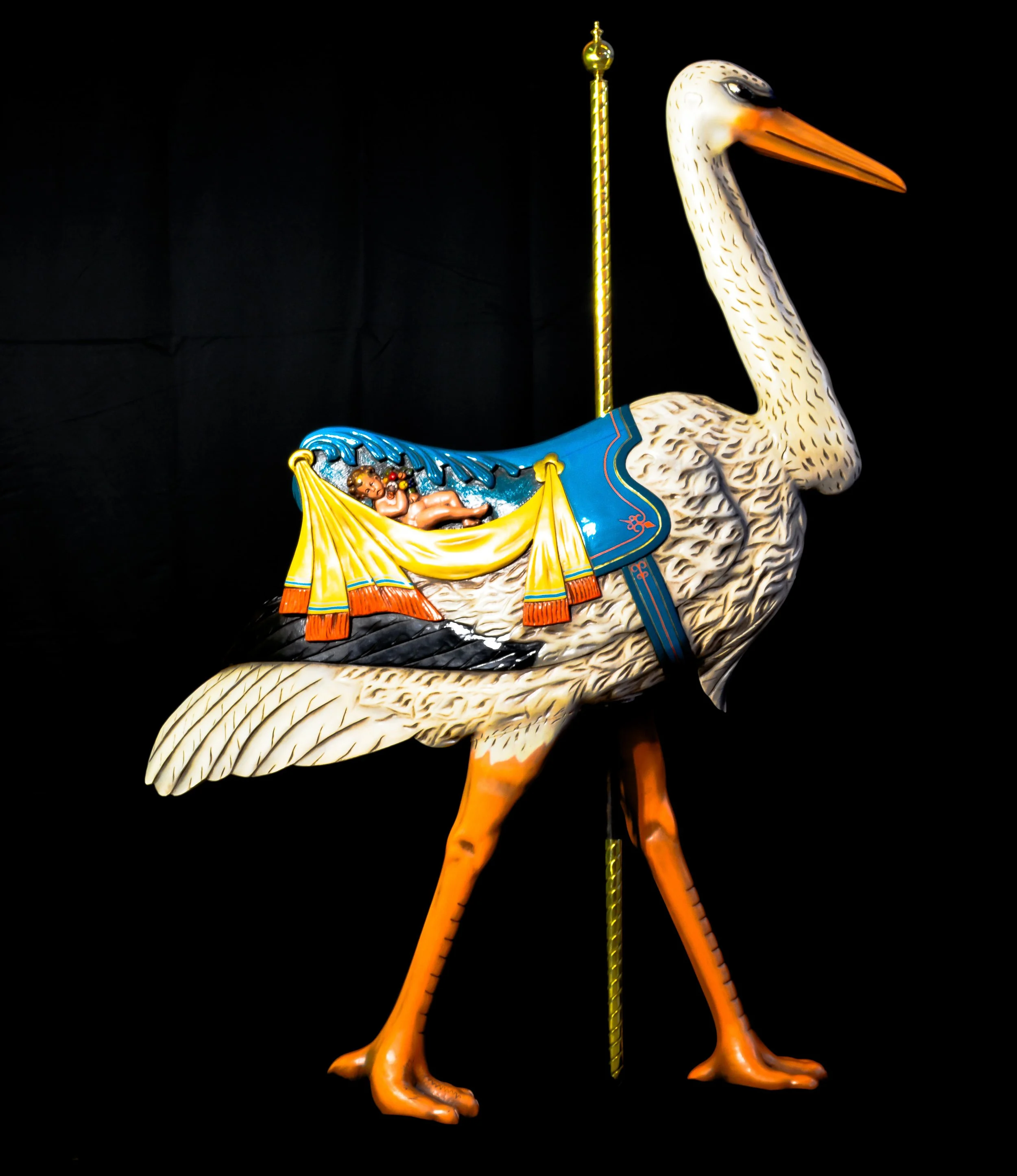
MAKER Herschell-Spillman Co. · MADE c. 1905–1916 · FACTORY North Tonawanda, NY · FIGURE Menagerie stork · ATTRIBUTION Medium
Look closer
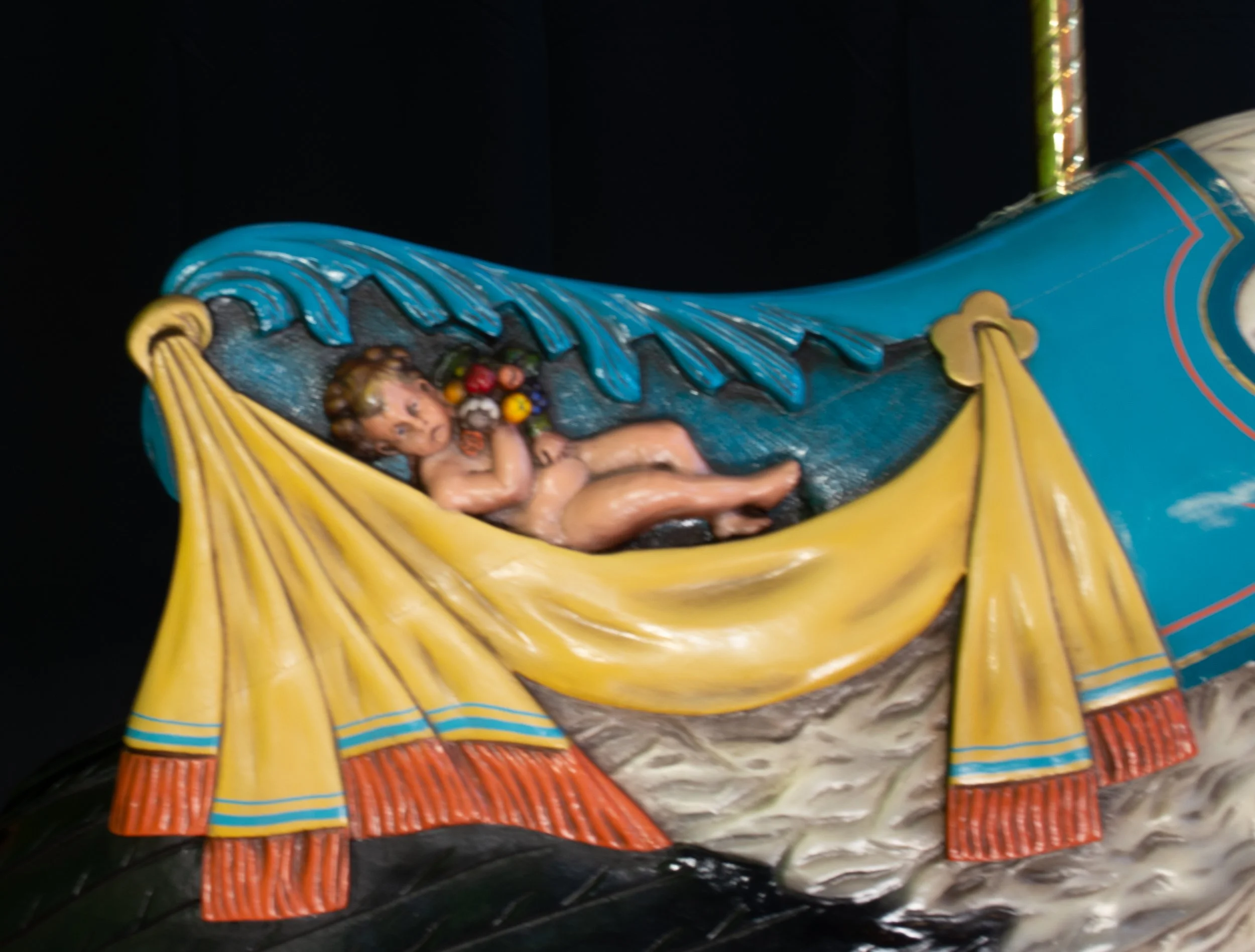
The baby in the hammock
A carved infant rests in a yellow hammock sling under the saddle, with a teal wave arch behind it. This detail shows the old story of the stork that brings the baby.
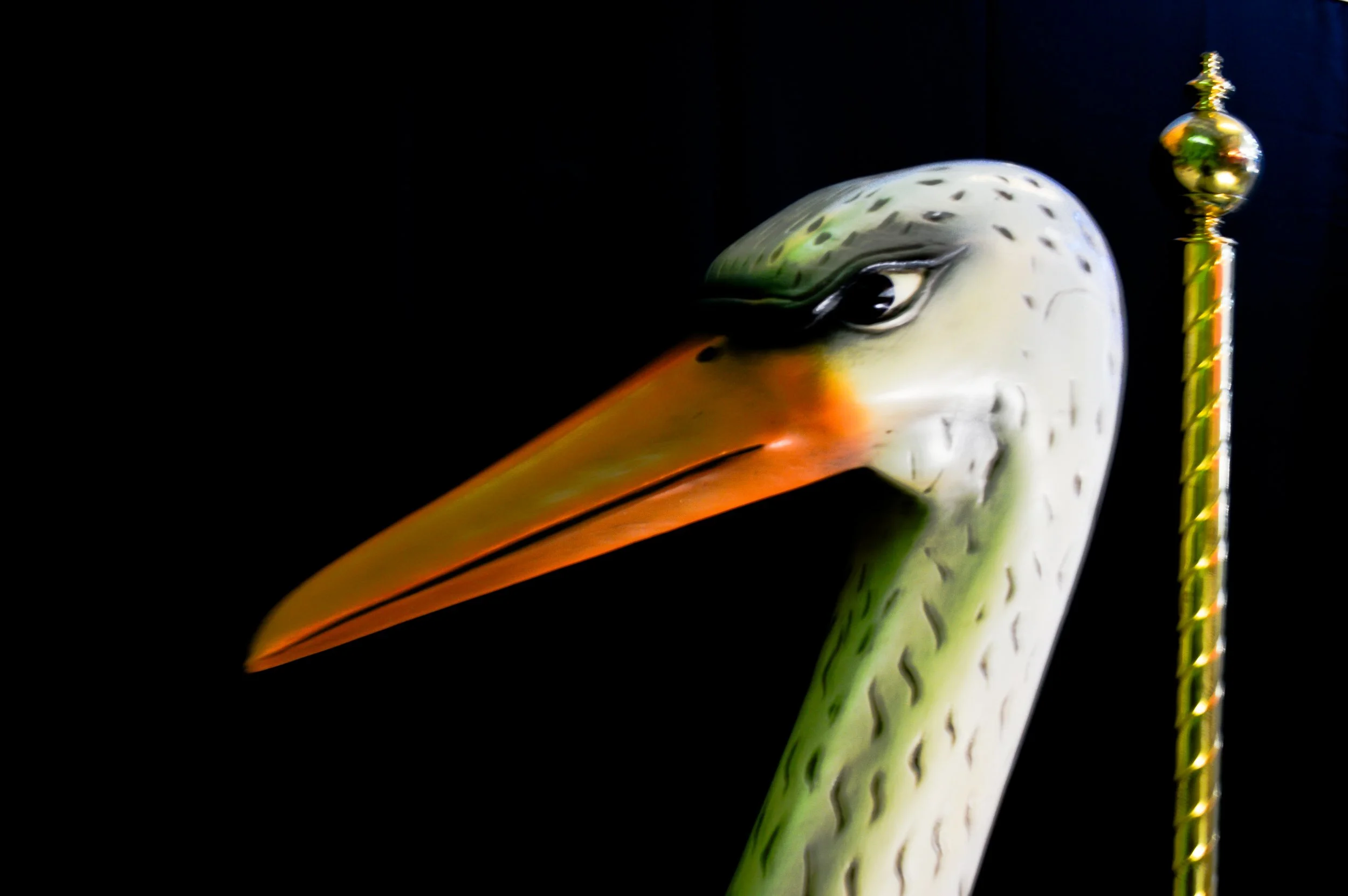
The head
A dark, realistic eye and an orange beak with subtle shading. The neck plumage is grey, green and white with dark spots.
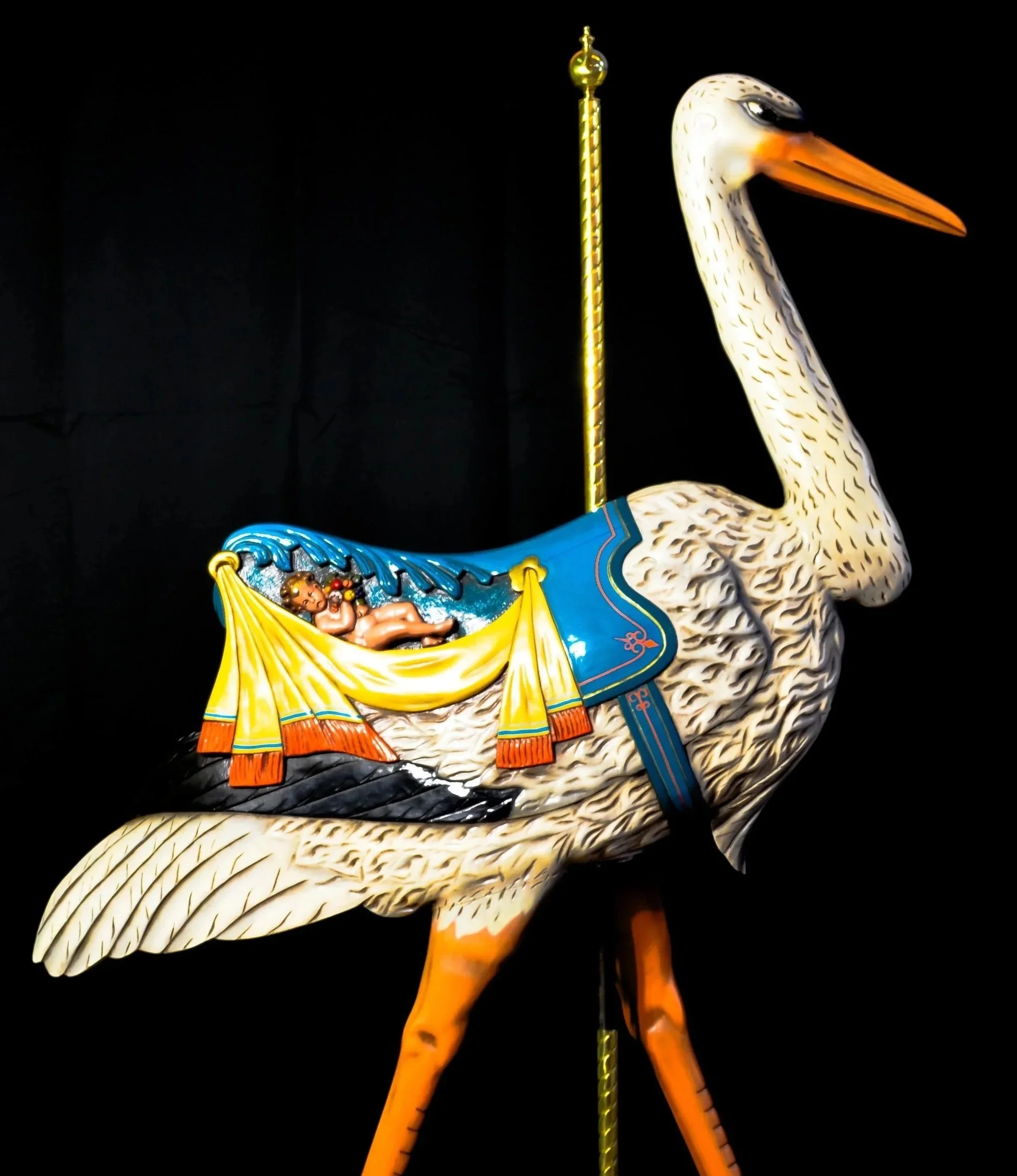
The romance side
This side faced the crowd, so it carries the most carving. The saddle, the hammock sling and the wave arch are all on this side.
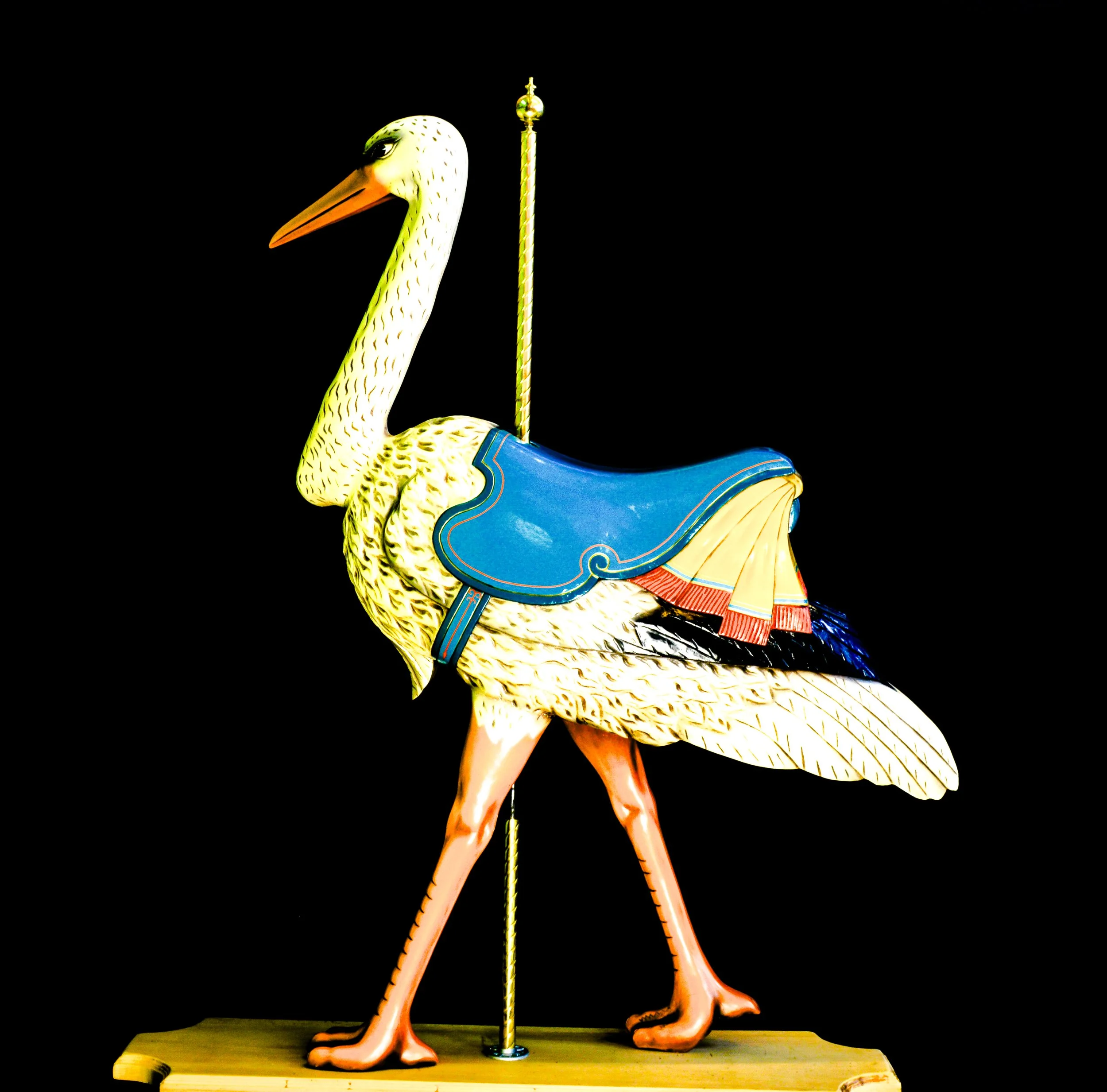
The walker pose
The stork strides on a wooden base with both feet on the platform. The bright, even color shows a professional restoration.
-
A full-size carved wooden carousel stork attributed to the Herschell-Spillman Company of North Tonawanda, New York, most likely produced during the company's park carousel period, c. 1905–1916 (inferred). The figure stands in a striding walker pose on a wooden base with both feet on the platform, displaying grey-green-white plumage with dark spot markings, a dark realistic eye, and an orange beak with subtle shading. The romance side carries the figure's defining feature: an elaborately carved infant reclining in a yellow hammock sling suspended from the saddle, backed by a teal wave-form arch — a secondary carving of exceptional ambition that makes explicit the folkloric stork-and-baby association. The owner identifies the piece as a Herschell-Spillman stork (reported).
-
Acquired from private seller Jim Aten (reported). The owner reports this was the first example of this type they had seen offered for sale in approximately forty years: "This was our chance to purchase — this was the first one we saw for sale in 40 years" (reported). Aten does not appear in specialist carousel dealer sources consulted during research (sourced — no results). Approximate acquisition date falls between 2021 and 2023 (reported).
-
Machine of origin unknown. The figure most likely came from a dismantled or decommissioned carousel (inferred). No prior ownership chain has been established beyond the immediate seller.
-
The Herschell-Spillman Company was founded in North Tonawanda, New York, in 1903, succeeding the Armitage-Herschell Company. It became the largest American carousel manufacturer between 1904 and 1920, producing over 3,000 hand-carved wooden carousels (sourced: RM Sotheby's; The Henry Ford). The factory created 18 separate menagerie animal types, and its park-model carousels included extensive menagerie programs (sourced: International Independent Showmen's Museum). Storks appear on documented surviving Herschell-Spillman menagerie carousels at multiple institutional locations: the 1913 carousel at Greenfield Village (The Henry Ford), which includes storks among its menagerie (sourced: The Henry Ford); the 1910 carousel at Balboa Park, San Diego, which lists 1 stork among its 25 menagerie animals (sourced: VintageCarousels.com); the 1911 carousel at Tilden Park, Berkeley, which includes 1 stork (sourced: VintageCarousels.com); and the 1914 carousel at Golden Gate Park, San Francisco, also with 1 stork (sourced: VintageCarousels.com).
These operating-census records confirm that storks were a standard — though not ubiquitous — part of the Herschell-Spillman menagerie program, typically appearing as a single figure per machine. The owner's observation that examples are not uncommon on operating carousels but are infrequently available on the private market is consistent with this pattern (reported; confirmed by sourced census data). No auction record for a Herschell-Spillman stork figure sold individually has been located through research across the sources specified in the research protocol (sourced — no results).
The infant-in-hammock secondary carving is documented on Herschell-Spillman stork figures on surviving operating machines; however, no private-market sale of an example with this feature has been identified, making direct price comparison unavailable. -
The figure appears approximately 54–60 inches at neck peak, exclusive of pole (estimated from photographic scale reference). Surface finish is consistent with professional restoration — bright, even color throughout. Formal condition rating pending direct examination.
-
Medium. Maker attribution is reported by a knowledgeable owner and consistent with documented Herschell-Spillman menagerie production. The stork type and infant secondary carving are confirmed on operating machines. Carousel of origin and full provenance chain are undocumented. Seller Jim Aten has not been independently verified in specialist dealer records.
-
Owner interview (audio transcript, transcribed)
- Seven photographs analyzed: romance side, non-romance side, head detail, ID board (confirms "001," dated 7/31/25), scale reference with tape measure
- The Henry Ford Museum: 1913 Herschell-Spillman carousel documentation (sourced)
- VintageCarousels.com: California operating carousel census — Balboa Park, Tilden Park, Golden Gate Park (sourced)
- RM Sotheby's: 1918 Herschell-Spillman carousel, John Staluppi Collection (sourced)
- International Independent Showmen's Museum: Herschell-Spillman menagerie production context (sourced)
- AntiqueCarousels.com: Spillman/Herschell manufacturer listings searched (sourced — no stork-specific results)
- LiveAuctioneers, Invaluable, Potter & Potter: searched for Herschell-Spillman stork auction records (sourced — no results)