
Herschell-Spillman - Stork
Catalog #001 175×135×30cm
-
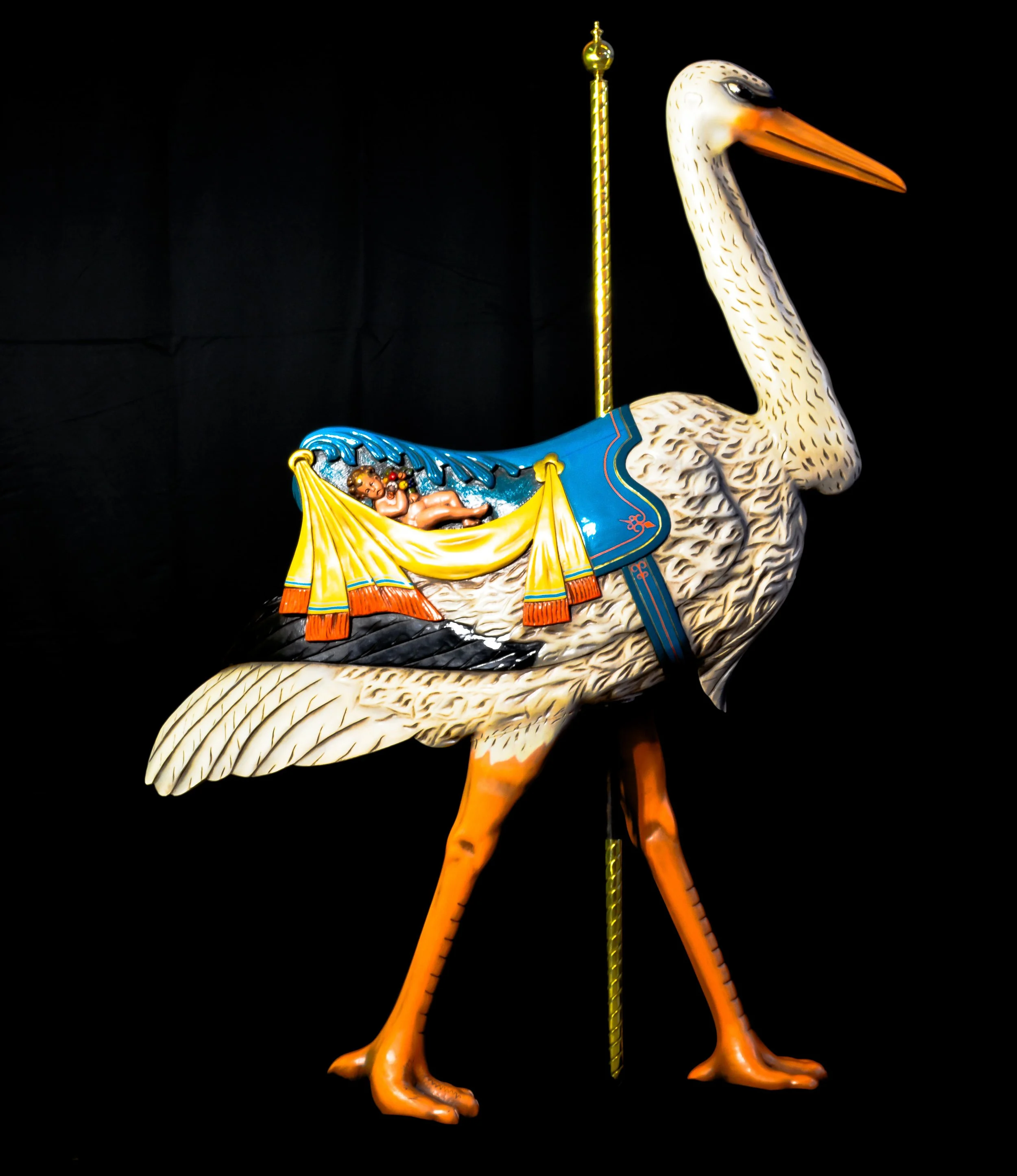
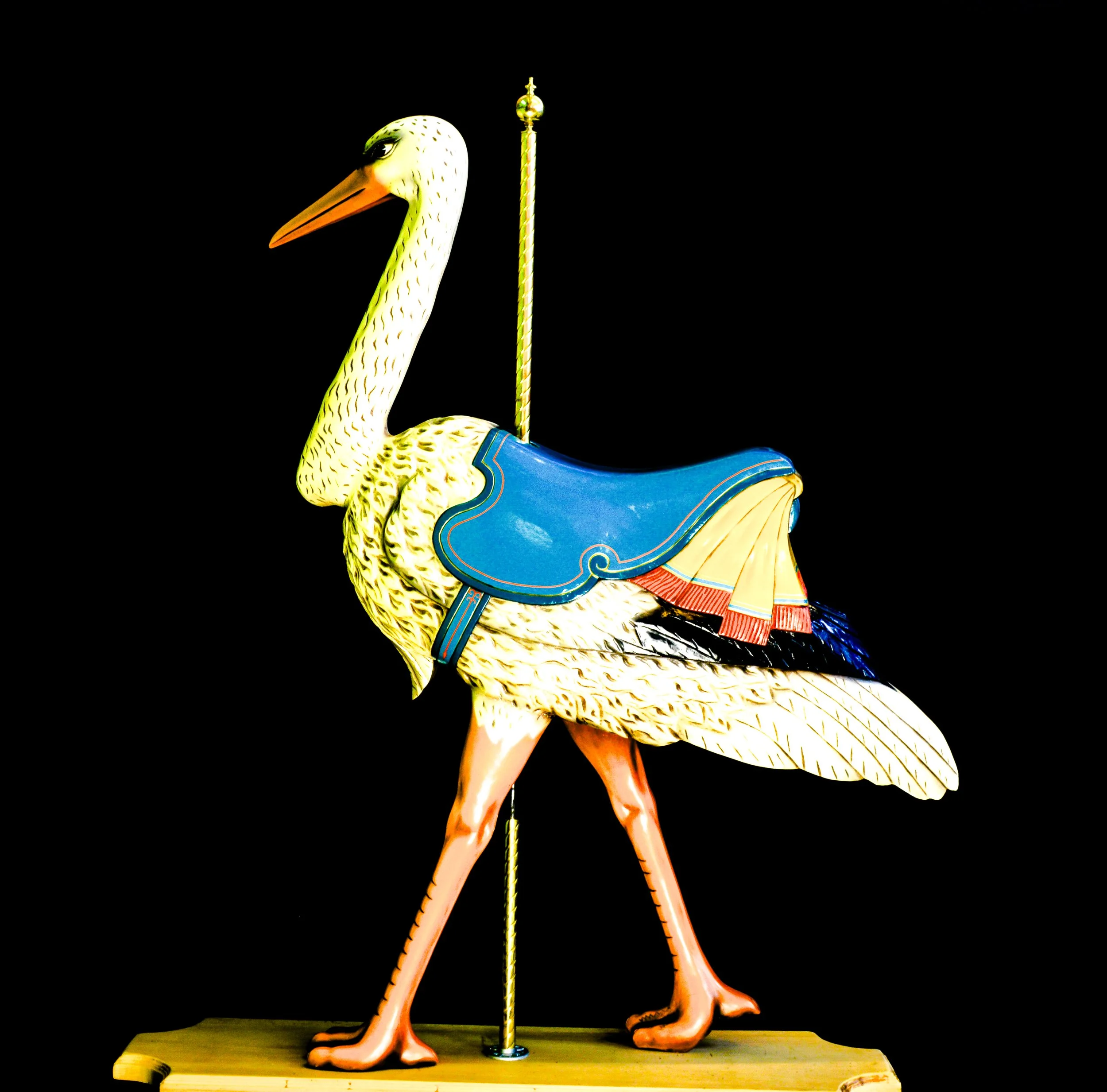
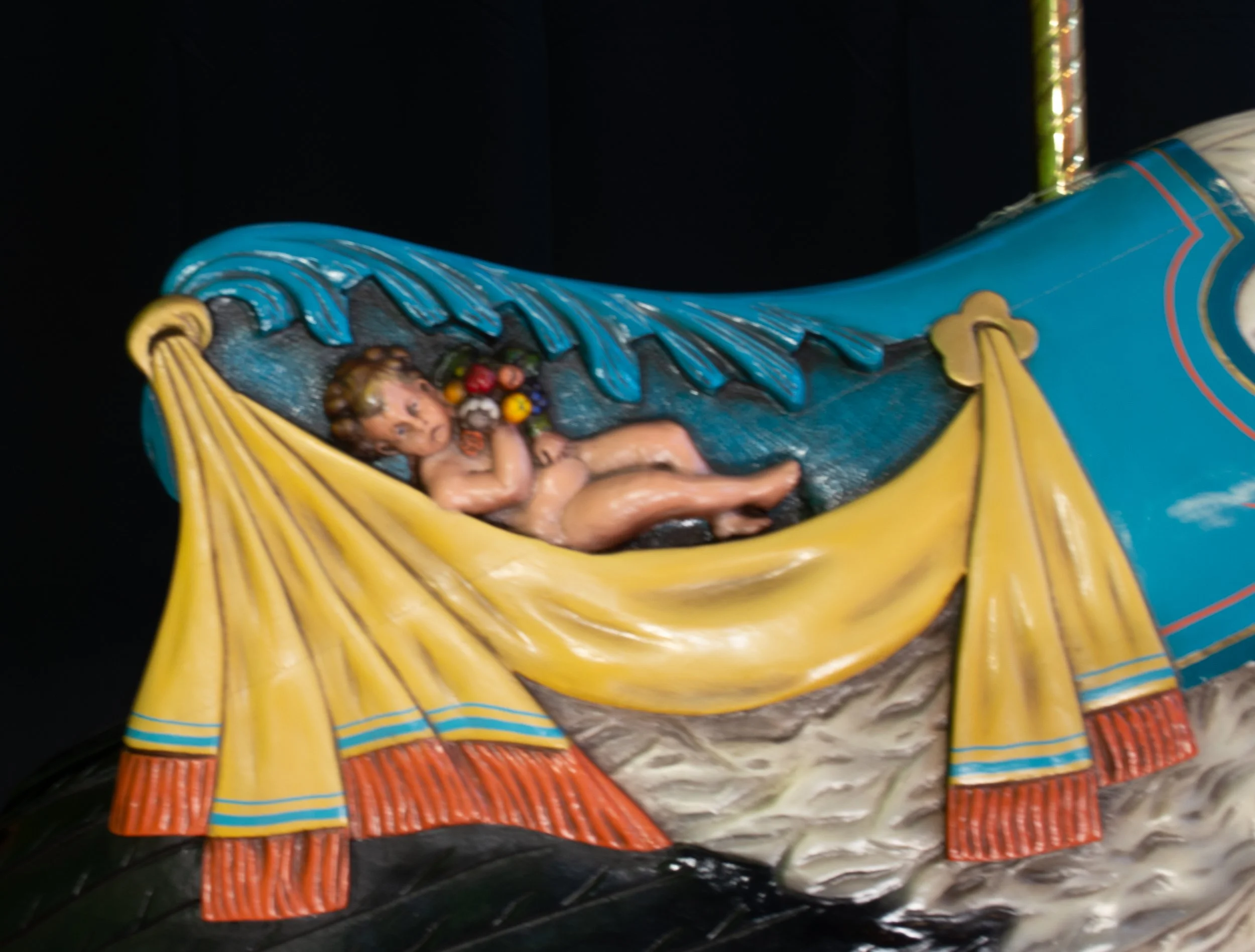
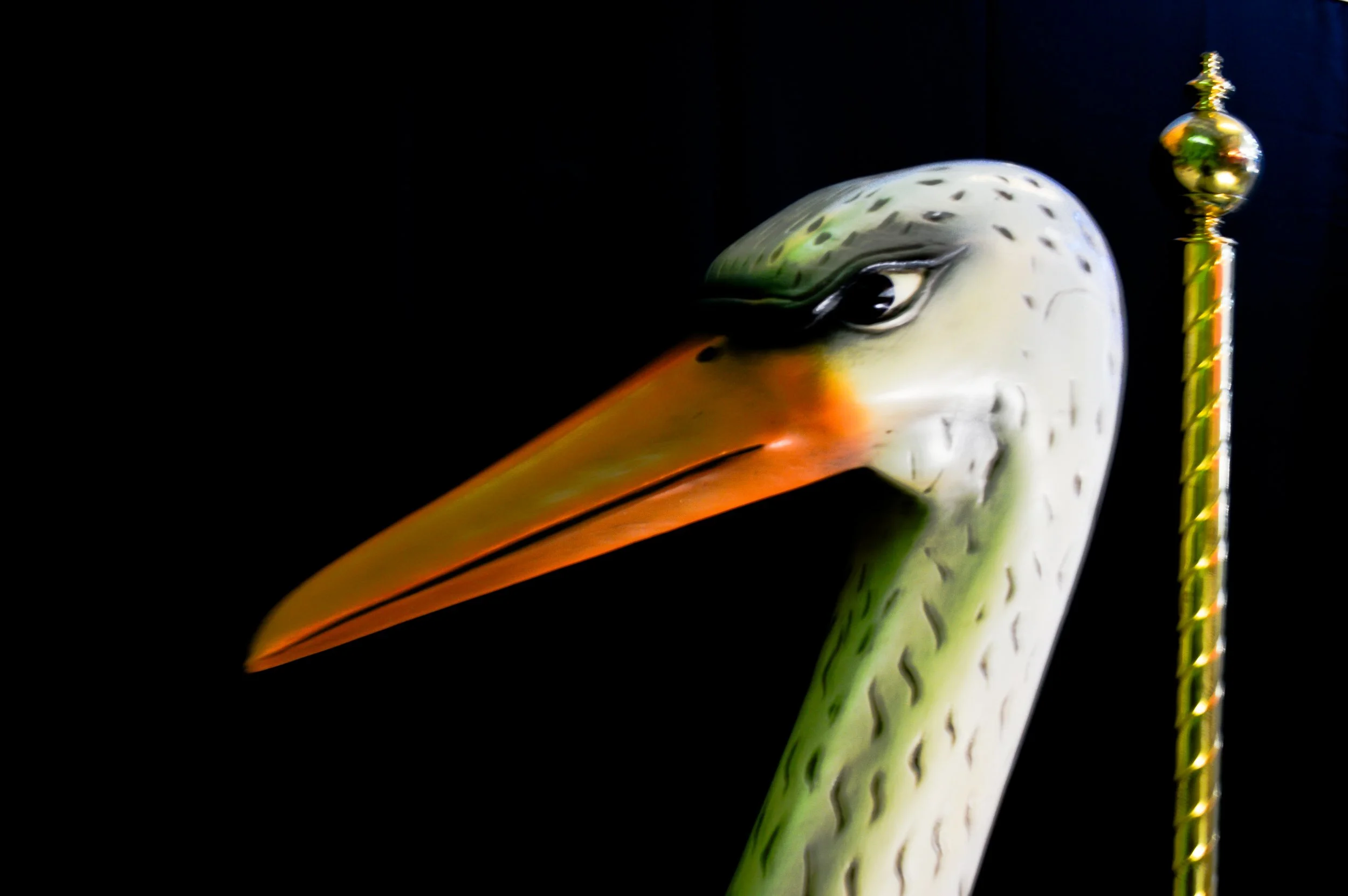
A full-size carved wooden stork figure attributed to the Herschell-Spillman Company of North Tonawanda, New York, most likely produced during the company's park carousel period, circa 1905–1916 (inferred). The figure stands in a striding walker pose with both feet on a base platform, a long orange-red bill, and white-and-dark-speckled plumage throughout. The romance-side saddle carries the most distinctive detail visible in photographs: a three-dimensional carved infant figure reclining in a yellow-gold hammock suspended from a blue wave-form cantle — a design that makes explicit the folkloric stork-and-baby association. The owner describes the figure as a Herschell-Spillman stork (reported).
-
(Reported): "This was our chance to purchase — this was the first one we saw for sale in 40 years. So obviously it was a carousel that got dismissed someplace." No further detail on venue, date, or seller provided at time of interview.
-
Machine of origin unknown. The owner's account — that a carousel was "dismissed" (deaccessioned or dismantled) — is consistent with how individual menagerie figures enter the private market; most surviving Herschell-Spillman park carousels are institutional holdings whose figures remain in place (inferred from sourced records). No documentary chain exists prior to current ownership. Unknown.
-
Founded in 1901 in partnership with the Spillman family, the Herschell-Spillman Company began with simpler country-fair style carousels and expanded to elaborate park machines with many types of animals. The company dropped Herschell's name in 1916 and became the Spillman Engineering Company. Wikipedia During this period, it was the largest U.S. carousel manufacturer, a position it held from approximately 1904 to 1920. The Henry Ford All carved animals — basswood or poplar — were produced by artisans on the factory carving floor, finished in the paint shop, and shipped out for final assembly. Gregory Couch
Between 1905 and 1910, the company began producing pole-suspended carousels with jumping eccentrics, more realistic animals, and an expanding menagerie. By 1910, Herschell-Spillman had introduced eighteen different menagerie animal types — more than any other American manufacturer. Cfwebtools The stork is among those eighteen documented types.
Independent research confirms single stork figures on at least five currently operating Herschell-Spillman park machines: the 1910 machine at Balboa Park in San Diego (sourced); the 1911 machine at Tilden Park in Berkeley (sourced); the 1913 machine at Greenfield Village, Dearborn, Michigan (sourced); the 1914 machine at Golden Gate Park in San Francisco (sourced); and the Noah's Ark carousel at Oaks Park in Portland, Oregon (sourced). The Oaks Park machine is a three-row menagerie with pairs of most menagerie types, but the stork appears as a single figure. Oregon Digital This pattern holds across all documented machines: the stork consistently appears as a single figure rather than in pairs, unlike many counterpart menagerie types that appear two to a machine (sourced). Fewer were built; fewer survive.
The owner's characterization holds up under scrutiny. The stork was a standard component of Herschell-Spillman park carousel programs — present on every major surviving machine — but it was built in limited numbers per machine and those machines are now civic and museum holdings. Individual figures rarely leave operating carousels. No documented auction records for individual Herschell-Spillman stork figures were found in this research (not found). General market context for Herschell-Spillman menagerie figures shows broad price variability depending on type and condition. A giraffe figure from another major American manufacturer of the period sold at Schmidt's Antiques (Ypsilanti, Michigan, May 2024) for $37,500 against a $2,000–4,000 estimate (sourced); specialty dealers list selected Herschell-Spillman menagerie figures between $12,000 and $50,000 depending on type (sourced, AntiqueCarousels.com). No stork-specific comparable was located.
The romance-side saddle carving — a three-dimensional infant in a yellow hammock suspended from a wave-form blue cantle — has not been independently confirmed in any published survey, carousel database, or institutional record consulted here (not confirmed). Its iconographic logic is deliberate: the carver made the stork's folkloric identity explicit in the saddle program. Whether this treatment is standard to Herschell-Spillman stork figures or distinctive to this example is unresolved. Photographic comparison with the stork figures on operating machines at Balboa Park or Tilden Park would settle the question.
-
All four photographs show a figure with even, well-applied polychrome paint throughout, consistent with a professional restoration. The plumage detail, bill coloring, leg texture, and saddle elements appear fresh and intact; no visible losses, crazing, exposed wood, or prior repair patches are apparent in photographs. Owner condition assessment was not provided in interview materials. Formal rating pending direct examination (assessment incomplete).
-
Attribution is reported by the owner and independently consistent with documented Herschell-Spillman park menagerie output — the stork type is confirmed on multiple surviving machines, and the figure's construction, scale, and painted detail are consistent with factory-period work. Machine of origin, carver, and production date within the 1905–1916 window are unknown. The romance-side baby-in-hammock saddle carving has not been independently confirmed as a factory standard for this figure type.
-
Source of Information
Owner interview (primary source)
Four photographs analyzed: DSC_2232 (romance saddle, close-up); DSC_2230-2 (head, close-up); DSC_2227-3 (non-romance side, full figure); DSC_2215-3 (romance side, full figure)
The Henry Ford / Greenfield Village (thehenryford.org) — stork documentation, 1913 machine (sourced)
Vintagecarousels.com — stork documentation, 1911 Tilden Park and 1914 Golden Gate Park machines (sourced)
Oregon Digital / University of Oregon — stork documentation, Oaks Park Noah's Ark carousel (sourced)
Balboa Park Historical Resource Research Report (Heritage Architecture & Planning, via sandiego.cfwebtools.com) — stork documentation, 1910 machine; factory menagerie development timeline (sourced)
Wikipedia, Allan Herschell Company — company history and name change timeline (sourced)
AntiqueCarousels.com — general market pricing, Herschell-Spillman menagerie figures (sourced)
Antiques and the Arts Weekly (antiquesandthearts.com) — auction comparable, Schmidt's Antiques, Ypsilanti, Michigan, May 2024 (sourced)