
Unknown - Pig
Catalog #056 120 × 70 × 48xcm
-
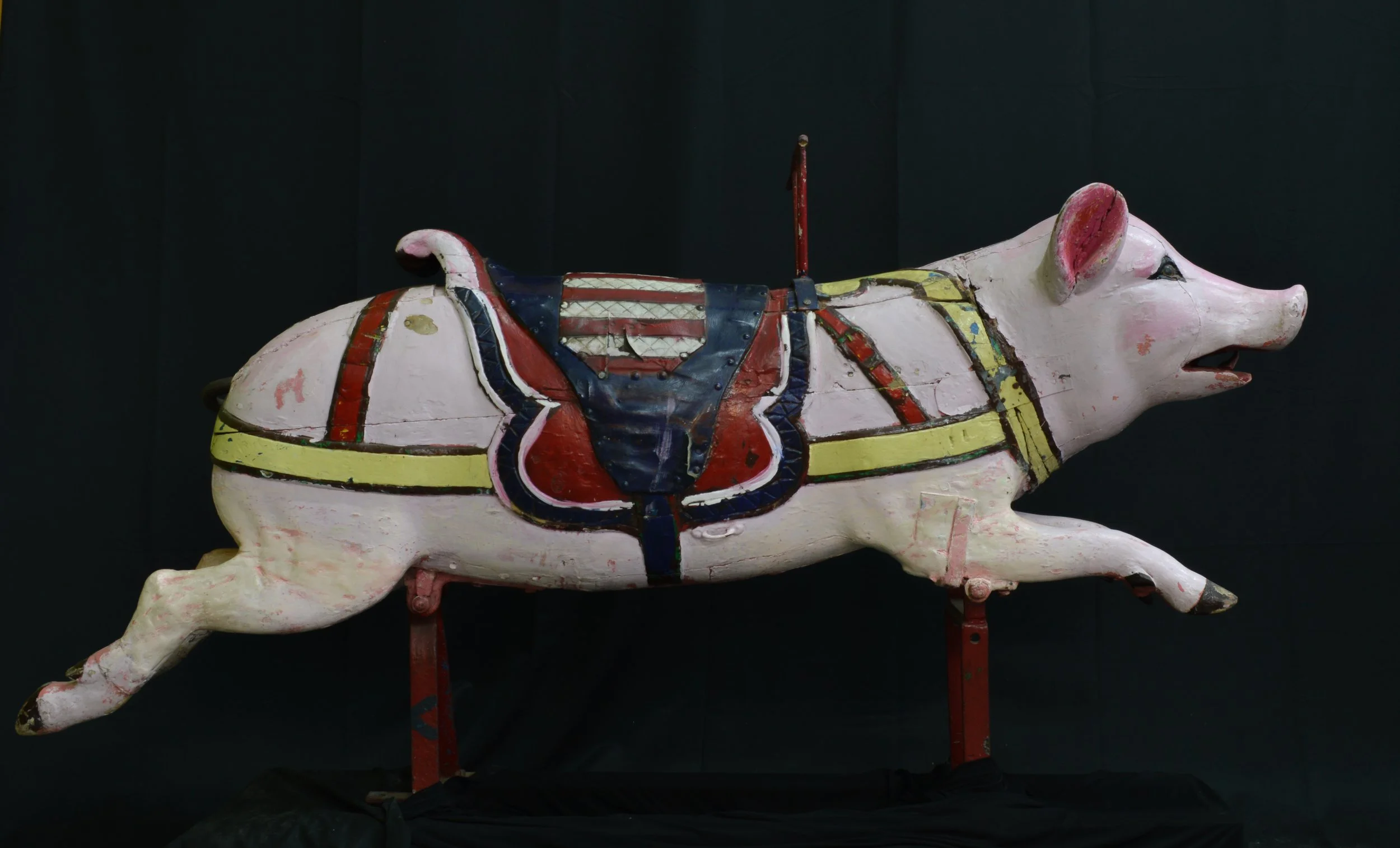
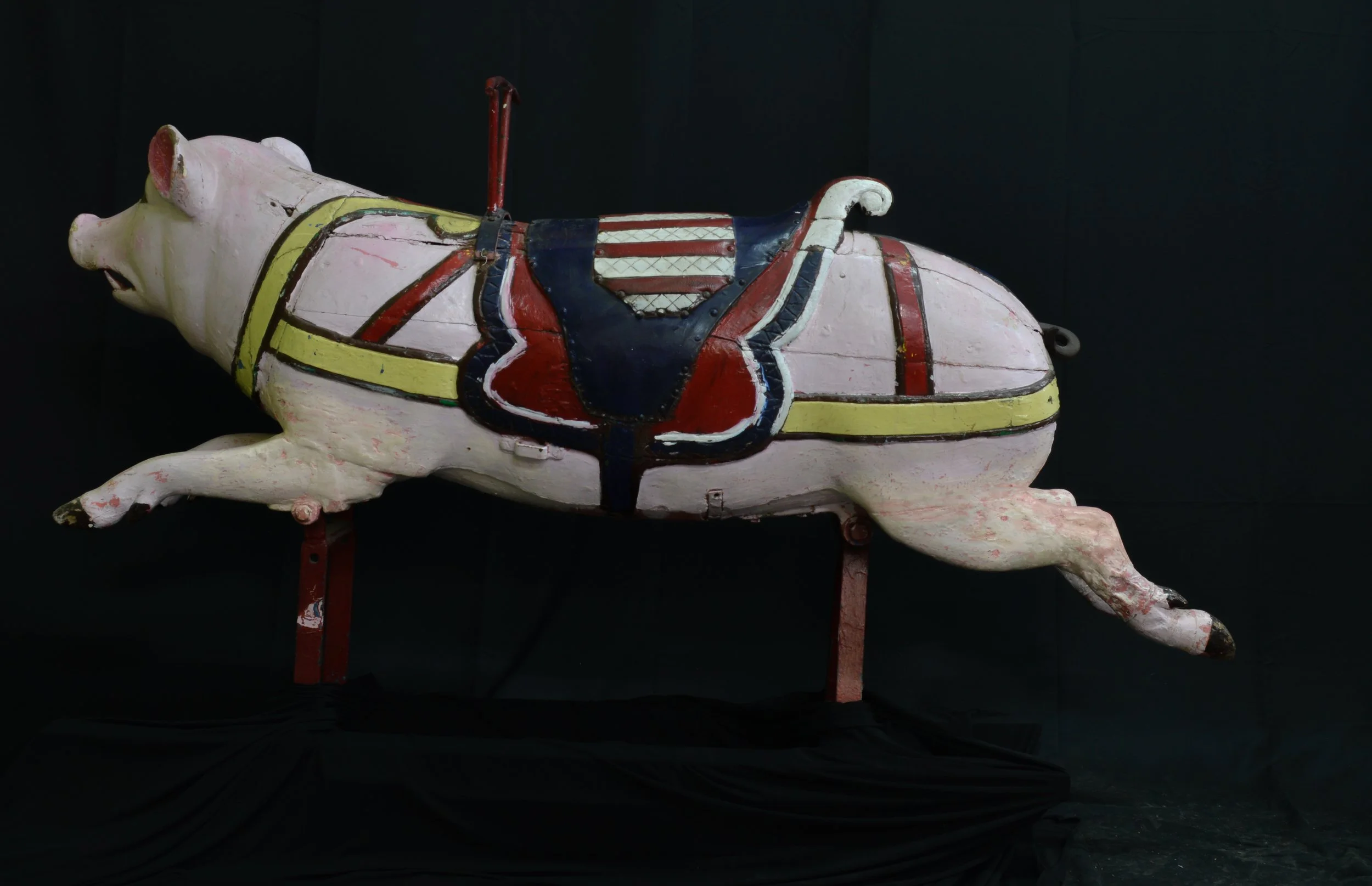
A large carousel pig in full flying gallop pose — body horizontal, all four legs fully extended — with open mouth and carved curly tail. The figure is fully finished on both sides, with a bold painted saddle in navy blue, red, and yellow-lime visible on each. Red-painted iron mounting hardware is present top and underside. Maker attribution is currently unknown; photographic and physical evidence supports an English traveling fairground origin (inferred). No owner interview material is available for this entry.
-
No owner interview material available. Acquisition history, date, price, and seller are all unknown at this time. This section requires owner follow-up before the entry can advance.
-
Unknown. No documentary trail has been identified. The bilateral finishing of this figure — both sides worked to equivalent decorative standard — is consistent with a traveling fairground machine rather than a fixed park installation (inferred). Park carousel figures were typically finished on the outward-facing side only; traveling fair figures were seen from all angles and finished accordingly.
No connection to a specific machine, showman, or sale has been established.
-
The evidence pointing toward an English traveling fair origin rests on three converging observations from the photographs.
First, the bilateral finishing. Both sides carry equivalent saddle decoration and carved detail. This is a strong indicator of traveling fairground work rather than fixed-park manufacture, where only the romance side was typically dressed (inferred from documented production conventions).
Second, the mounting hardware. The red-painted iron brackets visible at the top and underside, with small circular bolt fittings on the belly, are consistent with the standardized knockdown iron hardware used by English traveling carousel manufacturers, who built figures for repeated assembly and disassembly during fair circuits (inferred from photographic comparison with documented English figures).
Third, the saddle vocabulary. The palette — strong navy blue, red, and a distinctive lime-yellow horizontal girth band — is a bold, flat, high-contrast graphic treatment without flower garlands, secondary carvings, or jeweling. This decorative register is characteristic of the English traveling fair tradition and distinct from the more ornate painterly saddles of the major French workshop tradition and the carved-and-jeweled saddles of American park carousel work (inferred).
Frederick Savage of King's Lynn documented "Flying Pigs" as a named novelty variant on his Platform Gallopers line, alongside Racing Peacocks and Jumping Cats Antique Collecting (sourced). The pose of this figure — all four legs fully extended in a near-horizontal flying gallop — is precisely consistent with that category. Charles Spooner, the principal carver supplying figures to Savage and later to Orton & Spooner, produced pigs among a wide range of menagerie figures for English roundabouts Fairground-heritage (sourced). Anderson of Bristol, the third major supplier in the English traveling fair trade, produced comparable menagerie work during the same period (sourced).
Attribution among these three makers — Savage, Spooner, Anderson — cannot be established from photographs alone. Figures from these workshops rarely appear on the market and are described by specialists as almost impossible to replace Sworder (sourced). The documented body of surviving, attributed examples is small, and even specialists routinely disagree on attribution without physical examination and archival comparison.
A German origin cannot be definitively excluded. At least one large animated carousel pig has been handled on the specialist market with a tentative German attribution (sourced: AntiqueCarousels.com). However, the hardware type, bilateral finishing, and saddle vocabulary all weigh against a German or French origin and in favor of English traveling fair work (inferred).
Material composition — whether the body is carved wood, hollow wood, or incorporates any metal construction — has not been confirmed. The surface condition and paint wear pattern visible in photographs are consistent with wood, but this requires physical examination and owner confirmation.
-
Visible paint loss at multiple points across both sides of the body, consistent with honest fairground use and age. The saddle decoration retains strong color and legibility on both sides. The overall structural form appears sound — no visible major cracks, splits, or missing carved elements in the photographs. The iron mounting hardware appears intact. Formal condition rating is pending physical examination and owner assessment.
-
Low Maker attribution is entirely unestablished. No owner interview material has been captured. Physical evidence supports an English traveling fairground origin but does not permit narrower attribution. All substantive claims are inferred from photographic and documentary evidence only.
-
Photographs: Two, showing both sides of the figure (non-romance side, Image 1; romance side, Image 2)
Owner interview: None available
Independent research: AntiqueCarousels.com; Fairground Heritage Trust (Orton & Spooner documentation); Antique Collecting journal (Fairground Art collector's guide); VintageCarousels.com (carvers and manufacturers reference); Wikipedia (Frederick Savage); Circato (Savage biographical); multiple auction and dealer records reviewed for comparative pig figures