
Unknown - Dragon
Catalog #017 155×190×20cm
-
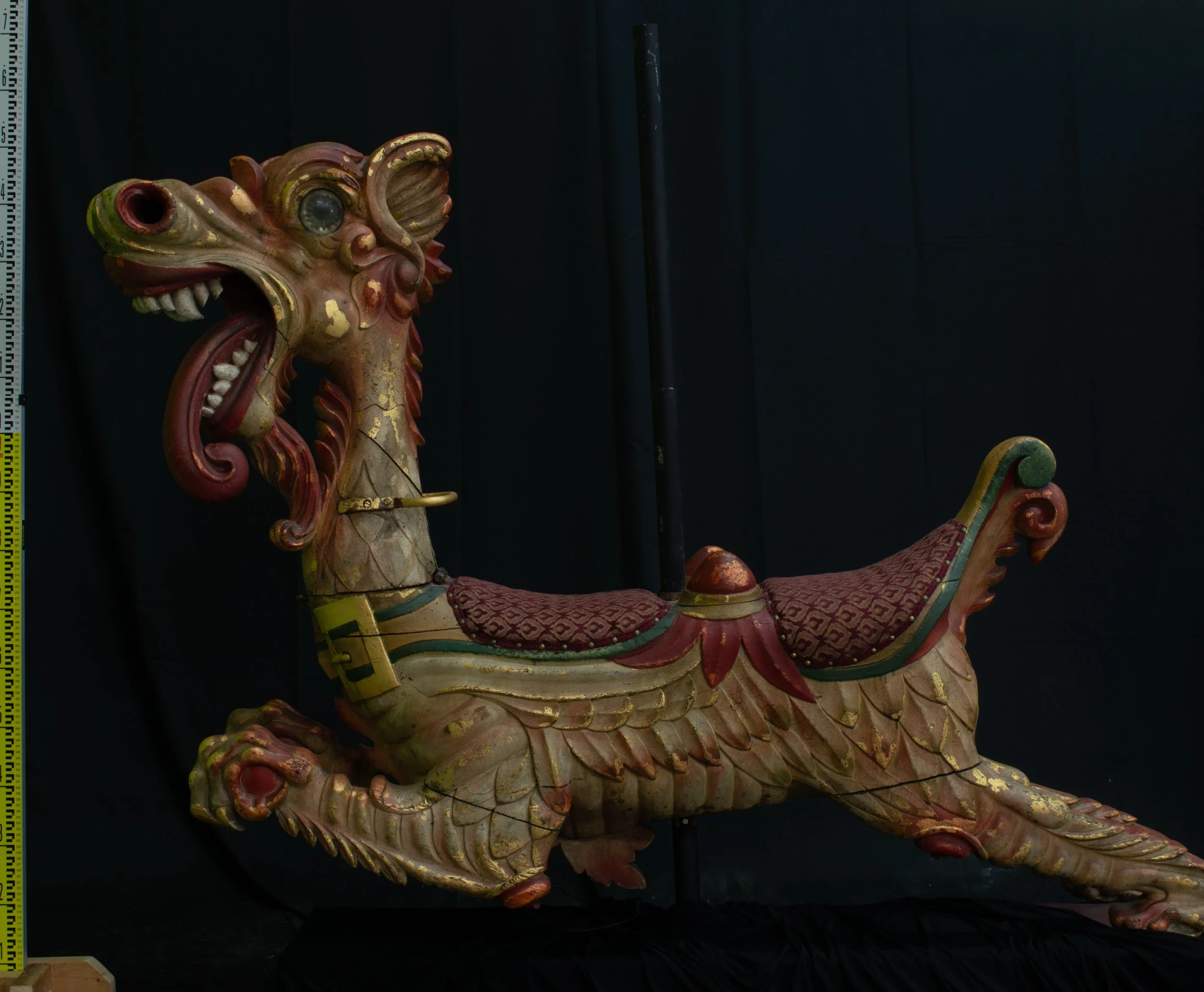
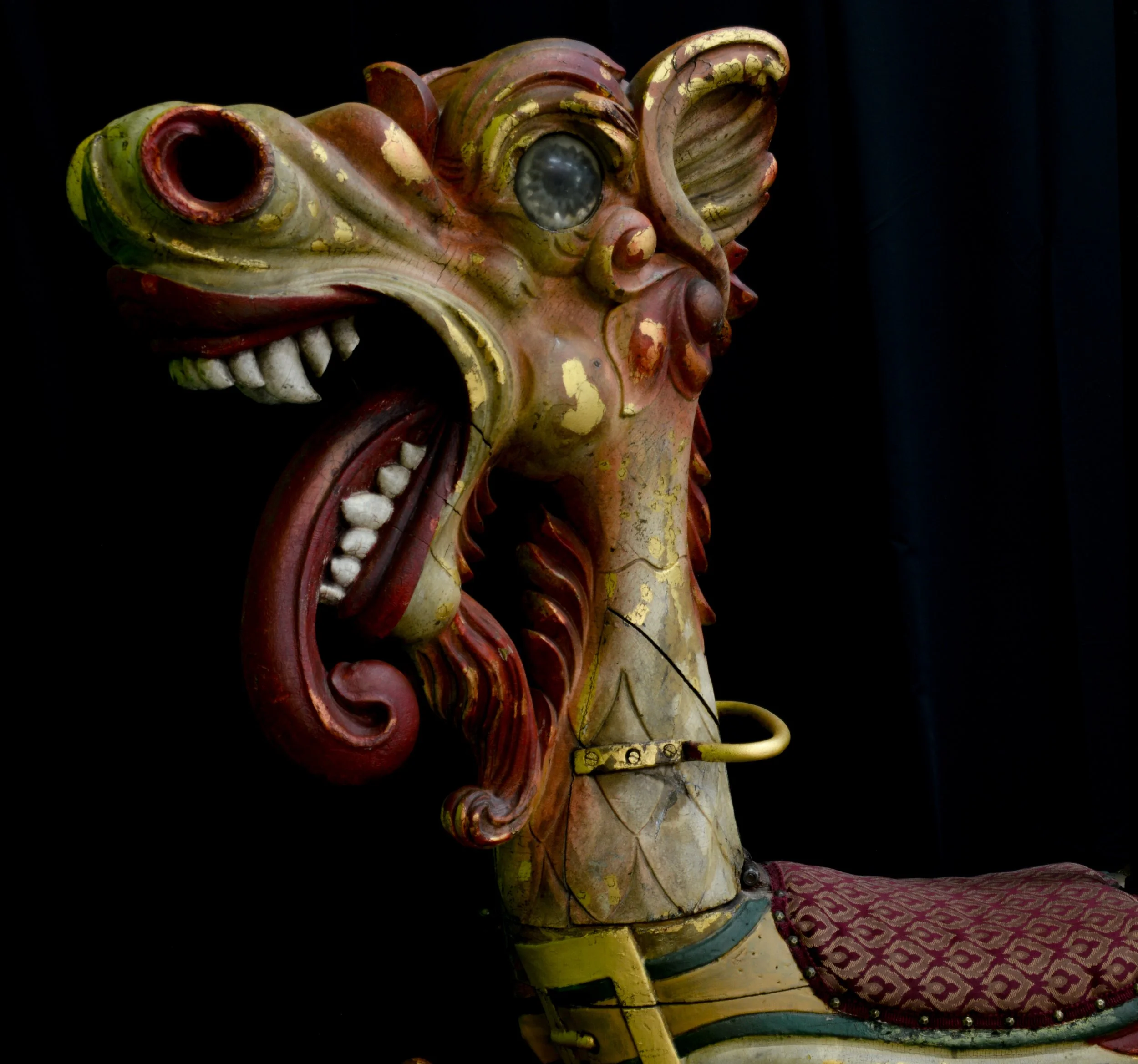
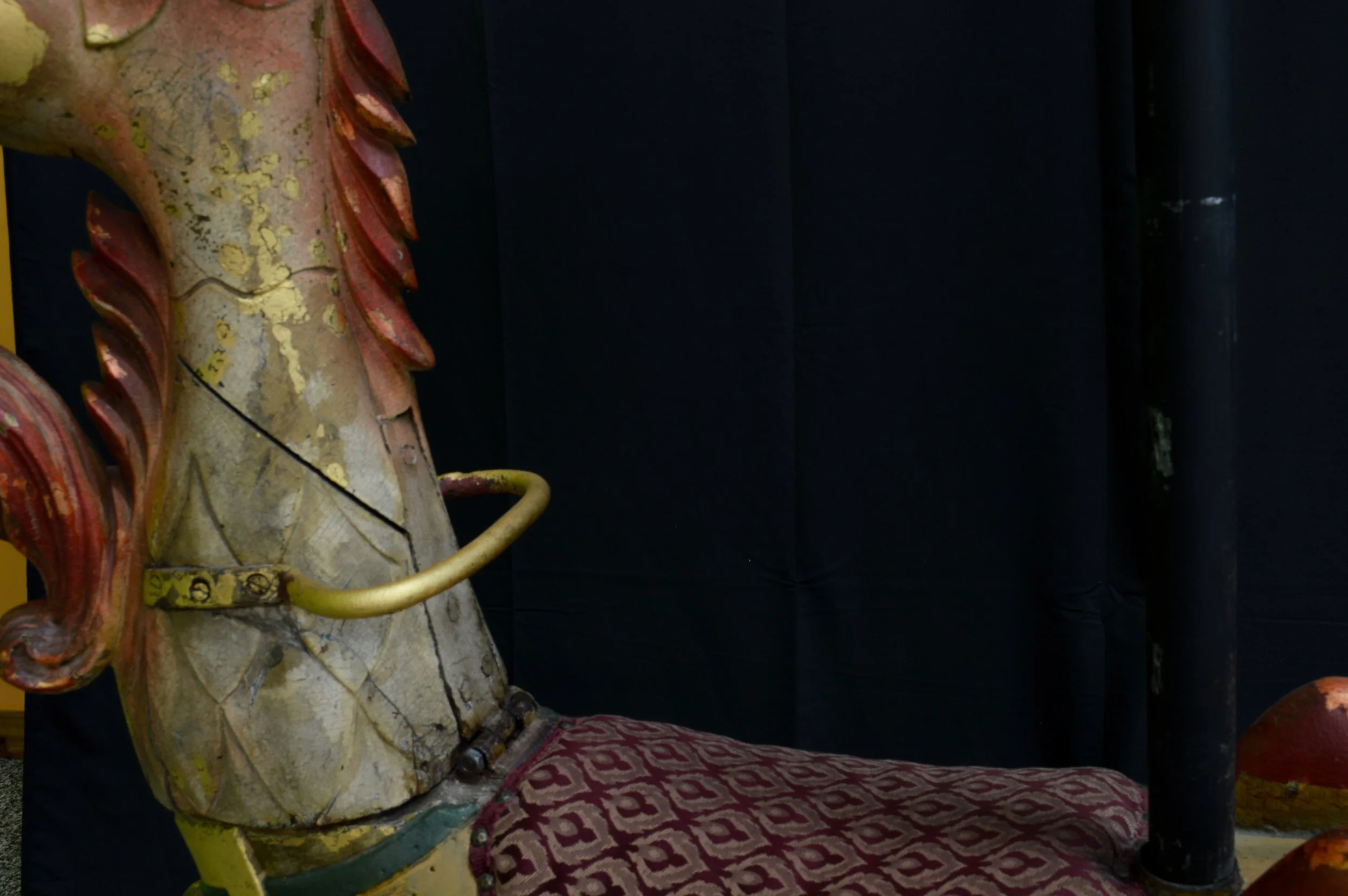
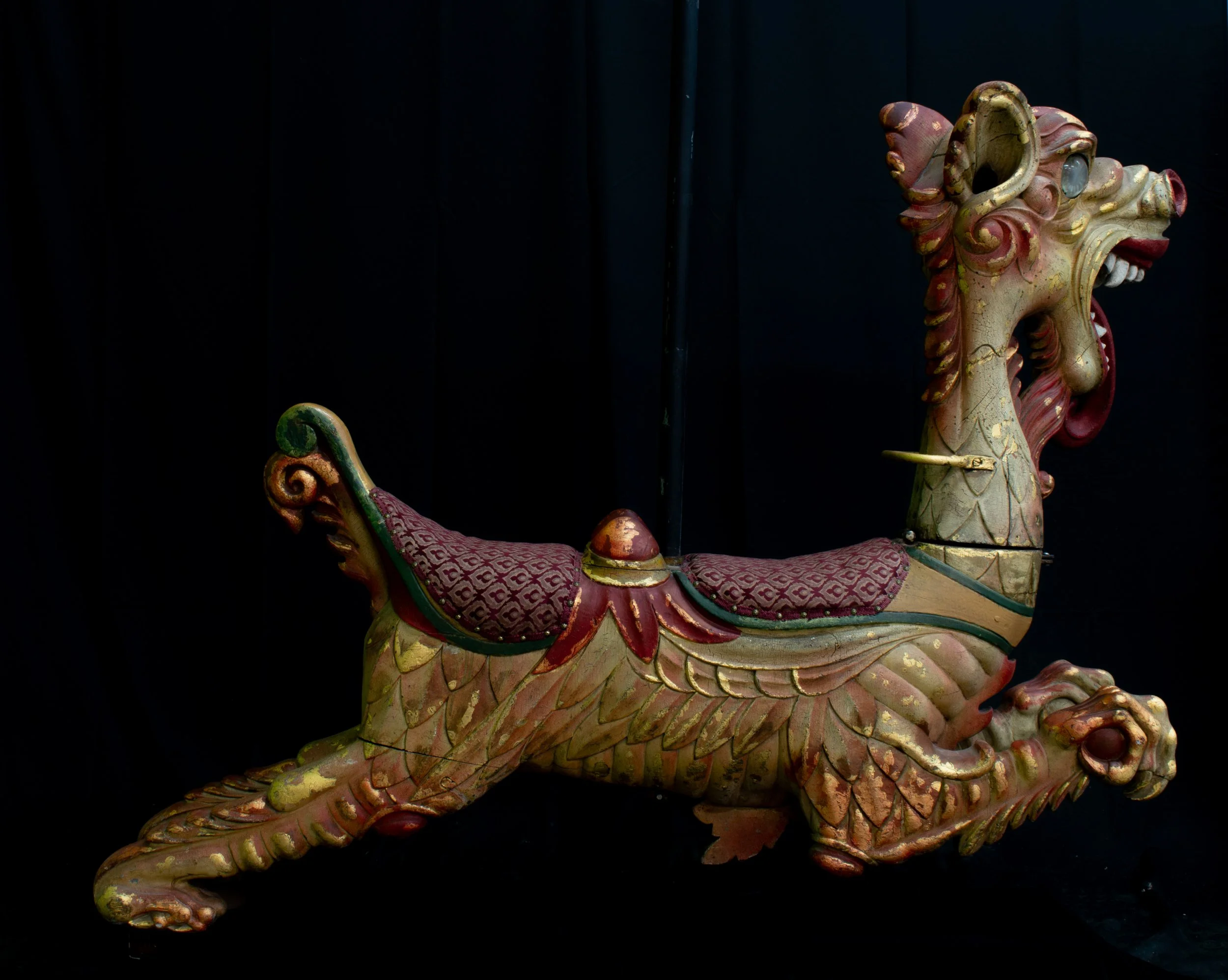
A full-size carved wood carousel dragon in a leaping/galloping pose — front legs tucked forward with clawed paws, rear legs extended. The body is entirely covered in meticulously carved overlapping scales, transitioning to layered feather-like wing elements along the flanks. The head is extraordinary: a wide-open mouth with individually carved teeth in both upper and lower jaw, a long curling tongue or beard rendered in deep red, large scrolling horns or ears, a bulbous snout with a tubular nostril opening, and large domed glass eyes that are wired for internal illumination — the figure plugs in and the eyes glow red (reported; tested and confirmed). A metal collar with a brass ring encircles the neck. The saddle is a deep burgundy/maroon panel with a repeating geometric diamond pattern that reads like woven textile, edged with green trim, gold accents, and small brass studs or rivets. The tail terminates in a curling green-and-gold ornamental scroll.
A gold/yellow geometric symbol is painted on the chest below the collar — its precise form is difficult to resolve from photographs but appears to be a directional cross or Greek key variant. This marking is an open attribution lead.
The paint throughout shows significant age: crazing, chipping, gold leafing wearing through to earlier layers, and accumulated patina consistent with extended park or fairground service. This reads as old park paint, not a modern restoration.
-
PPurchased from a private party in Berkeley, California, within the last five years (approximately 2020–2025) (reported). Matthew and the owner picked the figure up together — "that was a beautiful street" (reported). The owner references "Adam" in connection with the estate or source, though the name is phonetically uncertain in the transcript (reported). No price is stated. No prior history is known (reported).
-
No provenance prior to the Berkeley acquisition has been established. The private party source has not been further identified. Berkeley's deep antiques and Asian art market means the figure could have arrived through any number of dealer, estate, or collector channels. The lack of any documented history is the central limitation of this entry.
-
The owner identifies this as a European dragon (reported). Dragon figures appeared on American menagerie carousels — surviving examples from a major North Tonawanda manufacturer include dragons at Balboa Park, Golden Gate Park, and Tilden Park (sourced: VintageCarousels.com). The 1912 carousel at Trimper's in Ocean City also features a green dragon among its forty-five individual animals (sourced: Atlas Obscura). However, earlier research for this collection established that no American manufacturer produced a comparable leaping dragon riding figure (sourced from prior research cycle). European manufacturers such as Frederick Heyn of Germany and other Continental makers carved fantasy and animal figures, including dragons, for fairground roundabouts and salon carousels (sourced from prior research cycle).
The red-glowing illuminated eyes are the most distinctive feature of this figure. Internally wired glass eyes designed to glow red are unusual on American carousel figures but appear on some European fairground and salon carousel animals, particularly English and Continental examples where electric lighting was integrated into fantasy figures during the early twentieth century (inferred from general fairground history). The effect — a dragon whose eyes burn red in dim fairground light — is theatrical and deliberate, suggesting a maker and context where spectacle was part of the design program. The gilded surface treatment, elaborate scrollwork, and overall ornamental vocabulary are consistent with European fairground carving traditions.
The chest marking remains unidentified. If it is a swastika in its pre-Nazi decorative/auspiciousness usage, this would indicate Asian cultural influence in the figure's design program — common on Indonesian, Balinese, and Southeast Asian decorative carving but also used on some European fairground work with Asian motifs. If it is a Greek key or other geometric element, it fits within standard European ornamental vocabulary.
Dragon figures are uncommon on any carousel tradition. On American machines, they appear as one or at most two figures per carousel. On European machines, they are similarly rare outside of chariot or housing decoration. An early 1900s European salon carousel dragon is listed at AntiqueCarousels.com for $6,500 (sourced). Individual dragons separated from their original machines appear very infrequently on the private market.
-
The paint surface is old park paint with significant age — crazing, chipping, and wear are visible throughout, particularly on the body and legs. Gold leafing shows through in patches where later paint layers have worn away. The glass eyes are intact with their internal illumination mechanism confirmed functional — the figure plugs in and the eyes glow red (reported). The carved teeth are intact in both jaws. The scrolling horns and ornamental tail appear structurally sound. The brass collar ring is in place. The saddle panel with its geometric textile pattern shows some wear but the pattern remains legible. Construction seams and some cracking are visible in the neck area (Images 5 and 6). Overall structural condition appears good for a figure of this age, though formal assessment is pending.
-
Low. The figure is identified as European by the owner, which is consistent with the gilded surface treatment, red-glowing illuminated eyes, and ornamental vocabulary. Earlier research confirmed that no American manufacturer produced a comparable form. However, no maker, country of origin, or carousel of origin has been established. The chest marking is unresolved. No provenance prior to the Berkeley acquisition exists.
-
Owner interview transcript (undated; provided with photographs)
Photographs: six images (DSC_2377, DSC_2379, DSC_2380, DSC_2381, DSC_2382, DSC_2384), covering both sides, head close-up, and neck/chest detail. Whiteboard dated 8/20/2025 and labeled "#017"
Independent web research: carousel dragon production by American and European makers, illuminated carousel figure features, fairground carving traditions
Prior research cycle: earlier conversation established European attribution basis and ruled out American comparable forms
Specialist sources consulted: VintageCarousels.com, CarouselHistory.com, The Henry Ford, Atlas Obscura (Trimper's carousel), AntiqueCarousels.com, 1stDibs
Cross-collection note: this figure was previously flagged in project notes as having "illuminated eyes and unidentified chest marking" as open research leads — both now documented photographically