
Unknown - Peacock
Catalog #025A 80×60×40cm
-
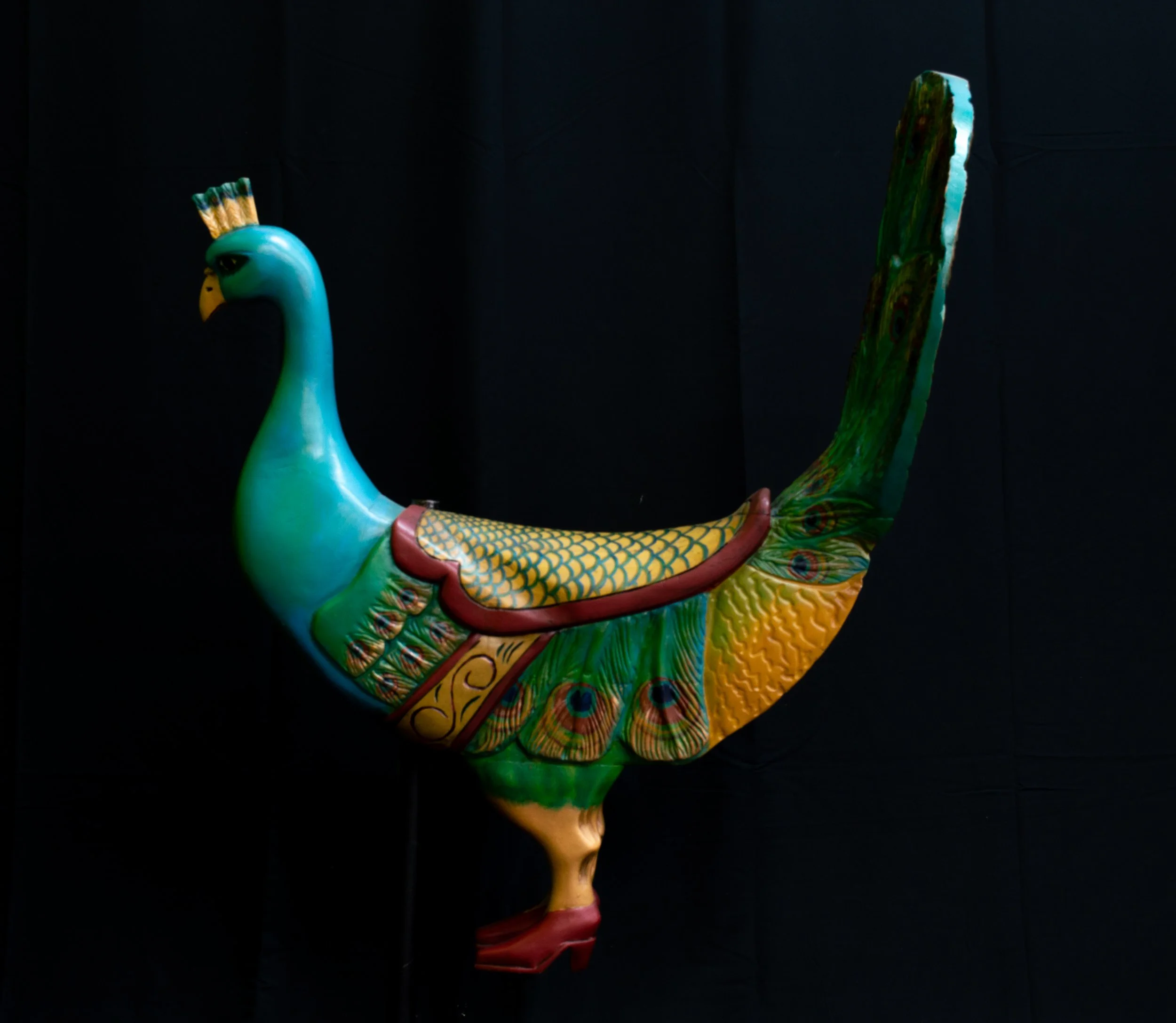
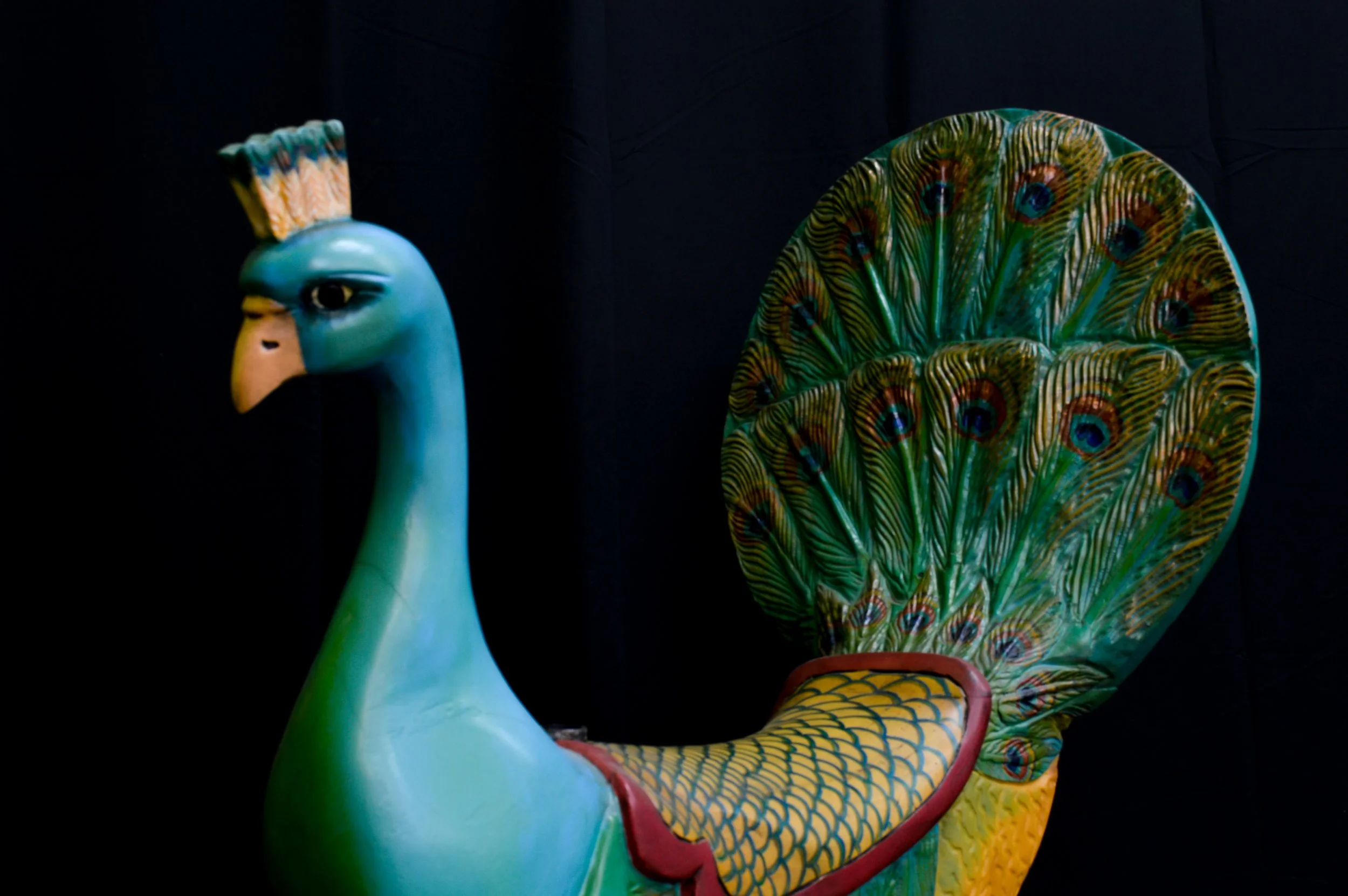
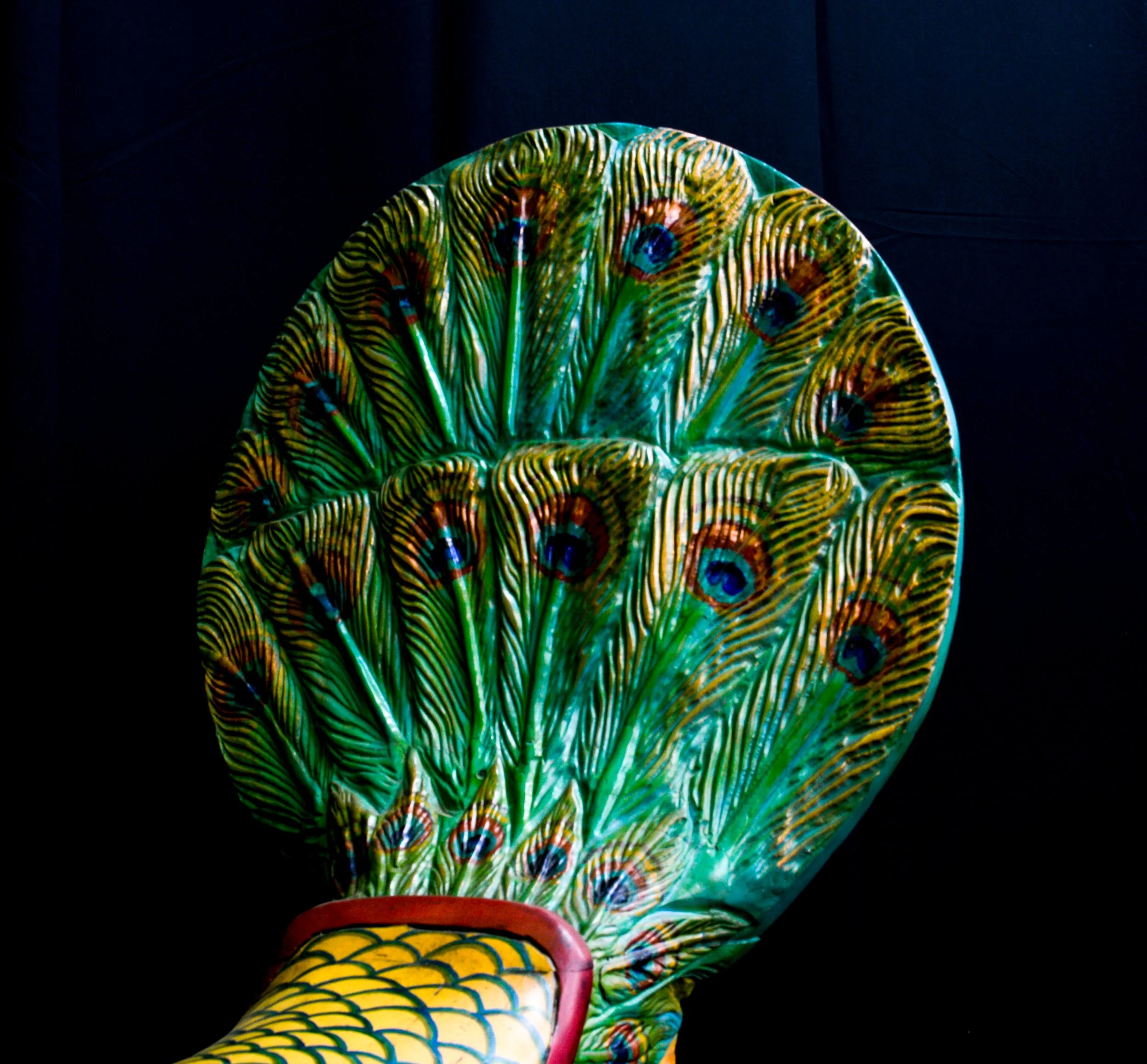
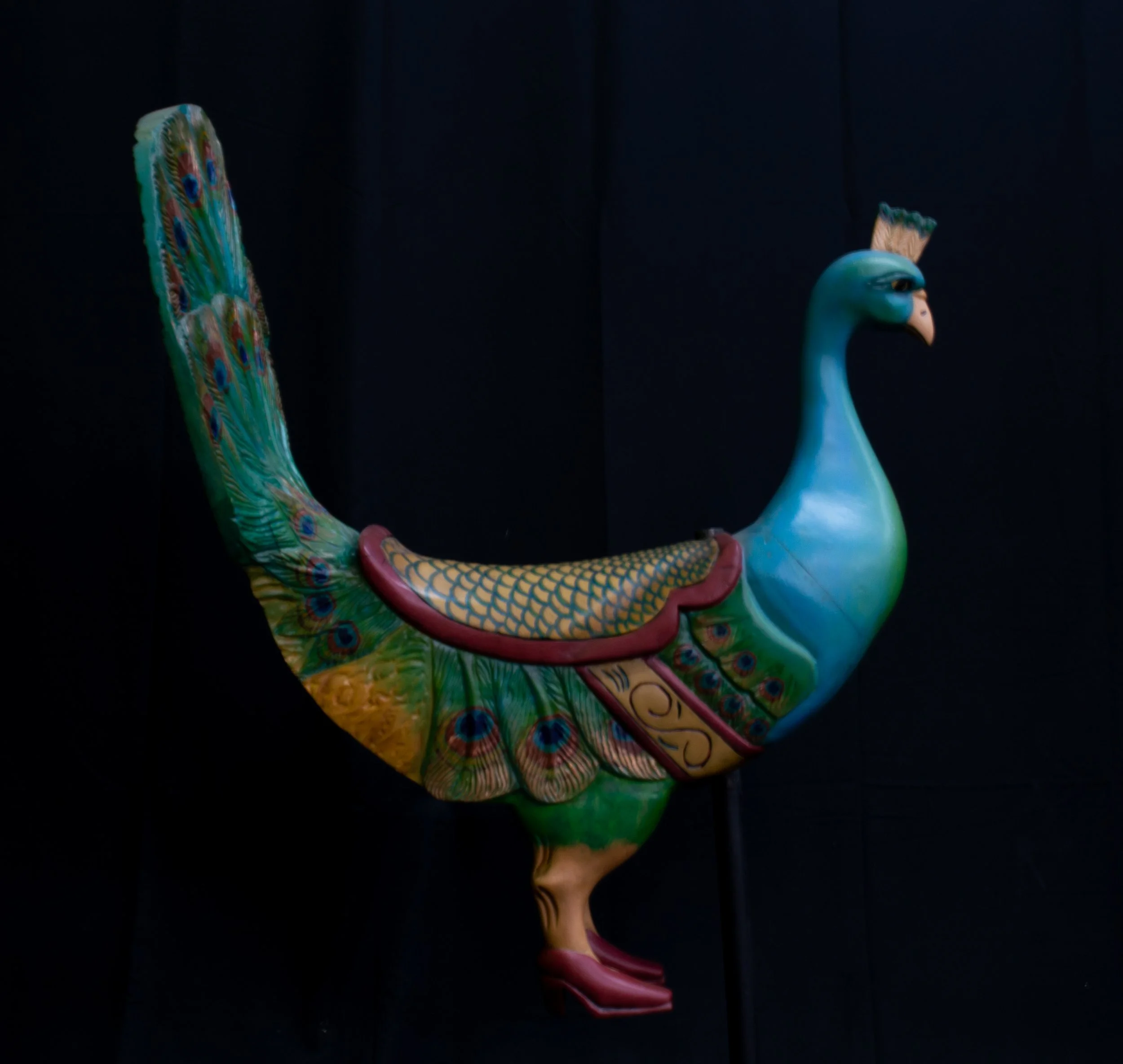
A carved and painted wood carousel peacock in standing pose, attributed to a French or possibly English workshop, c. 1920 (reported). The figure is richly polychromed in turquoise, green, and gold, with an elaborate fanned tail that rises into a large oval backrest behind the saddle area. The body plumage transitions from a smooth turquoise breast and neck through increasingly detailed featherwork across the wings and haunches, terminating in individually carved and painted eye-spot feathers. The bird wears painted red heeled shoes — a whimsical decorative detail the owner specifically noted (reported). A carved crest of green and gold feathers tops the head. The saddle area features a scalloped golden field with fine painted scale patterning, bordered by a maroon surround with decorative scroll details.
-
Acquired in 1991 from the Walter and Mary Lawrence Youree collection for $5,000 (reported). The owner initially considered this among the oldest pieces in the collection but corrected themselves, settling on the c. 1920 date (reported). Restoration was performed by Mary Lawrence Youree, with additional repair and painting work by an associate named Pam (reported).
-
The Youree collection is well-documented in specialist carousel sources. Walt Youree (1915–2001) is memorialized on CarouselHistory.com as one of the early collectors of carousel figures active in the 1970s and 1980s (sourced). The collection is the subject of a dedicated archive gallery on CarouselHistory.com (sourced). Figures from the Youree collection have been donated to the American Folk Art Museum, and AntiqueCarousels.com maintains a product tag for pieces with Mary Lawrence Youree restoration credit (sourced). This is the second piece in the present collection acquired from the Yourees; the Armitage-Herschell jumper horse (ID: 004) was purchased from the same collection in 1988, also restored by Mary Lawrence Youree (reported; cross-referenced).
The prior provenance — how the figure entered the Youree collection and from what source — is not documented.
-
The owner attributes this figure to a French or possibly English carver (reported). No maker's mark or identifying plaque has been noted. The c. 1920 date, if correct, places the figure in the late period of European handcarved carousel production, after the peak of the major French workshop's output but before the general decline of the craft in the interwar years (inferred).
This bird form is exceptionally uncommon as a carousel figure. No major American manufacturer is documented as having produced this type of bird in its menagerie output (sourced — CarouselHistory.com menagerie galleries, which catalog surviving examples by animal type, do not include a category for this form). In American carousel production, avian figures were limited almost entirely to gallinaceous types, which were carved by only two makers (sourced — CarouselHistory.com). The Museum of Fine Arts, Houston holds one American example of this bird form, dated c. 1900, in carved wood (possibly pine), unattributed to a specific maker, measuring 37¾ inches (sourced — MFAH Bayou Bend Collection, B.71.87).
On the European side, the dominant French carousel maker — active in Angers from 1887 to c. 1914 — was primarily known for farm animals common in the French countryside (sourced — AntiqueCarousels.com, Brunk Auctions). No specific documentation of this bird form in that workshop's output was found. The other major Parisian firm of the period was primarily an organ and mechanism manufacturer, though it also produced carousel figures and accessories (sourced — Wikipedia, Etsy dealer provenance notes). No documented attribution of this bird form to either workshop was located.
The red shoes on this figure are a noteworthy decorative detail. The same motif appears on at least two other documented examples of this bird type in carousel form — a Mexican figure from the 1940s and another from the 1950s — suggesting the convention crosses cultural and chronological boundaries rather than pointing to a single maker (sourced — Bloomsbury Fine Art listing; AntiqueCarousels.com). The AntiqueCarousels.com dealer described the shoes on the Mexican example as referencing a well-known cinematic motif, calling them "very interesting" (sourced).
Auction and market comparables for this bird form in carousel figures are extremely limited. AntiqueCarousels.com lists a Mexican example from c. 1950 at $2,950, described as a juvenile figure with simple head and saddle but detailed plumage, in old paint (sourced). A dealer listing on Pamono offers a carved wood example from the 1950s at $4,550 (sourced). No European examples of this bird form in carousel figures were found at auction during this research cycle. The scarcity of comparables itself constitutes a form of rarity documentation: this bird type simply does not appear in the auction record with the regularity of other menagerie forms.
-
The figure presents in restored condition, consistent with the reported restoration by Mary Lawrence Youree and Pam (reported). The polychrome surface is vibrant and well-preserved, with smooth, even paint application visible across all five photographs. No significant cracks, losses, or structural damage are evident in the images. The tail section shows a slight area of surface irregularity or possible minor damage at the upper tip where the tail rises to its highest point — this may warrant closer physical inspection. The carved featherwork on the fanned backrest is intact and detailed, with individually painted eye-spots showing no obvious losses. The red shoes at the feet show clean paint lines.
Formal condition rating is pending physical inspection.
-
Low-Medium Attribution to a French or English workshop rests on the owner's report and the Youree collection's general credibility, but no maker's mark, documentary evidence, or stylistic match to a specific named workshop has been established. The c. 1920 date is owner-reported and unverified. The form's extreme rarity makes stylistic comparison difficult — there is no established visual vocabulary for this bird type against which to test the attribution.
-
Owner interview: Recorded interview providing acquisition date, source, price, attribution, and restoration history
Photographs: Five images (DSC_2442 through DSC_2447) showing romance side, non-romance side, head/backrest detail, backrest detail, and full non-romance profile; photographed 10/12/25
CarouselHistory.com: Youree memorial and collection archive gallery confirmation
AntiqueCarousels.com: Youree Collection product tag; Mexican carousel peacock listing and dealer commentary
American Folk Art Museum: Youree collection donation documentation
Museum of Fine Arts, Houston: Peacock carousel figure in Bayou Bend Collection (B.71.87)
Bloomsbury Fine Art & Antiques: Mexican carousel peacock listing with red shoes notation
Pamono: Carved wood peacock carousel figure listing (1950s)
Brunk Auctions: Bayol workshop biographical and production context
CarouselHistory.com menagerie galleries: Absence of peacock category in documented American menagerie types