
C.W. Parker - Horse
Catalog #006 170×88×27cm
-
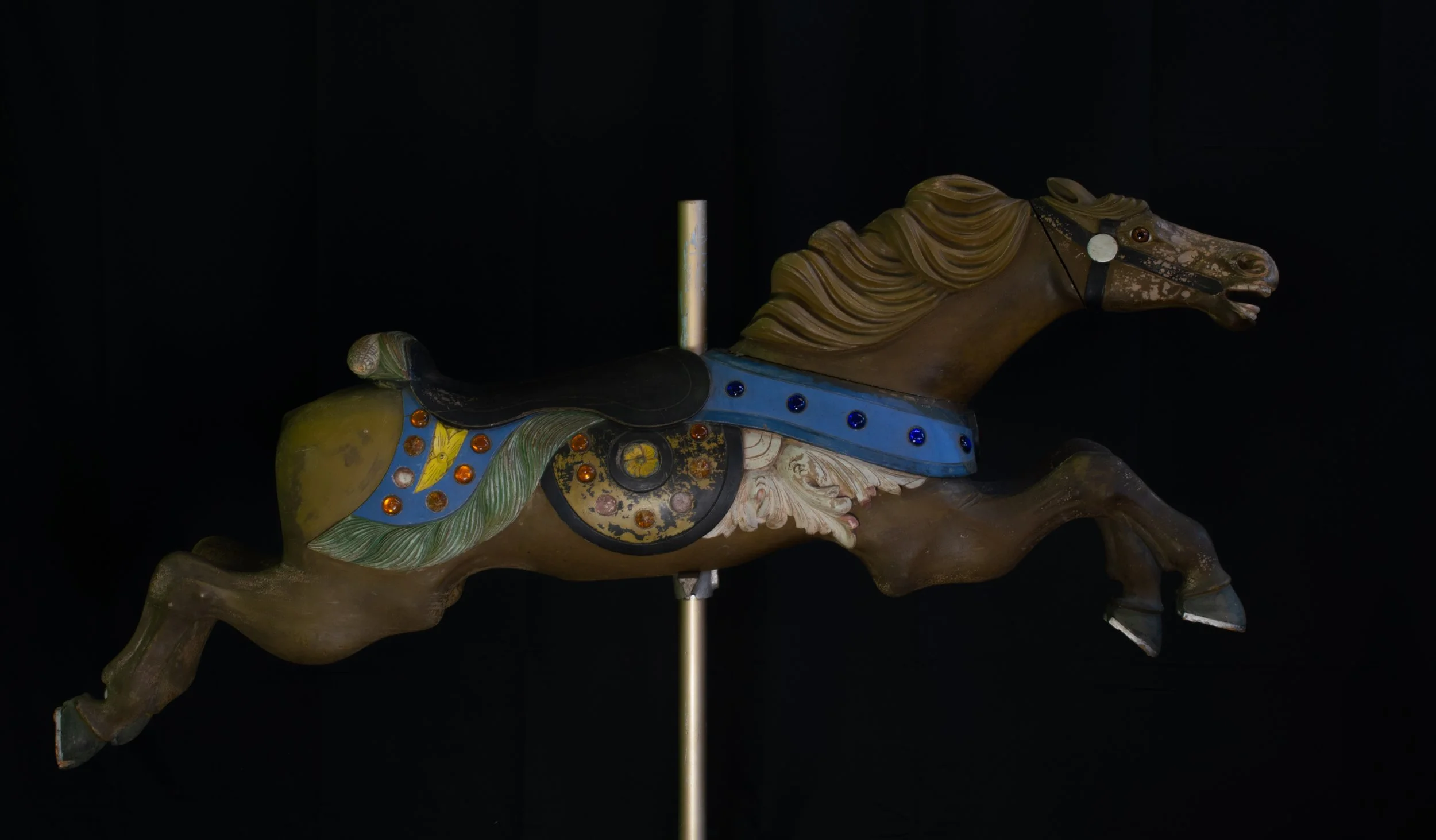
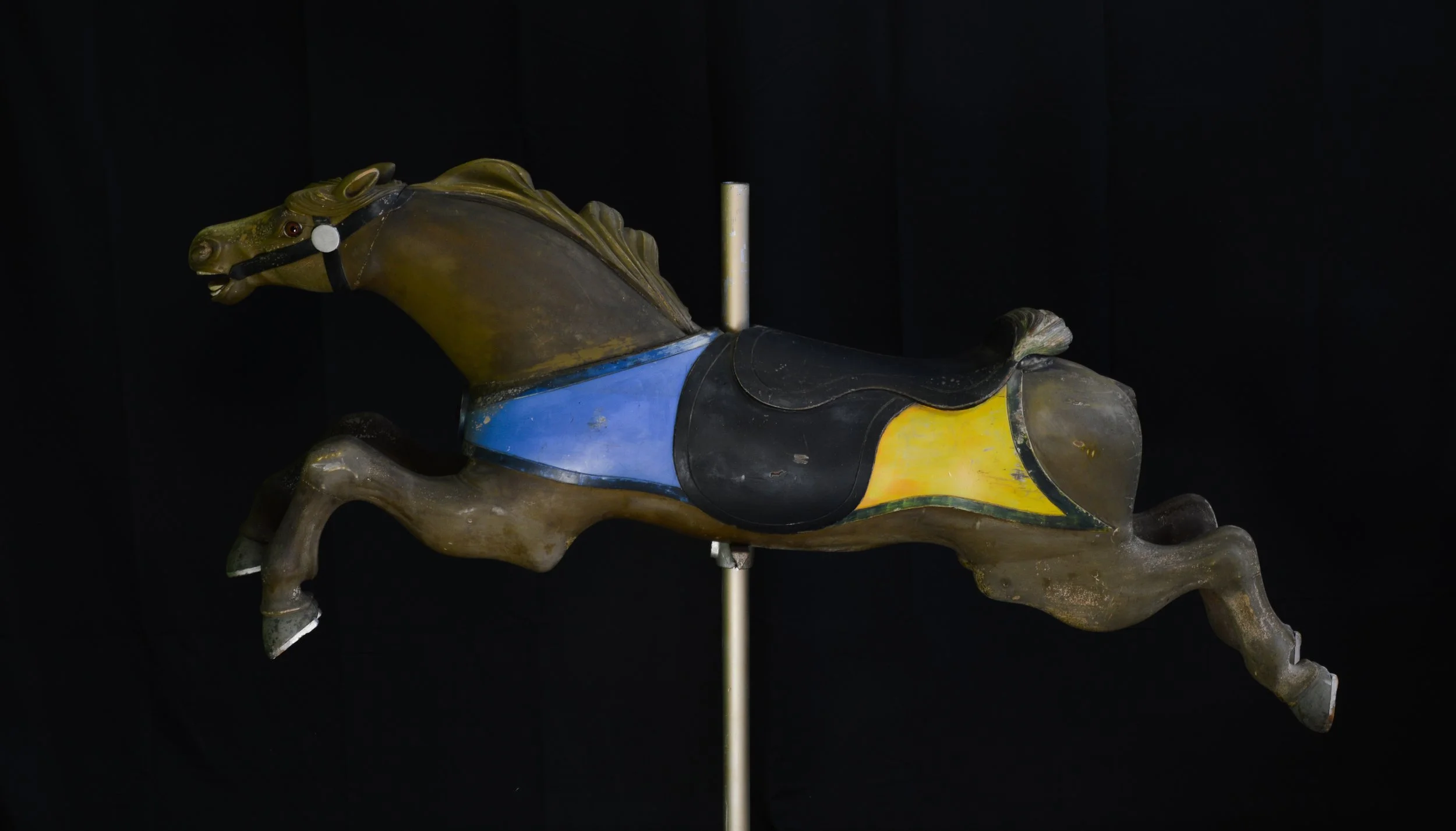
A hand-carved wooden outside row jumper attributed by the owner to the C.W. Parker Amusement Company of Leavenworth, Kansas (reported), and consistent in every visible characteristic with that attribution. The horse is posed in a full jump — all four legs airborne, body fully extended — with head turned downward and forward and mouth open. The romance side carries elaborate jeweled trappings typical of Parker's Leavenworth-era outer row horses: a blue breast strap set with blue and amber cabochon jewels; a large circular cantle disc painted in black and gold with rose and floral motifs, bordered by amber jewels in a blue arc; a carved white acanthus leaf at the chest; and a carved green feather at the hip. The non-romance side is plainly finished, as expected of an outer row horse. The owner describes the surface as being in park paint (reported) — the amber-darkened, unrestored original surface visible throughout the photographs is fully consistent with that assessment.
-
The owner identifies the piece as a Parker and notes the park paint condition (reported). Further acquisition details, including venue, date, and price, are pending owner follow-up.
-
The machine of origin is unknown. The owner has not yet identified which specific carousel this horse operated on (reported). No independent documentary trail to a named carousel has been established at this time. The Parker Amusement Company produced approximately 1,000 carousels (sourced), the overwhelming majority of them portable traveling machines; individual animal provenance is rarely traceable without factory records or continuous collection history.
-
Charles Wallace Parker (1864–1932) founded his carousel manufacturing operation in Abilene, Kansas, in 1892 and moved to a new, much larger factory in Leavenworth in 1911, where he built hundreds of small traveling carousels used by carnivals worldwide. Around 1925, the company started producing carousels with aluminum horses rather than wood. All wooden Parker horses therefore predate approximately 1925, placing the production window for this figure between 1911 and the mid-1920s.
About 1914, Parker began to introduce the new stretched leg and long bodied shape to the horses on his carousels that became his best known figures; by 1917 most of the older designs had been phased out. The fully extended body and dynamic airborne pose visible in the photographs are consistent with this post-1914 production style.
Parker outside row horses are the most elaborately decorated figures from any given machine. C.W. Parker's carvings behind the cantle are some of the more interesting found on carousel horses; his standard carvings were hound's heads, roses, tobacco leaves, bull horns, fish, shields, and ears of corn. The elaborate romance side visible here — jeweled breast strap, painted cantle disc with rose motifs, carved acanthus leaf — is consistent with an outer row or lead horse position on a Leavenworth-era machine. One specialist dealer has described a comparable bejeweled and armored Parker outside jumper from approximately 1915 as "a masterpiece of American carousel carving and one of the most sculptural and colorful examples" with "great, early, in-service, park-painted surface," noting that because many of Parker's carousels were portable, more wear can be expected from his animals than from those of some other carvers.
Parker horses are reliably identified by their iron shoes, sometimes stamped with the maker's name and location. The metal hooves are clearly visible in photographs and consistent with this identification; whether the shoes carry a stamp has not yet been confirmed from close examination (open question).
AntiqueCarousels.com lists a comparable "CA 1919 Parker Jumper — Large stretched jumper with jewels" in their active inventory (sourced). No specific hammer price for a directly comparable park paint outer row Parker jumper was located through searches of Morphy Auctions, Sotheby's, Christie's, Bonhams, Heritage Auctions, Skinner, Freeman's, Hindman, Cowan's, Langston, LiveAuctioneers, Invaluable, or WorthPoint at this time. A c.1915 jeweled and flowered Parker jumper retaining one horseshoe appeared at Nye & Company; a fully restored outer row Parker "Hunter's Pride" (c.1918) has been offered on the specialist market (sourced). Park paint Parker horses of outer row quality are infrequently encountered in this configuration given the hard use of traveling carnival service.
-
The owner describes it as park paint (reported). Photographs support this fully: the surface throughout shows the amber-darkened patina of aged varnish over original polychrome, with no evidence of overpainting or fresh restoration. The cantle disc shows significant paint crazing and flaking — consistent with extended in-service exposure. The jewels on the romance side appear largely intact; individual jewel condition should be confirmed by physical examination. The carved acanthus leaf and feather elements appear structurally sound in photographs. No obvious breaks, repairs, or replaced components are visible. Ears appear intact.
Formal condition rating: Good to Very Good — Unrestored / Park Paint (reported and photographic observation). Physical examination pending to confirm jewel count and assess crazing depth on cantle disc.
-
-High. The Parker attribution is strongly supported by photographic evidence — iron hooves, jeweled outer row trappings, Leavenworth-era body style — and by the owner's identification. The park paint designation is visually credible and owner-reported. The production date range (c.1911–1925) follows from documented factory history. Machine of origin and acquisition details remain unresolved.
-
Owner interview (audio transcript) (reported)
Six photographs: DSC_2282, DSC_2284, DSC_2286, DSC_2287, DSC_2288, DSC_2289 — romance and non-romance sides, including a close-up detail of saddle trappings
Wikipedia: C.W. Parker biography and production history (sourced)
C.W. Parker Carousel Museum (Leavenworth); Kansas Sampler Foundation: Leavenworth production period, style evolution, cantle carving identification (sourced)
1stDibs: bejeweled armored Parker outside jumper c.1915 with park paint surface — closest market comparable identified (sourced)
AntiqueCarousels.com: CA 1919 Parker stretched jumper with jewels listed (sourced)
Morphy Auctions, Sotheby's, Christie's, Bonhams, Heritage Auctions, Skinner, Freeman's, Hindman, Cowan's, Langston, LiveAuctioneers, Invaluable, WorthPoint, CarouselHistory.com, National Carousel Association, allthingscarousel.org: searched; no specific hammer price for a park paint outer row Parker jeweled jumper identified at this time