
Dentzel - Horse
Catalog #005 120×110×25cm
-
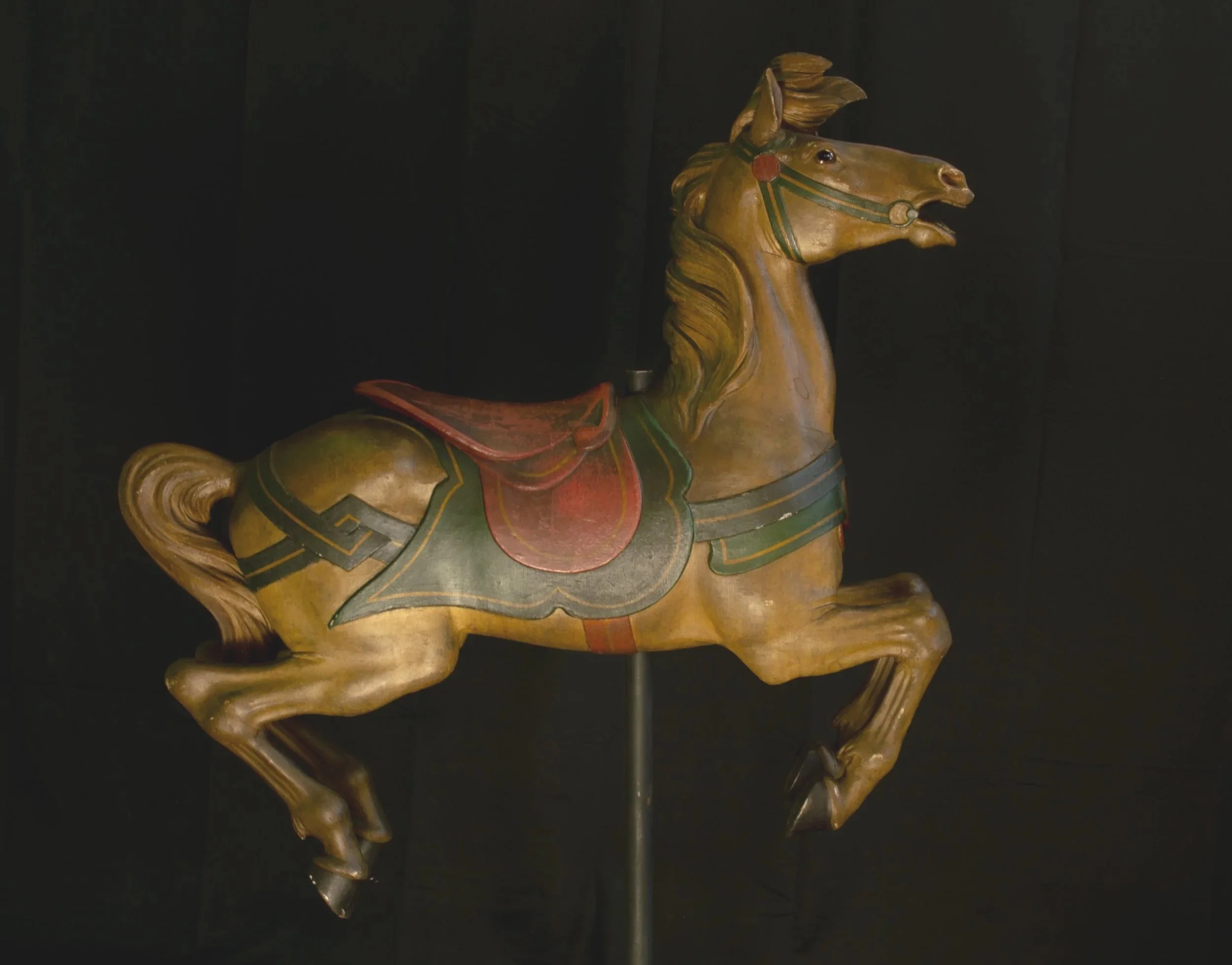
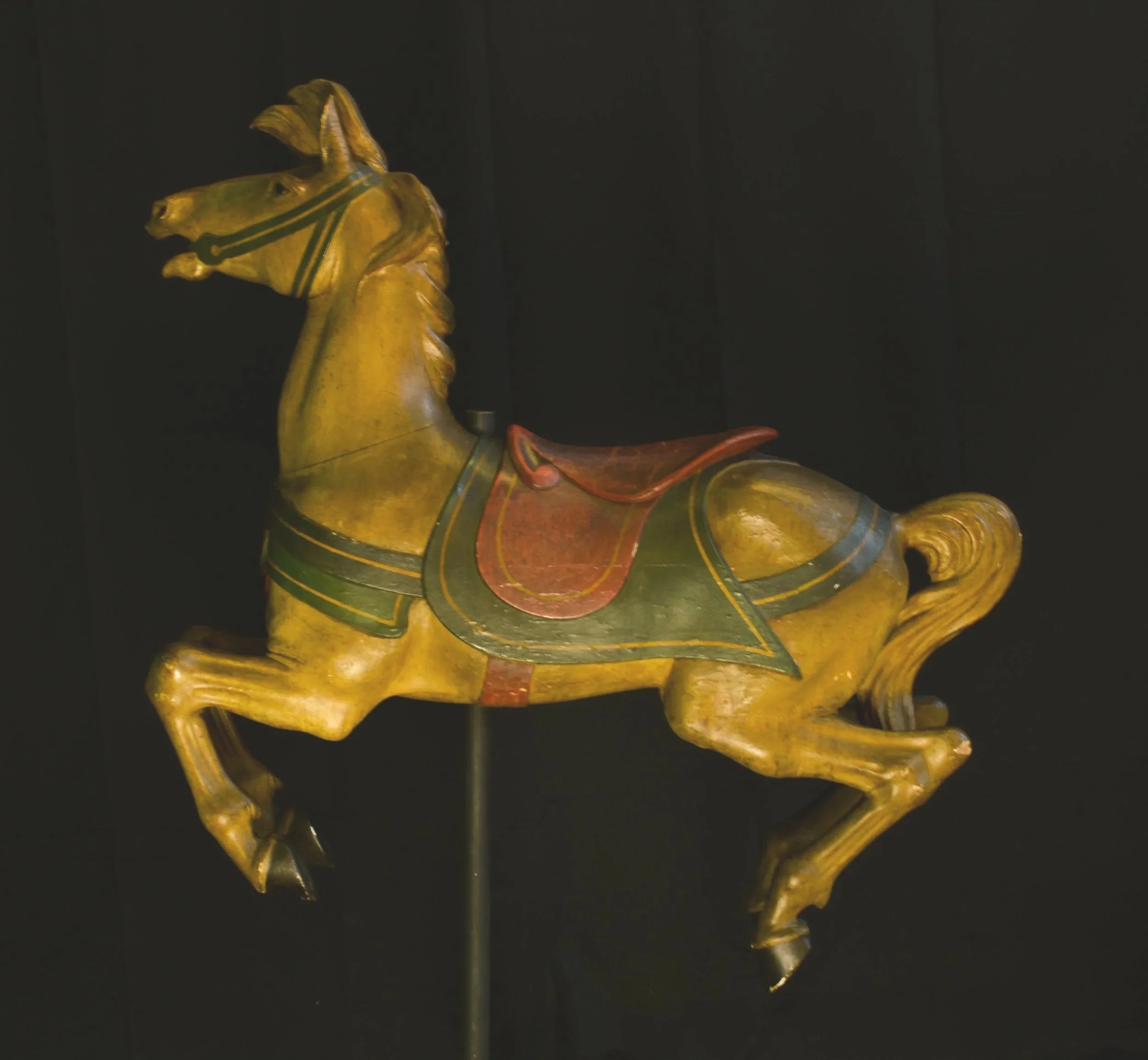
A hand-carved wooden inner row prancer attributed to the William Dentzel Company, Philadelphia, Pennsylvania, dating to approximately 1925–1928 and consistent with the factory's late production period. The horse is captured in a full prancer pose — both forelegs elevated, hindquarters low and extended — with head raised and mouth open. The body retains its full original surface in what the owner describes as park paint (reported): an unrestored original finish visible in the photographs as a warm amber-gold tone consistent with decades of seasonal varnish applications over the original polychrome layer. A carved topknot at the crown of the head, noted by carousel expert Tobin Fraley as a distinguishing feature (reported), is clearly visible in photographs. The saddle, saddlecloth, and bridle are simply but cleanly executed — appropriate to an inner row figure — with no jewels or secondary carved figures present.
-
Purchased at Morphy Auctions, Denver, Pennsylvania (reported). Additional acquisition details — including purchase date and sale price — were not fully captured in the interview and remain pending owner follow-up.
-
The owner reports, based on Tobin Fraley's assessment, that this horse originated from the last carousel the Dentzel factory produced before its closure in 1928 (reported). Independent research supports and substantially corroborates this claim: CarouselHistory.com documents the 1927 Dentzel-Müller carousel from Rock Springs Park, Chester, West Virginia, as "the last carousel to leave the Dentzel Factory." That machine — an all-horse carousel — was later broken up following the condemnation of Rock Springs Park for highway construction in the mid-1970s, with its animals sold through the American Carousel Museum, San Francisco, in 1988. If the owner's account is accurate, this horse was among the final figures to leave the Dentzel factory floor — a provenance of unusual documentary significance. The specific machine of origin has not yet been independently confirmed for this entry and should be established with the owner.
-
The G.A. Dentzel Company, founded by Gustav Dentzel in 1867 in Germantown, Philadelphia, was among the most technically accomplished and historically significant carousel manufacturers in American history. The factory lasted until the death of William in 1928; the Dentzel factory manufactured two or three carousels per year and sold them to amusement parks across the United States, and although the factory worked for some sixty years, their detailed style varied very little and remained consistent. After William's death, the remaining Dentzel equipment and stock were sold to the Philadelphia Toboggan Company.
Inner row horses from the Dentzel workshop are considerably less decorated than their outer row counterparts — simpler saddle trappings, no jewels, single blanket — but are carved to the same structural and anatomical standard as the more visible outer row pieces. The inner row designation of this horse is confirmed both by the owner (reported) and by the plainness of the trappings visible in photographs (inferred). Inner row Dentzel prancers from the final production decade are well-represented in specialist dealer inventory, though examples retaining unrestored original paint surface are materially rarer. AntiqueCarousels.com, a specialist carousel marketplace, uses "park paint" as a distinct and positive collector designation — reflecting the understanding that original unrestored surfaces, even when darkened by age, preserve the factory's original palette beneath the varnish and are considered superior by preservationists to repainted examples (sourced).
Tobin Fraley is a writer and woodcarver, a restorer and collector of wooden carousel animals, and the author of several standard reference books on the subject including The Carousel Animal (1983), The Great American Carousel: A Century of Master Craftsmanship (1994), and Carousel Animals: Artistry in Motion (2002). His involvement with this piece — specifically his identification of the topknot feature and his recommendation regarding the treatment of the varnish layer — constitutes expert specialist endorsement of significance.
No directly comparable auction result for a park paint inner row Dentzel prancer from the late production period was located through Morphy Auctions, Sotheby's, Christie's, Bonhams, Heritage Auctions, Skinner, Freeman's, Hindman, Cowan's, Langston, LiveAuctioneers, Invaluable, or WorthPoint searches at this time. A restored Dentzel inner row prancer (1910–1925) has been offered in the specialist dealer market at $3,995 unrestored (sourced, Carousel Workshop); the park paint designation and the provenance claim from the factory's final machine would place a well-documented example considerably above the unrestored-without-provenance baseline. The CarouselHistory.com auction timeline confirms that Rock Springs animals were sold at the American Carousel Museum San Francisco auction in 1988 (sourced), which could provide a further paper trail if lot records from that sale can be located.
-
The owner describes the piece as being in original park paint (reported), with the varnish layer having yellowed and darkened the surface over the decades of seasonal maintenance coats between operating seasons. The owner notes, based on Tobin Fraley's recommendation, that removing this varnish layer — rather than restoration — would likely reveal vivid original polychrome beneath (reported). Fraley has specifically suggested this treatment be undertaken by a named restorer whose identity requires confirmation from the interview record (reported; name phonetically uncertain from transcript).
Photographs support the park paint assessment: the surface presents as a uniform amber-gold consistent with aged varnish throughout, with no visible areas of overpainting, filler, or color inconsistency that would suggest later repainting. Some minor crazing is visible in the saddle area. The carved mane, tail, and all four legs appear structurally sound in photographs; the pole mounting bracket is visible at the saddle. Glass eyes are confirmed intact on both sides.
Formal condition rating: Very Good — Unrestored / Park Paint. Pending physical examination and owner confirmation of material.
-
-High. The Dentzel attribution is strongly supported by photographic evidence and specialist endorsement from a named expert. The park paint designation is visually credible and owner-reported. The "last carousel" provenance claim is substantively corroborated by documentary sources identifying the 1927 Rock Springs machine as the final Dentzel production, but the specific machine of origin has not yet been formally confirmed for this entry.
-
Four photographs: DSC_2276, DSC_2278, DSC_2279, DSC_2281 — both romance and non-romance sides
CarouselHistory.com: documentation of the Rock Springs 1927 Dentzel-Müller carousel as the last machine to leave the Dentzel factory (sourced)
Wikipedia / VintageCarousels.com: Dentzel Company operational history and closure (sourced)
Encyclopedia.com / LensCulture / Amazon: Tobin Fraley biographical and bibliographical records (sourced)
AntiqueCarousels.com: "park paint" as a recognized collector and dealer designation (sourced)
Carousel Workshop: inner row Dentzel prancer dealer comparables (sourced)
Sotheby's, Christie's, Bonhams, Heritage Auctions, Skinner, Freeman's, Hindman, Cowan's, Langston, LiveAuctioneers, Invaluable, WorthPoint, CarouselHistory.com, National Carousel Association, allthingscarousel.org: searched; no directly comparable auction result for this specific configuration identified at this time