
P.T.C. - Lion
Catalog #041 160×170×40cm
-
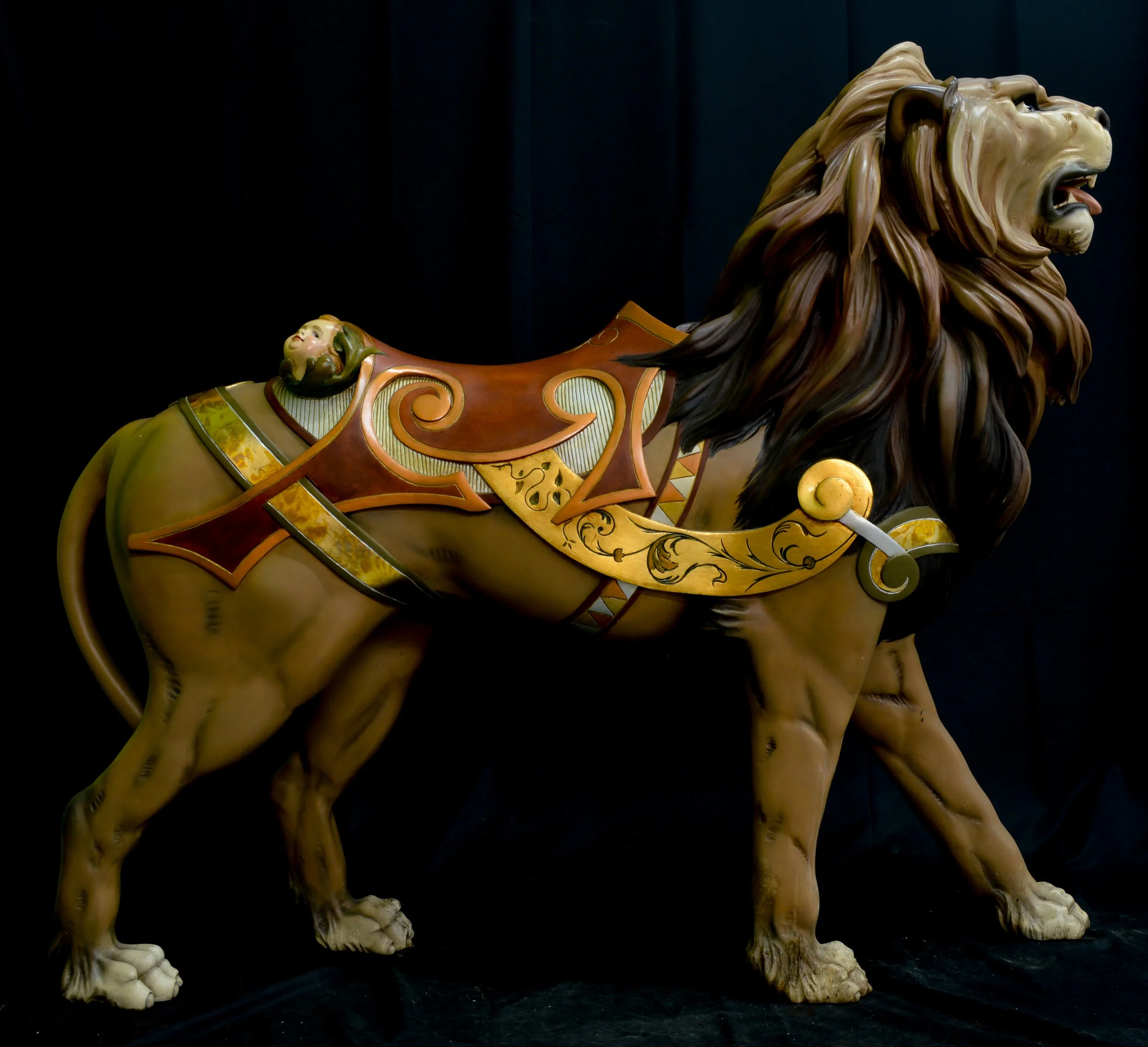
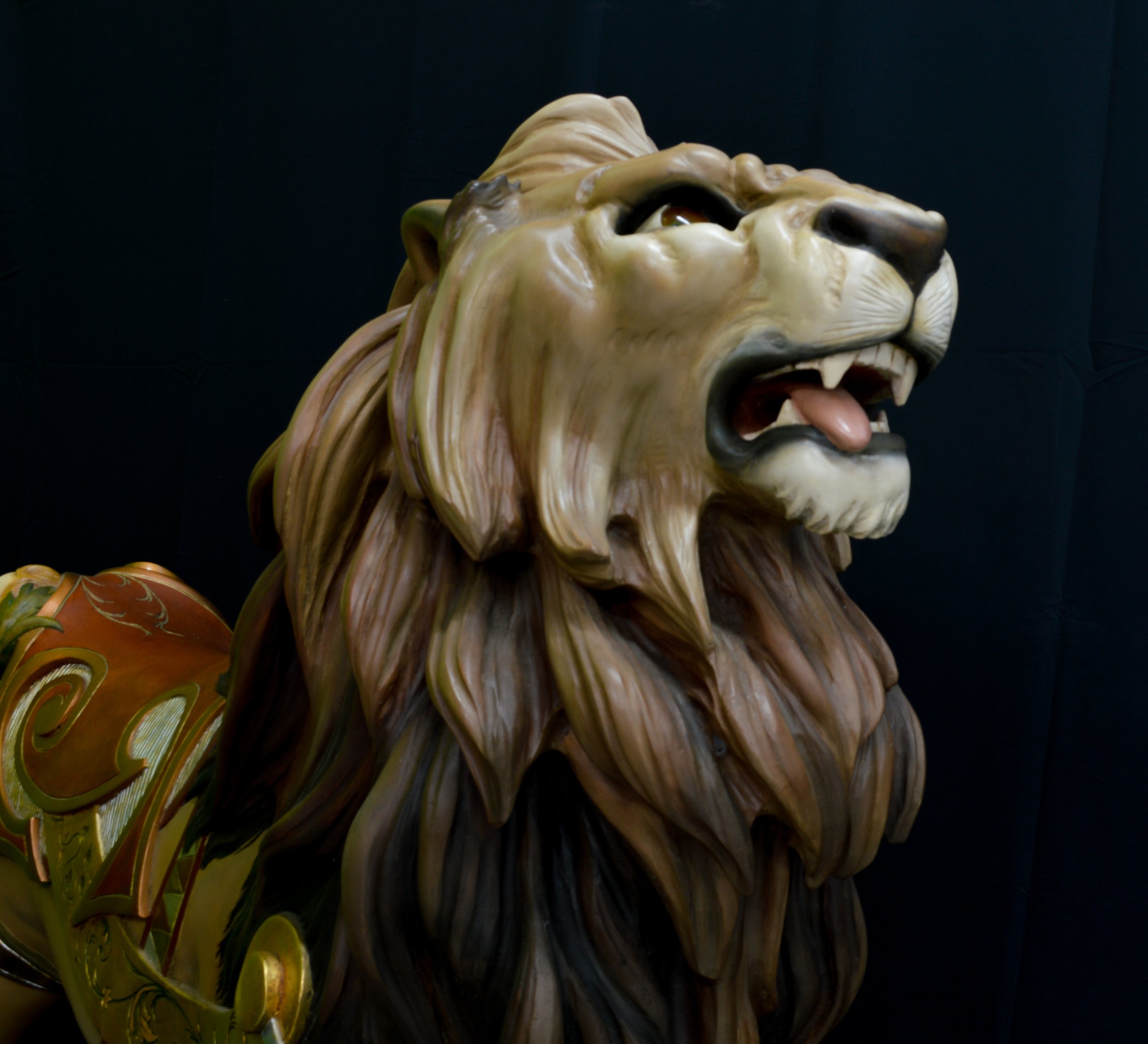
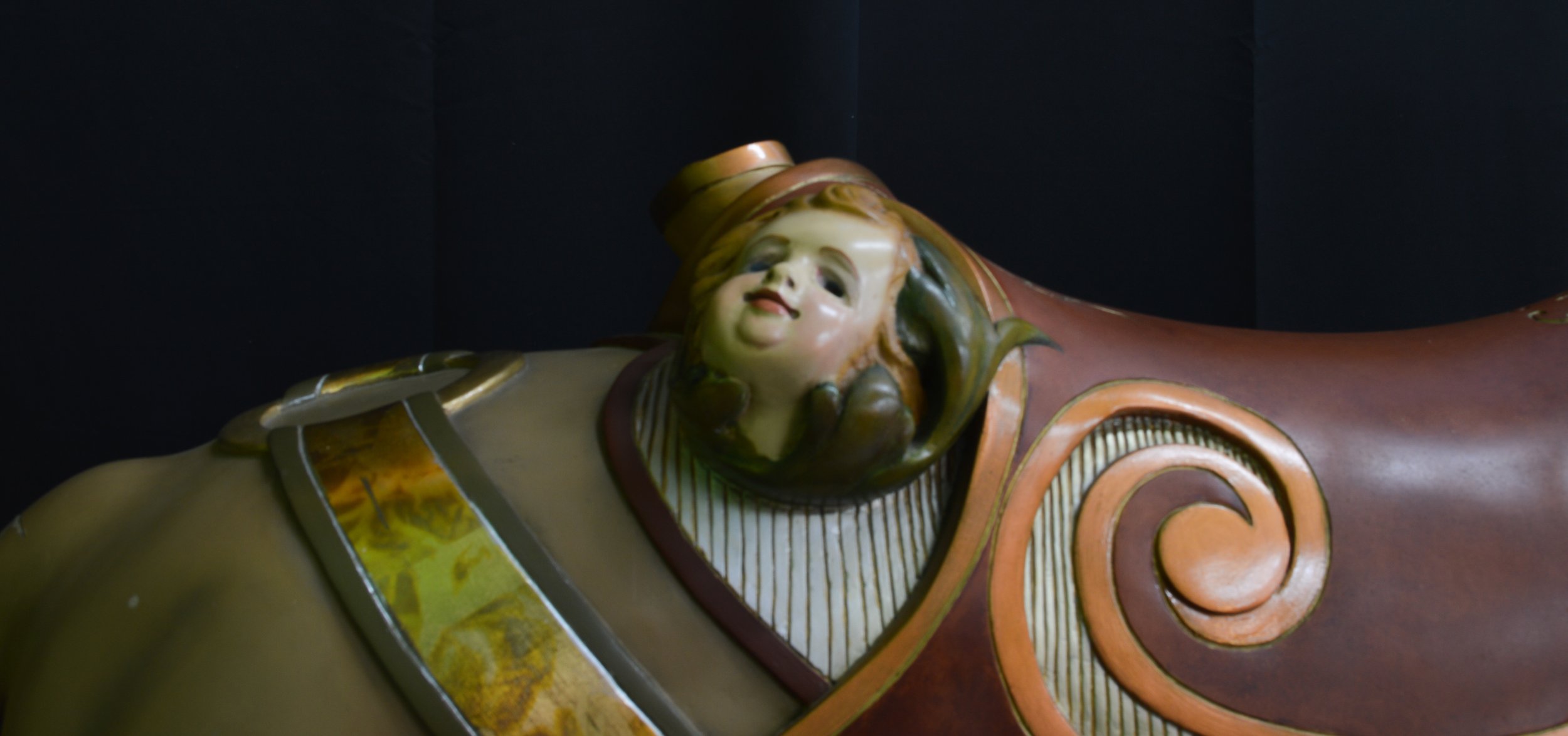
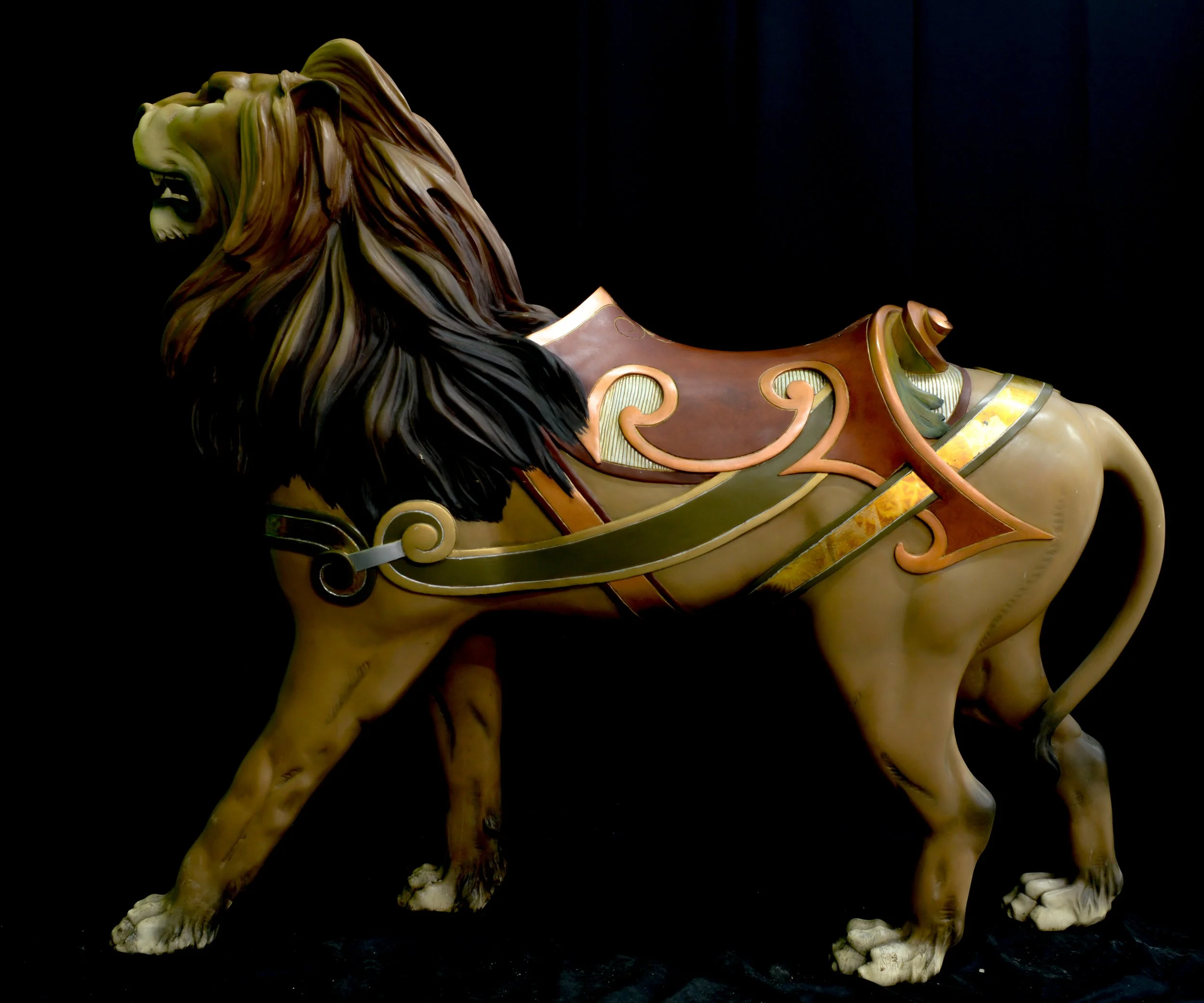
A large carved and painted carousel lion in a standing walk — all four paws planted, head raised and turned sharply to the right in a full-throated roar, mouth open with teeth and tongue visible. The mane is deeply carved in long, individually rendered flowing strands that cascade from the crown of the head down the chest and shoulders, transitioning from warm tawny gold at the face through progressively darker brown to near-black at the tips. Amber glass eyes are intact. The romance-side saddle features a brown/rust field with raised scroll cartouches, fine-line hatched inlay panels, and a gold acanthus-scroll belly band with curled terminals. A carved female head — rounded face, flowing hair, small crown or headdress — serves as the cantle ornament at the rear of the saddle (observed). The non-romance side carries a simpler trapping scheme: olive-green belly band with scroll terminals but without the acanthus leaf decoration of the romance side (observed). The figure is attributed to the Philadelphia Toboggan Company (reported).
-
Acquired from the Ersepke collection (reported). The owner notes that the majority of pieces obtained from this collection were painted by Pam [Hessey], who maintains detailed records of her work — including the identity of the owner for whom each piece was painted and the date of completion (reported). The owner also notes that Lise [Liepman] was likely involved in restoration of Ersepke collection pieces (reported). No further acquisition details — date, price, or intermediary — were provided in this interview.
-
The Ersepke collection is the immediate prior provenance (reported). The collection name is spelled Ersepke.
If Pam Hessey's painting records can be accessed, they represent a significant provenance resource — not only for this lion but potentially for other pieces in the collection that originated from the same source. Lise Liepman's involvement, if confirmed, would add a second documented restorer with traceable records.
No earlier provenance chain, machine of origin, or documentary history has been established.
-
The Philadelphia Toboggan Company was founded in 1904 by Henry Auchy and Chester Albright in Germantown, Pennsylvania (sourced — Wikipedia; CarouselHistory.com; PTCI official site). Between 1904 and approximately 1934, PTC manufactured 87 carousels, of which roughly 35 remain in operation today (sourced — CarouselHistory.com). PTC's earliest figures were not carved in-house — the company acquired the inventory and operations of a contemporary Philadelphia carousel manufacturer around 1903, incorporating as many as 200 existing figures into its first several machines produced between 1903 and 1907 (sourced — VintageCarousels.com; PTCI official history). Because of this, some early figures originally produced by the predecessor firm have historically been misidentified as PTC originals (sourced — VintageCarousels.com).
PTC employed a succession of distinguished carvers over its production years. Lead carvers included Daniel Carl Müller, Leo Zoller, Frank Caretta, and John Zalar, the Austrian-born master carver who joined the factory around 1915–1916 and is credited with revitalizing PTC's carving style during the late teens (sourced — Wikipedia; VintageCarousels.com; Coaster101; HistoryLink.org). The company also employed Salvatore Cernigliaro and Charles Carmel at various points, and acquired the remaining inventory of another major Philadelphia-school workshop in 1927 (sourced — Wikipedia; PTCI official site).
Lions appear on PTC carousels as single menagerie figures among predominantly equine rosters. The only surviving intact PTC menagerie carousel — PTC No. 6 at Kit Carson County, Colorado, built in 1905 — includes one lion among its 46 figures (sourced — Kit Carson County Carousel; TheFencePost.com). That lion, along with several other menagerie figures on the machine, carries no PTC machine number, suggesting it may derive from pre-PTC inventory acquired with the predecessor firm's stock (sourced — Kit Carson County Carousel museum). PTC No. 6 is designated a National Historic Landmark and retains its original paint (sourced — Kit Carson County Carousel).
Documented PTC and predecessor-firm lions in the current dealer and auction record include: a ca. 1904 example with an eagle cantle, offered at $18,500 (reduced from $23,500); a ca. 1905 example attributed to John Zalar, described as having an "incredible mane" and featured in published reference works; and a ca. 1902 example from Hoppyland in Venice, California, also with an eagle cantle, sold at $17,000 (sourced — AntiqueCarousels.com). Notably, the eagle cantle appears to be the standard secondary ornament on documented examples from this tradition. This lion's female-head cherub cantle is a departure from that pattern — whether it reflects a variant within the factory's production, a later modification, or a specific carver's hand is an open question.
A ca. 1905 stander from the same Philadelphia tradition bearing a cherub angel head with wings at the saddle back has been documented with a Lise Liepman paint restoration (sourced — AntiqueCarousels.com).
-
The surface presents as a professional restoration — uniformly glossy, with consistent color saturation and no visible flaking, crazing, or paint loss (observed). This is not original park paint. The restoration quality is high: transitions between mane tones are smooth and naturalistic, the saddle decoration includes fine-line detail work, and the belly-band acanthus scrollwork on the romance side is precisely executed. The body is free of visible structural cracks, gaps, or seam separations. Paws show ivory/cream paint in good condition. A measuring tape visible in one photograph indicates the figure stands approximately five feet tall to the top of the head (observed).
If Pam Hessey is confirmed as the painter, the restoration carries documented provenance in its own right — Hessey is recognized as one of the leading carousel restoration painters in the United States, a protegee of the late Nina Fraley who has been painting carousel figures for decades from her Hawk's Eye Studio (sourced — AntiqueCarousels.com; Collectors Weekly; Bob Yorburg credits page).
Formal condition assessment has not been conducted. A conservator's review of underlying wood condition, construction details, and any evidence of original paint beneath the restoration would strengthen the record.
-
Low-Medium — Maker attribution is owner-reported with no independent documentary confirmation. The figure is stylistically consistent with the PTC/E. Joy Morris tradition. Provenance is traceable through the Ersepke collection and potentially through Pam Hessey's painting records, but neither has been independently verified. The cherub cantle departs from the eagle-cantle pattern documented on other examples from this tradition, which may narrow or complicate attribution once examined by a specialist.
-
Owner interview (recorded, transcribed): PTC attribution, Ersepke collection provenance, Pam Hessey and Lise Liepman connections
Photographs (6 images, DSC_2545–2552, dated 10/3/25): Romance side (3 views including measurement reference), non-romance side, head close-up, cantle close-up
AntiqueCarousels.com: PTC/E. Joy Morris lion listings, Pam Hessey and Lise Liepman paint tags, comparable pricing
CarouselHistory.com: PTC company history, Historic American Carousel Lions gallery, world record auction prices
Kit Carson County Carousel (kitcarsoncountycarousel.com): PTC No. 6 menagerie details, museum documentation of unmarked figures
VintageCarousels.com: PTC carver history, Morris-to-PTC transition documentation
Wikipedia — Philadelphia Toboggan Coasters: Lead carvers, company history, Dentzel inventory acquisition
Collectors Weekly: Pam Hessey interview and restoration practice
Nina Fraley tribute, AntiqueCarousels.com: Fraley–Liepman–Hessey mentorship lineage