
Unknown - Centaur
Catalog #028 102×102×23cm
-
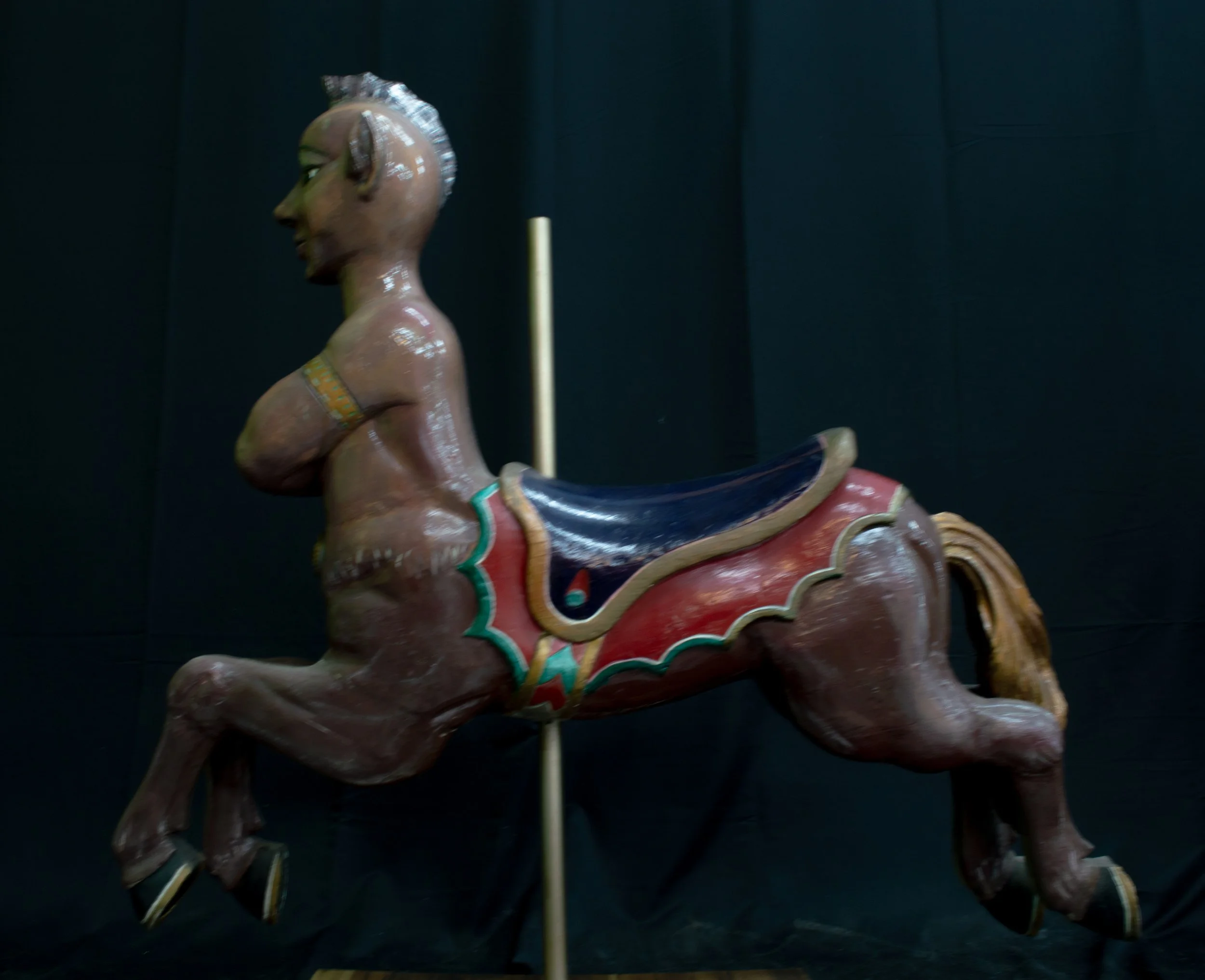
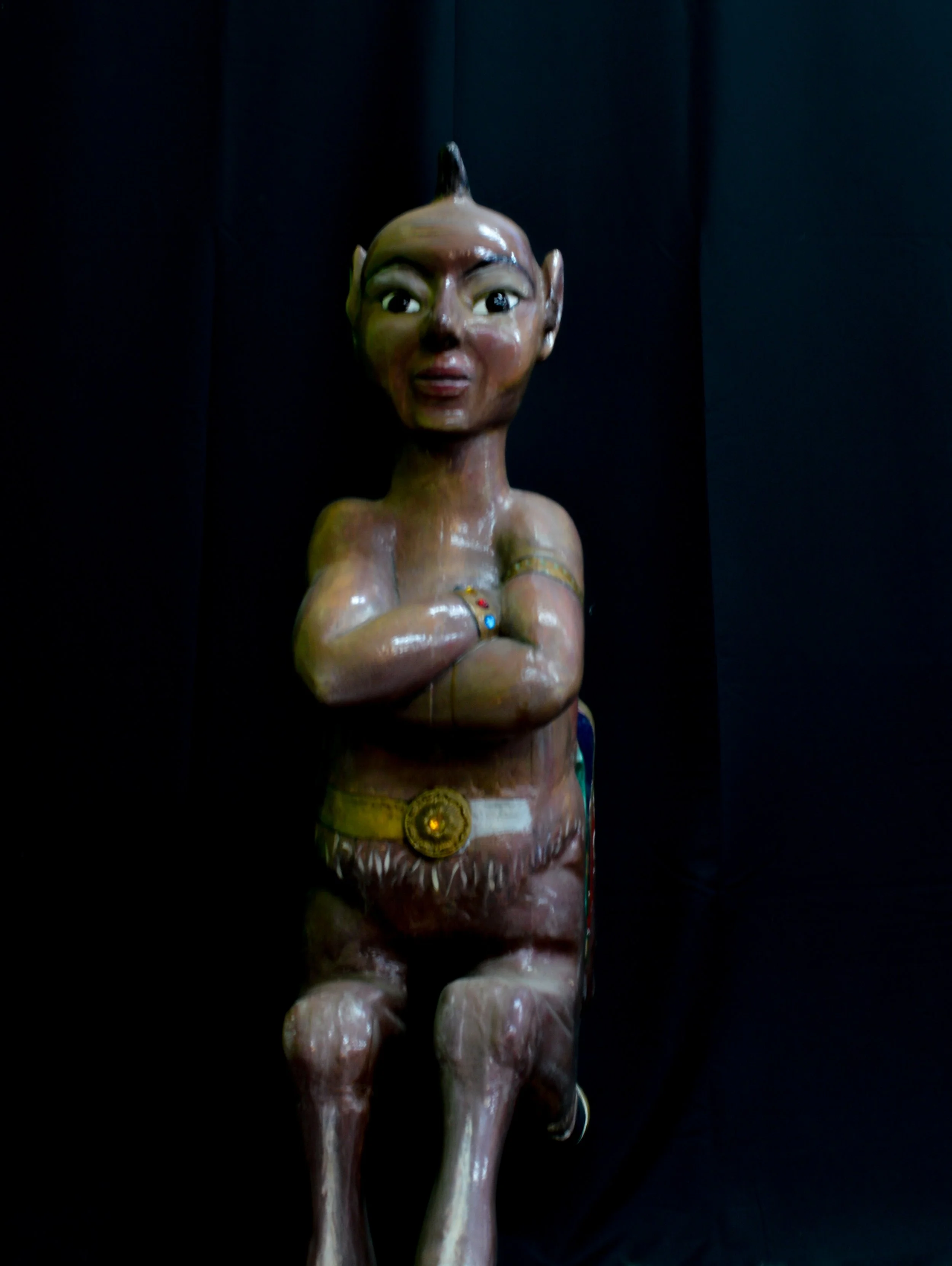
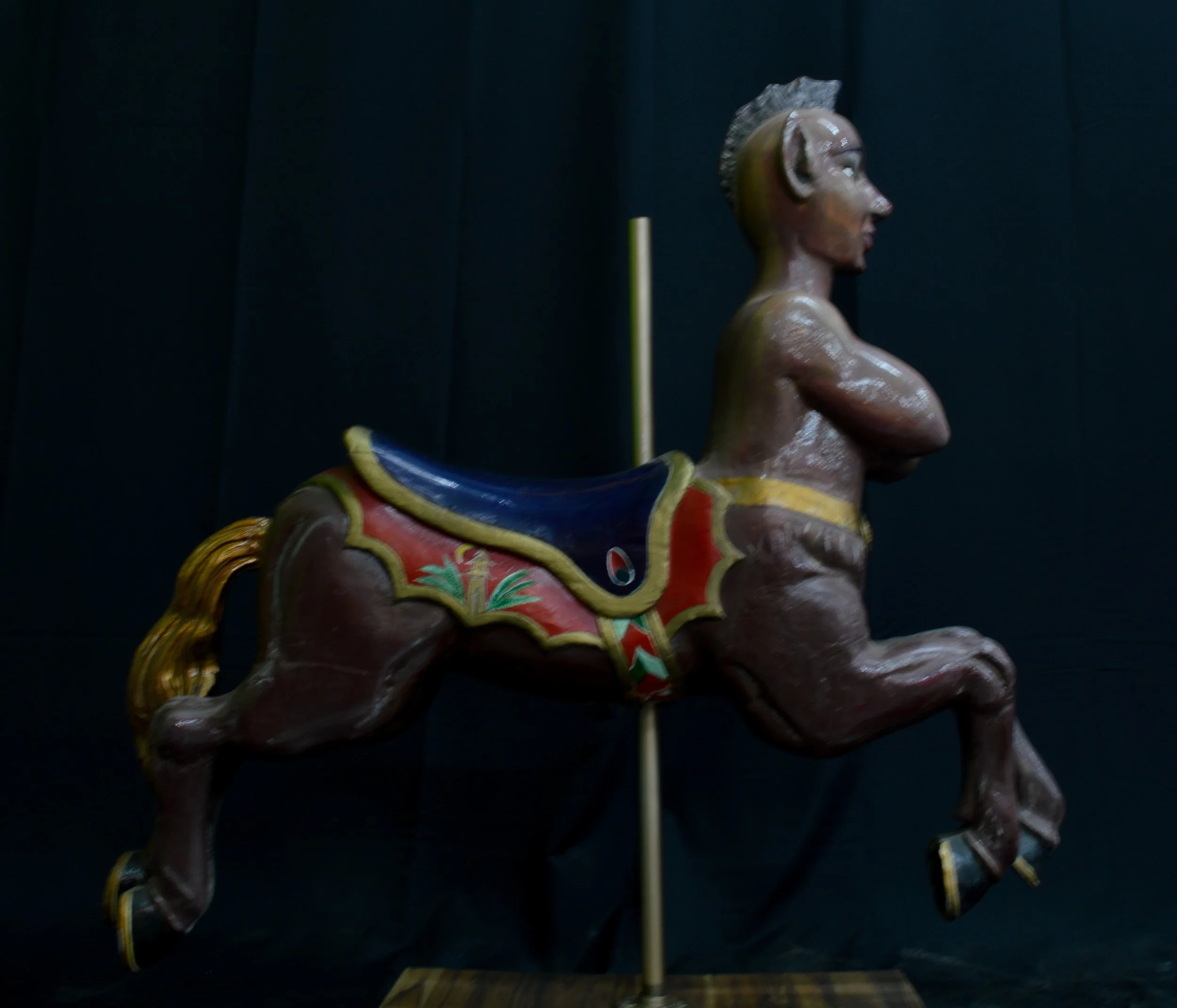
A carved and painted carousel centaur in a jumping pose — a male human upper body merged with a horse's lower body, front legs raised. The human torso is painted flesh-brown with a muscular build; the arms are crossed over the chest. The face has distinctly pointed ears, arched eyebrows, a small pointed tuft or horn atop the head, and an alert, slightly impish expression — more faun or satyr in character than classical centaur. A gold armband with colored jewels decorates the upper arm, and a gold belt with a round medallion and jewel marks the transition from human to equine form. A carved fur or grass skirt detail rings the waist at the junction. The horse body is chestnut brown. The trappings include a shaped saddle blanket in red with green foliate decoration, scalloped gold-edged borders, and a dark navy-blue seat with a teardrop-shaped jewel inset. The tail is painted gold-yellow. Hooves are dark with gold trim. A carousel pole passes through the figure. The owner identifies this as a "Mexican centaur" (reported).
-
Purchased from Morphy Auctions (reported). No date, lot number, or price has been provided. The owner also acquired the Mexican gorilla (ID: 025) from Morphy's, and has auction records available for consultation (reported).
-
Not established beyond the Morphy's sale. As with ID: 025, the Morphy's auction catalog — once consulted — may contain lot descriptions, provenance notes, or attribution information.
-
A centaur is among the rarest and most unusual figure types in any carousel tradition. No American carousel manufacturer is documented as having produced centaur figures during the golden age of carousel carving. The subject is mythological rather than zoological, which places it outside the standard menagerie vocabulary of horses, exotic animals, and barnyard figures that defined the American carousel industry. No centaur figures have been identified in the auction records, dealer inventories, or specialist archives surveyed for this entry.
The Mexican carousel tradition, which produced the gorilla (ID: 025) and is documented through the Ortega workshop and other sources, operated with a broader and more imaginative subject range than its American counterpart. Mythological and fantastical figures appear to have been within the repertoire of Mexican carnival carvers, though documentation of this tradition remains sparse.
The carving style of this centaur — expressive, folk-art in character, with simplified musculature and a somewhat naive treatment of anatomy — is consistent with the Mexican carousel production documented in other entries in this collection. The pointed ears and tuft/horn give the figure a faun-like quality that may reflect a deliberate creative choice by the carver rather than a misunderstanding of classical centaur iconography. The paint shows wear and aging consistent with use or extended display, and appears to be either park paint or an older restoration rather than a recent repaint.
-
The paint is worn throughout, with surface losses and dulling visible across the flesh-toned areas and the saddle blanket. The underlying carving appears structurally sound in the photographs. No major cracks, missing elements, or structural repairs are visible. A formal condition assessment is pending.
-
Low. The figure is identified as Mexican by the owner, and the carving style and paint character are consistent with Mexican carousel production documented elsewhere in this collection. No maker attribution has been offered or independently established. The Morphy's auction record, once consulted, is the primary outstanding research lead.
-
Owner interview recording (October 17, 2025): identifies the figure as a Mexican centaur purchased from Morphy Auctions
Three photographs (DSC_2468, DSC_2470, DSC_2472): left profile, front view of face/torso, and right profile showing saddle detail