
Armitage Herschell - Horse
Catalog #004 140×105×30cm
-
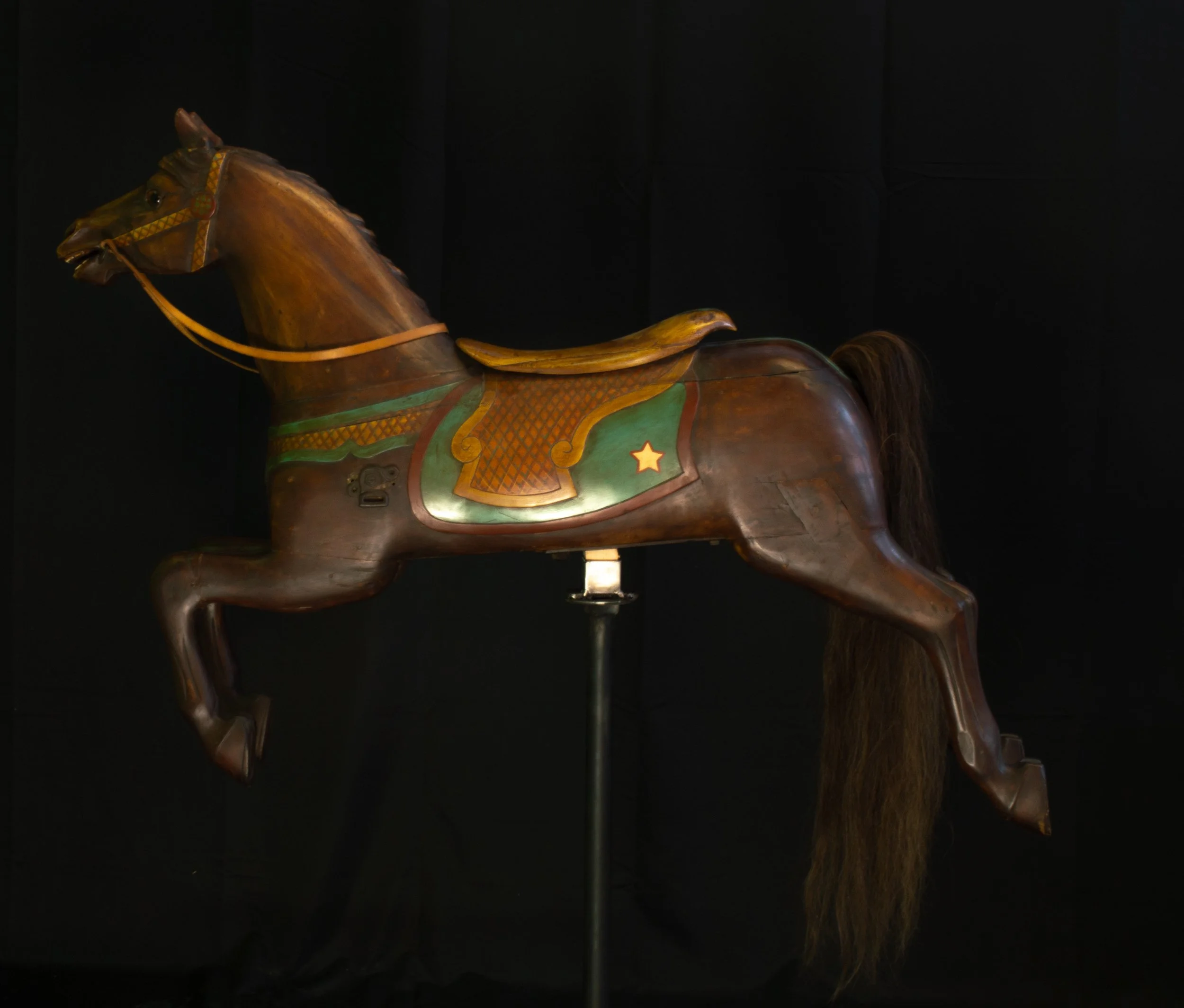
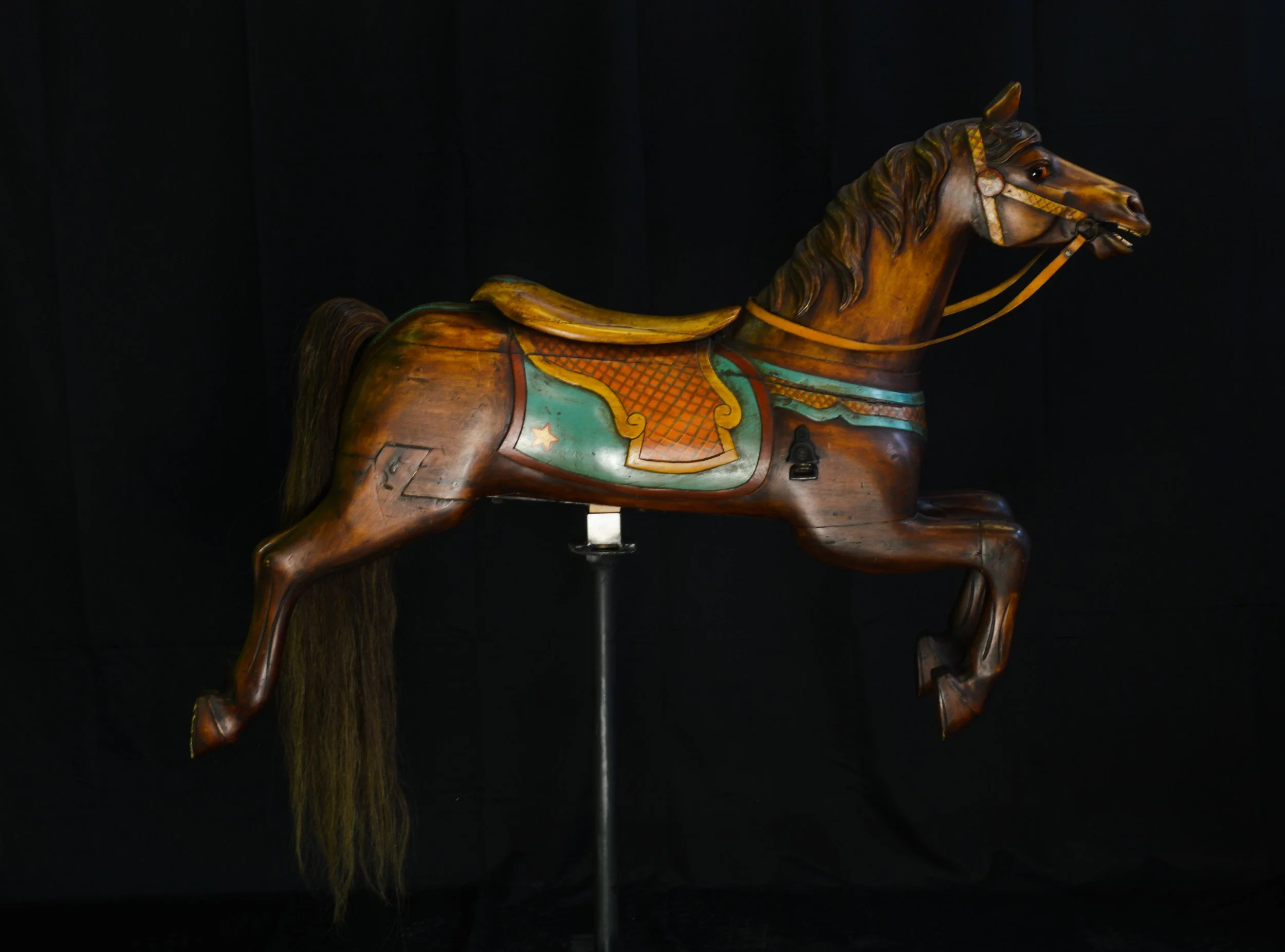
A full-size, hand-carved wooden jumper carousel horse attributed to the Armitage-Herschell Company of North Tonawanda, New York, dating approximately 1890–1900, acquired in 1988 from the renowned collection of Walter and Mary Lawrence Youree of Oregon (reported; sourced as described). The figure is modeled in a full jumping pose with both front legs raised, body extended — the open, confident stance typical of the Armitage-Herschell county fair machine. The body is painted deep mahogany-brown with warm chestnut undertones. The saddle is rendered in a green field with an amber crosshatch-patterned saddle pad, gold scrollwork trim, and red border, with a small gold star on the saddle skirt. The owner identifies two physical features as maker identifiers: the "floating saddle" — where the seat appears elevated above the horse's back rather than fully integrated with the body — and a distinguishing notch in the rear leg, both documented Armitage-Herschell characteristics (reported, consistent with sourced maker documentation). The figure was restored by Mary Lawrence Youree (reported) and retains its original real-hair tail.
-
The owner acquired this figure in 1988 from Walter and Mary Lawrence Youree (reported). The Yourees were established Oregon-based carousel collectors whose collection is described in the specialist community as "renowned" (sourced — AntiqueCarousels.com). Mary Lawrence Youree served as both co-collector and restorer of collection pieces, including this figure (reported). 1988 falls at the early edge of the antique carousel market's peak period, which crested in the early 1990s, a context that informs the acquisition price. The owner states a genuine admiration for the piece: "I love her."
-
Prior to the Youree collection, this figure's history is unknown — the original carousel installation, operating location, and chain of ownership before the Yourees cannot be established from available evidence. The Youree collection itself, however, is documented and recognized: figures from it have been donated to the American Folk Art Museum (sourced — American Folk Art Museum exhibition records), and Walt Youree (1915–2001) is memorialized in the carousel specialist press (sourced — CarouselHistory.com). CarouselHistory.com maintains a dedicated archive gallery for the Youree collection (sourced). Acquisition from this collection constitutes a meaningful, traceable provenance link — one level above an anonymous private seller.
Original iron bracket hardware visible on the left flank of the figure and a bottom-mounted pole fitting may be physical traces of the figure's working life on a specific machine but have not been further investigated.
-
The Armitage-Herschell Company was established in North Tonawanda, New York, in 1872/1873 by Scottish-born Allan Herschell and his partner James Armitage, reorganized formally as the Armitage-Herschell Company in 1890, and operated until bankruptcy in 1903 (sourced — North Tonawanda History archive, Encyclopedia of Arkansas). Herschell built his first steam-powered carousel in 1883–1884, and by the late 1880s his portable steam riding gallery was in international demand (sourced). The company produced portable, steam-driven carousels primarily in the county fair style — relatively unelaborated compared to the Philadelphia-school park machines of the same era, but consistent and prolific in output.
The owner's summary of the corporate lineage — Armitage-Herschell into Herschell-Spillman into Spillman Engineering — is substantively accurate (confirmed by research), and the owner's observation that "the animals were totally different from each change" is consistent with documented stylistic distinctions across these successor firms (sourced). This piece is identified by the owner as "a very early piece," which is consistent with the Armitage-Herschell attribution and estimated date.
The floating saddle — the elevated, visually separated saddle seat — is documented as a characteristic feature of Armitage-Herschell track machine jumpers (sourced — Carousel Workshop). Its presence here is visually confirmed in the photographs and supports the attribution (inferred from sourced maker documentation and photographic evidence). The notch in the rear leg described by the owner as a maker identifier is a specific structural feature associated with this manufacturer (reported; consistent with attribution; independent citation not yet located for this entry).
Intact surviving Armitage-Herschell steam riding galleries are extremely rare — only two have been documented as operating survivors, one in Maine and one in Greenville, Mississippi (sourced — Carousel Workshop). Individual track machine horses, separated from their machines over the twentieth century, circulate periodically on the secondary market. Comparable Armitage-Herschell track machine horses have sold through AntiqueCarousels.com in the $700–$1,200 range depending on condition and restoration status (sourced — AntiqueCarousels.com sold listings); a late 19th–early 20th century example appeared on LiveAuctioneers with a pre-sale estimate of $1,000–$1,500 (sourced). These current-market prices reflect the significant correction following the early 1990s peak. No auction result was located for an Armitage-Herschell figure with comparable named collection provenance and documented restoration.
-
The figure presents in very good condition consistent with a professional older restoration by Mary Lawrence Youree (reported). Paint surfaces across the body, saddle, and bridle are intact and cohesive. The deep mahogany-brown body and green saddle decoration display well. The carved mane retains good crisp detail. The real-hair tail appears full and well-maintained. The glass eye visible in the romance-side photograph appears original in character. A small ornamental fitting below the saddle and iron bracket hardware on the left flank are visible in photographs but unresearched. Formal condition rating is pending owner confirmation of restoration history details and material composition.
-
Medium-High. The attribution to Armitage-Herschell is reported by an owner with specific maker knowledge and is supported by visually confirmed physical characteristics — the floating saddle is legible in photographs and is documented as maker-specific; the rear leg notch is owner-identified and consistent with attribution. The corporate lineage is accurate. Provenance from the documented, specialist-recognized Youree collection elevates this entry above figures with anonymous private-seller origins. Confidence is medium-high rather than high because no pre-Youree provenance has been established and the rear leg notch has not been cited in a published reference for this specific entry.
-
Owner interview (June 8, recorded; transcript prepared from audio)
Four photographs analyzed: DSC_2268.jpg, DSC_2270.jpg, DSC_2263.jpg, DSC_2266.jpg
AntiqueCarousels.com — Youree collection attribution and Armitage-Herschell sold listings
CarouselHistory.com — Youree collection archive gallery; Walt Youree (1915–2001) in memoriam
American Folk Art Museum — Youree collection institutional provenance
North Tonawanda History archive, Encyclopedia of Arkansas, Wikipedia, VintageCarousels.com — Armitage-Herschell corporate history
Carousel Workshop — floating saddle documentation; surviving machine records
LiveAuctioneers — Armitage-Herschell price result records
Morphy Auctions, Sotheby's, Christie's, Bonhams, Heritage Auctions, Skinner, Freeman's, Hindman, Cowan's, Langston, Guernsey's, Jeffrey S. Evans, Invaluable, WorthPoint, CarouselHistory.com auction archive — searched; no comparable result with named collection provenance located