
Armitage Herschell - Horse
Catalog #004 140×105×30cm
-
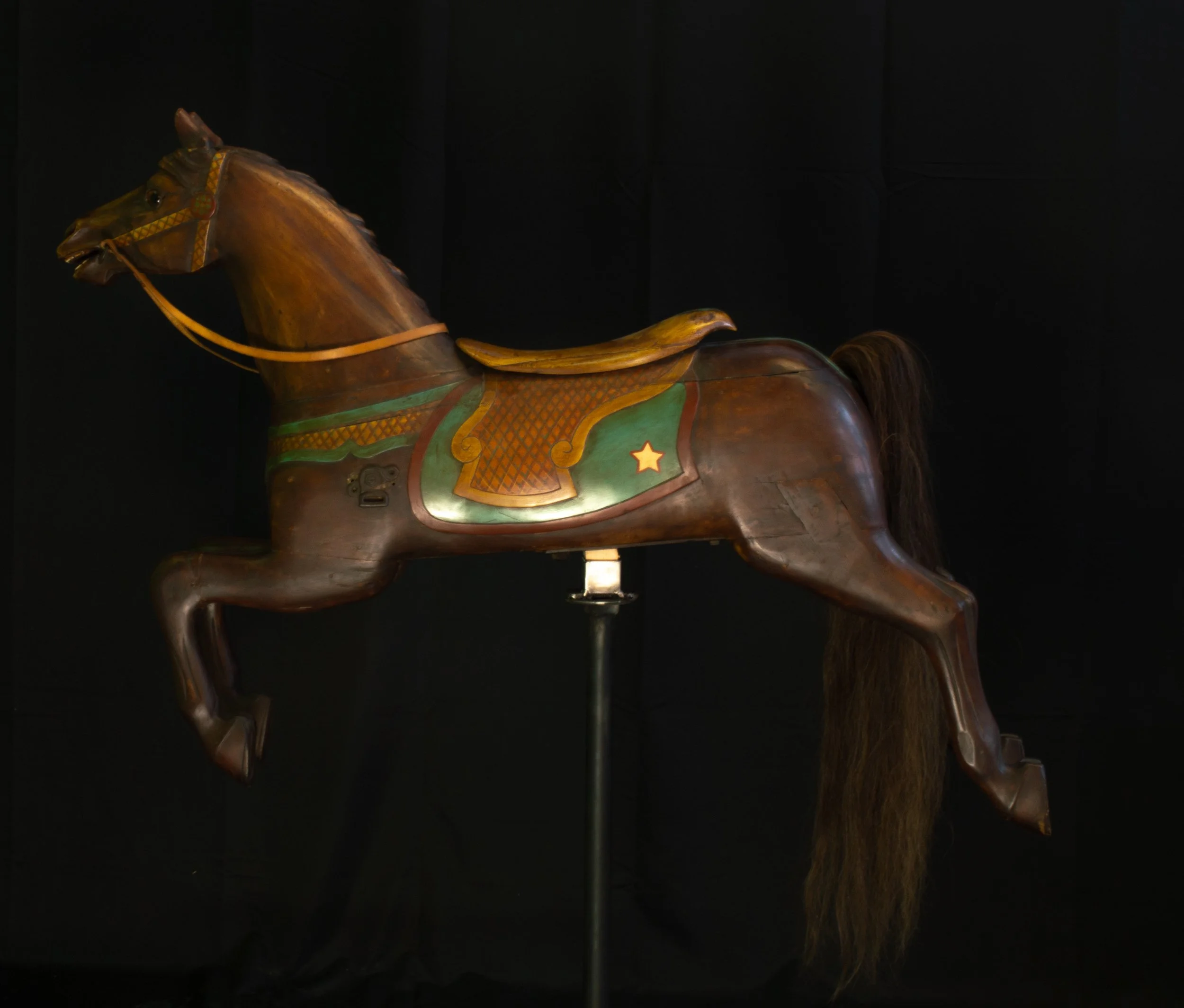
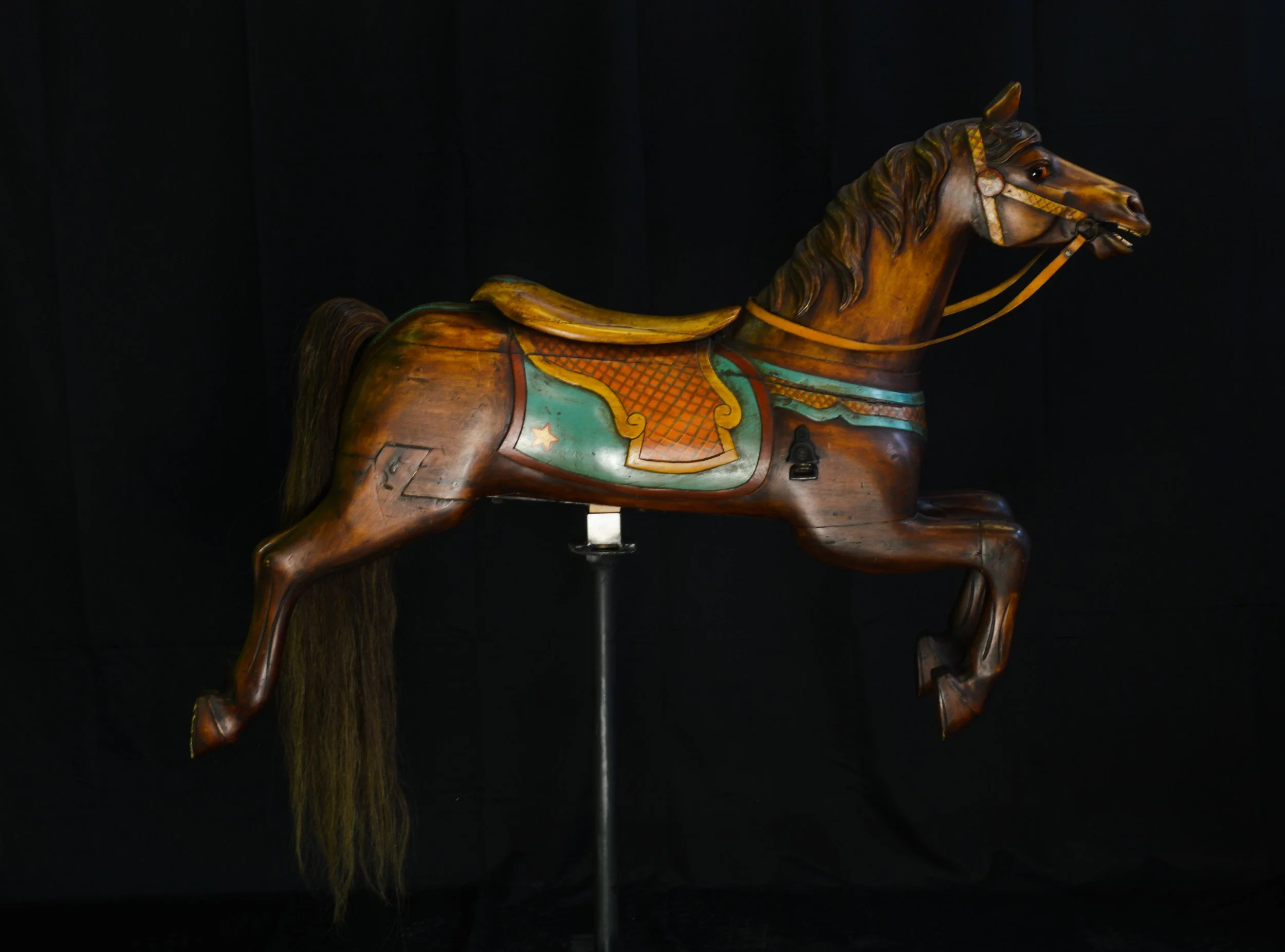
A carved wooden carousel jumper attributed by the owner to the Armitage-Herschell Company of North Tonawanda, New York, dated circa 1900 (reported). The owner calls the piece "Dark Horse" — an apt description: the figure is finished in a deep chestnut stain that leaves the wood grain visible throughout the body, a deliberate workshop practice confirmed by independent sources as characteristic of Armitage-Herschell production (reported; sourced). The figure is in a full airborne jumper pose with all four legs extended. Both sides carry a floating saddle in teal-green field with an orange-amber diamond-pattern seat, a swept gold cantleboard with wing-carved terminals, and a five-pointed star on each saddle panel — the floating saddle itself a recognized identifying feature of this maker (reported; sourced). Mane and tail are real horsehair. The owner describes the piece as "a perfect example" of the company's workmanship (reported).
-
Acquired in 1988 from the Walt and Mary Lawrence Youree Collection of Oregon (reported; Youree Collection independently confirmed as a significant documented private collection, active 1970s–2000s). Purchase price $4,000 (reported). The restoration is attributed by the owner to a figure identified phonetically as "Meredivine Story" (reported; name not independently confirmed in specialist sources — follow-up needed).
-
From the Walt and Mary Lawrence Youree Collection, Oregon (reported; collection independently sourced). This is the second piece in the current collection confirmed as Youree provenance, alongside ID: 002. Prior history before Youree ownership is unknown. Machine of origin has not been documented. The owner notes that the company's horses "traveled from location to location" (reported), consistent with Armitage-Herschell's county fair and traveling operation model — individual machine provenance is rarely traceable for this maker's figures.
-
The Armitage-Herschell Company was established in North Tonawanda, New York in 1872 by James Armitage and Allan Herschell, initially as an iron foundry, expanding into hand-carved wooden carousels by 1883. The company went bankrupt shortly after 1900, with its successor companies continuing under different names. The owner accurately traces the full lineage: Armitage-Herschell → Allan Herschell Company → Herschell-Spillman → Spillman Engineering — noting that each company iteration produced distinctly different animals (reported; lineage confirmed sourced). This figure, at circa 1900, represents the final years of the Armitage-Herschell name and the earliest phase of the broader North Tonawanda tradition.
Two physical features the owner identifies as maker markers are independently confirmed. The floating saddle — a saddle that sits proud of the body surface rather than flush-carved — is documented as a characteristic Armitage-Herschell design feature (reported; sourced). The notch in the rear leg, which the owner identifies as the company's distinctive leg attachment method and "a big identifier" (reported), is consistent with the hollow-body construction used by Armitage-Herschell, in which legs were attached at jointed seams rather than carved solid from the body block. The deep stained finish exposing the wood grain is also a confirmed workshop practice (sourced).
Armitage-Herschell figures produced before the company's 1901 reorganization are among the earliest documented American carousel horses. They are infrequently encountered on the private market; examples with intact original stain, hardware, and horsehair survive in smaller numbers than figures from the subsequent larger-output successor companies. No auction comparable for an Armitage-Herschell jumper of equivalent condition and character was located in this research.
-
All photographs show a figure with a deep, even chestnut surface with visible wood grain throughout — consistent with the original stained finish rather than an overpainting. Some surface variation and darkening at the joints and extremities suggests age and use. The floating saddle paint appears sound; teal, amber, and gold tones are visible with minor wear. The horsehair mane and tail are present and intact. A rectangular hardware fitting is visible on the underside in photographs — consistent with the pole-mount mechanism — and a metal bracket appears on the belly area; neither has been examined for originality. Formal condition rating pending direct examination.
-
Attribution to Armitage-Herschell is reported by the owner and supported by two independently confirmed maker features — the floating saddle and the stained-wood finish. The Youree Collection provenance is independently documented. Production date of circa 1900 is consistent with the company's active window. Machine of origin and carver are unknown; the restorer name as reported has not been independently confirmed.
-
Owner interview (two recordings; transcribed)
Three photographs analyzed: romance side full figure (Image 1); non-romance side full figure (Image 2); non-romance side with scale reference (Image 3)
CarouselHistory.com — Walt and Mary Lawrence Youree Carousel Collection documented; Walt Youree (1915–2001) memorialized as early major collector (sourced)
AntiqueCarousels.com — Armitage-Herschell figures, floating saddle as documented maker feature (sourced)
VintageCarousels.com — Armitage-Herschell company history and North Tonawanda lineage (sourced)
No Armitage-Herschell jumper auction comparable located in research.