
Dentzel - Cat
Catalog #058 175×135×30cm
-
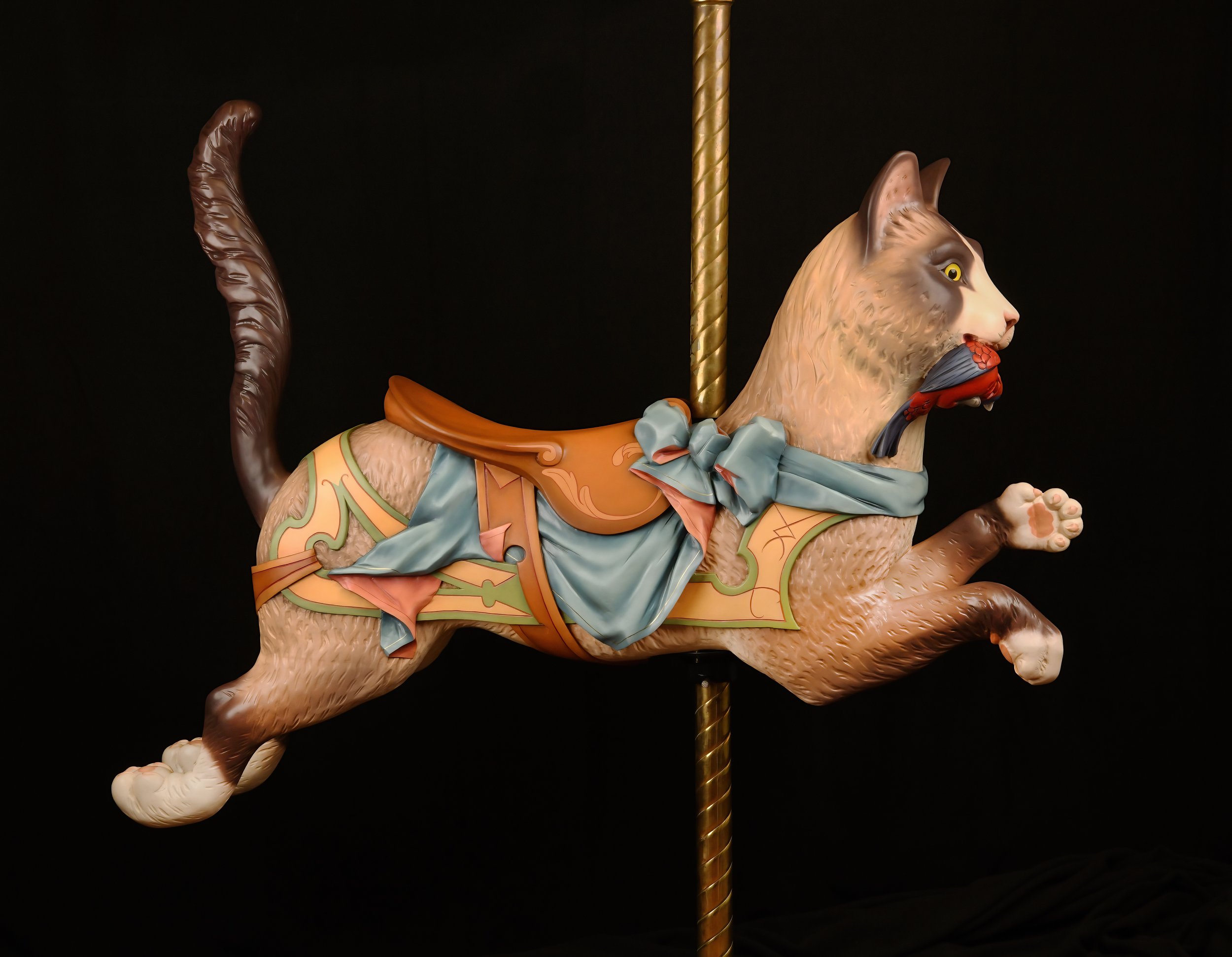
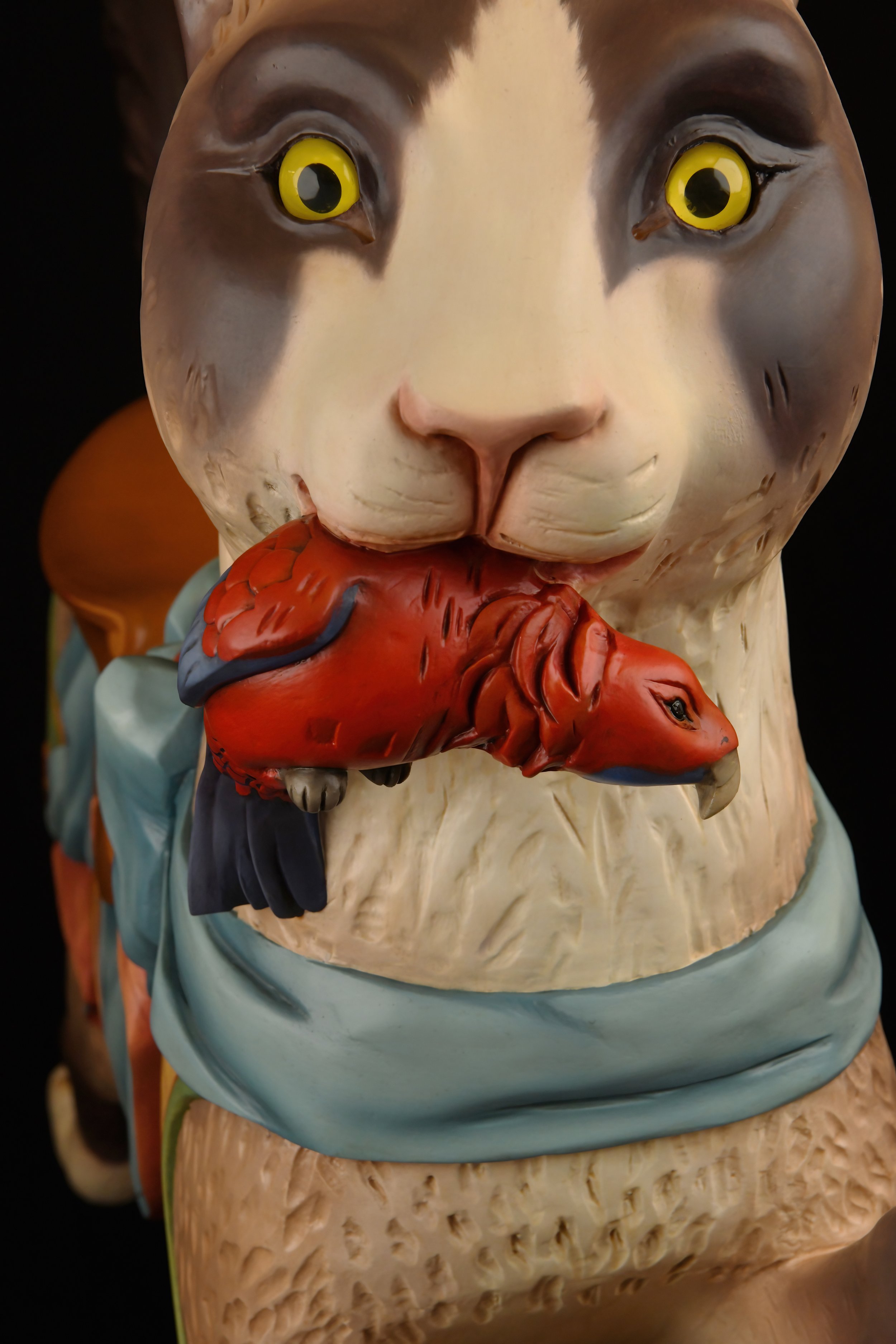
A leaping Dentzel cat in full horizontal extension, mounted through the center on a twisted brass pole. The body — warm tan with dark brown markings on the ears, tail, and paws — has been painted to evoke Norwegian Forest Cat and Ragdoll Cat coloration in a post-acquisition restoration by Pamela Hessey (reported). Gripped in the figure's jaws is an elaborately carved parrot rendered as an Eastern Rosella (reported), its red body and blue-gray wings visible in both photographs. The romance-side trappings include a brown leather-style saddle, a cream blanket panel with orange border and green scroll vine decoration, and a draped blue-gray silk sash tied in a prominent bow at the neck — an element documented across the Dentzel cat type as a Cernigliaro stylistic signature (sourced).
-
The owner acquired this figure from a private seller identified as "Rusty" (reported), noting that the purchase occurred in the same transaction as the collection's hippocampus. The Tuttle Collection is cited as the provenance source (reported). Two interview sessions recorded different purchase prices: $22,000 — cited in direct connection with the Tuttle Collection — and $24,000, stated without specific provenance reference. The $22,000 figure appears in the more specific and contextualized statement; the discrepancy has not been resolved and may reflect restoration costs, associated expenses, or memory variance between sessions.
-
The Tuttle Collection is cited as the immediate prior source (reported). Research identifies "Gray Tuttle" as a documented private carousel collector whose figures have entered the specialist market through dealers including AntiqueCarousels.com (sourced); multiple figures listed on that platform note Gray Tuttle as their source of purchase. No independent documentary evidence confirming this specific figure's Tuttle Collection membership has been located. The seller "Rusty" has not been independently identified.
-
The G.A. Dentzel Carousel Company operated in Germantown, Philadelphia, from approximately 1867 until its acquisition by the Philadelphia Toboggan Company in 1928–1929 (sourced). From 1903, the company's chief carver was Salvatore Cernigliaro — known in the field as "Cherni" — who is documented as the carver responsible for introducing the domestic cat figure to the Dentzel menagerie (sourced — VintageCarousels.com, AntiqueCarousels.com). Cernigliaro established the decorative vocabulary that defines the type: elaborately draped fabric, a distinctive bow carving at the neck, and prey held in the figure's jaws. AntiqueCarousels.com identifies the neck bow as a "Trademark 'Cherni' carved bow" (sourced). The blue-gray sash with its prominent bow, clearly visible in the photographs, is consistent with this documented signature across the figure type.
The Dentzel cat's prey-in-mouth convention is confirmed across all known examples: fish, bird, turtle, and bullfrog catches have been documented (sourced — AntiqueCarousels.com; owner interview). This figure's carved parrot represents a more elaborate secondary figure than the most commonly encountered prey type. The owner's observation — "all Dentzel cats had a creature in their mouth" (reported) — is directly corroborated by independent sources (sourced).
On surviving operating machines, cats appear in limited numbers relative to dominant quadruped figures. The Dentzel machine at Burlington, NC carries four cat figures alongside single examples of its larger exotic animal types (sourced). On the private resale market, the type is described as "a rare find" by AntiqueCarousels.com (sourced). Documented market comparables include a c. 1905 Dentzel cat with fish catch, sold through AntiqueCarousels.com at $27,000, and a c. 1920 example with bullfrog catch sold at $18,500 (sourced — AntiqueCarousels.com). The collection's acquisition price falls within this documented range.
-
Professionally restored by Pamela Hessey of Hawk's Eye Studio, Kingman, AZ (reported). Hessey is listed as a specialist carousel restoration artist on AntiqueCarousels.com, recognized in the same professional lineage as Lise Liepman — both documented as protégées of carousel preservation pioneer Nina Fraley (sourced). The paint scheme was designed to evoke Norwegian Forest Cat and Ragdoll Cat coloration at the owner's direction (reported); this is a stylistic restoration choice, not a recovery of original or factory paint. No original paint is known to survive. Photographs confirm vibrant, well-preserved paint throughout, with carved detail intact in the facial musculature, fur texture across the chest and body, and the secondary bird figure. Glass eyes appear bright and undamaged (inferred from photographs). Condition: Excellent (post-restoration).
-
The Dentzel attribution is well-supported by figure type, carving vocabulary, prey-in-mouth convention, and trappings style, all consistent with documented factory practice. Cernigliaro carver attribution is strongly indicated by the trademark bow and the documented history of his introducing this figure type, but has not been independently confirmed for this specific example. Tuttle Collection provenance is owner-reported and plausibly corroborated by Gray Tuttle's documented status as a carousel collector, but no transaction record has been located.
-
Owner interview recordings (two sessions, file #058). Photographs (Images 1–2: romance side and head detail).
AntiqueCarousels.com (Cernigliaro context, market comparables, Hessey listing, Tuttle documentation).
VintageCarousels.com (Cernigliaro production history). Burlington, NC carousel documentation (cat survival count). Americana Insights / AntiqueCarousels.com
Tribute to Nina Fraley (Hessey professional lineage).