
Unknown - Hippocampus
Catalog #055 TBD
-
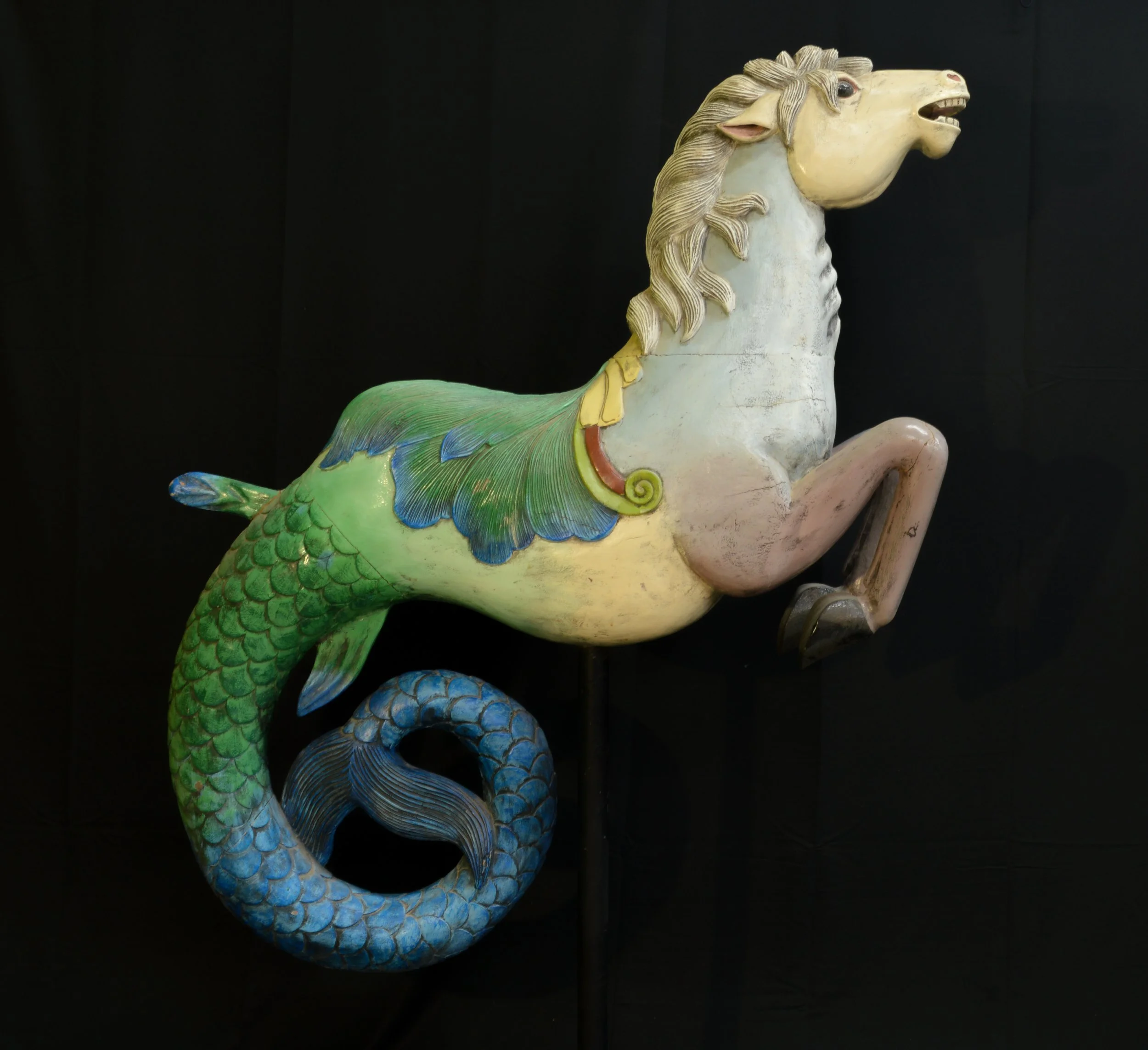
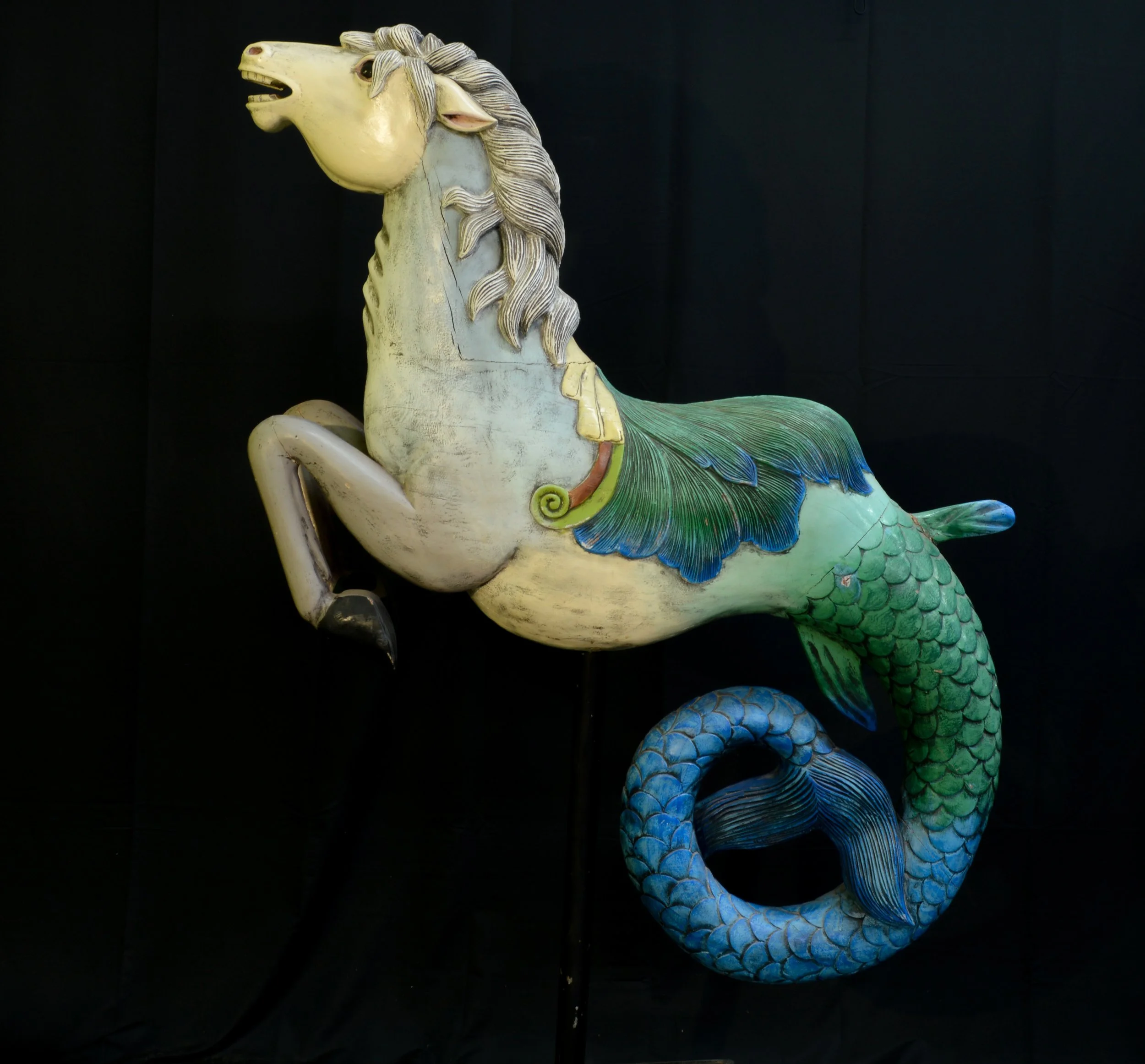
A large carved and polychrome-painted wood hippocampus in a rearing pose, of Southeast Asian workshop origin, date unknown. The horse forepart rears with both forelegs bent at the knee; the body transitions to a coiling fish tail at a decorative collar with a carved volute, rendered in yellow, red, and lime-green. The carving is accomplished and fully bilateral — both sides receive equal detail across the dorsal fin, body scales, and tail coil. The paint palette runs from cream and pale blue-white on the horse portion through green on the upper scales to vivid blue on the coiling lower tail. The owner confirmed at time of acquisition that the piece is not a Western antique carousel figure and is of Southeast Asian origin (reported).
-
Purchased approximately 1995–1996 (reported), within a year or two of the owner acquiring a beach house in 1994. The purchase was made from a restaurant in a small town near Medford, Oregon (reported). At time of acquisition, the owner knew the piece was not a Western carousel antique and understood it to be Southeast Asian in origin (reported). The figure was displayed in the entry of the beach house for approximately 26 years (reported). Price paid not recorded. The owner notes the figure requires two people to move and suspects teak or a comparable dense hardwood as the material (reported).
-
The Medford-area restaurant is the only documented prior location. No workshop, country of origin within Southeast Asia, or earlier ownership history has been established.
-
This piece belongs to the tradition of Southeast Asian decorative wood carving, in which accomplished workshop carvers — particularly in Bali, Thailand, and neighboring regions — produced large-scale polychrome-painted figures for the export and restaurant interior trade from the late twentieth century onward. Teak and similar dense tropical hardwoods are characteristic materials of this tradition, consistent with the figure's reported extreme weight. The hippocampus form translates readily into Southeast Asian carving practice, which has a long engagement with composite mythological creatures — the Makara, a Hindu-Buddhist sea-creature combining horse-like and fish-like features, is a regional analogue that would have made the subject familiar to a trained carver in this tradition. The quality of carving on this piece — particularly the bilateral fin and scale detail, the volute collar, and the articulation of the tail coil — places it well above commercial souvenir production.
As a Southeast Asian decorative object this piece occupies a separate market and valuation framework from American Golden Age carousel figures. Comparable large-scale carved and polychrome-painted teak figures from this tradition appear on the decorator market and at regional auction; pricing varies widely by size, quality, and subject.
-
No formal assessment on record. Photographs show the figure in good overall condition: paint vivid and largely intact, carved detail crisp throughout fin, scale, and tail sections, no breaks or structural losses visible. Surface scuffing and minor crazing on the belly and lower chest are consistent with long-term display. Glass eyes intact in all views. Given the reported material density, structural integrity appears robust. No post-acquisition restoration recorded.
-
Low — though for different reasons than most Low-rated entries. Maker, workshop, and specific country of origin are all unestablished. The owner's Southeast Asian attribution is accepted as stated (reported) and is consistent with the figure's carving character and material weight, but has not been independently verified. The piece cannot be assigned to a specific workshop tradition without specialist examination.
-
Owner interview (Southeast Asian attribution; Medford, Oregon restaurant acquisition ca. 1995–1997; extreme weight; teak or similar wood; 26-year beach house display; confirmed not a Western antique carousel piece)
Four photographs (DSC_2664, DSC_2666, DSC_2668, DSC_2663): romance side, romance side with measuring rod, non-romance side, romance side with ID board
CarouselHistory.com (hippocampus carousel figure history; American Golden Age makers)
Mystic Seaport Museum (Dentzel hippocampus, 1895)
Amusement Today (E. Joy Morris hippocampus auction results, 1989)
1stDibs (Southeast Asian decorative teak carving market context)