
Carmel - Chariot End Piece
Catalog #048 115×77×23cm
-
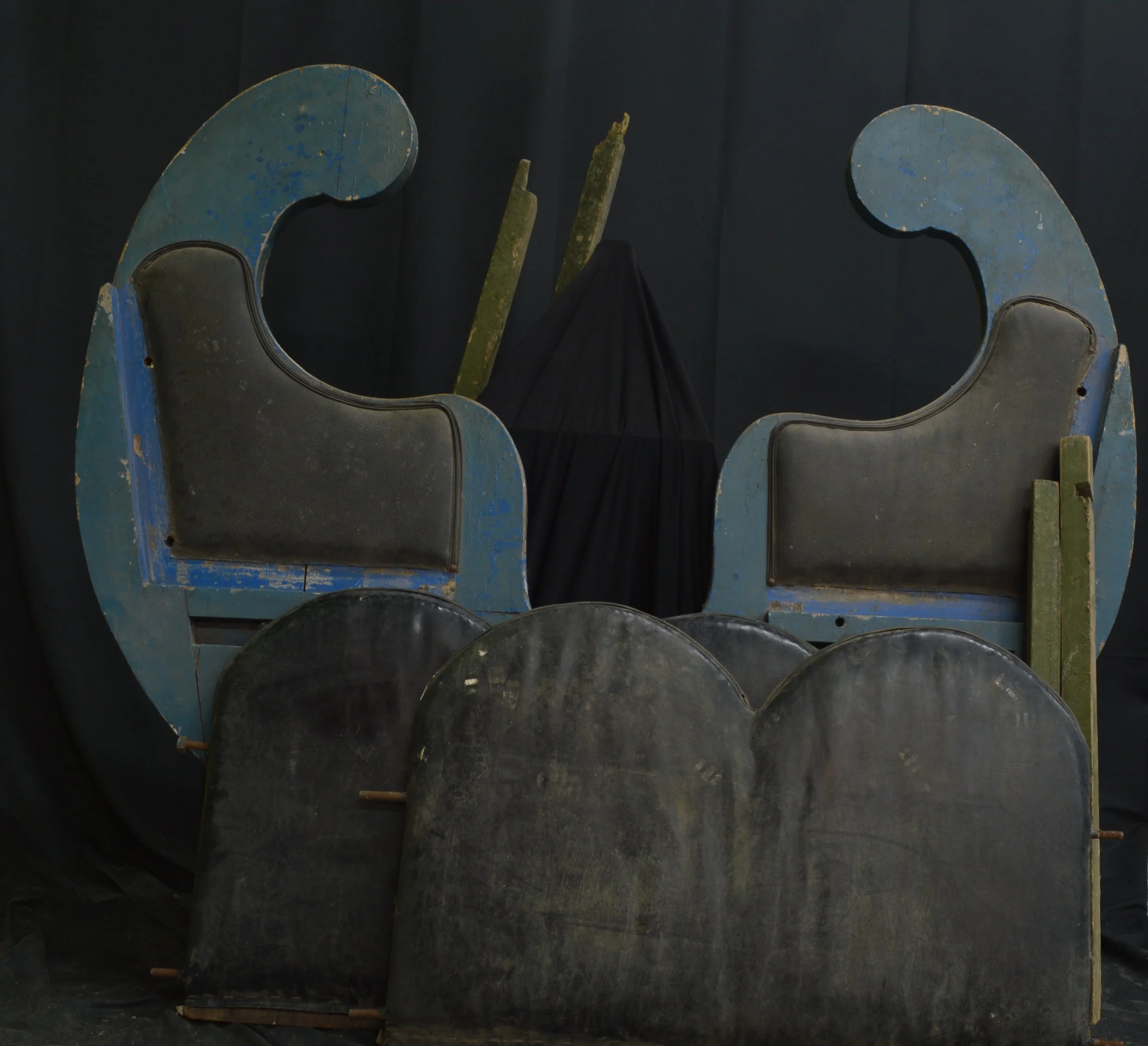
A disassembled two-sided carousel chariot attributed to carver Charles Carmel with frame and jeweling by M. D. Borelli, ca. 1905–1920, presented here as components rather than as a reassembled whole. The photograph (DSC_2633) shows the two matching end panels and three upholstered seat cushions. Each end panel is painted blue in a bold Coney Island-style scroll profile — a large volute sweeping outward at the top — with a charcoal-upholstered seat back inset. Three black seat cushions rest disassembled in the foreground. Green-painted structural support bars, visible between the panels, are the connecting members that span the two sides. The paint surface shows significant crazing, layering, and bare-wood exposure consistent with heavy age and working life. The front panel — the most elaborately decorated element, expected to carry the principal Carmel carving and Borelli jeweling — is not shown here; the owner reports it is separately mounted on a hall wall (reported). The owner is clear that all components needed to reassemble the chariot are present (reported).
-
No acquisition context was captured in the interview. Source, date, and price paid are pending a dedicated follow-up session.
-
Unknown. The carousel of origin has not been established. No park or operator history is on record.
-
Charles Carmel, born in Russia in 1865, was trained as a carver before arriving in America in 1883. He initially worked alongside Marcus Charles Illions at Charles Looff's Coney Island shop. Showmen's Museum In 1905, Carmel left Stein and Goldstein and opened his own carving facility at 202 Ocean Parkway in Brooklyn, selling his figures to carousel frame manufacturers including William Mangels, Stein and Goldstein, Frederick Dolle, M. D. Borelli, the Murphy brothers, and the Philadelphia Toboggan Company. Find a Grave He is considered possibly the most prolific of the known carvers from the era, having carved for nearly every early-twentieth-century carousel manufacturer at one time or another. Antiquecarousels
The relationship between Carmel's carving and Borelli's platform work is well established in specialist documentation. M. D. Borelli was an Italian immigrant who manufactured carousel machinery and frames during the period Carmel was creating his figures. It is thought that the jewels may have been added by platform manufacturers such as Borelli, since Carmel did not like jewels and used them very sparingly. Vintagecarousels The owner's description of the chariot as "jeweled by Borelli" is therefore consistent with the documented division of labor between carver and frame maker (reported, consistent with sourced records). The designation "Carmel/Borelli" is used by specialist institutions including The Carousel Museum in Bristol, Connecticut, which holds a Carmel/Borelli chariot in its permanent collection (sourced, thecarouselmuseum.org), and by AntiqueCarousels.com, which categorizes Carmel-Borelli jeweled figures as a distinct production type (sourced).
The heavily jeweled Borelli carousel that appeared at the 1962 Seattle World's Fair was a mix of Carmel, Looff, and Illions figures; it was sold at a record-breaking auction in 1988. Carouselhistory At that Guernsey's sale in New York City, two Carmel/Borelli chariots from the Fun Forest carousel sold to the same bidder for $11,000 each; a chariot from a separate Carmel carousel at the Maple Leaf Village in Ontario brought $3,850. Carouselhistory These remain among the most directly comparable public auction records for this chariot type. In the current dealer market, Carmel-Borelli figures are listed on AntiqueCarousels.com in a range from approximately $4,500 for smaller inner-row jumpers to $27,500 for outside-row standers (sourced, 2026).
Coney Island-style chariots of this carver-frame manufacturer pairing are infrequently encountered on the private market. Most surviving Carmel chariots remain on their original operating machines; the Prospect Park carousel in Brooklyn and the Rye Playland carousel in Rye, New York both retain Carmel-carved chariots in situ (sourced). Free-standing examples with documented provenance are comparatively rare, and complete chariots with original jeweling and paint intact are rarer still.
-
Pending full assessment. The side panels show extensive paint wear: heavy crazing, paint loss, and bare-wood exposure across both pieces are clearly visible in photographs. The blue paint surface appears to be an accumulated working paint rather than an untouched original layer, though the number of coats or the presence of original paint beneath cannot be determined from photographs alone. The upholstered seat backs and seat cushions show heavy use and surface soiling consistent with decades of operating history. Whether the upholstery is original or a later replacement requires examination. The front panel — the key decorative element — has not been assessed; its condition and the integrity of any remaining jeweling are unknown pending direct examination.
Note: The chariot is currently disassembled. The front panel is displayed separately; the side panels and cushions are stored. A complete condition assessment requires bringing all components together and examining the front panel.
-
Medium-High. The owner directly and confidently attributes both the carver (Carmel) and the frame manufacturer/jeweler (Borelli), and this pairing is well documented in specialist literature and institutional records. What prevents a High rating: the front panel — the element that would most clearly confirm Carmel's carving style and the Borelli jeweling — has not been photographed or independently examined. A complete assessment requires the full chariot assembled or at least the front panel documented.
-
Owner interview (attribution of both carver and frame manufacturer; confirmation that all chariot components are present; identification of front panel location)
One photograph (DSC_2633): both side panels with cushions; structural support bars visible
VintageCarousels.com (carver and manufacturer biography; Carmel/Borelli jeweling practice)
Find a Grave (Charles Carmel biographical record)
The Jewish Museum, New York (Carmel biography and carving context)
AntiqueCarousels.com (Carmel manufacturer page; Carmel-Borelli figure listings and pricing)
CarouselHistory.com (Guernsey's December 1988 auction records; Fun Forest carousel documentation)
The Carousel Museum, Bristol, CT (Carmel/Borelli chariot in permanent collection)