
Looff - Dog
Catalog #057 51×25×14cm
-
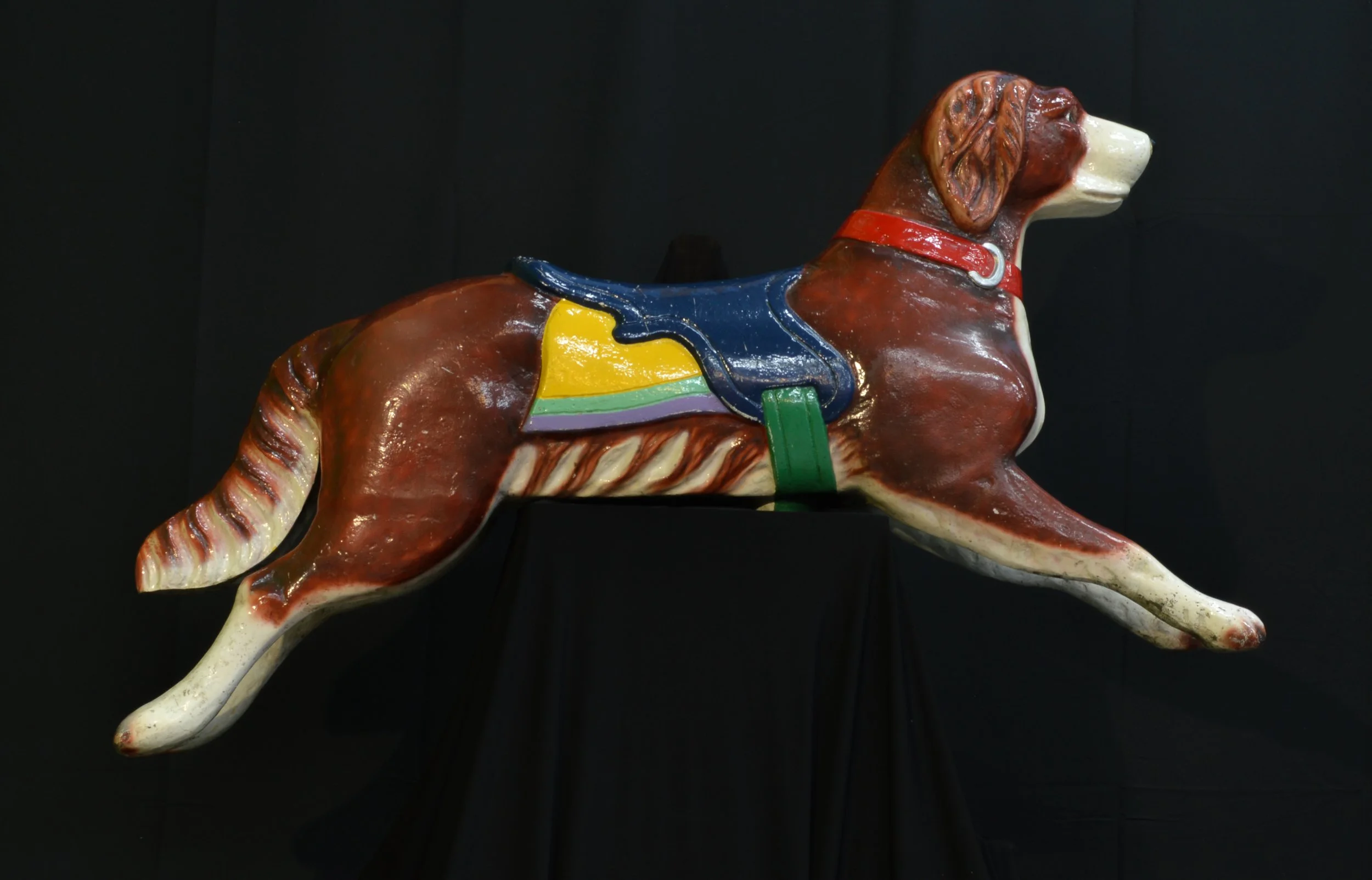
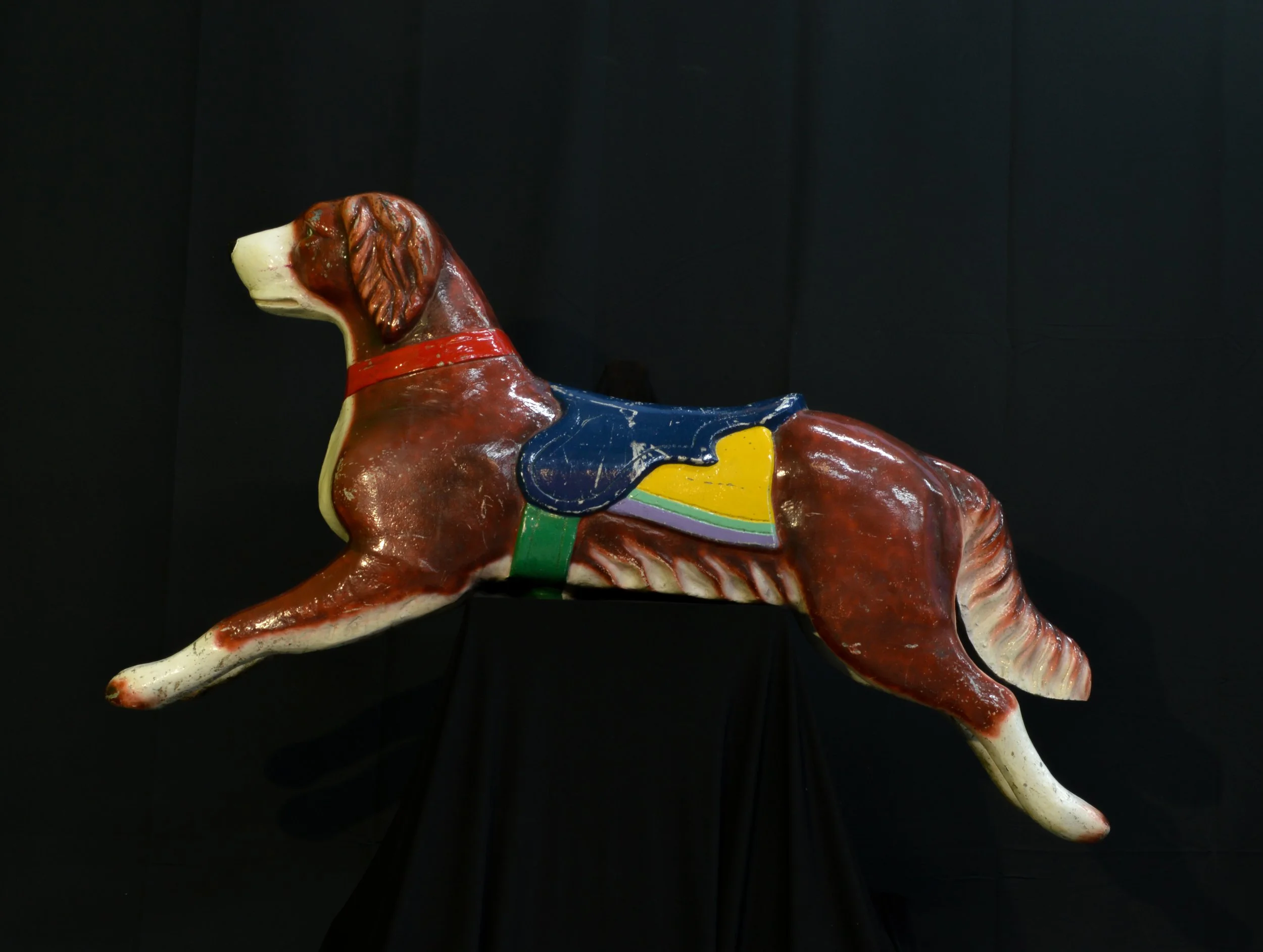
A carousel dog figure in a full running gallop pose — all four legs extended, body horizontal — in a breed consistent with an Irish Setter or related spaniel type. The body is a rich reddish-brown throughout with white legs and paws, white muzzle and chest, and long drooping ears in darker brown with individually rendered strand detail. The head faces slightly forward and upward with an alert expression. A bold red collar at the neck carries a small white ring or clasp. The saddle is a three-layer arrangement: navy blue main field, yellow/gold accent panel visible toward the rear, and a lavender lower layer — an unusual color combination. A green pole sleeve or girth strap passes through the mid-body. The long feathered tail trails behind naturally. The figure is mounted on a presentation stand with a black base visible in Images 1 and 3.
The surface is the critical observation: smooth, glossy, and uniform throughout, with no visible wood grain, construction seams, or carving tool marks anywhere on the body, legs, or head. This surface profile is not consistent with hand-carved and assembled wood. The owner states directly: "it is metal" (reported). The surface appearance and construction are consistent with cast aluminum, which became the dominant material for American commercial carousel production beginning in the late 1920s. The measuring rod in Image 2 indicates approximately 18–22 inches at body height — smaller than a full park-scale figure, consistent with an inner row or smaller-platform machine.
Images 1–3 show the romance side (facing right). Image 4 shows the non-romance side (facing left), which carries equivalent decoration — a bilateral finish consistent with a traveling fairground machine.
-
Acquired at Morphy Auctions, Denver, Pennsylvania (reported). Year and price paid are not recorded in the interview.
-
Unknown. No carousel of origin, prior collection, or intermediate dealer history has been documented.
-
The hippocampus is among the rarest figure types in the documented Western carousel tradition. American Golden Age carvers produced very few mythological figures; the hippocampus — a horse head and torso with a scaled fish lower body — was produced by a handful of makers in the very early 1900s. A Dentzel-carved hippocampus dated to 1895 is held in the collection of Mystic Seaport Museum; two E. Joy Morris hippocampuses from the carousel at Quassy Amusement Park sold at the 1989 auction for $20,000 and $15,000 respectively (sourced, Amusement Today). This collection holds a separate PTC-attributed hippocampus documented elsewhere in the catalog; that piece represents the Western carousel tradition. The present figure does not.
This piece instead belongs to the tradition of Southeast Asian decorative wood carving, in which highly skilled carvers — particularly in Bali (Indonesia), Thailand, and neighboring regions — produced large-scale figurative pieces for the export and restaurant interior market from the late twentieth century onward. Teak and similar dense hardwoods are characteristic materials of Southeast Asian sculptural work, consistent with the owner's weight observation and material suspicion. The hippocampus form, while rooted in Greek and Phoenician mythology, translates readily into Southeast Asian carving traditions that frequently engage with composite creature imagery (cf. the Makara, a mythological sea-creature with horse-like and fish-like features in Hindu-Buddhist iconography). The quality of carving and painting on this piece is high — not commercial souvenir production, but accomplished workshop craft.
As a Southeast Asian decorative object of this type, the piece occupies a separate market and valuation framework from Western carousel figures. Comparable large-scale Southeast Asian carved and polychrome-painted figures in teak are encountered on the decorator market and at regional auction; pricing varies widely by size, quality, and subject.
-
Pending formal assessment. Photographs show the figure in good overall presentable condition. The painted surface appears intact with no obvious major losses, chips, or repairs visible. The saddle colors are vivid and relatively well-preserved. Some minor surface scratching is visible in Image 4 at the saddle area. The green pole element appears intact. No structural issues are visible.
-
Low. The owner's Looff attribution is reported but presents a documented material contradiction: Looff produced carved wood figures, and this figure is confirmed metal. The attribution may reflect the figure's stylistic connection to Looff-school dog carving, a presentation at auction, or a later casting derived from a Looff original. The relationship between the reported attribution and the figure's actual production context cannot be resolved from photographs and interview alone.
-
Owner interview (Looff attribution; confirmed metal material; Morphy Auctions acquisition)
Four photographs (DSC_2677, DSC_2678, DSC_2679, DSC_2680): romance side with ID board, romance side with measuring rod, romance side, non-romance side
VintageCarousels.com (Looff carvers and manufacturers history; cast aluminum production timeline)
Heritage Museums & Gardens (Looff biography and production characteristics)
CarouselHistory.com (Slater Park Looff carousel documentation; Whalom Looff menagerie dispersal with greyhound figures)
Proxibid (carved wood Herschell-Spillman leaping dog, comparable figure, estimate $1,000–$2,000)