
Unknown - French Poodle
Catalog #038 74×67×21cm
-
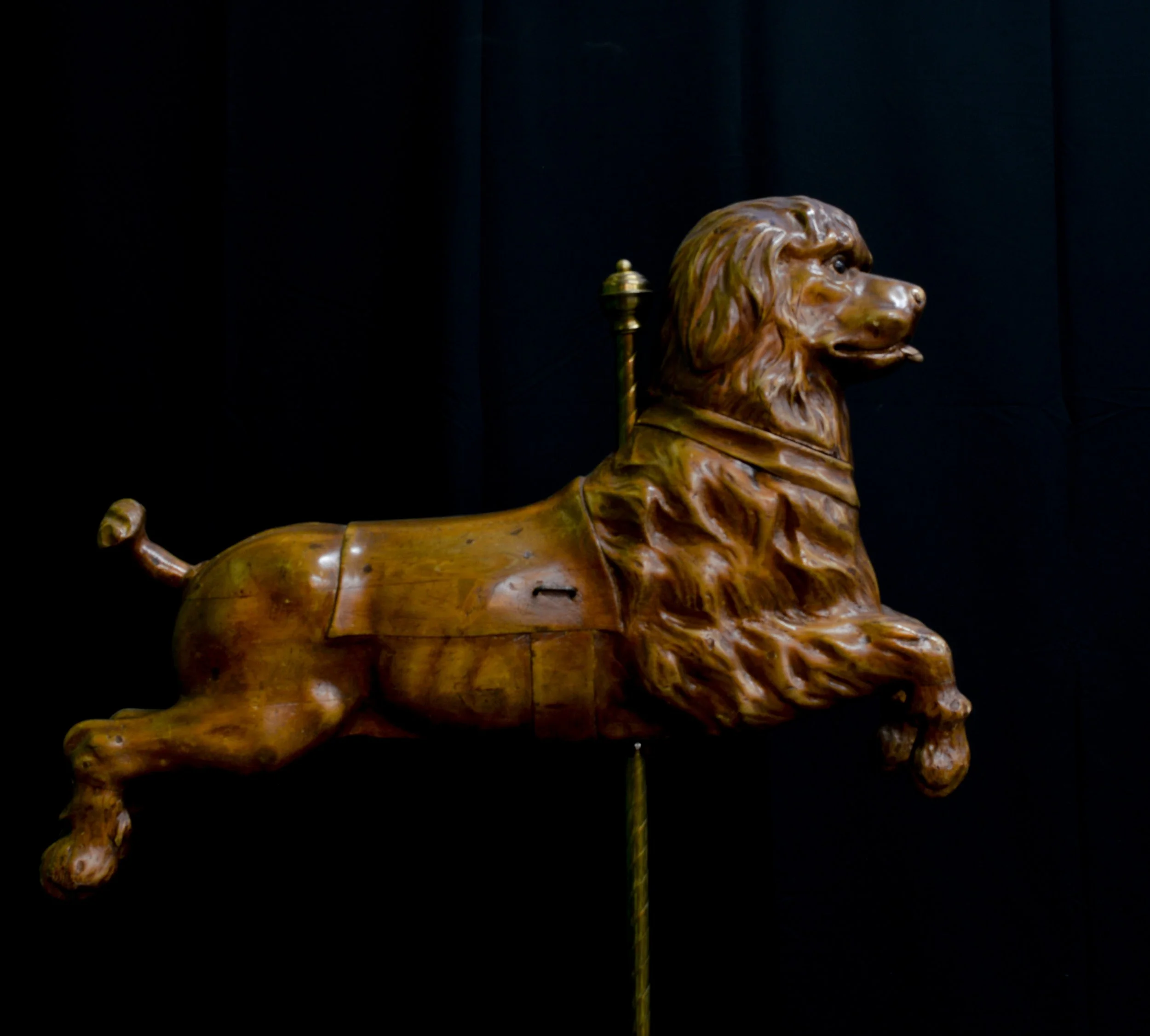
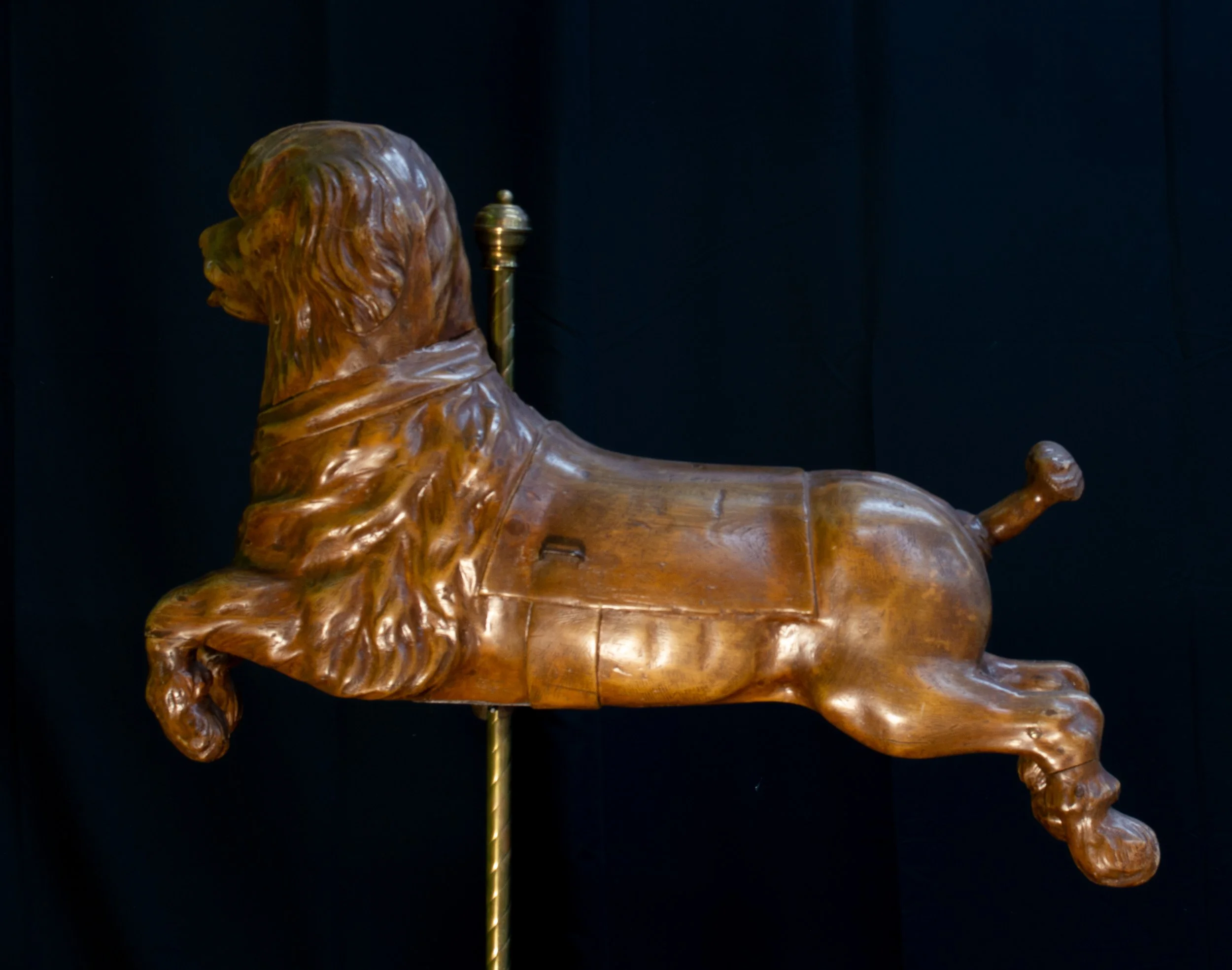
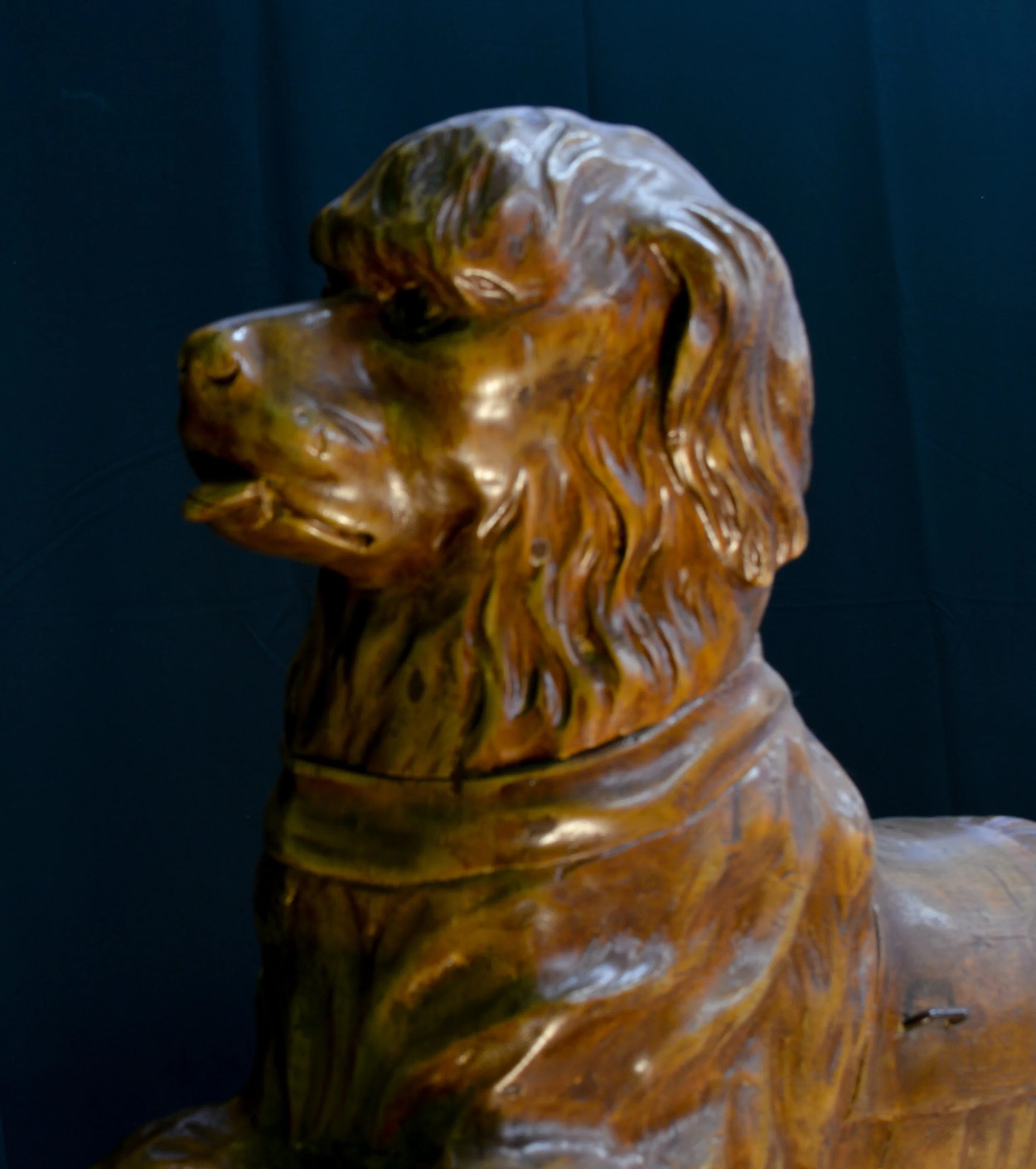
A carved wooden poodle in a full leaping pose, attributed to a French children's carousel (reported). The figure is carved with deeply rendered, flowing fur around the chest, neck, and ears, a plain collar at the neck, and a short curled poodle tail. The head is alert and slightly open-mouthed with glass or painted inset eyes. No saddle or trappings are present, consistent with the owner's identification as a children's carousel figure (reported). The figure is mounted on a brass twist pole with a decorative finial. The owner describes this as "the poodle" and considers it a relatively recent acquisition (reported).
-
Acquired from the estate of John and Ann Engelhart of Sedona, Arizona (reported). The owner references a photo in what appears to be a catalog or reference publication — transcribed as "social art, number three, at page 27" — which likely served as documentation accompanying the purchase (reported). The specific publication has not been identified.
-
The provenance trail begins and ends with the Engelhart estate. No independent records of a John and Ann Engelhart carousel collection in Sedona, Arizona, were located through auction databases, specialist carousel sites, or collector archives (sourced). Whether the Engelharts were collectors of carousel figures specifically, or whether this piece was part of a broader decorative arts collection, is unknown. The reference publication mentioned by the owner could establish a longer provenance chain if identified.
-
Dogs appear as a recognized menagerie figure type across both American and Continental European carousel traditions. Among American manufacturers, one major North Tonawanda producer included dogs regularly on menagerie machines — surviving examples from that workshop can be found at institutions including the Henry Ford Museum's Greenfield Village, where a 1913 menagerie carousel includes dogs among its hand-carved animals (sourced). Multiple operating American carousels in California retain original dogs from the same manufacturer (sourced).
This figure, however, does not share the physical characteristics of known American carousel dogs. The deliberate breed-specific carving — the elaborately rendered flowing poodle fur, the curled tail, the specific ear treatment — is more consistent with Continental European carousel work, where specific breed representation was a more common practice. French carousel workshops, including those active from the late nineteenth century through the mid-twentieth century, produced dog figures for children's rides and fairground carousels (sourced). A carved and painted Fox Terrier from a French fairground carousel, dated to approximately the 1950s, has been documented through dealer records (sourced). A "scarce European antique hand carved and painted primitive French menagerie carousel dog" has also appeared in dealer inventory (sourced).
Dogs of any type are uncommon on the private market relative to more frequently traded menagerie forms. A carved wood leaping dog from a circa-1900 American portable menagerie carousel was estimated at $1,000–$2,000 at auction (sourced). A similar American menagerie dog listed through a specialist dealer was priced at $4,000, though that example had been modified with decorative artwork (sourced). European children's carousel figures generally trade at lower price points than full-size American menagerie counterparts, and the $2,500 paid for this figure falls within the expected range for a children's carousel dog of European origin.
The figure's construction — laminated block body with visible seams, rectangular keyhole slot on the romance side, hollow or partially hollow build — is consistent with standard carousel figure fabrication practices across traditions. The surface finish appears to be a stain or aged varnish rather than polychrome park paint, suggesting either a stripped and refinished surface or an original treatment. The comparable bilateral carving depth, with the non-romance side receiving comparable fur detail to the romance side, is noteworthy and somewhat unusual.
-
The figure appears structurally sound. The carved fur detail is intact throughout, with no obvious losses, breaks, or repairs visible in the photographs. The surface finish is a warm amber-brown, consistent with either aged varnish or stain; no evidence of polychrome paint layers beneath. Minor surface wear and patina are visible, particularly on the body barrel. The glass or painted eyes appear intact. The brass twist pole and finial appear to be period-appropriate. The whiteboard notation reads #038, dated 10/13/25. A formal condition assessment is pending.
-
Low–Medium. The owner's "French" attribution is plausible based on physical characteristics — the breed-specific carving, the scale, and the absence of trappings are all consistent with a European children's carousel figure rather than an American menagerie form. However, no maker identification or documentary evidence supports a specific workshop attribution. The provenance begins at the Engelhart estate and cannot be traced further at this time.
-
Owner interview recording (transcribed), providing acquisition context, price, attribution, and estate provenance
Four photographs (DSC_2523, DSC_2524, DSC_2527, DSC_2529): romance side, romance side close-up, non-romance side, and head detail
The Henry Ford Museum digital collections: Herschell-Spillman menagerie carousel documentation
VintageCarousels.com: California carousel census data documenting surviving menagerie dogs on operating machines
AntiqueCarousels.com: dealer listing for Herschell-Spillman dog ($4,000, sold) and menagerie carousel inventory records
Proxibid / Donley Auctions: Herschell-Spillman dog estimate ($1,000–$2,000)
1stDibs dealer listings: French menagerie carousel dog and French Fox Terrier carousel ride (c.1950s)
S16 Home dealer listing: French hand-carved dog carousel ride, c.1950