
Dentzel - Pig
Catalog #018 155×125×20cm
-
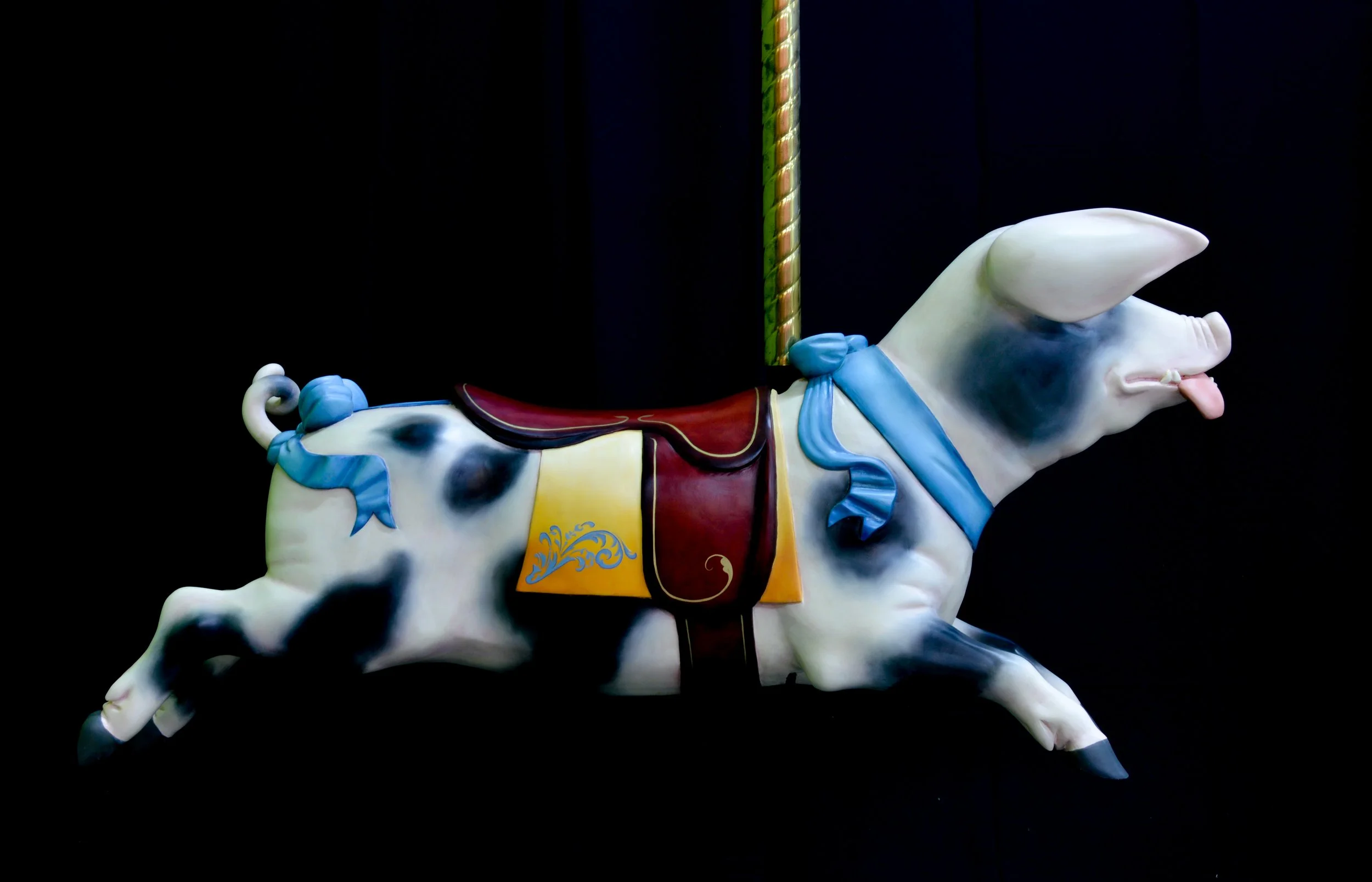
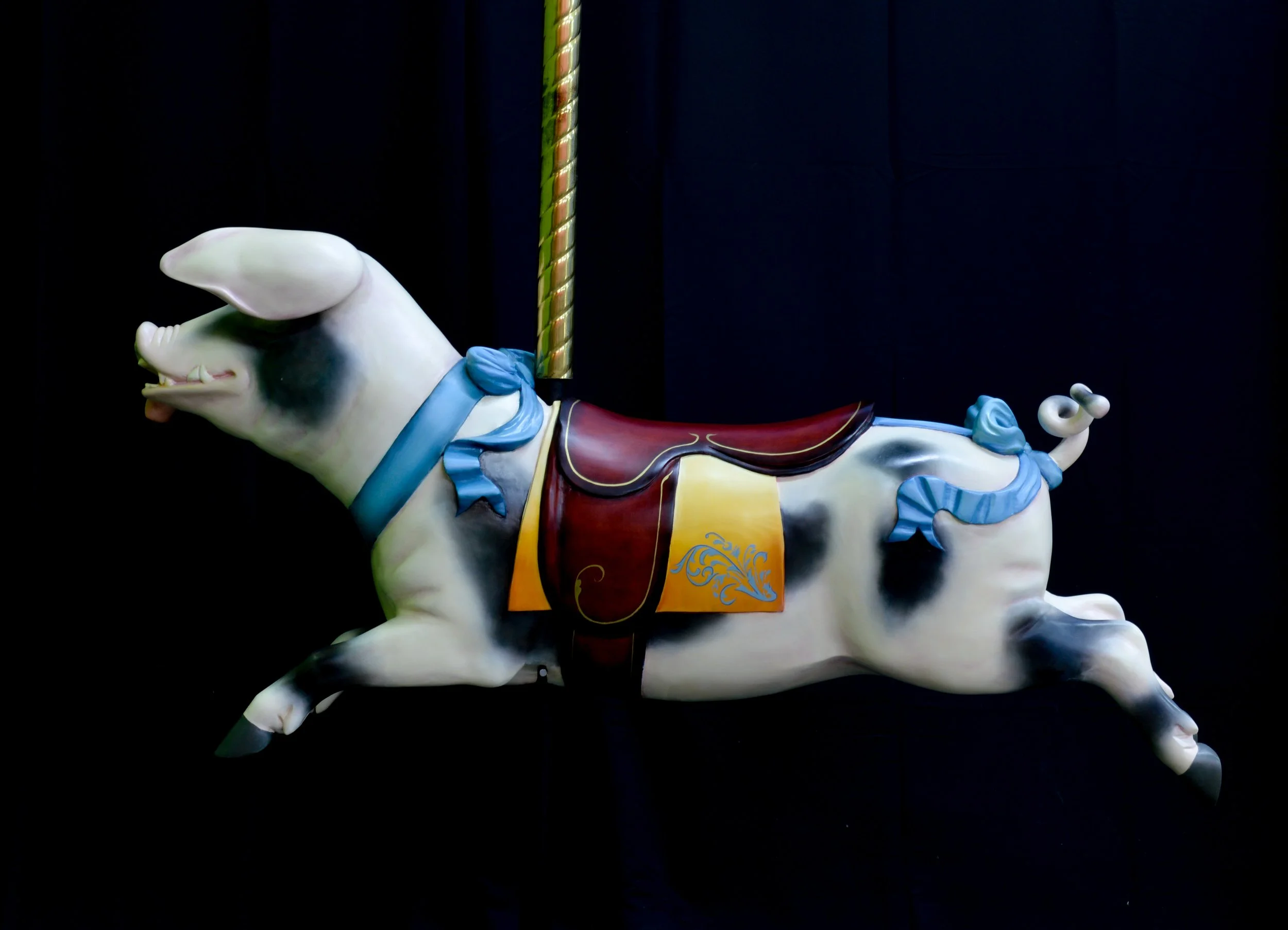
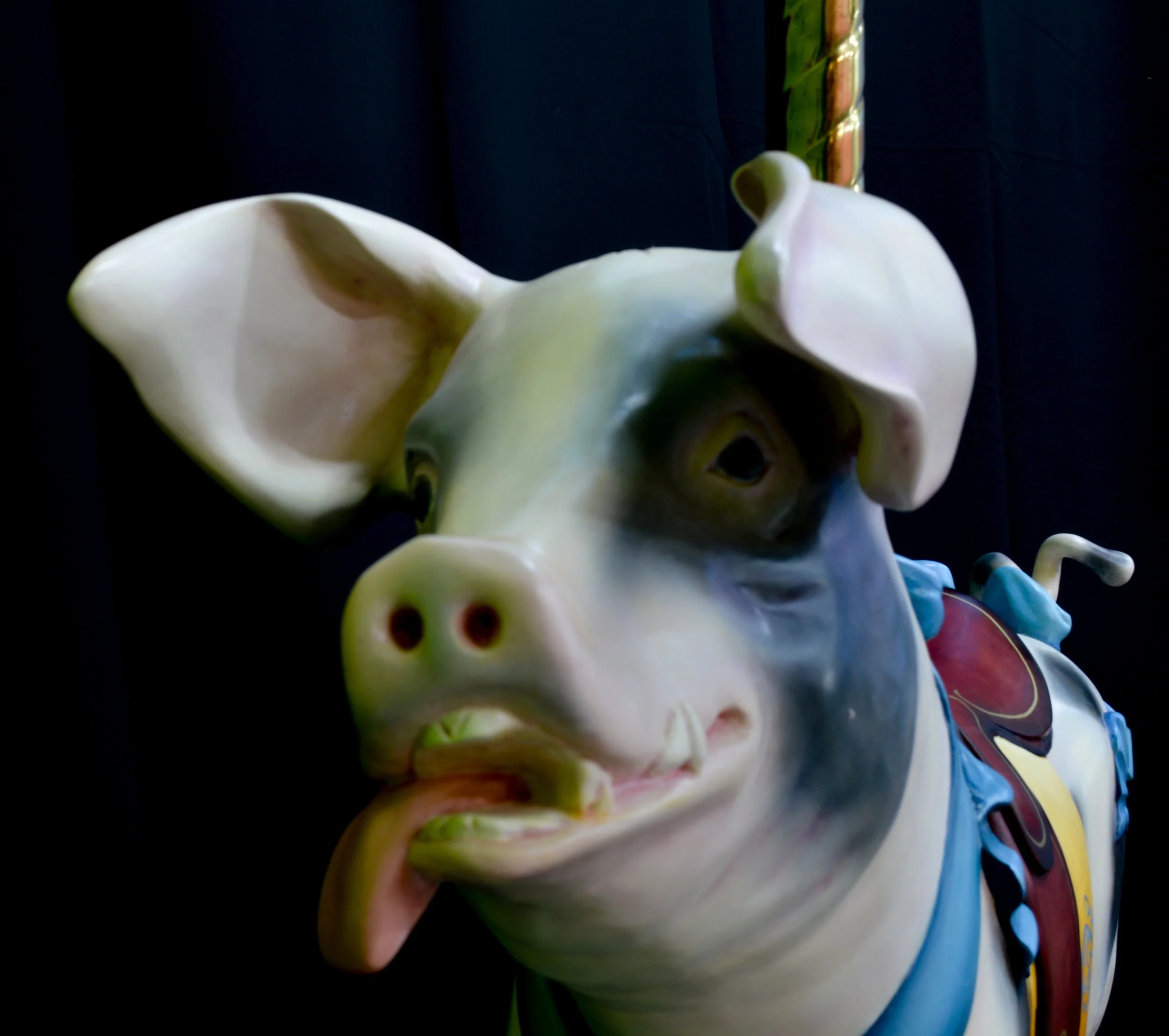
A full-size carved wood carousel pig in a jumping pose — all four legs extended in full gallop. The body is painted white/cream with large irregular black-gray spots, an American convention not documented on European pig figures (inferred from prior comparative research). The head is sharply expressive: open mouth with individually carved teeth and a lolling pink tongue, dark eyes, and large floppy ears. Blue ribbon bows adorn the neck (as a collar) and the rump (at the base of the curly tail). The saddle is a distinctly American two-element arrangement: a burgundy/brown seat over a separate yellow/gold blanket panel decorated with blue acanthus scrollwork. Dark hooves on all four feet. A carved secondary figure — identified in earlier photographic analysis as a snail — appears at the rump bow, a whimsical individualized detail consistent with the decorative vocabulary of the documented head carver of the major Philadelphia carousel workshop from 1903 onward (inferred from sourced records).
Both sides carry decorative treatment, with the romance side (Images 3–4) showing fuller scrollwork detail on the saddle blanket. The figure is mounted on a gold-and-green twisted display pole.
-
The owner identifies this as an American maker, circa 1915 (reported). It was the most expensive piece in the collection at the time of purchase (reported). No price, acquisition source, or date of acquisition is provided in this transcript. Owner interview follow-up is required.
-
No provenance has been established. No carousel of origin, prior collection, or dealer has been documented. This is the primary gap in the entry.
-
The owner confirms this as an American maker (reported), which aligns with independent photographic and comparative analysis conducted in an earlier research cycle for this collection. Three specific features distinguish this figure from European (specifically French school) pig production and support attribution to the Philadelphia school:
First, the spotted coloration. Every documented pig from the major French carousel workshop in the auction record — including examples at Rafael Osona Auctions, Brunk Auctions, and Freeman's — presents a solid natural pink body. Spotted coloration on a carousel pig is an American convention and is not documented on French figures (sourced from prior research cycle: Rafael Osona, Brunk, Freeman's).
Second, the saddle configuration. French school pigs carry a single saddle cloth with scalloped edges. This pig has a distinctly American two-element arrangement: a separate seat and a decorated blanket with painted acanthus scroll. That configuration matches documented American menagerie practice (inferred from comparative analysis).
Third, the absence of inscribed ribbon. French school pigs characteristically carry a name inscribed directly into a carved ribbon — documented examples include "Toto" and "Le Toine." This pig's blue bows show no inscription in any photograph (observed). The secondary carved snail at the rump bow is also not a documented French school feature; it is the kind of individualized whimsical detail associated with the Philadelphia workshop's head carver from 1903, who is documented as introducing "lavish trappings of flowers, bells, bows" and secondary carvings to the company's figures (sourced: VintageCarousels.com).
The collection also contains a second pig figure consistent with French production — specifically the Angers school — which the owner explicitly distinguishes from this piece (reported). Comparing the two directly reinforces the American attribution: the Bayol pig's solid pink body, single European-style saddle cloth with scalloped border, and flat ruffled ribbon bows are consistent with French production, while this pig's features are not (inferred from comparative analysis conducted in prior research cycle).
Documented auction comparables for pigs from the Philadelphia workshop include: Edgewater Park pig, $9,000 (AntiqueCarousels.com) (sourced); Cowan's Auctions pig, ca. 1905, 45 × 50 × 12 inches (sourced: WorthPoint); Guernsey's September 2010, est. $20,000–$30,000 (sourced: LiveAuctioneers).
-
The figure presents in fully restored condition (observed from photographs). The paint surface is smooth, vibrant, and free of crazing, cracking, or visible age. The restoration is professional and thorough — no earlier paint layers are visible. The carved detail appears crisp and intact throughout, including the secondary snail figure, the teeth, the ribbon bows, and the hooves. The restorer is not identified. The figure is confirmed carved wood (owner confirmed). The measuring tape in Image 3 places the body height at approximately 2.5–3 feet. Formal condition rating pending direct examination.
-
Medium. Owner confirms American maker, circa 1915, and carved wood. The decorative vocabulary — spotted body, two-element American saddle, blue ribbon bows, carved secondary snail figure, romance side differentiation — is consistent with the documented output of the Philadelphia workshop's head carver from 1903 onward. The Bayol alternative has been explicitly argued against on three evidentiary points and is rejected by the owner. However, no provenance, acquisition documentation, or physical markings have been established, and the restorer is unidentified.
-
Owner interview transcript (undated; provided with photographs dated 8/20/2025)
Photographs: five images (DSC_2387, DSC_2388, DSC_2389, DSC_2390, DSC_2392), covering both sides, head close-up, and scale measurement
Prior research cycle: Dentzel attribution and Bayol comparative analysis conducted in earlier conversation, including auction comparables from Rafael Osona, Brunk, Freeman's, Cowan's, Guernsey's, and AntiqueCarousels.com
Specialist sources from prior cycle: VintageCarousels.com (Cernigliaro documentation), CarouselHistory.com, LiveAuctioneers, WorthPoint