
Unknown - Pig
Catalog #056 153×89×61cm
-
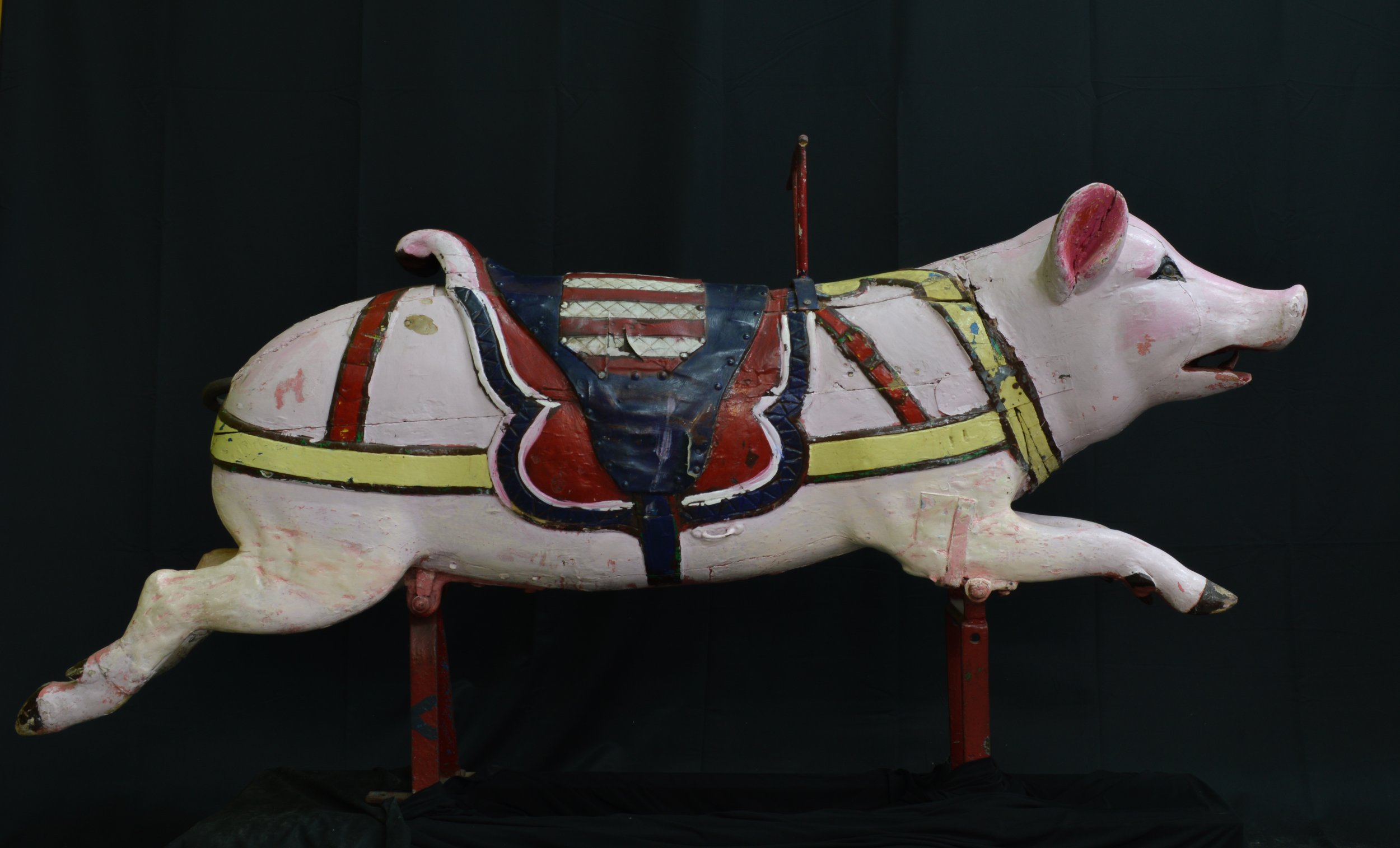
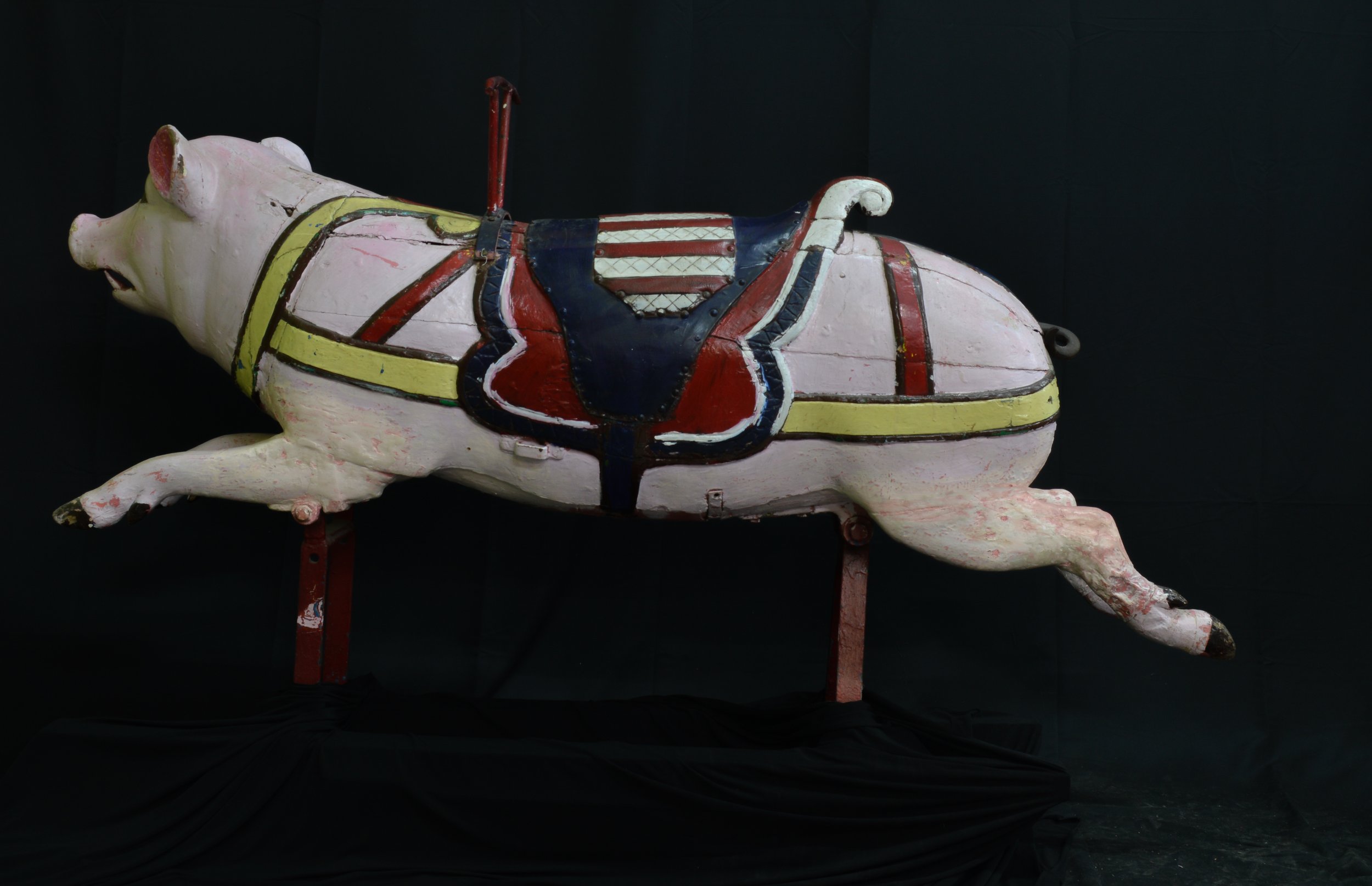
A large carousel pig in full flying gallop pose — all four legs fully extended, body horizontal — with open mouth, carved curly tail stub (the twisted steel tail is discussed below), and a bold two-sided painted saddle. The body is painted pink overall with extensive wear, crazing, and accumulated paint losses throughout, consistent with decades of operating use. The saddle is the figure's most diagnostic feature: a dark navy blue main field with actual metal studs/rivets along all edges, red concave panels flanking a diamond-quilted cream/white cantle seat, a prominent lime-yellow girth band running the full circumference of the body, and red diagonal harness straps across the front half. The saddle construction incorporates applied metalwork — the rivets are structural or decorative elements, not merely painted. Both sides of the figure carry equivalent decoration (sourced from photographic analysis, confirmed against prior research session). This bilateral finishing is a documented indicator of English traveling fairground origin: park installation figures received full decoration only on the outward-facing romance side, while traveling fair figures — seen from all angles as the ride moved through different positions — were finished symmetrically on both flanks. The owner reports the figure's tail is twisted steel (reported); a stub is visible in photographs at the rear. The head is small and pig-like with an open, somewhat aggressive expression — the owner characterizes it as "mean" (reported). Platform-mounting iron hardware is visible at the leg bases in Image 5. A metal rider-grip ring is present at the flank. The measuring rod in Image 3 indicates approximately 48–54 inches in body length. The figure is transported on a rolling wooden pallet, consistent with the owner's observation of significant weight.
-
The owner encountered this figure at an antique store in Santa Rosa, California, while driving through, was sufficiently drawn to it to return separately and acquire it (reported). Year of acquisition and seller identity are not recorded.
-
Unknown. The antique store in Santa Rosa, California. No prior dealer, collection, or operating machine has been documented.
-
The owner reports that multiple carousel specialists have been shown photographs and have been unable to attribute this figure to any maker (reported). This documented expert difficulty is itself meaningful. The well-known American producers of carousel pigs — the Philadelphia school and the North Tonawanda manufacturers — have consistent, well-documented physical profiles. When a figure resists attribution to those schools, it becomes more probable that it falls outside American production entirely.
Two physical features collectively point toward English traveling fairground origin:
Bilateral decoration. Both sides of this figure carry equivalent saddle painting and decoration (sourced, photographic analysis). This is a documented construction convention of traveling fairground machines, in which figures were viewed from all angles as the ride traveled between engagements and were finished on all sides accordingly. Fixed park carousels — including all major American producers — oriented their figures to face outward and finished the inward-facing side at a lower level of detail. No documented American carousel pig carries bilateral decoration of this caliber.
Metal tail. The twisted steel tail (reported) is a documented feature on European carousel pigs specifically. A French fairground pig circa 1910 in the tradition of the foremost French carousel maker carries a metal curly tail (sourced, Collinge Antiques). A second French Victorian-era pig at Greenwald Antiques is explicitly noted as carrying a wrought-iron tail (sourced). A London-based dealer listing of an English fairground pig confirms a cast iron tail on that figure (sourced, 1stDibs). An American auction record describes a pig carousel figure with both tail and rider handle in wrought iron (sourced, LiveAuctioneers). In every documented case, the metal tail appears on a European — French or English — figure. No American carved carousel pig with a fabricated metal tail has been found in research across two independent sessions.
English traveling fairground makers active in the relevant period include Frederick Savage of King's Lynn (the dominant English traveling carousel manufacturer), as well as workshop carvers including Spooner and Anderson. Savage's fairground machinery was exported widely, and his machines were the predominant traveling carousel platform in English fairground use through the early twentieth century (sourced). Surviving English traveling fair pig figures are rarely encountered in the American collector market; they appear infrequently even in English specialist auctions, and are underrepresented in published dealer and auction records relative to horses. The combination of bilateral finish, metal tail, applied metal saddle hardware, and the figure's failure to match any documented American production profile collectively support English traveling fair origin as the working attribution (inferred from photographic analysis, comparative research, and prior research session findings).
This collection holds three additional carousel pigs documented in separate entries: a stripped piece attributed to the American Philadelphia school (ID 015), a spotted piece also attributed to that school (ID 018), and a European pig painted by Lise Liepman attributed to the French Bayol tradition. ID 056 is physically and stylistically distinct from all three — its bilateral finishing, metal tail, applied saddle hardware, and the body's overall construction profile distinguish it clearly and consistently with a different national tradition.
-
Described by the owner as being in "pretty rough shape" (reported). Photographs confirm this characterization: extensive crazing, paint loss, and bare-wood exposure throughout the body; accumulated paint layers; and surface wear consistent with heavy operating life. The saddle paint is more intact than the body surface, likely due to the harder surface created by the metal saddle elements. The twisted steel tail is present (reported) but its condition is pending examination. Platform mounting hardware shows red paint and wear. No major structural failures, breaks, or missing limbs are visible in photographs, though the remark "pretty rough shape" warrants a thorough hands-on structural assessment before any restoration or conservation is undertaken.
-
Low-to-Medium. Maker is unestablished and has resisted attribution by specialists. However, two independent physical diagnostics — bilateral decoration and metal tail — both point consistently toward English traveling fairground origin, and this is supported by the figure's complete failure to match any documented American maker profile across two separate research sessions. What prevents Medium: no specific English maker has been confirmed; no provenance beyond Santa Rosa exists; no physical examination has been conducted.
-
Owner interview (Santa Rosa, California antique store; ~$2,000 price; drove back alone to acquire; expert consultations without attribution; twisted steel tail; "mean" characterization; rough condition)
Five photographs (DSC_2671, DSC_2672, DSC_2673, DSC_2674, DSC_2675): romance side with ID board, romance side, romance side with measuring rod, non-romance side with ID board, non-romance side
Prior research session (bilateral decoration analysis; English traveling fair attribution; Savage/Spooner/Anderson maker candidates; Sheffield archive and Weedon & Ward research recommendations)
Collinge Antiques (French carousel pig ca. 1910 with metal curly tail)
Greenwald Antiques (French Victorian-era carousel pig with wrought-iron tail)
LiveAuctioneers (pig carousel figure with wrought-iron tail, first quarter 20th century)
1stDibs (English fairground pig with cast iron tail)
Cross-references: IDs 015, 018, and Bayol pig entry