
Herschell-Spillman - Rooster
Catalogue #014 121×102×30cm
-
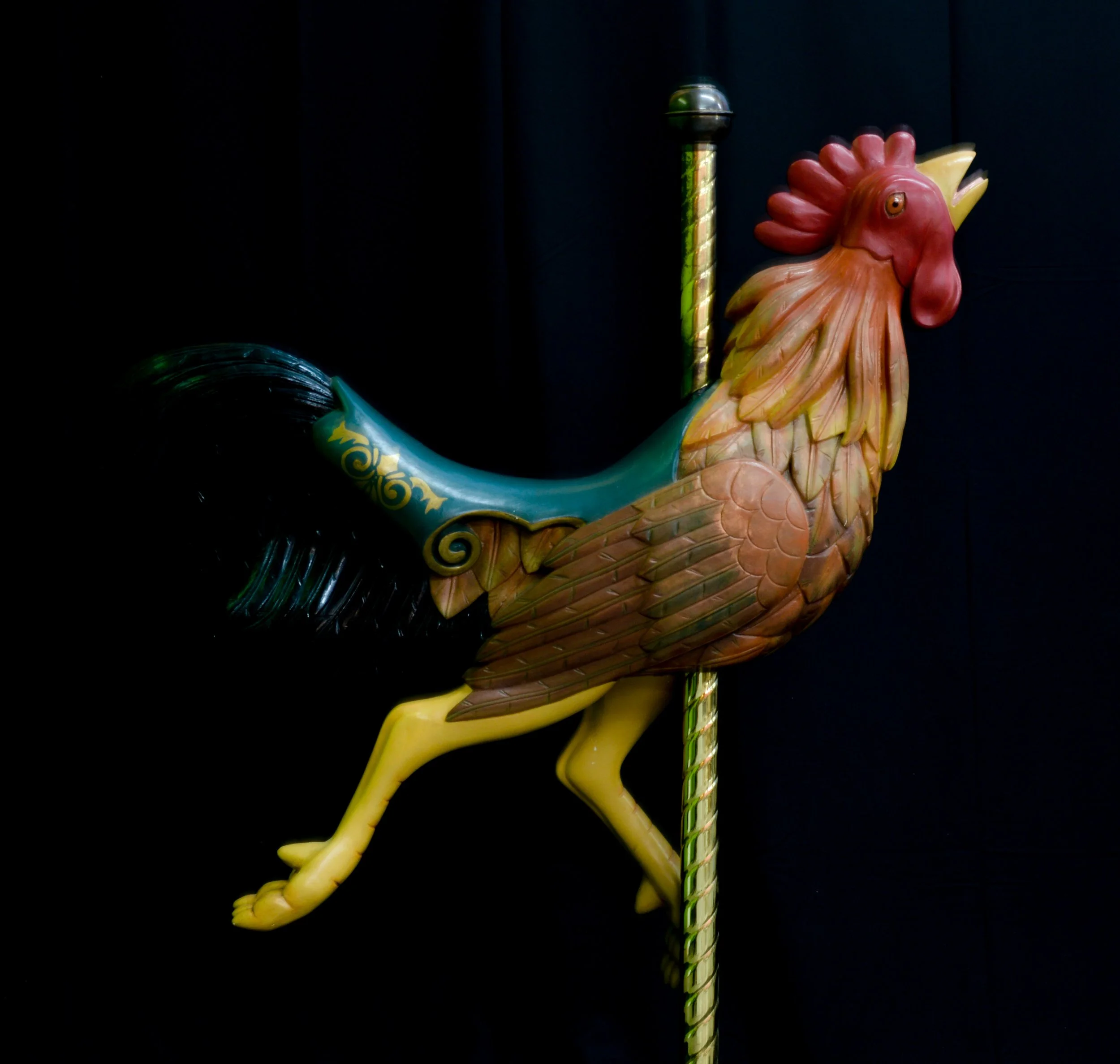
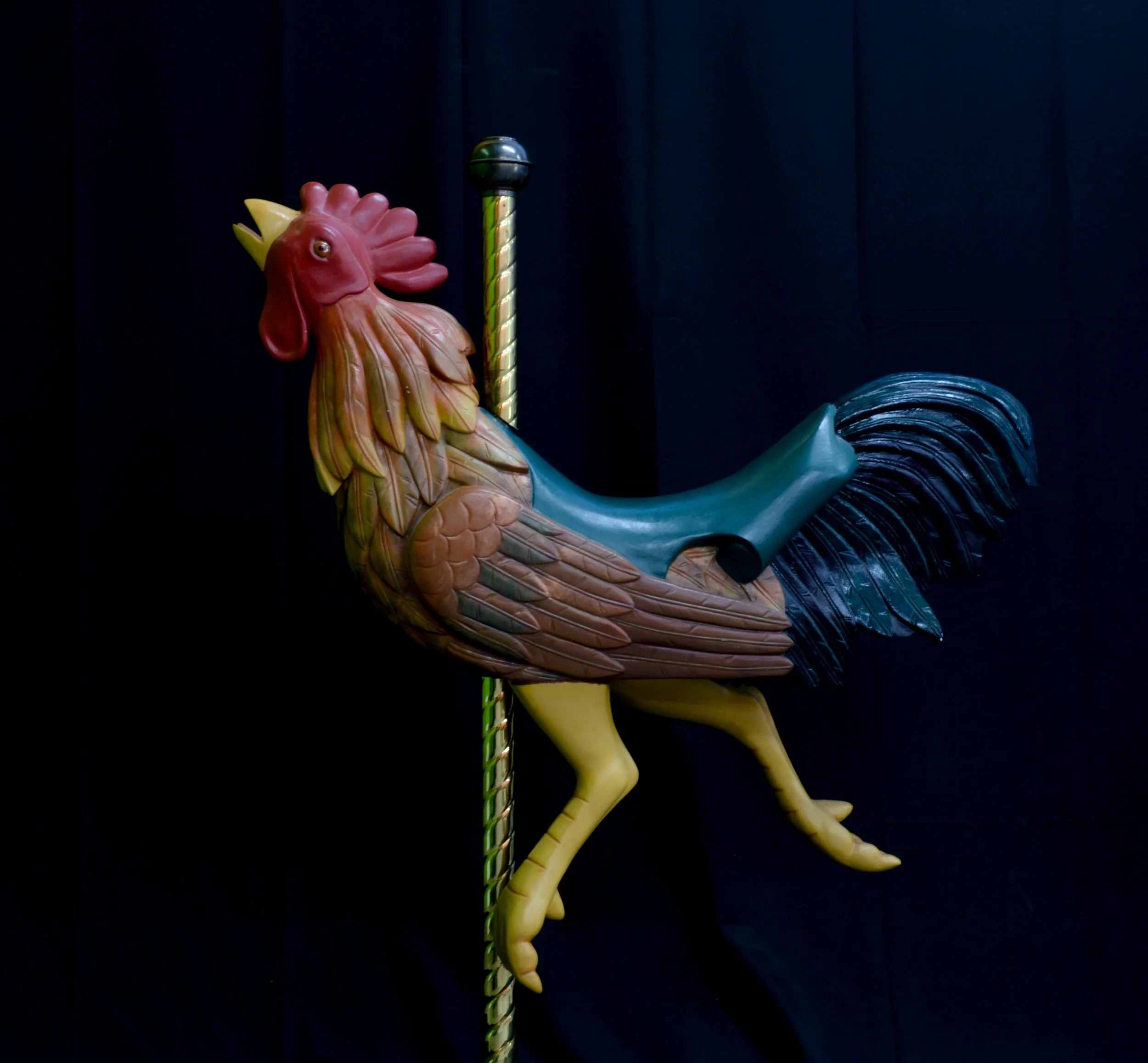
A full-size hand-carved wooden carousel rooster in a striding, crowing pose — head thrown back, beak open wide, neck extended upward in full display. The owner calls this figure "Chanticleer," the medieval literary name for the rooster (reported), and the name earns its place: the figure has genuine authority. The romance side (Images 1–4) shows vivid deep red at the comb, wattles, and face, transitioning through rose-red at the neck into warm rufous-brown on the breast and wings, with deeper brown on the body proper. Wing coverts are carved in an overlapping scale pattern; body feathers are individually rendered in long layered courses. The saddle/rump area is solid teal-green. The tail fan is navy-black, the feathers individually carved and separated. Legs and feet are yellow-gold with scaled texture and clear spur definition. Glass eyes are present on both sides. The non-romance side (Image 5) reveals lighter golden-honey and amber plumage tones in place of the deep rufous of the romance side — a deliberate two-sided treatment — along with gold scroll paintwork on the teal rump and a carved volute at the body-tail junction. The figure is mounted on a twisted gold-pattern pole with a dark ball finial.
-
Purchased at an auction in California (reported). Prior to acquisition, the piece was owned by a restorer identified in the owner's transcript as "June Reeley" (phonetic rendering; spelling unverified — see Open Questions) and was displayed for approximately ten years at the owner's sister store before entering the collection (reported). The owner's deliberate christening of the piece as "Chanticleer" has stuck as the working name throughout the collection (reported).
-
The immediate prior owner was the restorer "June Reeley," who both held the piece and performed its restoration before it came to auction in California (reported). No documentation of the California auction house, lot number, or sale date has been located. No history prior to "June Reeley's" ownership is known. The restorer name does not appear in carousel specialist directories, trade publications, or auction records across multiple phonetic spelling variants (Riley, Reilly, Reely, Riehl) — suggesting the name as recorded may be a transcription artifact rather than a confirmed identity (inferred). Owner clarification is the only path forward on this name.
-
Research confirms that only two American manufacturers produced full-size carousel roosters during the Golden Age: the Dentzel Carousel Company of Philadelphia and the North Tonawanda, New York firms that operated in succession under the Herschell-Spillman name from 1903, continuing as Spillman Engineering Corporation after 1920 (sourced, CarouselHistory.com). No other American maker is documented as having produced this figure type.
Several converging lines of photographic and contextual evidence support attribution to the North Tonawanda tradition rather than the Philadelphia workshop:
Dimensions. A fiberglass reproduction of the North Tonawanda rooster produced for the collector market measures 40 inches tall by 46 inches long — the standard established by the original carved figures (sourced, Carousel Workshop). A Dentzel rooster listed for private sale measures 58 inches tall by 60 inches long (sourced, Americana Antiques). Against the measuring rod in Image 3, Chanticleer reads as approximately 36–40 inches to the top of the comb — consistent with the North Tonawanda format, not the substantially larger Philadelphia format (inferred from photographs).
California provenance. The piece was acquired at a California auction (reported). Multiple full-size carousels with roosters from the North Tonawanda tradition operated historically in California: documented examples include machines at Balboa Park (San Diego, 1910), Tilden Park (Berkeley, 1911), Golden Gate Park (San Francisco, 1914), and Knott's Berry Farm, each carrying paired roosters as part of their menagerie complement (sourced, VintageCarousels.com). The Philadelphia workshop had a substantially smaller California footprint; the North Tonawanda tradition dominated the California market (sourced).
Carved saddle treatment. A North Tonawanda rooster offered by specialist dealer myCarousel.com (circa 1914–1917, sold) is described as displaying "a fancy saddle having a curvilinear edge and an undercurled cantle" as a defining carved feature (sourced, myCarousel.com). Image 5 of this entry shows precisely that combination on the non-romance side: a carved volute at the body-tail junction and painted gold scrollwork on the teal rump — an exact photographic match for the described carving treatment. This constitutes the strongest single physical indicator of North Tonawanda origin available from the photographs (inferred from sourced records).
One additional contextual note: a Spillman Engineering carousel rooster appearing in auction records is documented as having been restored by Mary Youree — the same Oregon collector whose collection supplied other pieces in this holding (sourced, LiveAuctioneers). That auction record pertains to a distinct piece and does not establish provenance connection to this figure, but it confirms that Mary Youree worked on this figure type from this maker tradition — a resonance worth documenting.
Among carousel menagerie types, roosters are among the least frequently encountered American figures on the private market. The Philadelphia workshop produced only a small number of roosters; those known examples have achieved significant auction results, with one recorded at $148,000 (sourced, CarouselHistory.com). North Tonawanda roosters surface more frequently but remain uncommon: they appear in documented surviving carousel complements (Tilden Park, Balboa Park, Golden Gate Park retain examples in operation), but private-market appearances are infrequent. The specialist dealer myCarousel.com sold a restored example in the mid-2000s; no current asking price or recent auction hammer is on record for a comparable piece.
-
The figure has been restored (reported, and consistent with photographs). Both sides of the paint surface are clean and well-defined with no visible cracking, flaking, or surface loss in the photographs. The feather carving reads crisply throughout, suggesting the restoration preserved structural integrity. The teal rump and the gold scroll treatment on the non-romance side appear to be restoration-period decisions; whether the gold scrollwork replicates original decoration or represents a restorer addition is not determinable from photographs alone. Glass eyes are present and undamaged on both sides. No formal condition rating is assigned pending direct physical examination.
-
Owner interview transcript — acquisition context, figure name, restorer and prior owner identity, display history
Photographs (Images 1–5, August 2025) — romance side (Images 1–4), non-romance side (Image 5), measuring rod (Image 3), whiteboard ID confirmation (Image 2)
CarouselHistory.com — confirmed that only two American makers produced carousel roosters; Dentzel auction record of $148,000 sourced
VintageCarousels.com — documented California operating carousels with North Tonawanda roosters: Balboa Park (1910), Tilden Park (1911), Golden Gate Park (1914), Knott's Berry Farm
Carousel Workshop (carouselworkshop.com) — North Tonawanda rooster fiberglass reproduction dimensions: 40" tall × 46" long, confirming standard format
Americana Antiques (americanaantiques.net) — Philadelphia workshop rooster private listing: 58"H × 60"L, confirming the larger format
myCarousel.com — sold North Tonawanda rooster (circa 1914–1917): "fancy saddle having a curvilinear edge and an undercurled cantle," 48 inches long; consistent with Image 5 observations
LiveAuctioneers — Spillman Engineering rooster record noting Mary Youree as restorer; contextual documentation, not provenance connection
Multiple phonetic spelling searches for "June Reeley" restorer identity — no results returned
-
Low-Medium Attribution to the North Tonawanda tradition is supported by converging photographic evidence (dimensions, carved scroll/cantle treatment in Image 5, California provenance), each individually inferential but collectively consistent; no documentary confirmation or specialist examination has been conducted, and the prior owner/restorer cannot be independently verified.