
Mathieu (Mathieu Père & Fils; Henri & Jacques Mathieu) 1920-1950
The Mathieu workshop was a multi-generational French carousel-figure family established in Bagnolet, a town on the eastern edge of Paris. The earlier generation, recorded as Mathieu Père & Fils, was active in the first decades of the twentieth century and produced carved figures alongside their contemporaries Bayeux, Coquereau & Maréchal, and Limonaire — at least one of their horses survives on Le Carrousel 1920, a working French manège originally inaugurated in 1920 in the Allier and still operated today by the Fanton family (sourced). The later and better-documented generation, Henri & Jacques Mathieu, carried the workshop forward through the mid-twentieth century, with dated works ranging from the 1950s into the 1970s and the atelier still associated with the same Bagnolet address. The continuous family thread between the two phases is the workshop's defining characteristic: French carousel manufacturing largely collapsed after the First World War, and the Mathieu atelier is one of the few documented French names that bridged the pre-war Angers-dominated golden age and the post-war fairground-revival period.
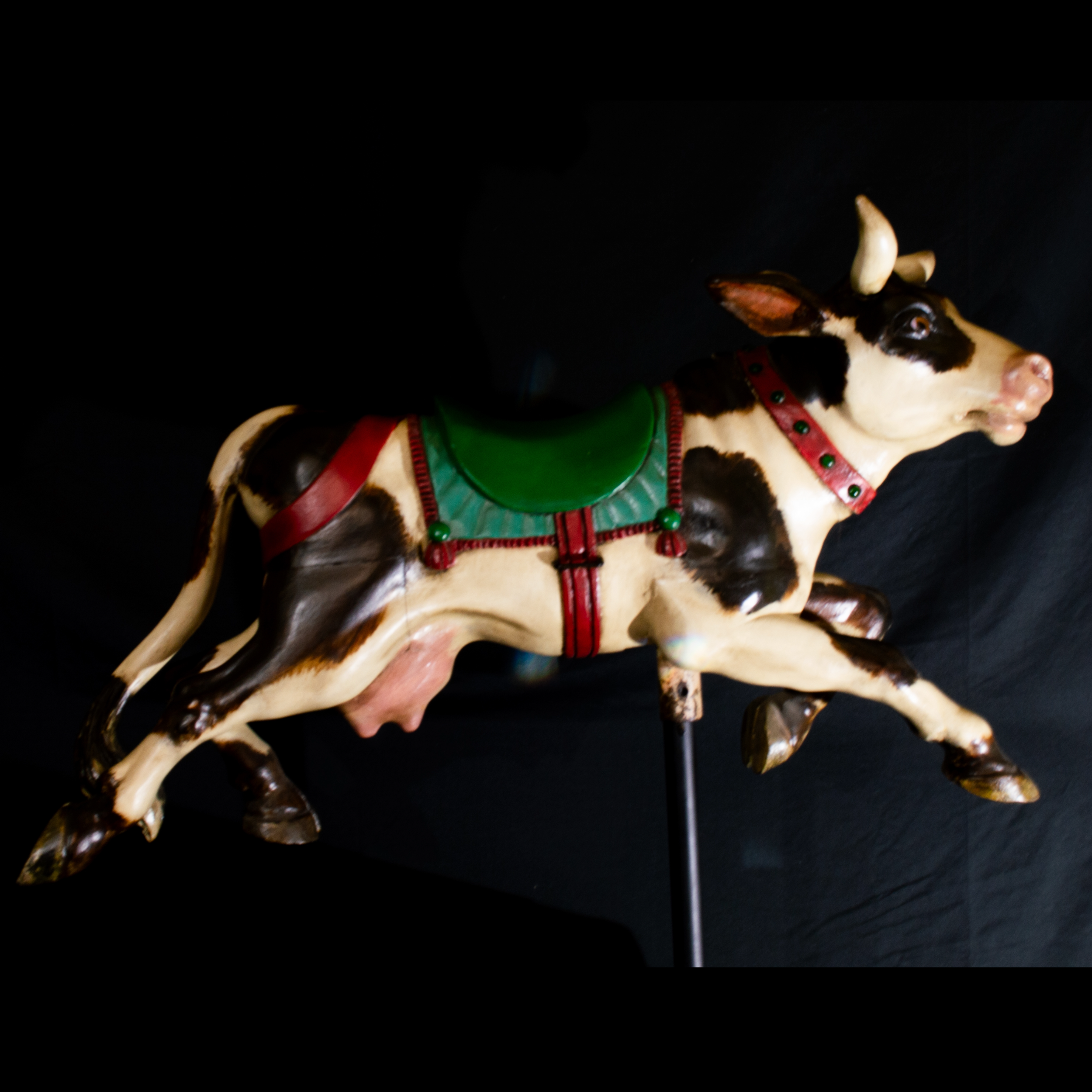
What sets the workshop apart in the scholarship is style. In their standard reference, L'Art forain : les animaux de manège (Éditions de l'Amateur, 2002), Fabienne and François Marchal note that Gustave Bayol's influence was so dominant across the French trade that nearly every later French maker — including Coquereau, Maréchal, Bourassé, Henri De Vos, and Chanvin — operated essentially within his idiom; "only Mathieu and Soccorsi managed to break away from him to assert each their own personal style" (sourced — Marchal, quoted in L'Inter-Forain). Mathieu's identity is characterful, narrative, and inventive rather than naturalistic: cartoon-tinged subjects, one-off models, animated mechanical elements, and a willingness to carve subjects outside the standard menagerie. Documented Mathieu output includes a dragon, a crocodile with an articulated jaw, an ostrich, a rooster, a donkey pulling a cart pushed by a dwarf, a giraffe in an unusual ambling pose, and Pollux from the French children's television series Le Manège enchanté — the last produced in the workshop's final years (sourced — Cornette de Saint Cyr catalog records, Marchal collection dispersal). Auction valuation reflects the rarity: a Mathieu dragon sold for €42,000 at the 2011 Marchal collection sale, and a unique articulated-jaw crocodile carried a 2019 estimate of €8,000–12,000 (sourced — Drouot auction records).
088