
Anderson - Horse
Catalog #031 87×56×26cm
-
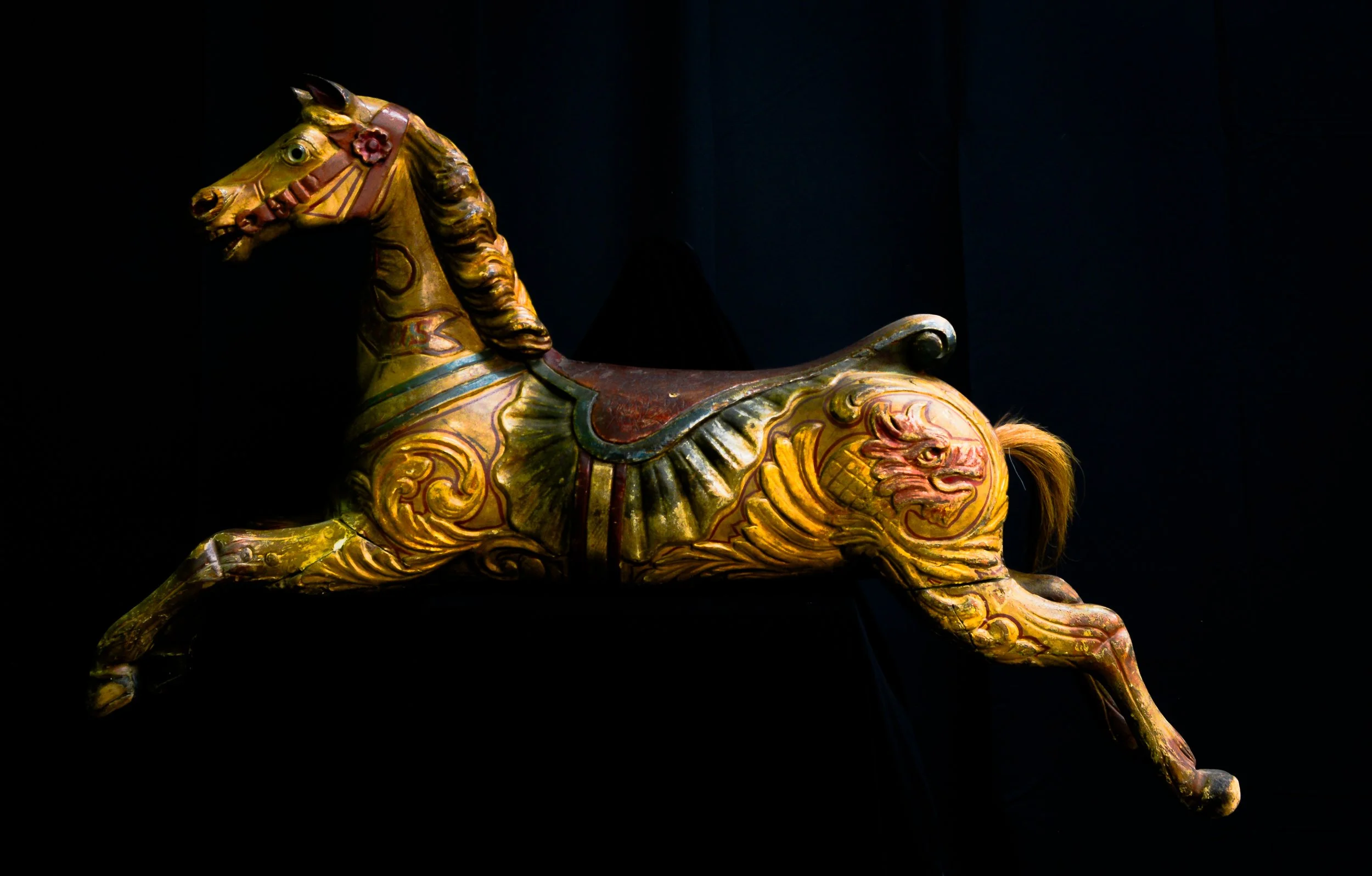
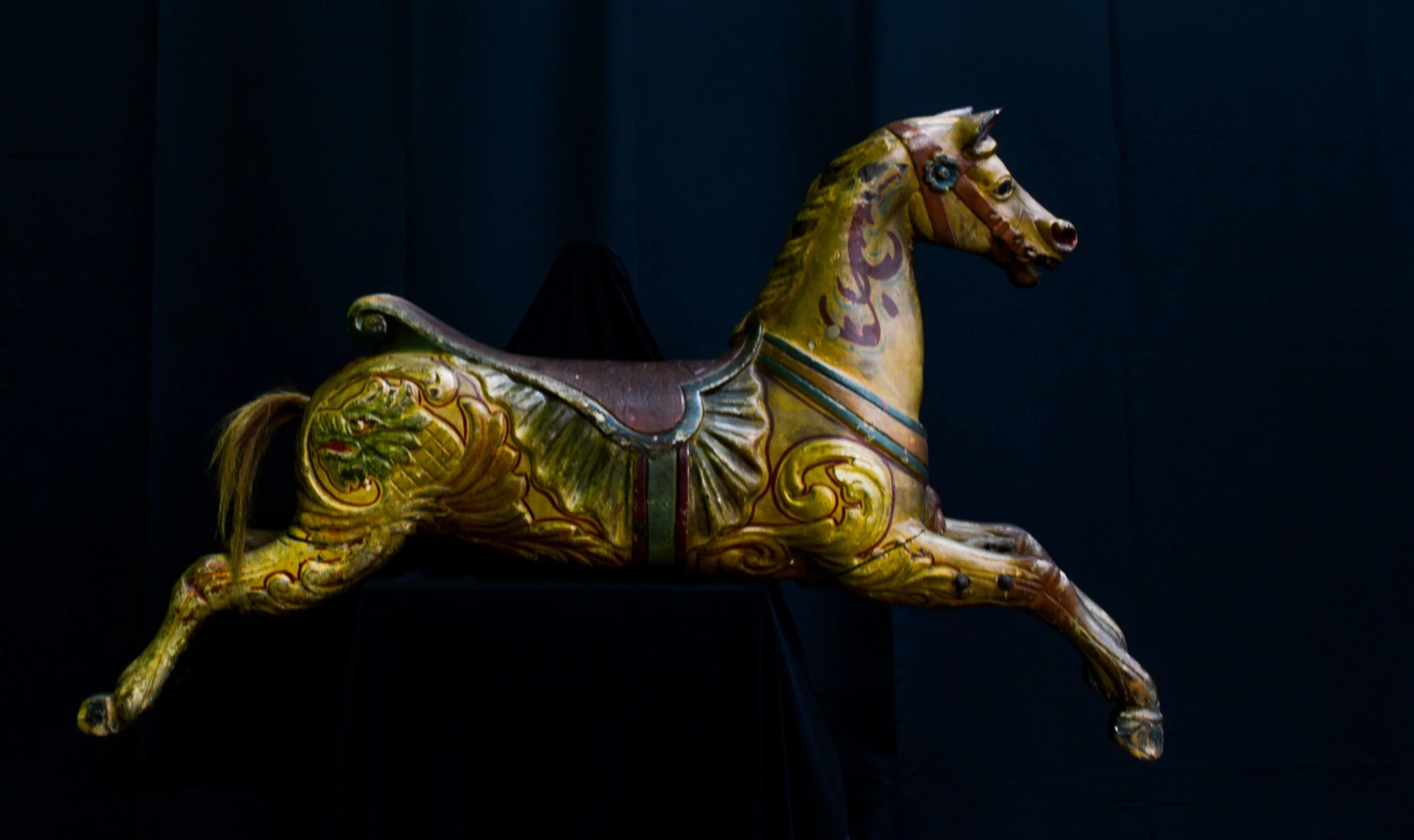
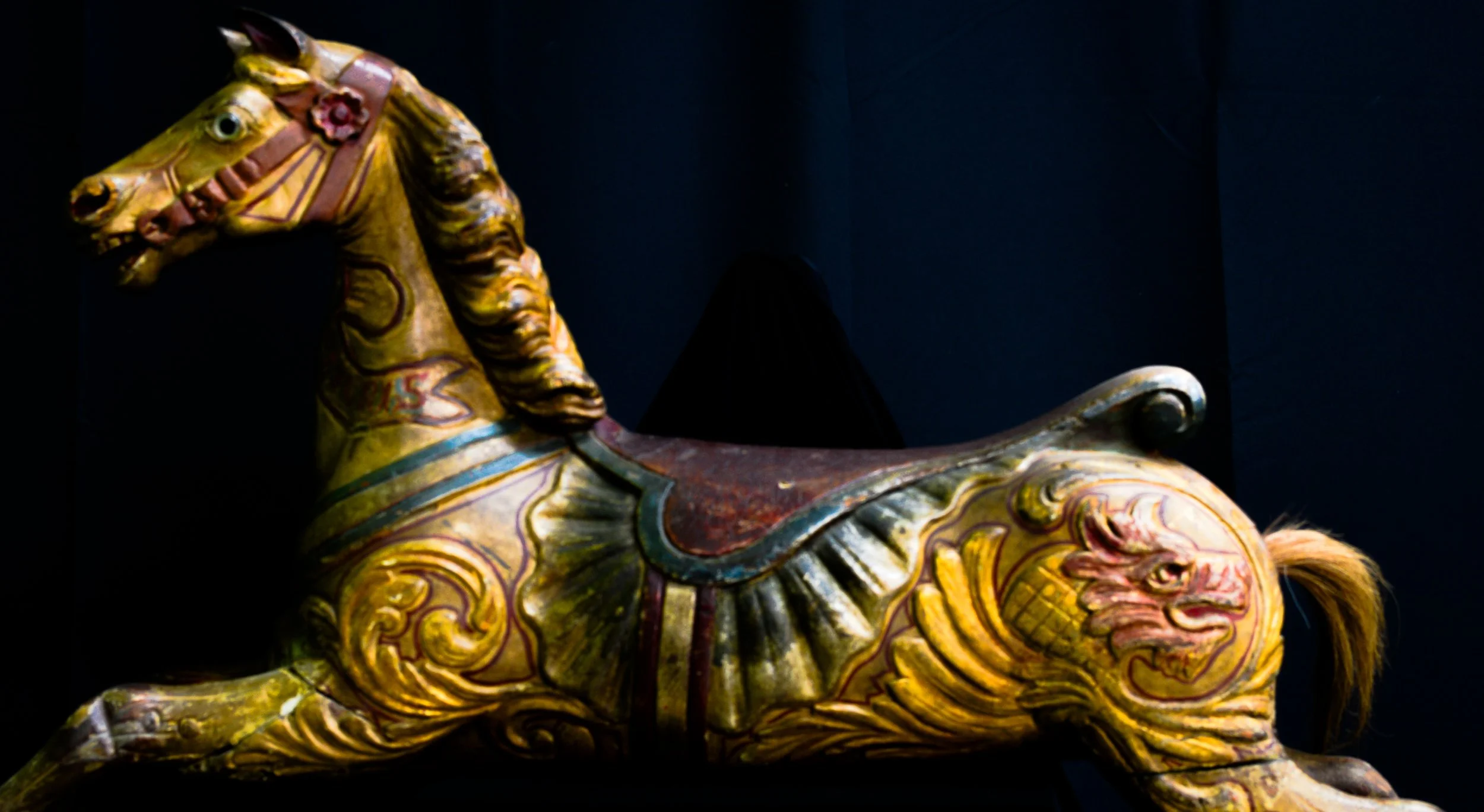
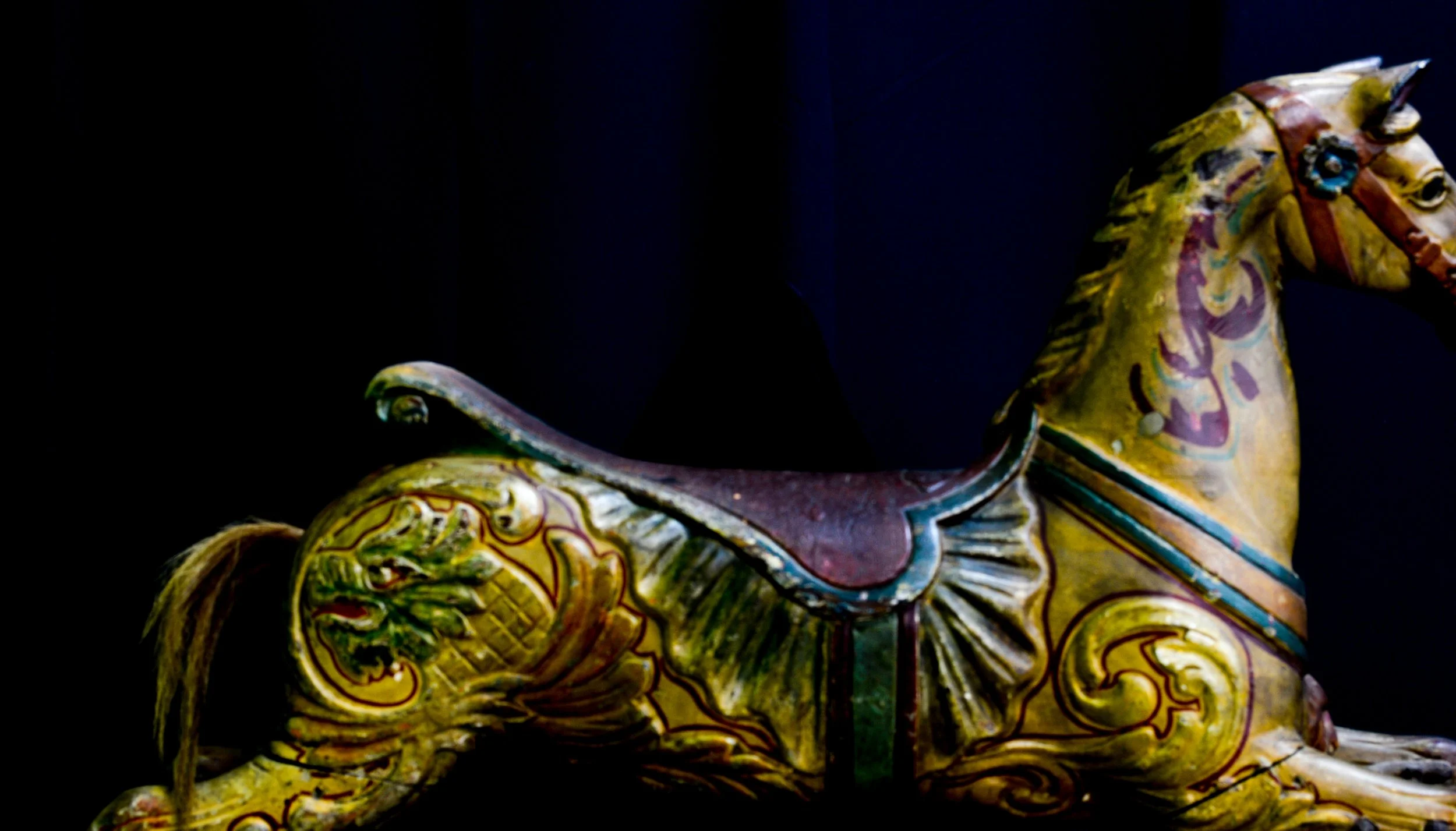
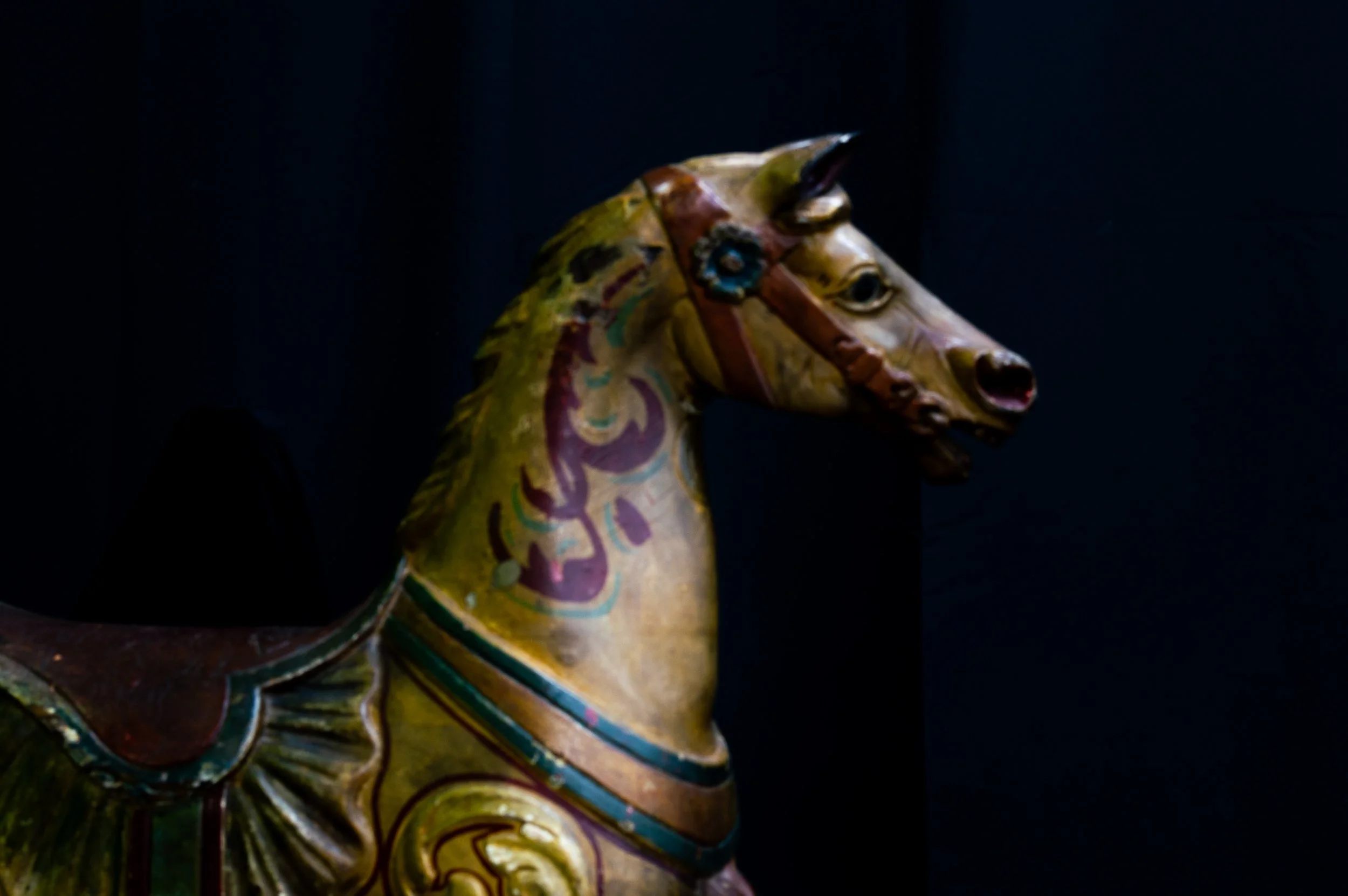
A small-scale English fairground galloper horse in a full-gallop jumper pose, attributed to Anderson of Bristol (inferred). The most distinctive carved feature is a snarling beast-head medallion — rendered with bared teeth in a circular roundel — set into the hip on both flanks. The romance side shows the head in pinkish-red tones against gold; the opposite flank renders the same motif in green with a crosshatch background. Elaborate baroque acanthus scrollwork covers both flanks and the belly, and the saddle has a pleated fan cantle with scrolled pommel and a dark red-brown seat. A rosette flower decorates the cheekpiece of the bridle. Glass eyes in blue-teal, horsehair tail. The owner characterizes the figure as "a little guy" (reported), consistent with an inner-row or juvenile galloper.
-
Purchased at auction, believed to be Morphy Auctions (reported). The owner is uncertain of the venue and does not elaborate further: "I believe it's Morphy, and I have to leave it at that" (reported). No sale date, lot number, or price paid has been provided.
-
No provenance chain has been established beyond the auction purchase. The auction lot description, if recoverable, may contain attribution and earlier provenance. English fairground gallopers were typically carved for specific ride operators and traveled with their rides for decades before dispersal. Anderson of Bristol is documented as having carved figures for operators including the ride at Clacton Pier and sets for touring showmen such as Walter Sharples (sourced). Whether this figure originated from any identified set remains unknown.
-
The attribution to Anderson of Bristol rests on visual comparison with documented Anderson characteristics. The National Fairground Archive describes Anderson gallopers as distinguished by elaborate scrollwork beneath the belly, "Italianate grotesque grins" on the flanks, and later work featuring animal heads carved directly into the bodywork (sourced). This figure exhibits all three features — the beast-head medallion, the extensive baroque scrollwork, and the overall elaboration of the trappings — placing it squarely within the documented Anderson idiom.
Williams & Anderson was a Bristol firm of maritime wood carvers, established in the mid-nineteenth century, originally producing figureheads for the sailing ships in Bristol's docks (sourced). The firm was registered under J.R. Anderson between 1889 and 1900, then under Arthur Ernest Anderson by 1919 (sourced). As demand for ship figureheads disappeared, the workshop shifted to carved fairground figures. Anderson produced figures for British fairs from the late Victorian period through the 1920s, and the business closed in 1936 (sourced). Anderson carved independently and also supplied figures to the major English ride builder Frederick Savage of King's Lynn (sourced).
English fairground gallopers are uncommon on the American collector market, where the vast majority of available carousel figures are American-made. Anderson figures occupy a respected position in the English fairground tradition and surface periodically at both UK and American auction houses. At AntiqueCarousels.com, a comparable Anderson outside-row galloper with lion-head trappings from the Clacton Pier Savage Gallopers has been listed at $9,500 (sourced). At Neue Auctions in 2019, a two-seater Anderson galloper designated "Nina" was offered, measuring 42 × 64 × 12 inches (sourced). Sworder's offered a large Anderson galloper carved for Walter Sharples, described as among the finest sets ever produced (sourced). Bonhams has offered a set of twelve Anderson gallopers, each approximately 43 × 11 × 49 inches (sourced). Inner-row and juvenile figures typically trade below outside-row examples.
A notable feature of this figure, consistent with English fairground rather than American carousel practice, is that both flanks are fully carved with equivalent detail. American carousels rotate counterclockwise, and carvers traditionally reserved their best work for the right-facing "romance" side. English gallopers rotate clockwise, making both sides visible to the public and warranting equal carving attention (sourced).
-
The figure retains what appears to be old park paint — multiple layers of polychrome with heavy patina and wear consistent with prolonged fairground service. No restoration is evident in the photographs. Some paint loss is visible at the joints and extremities. The carved scrollwork and beast-head medallions remain intact and well-defined on both flanks. The horsehair tail is present. One ear appears reduced or worn. A formal condition assessment is pending.
-
The visual characteristics are strongly consistent with documented Anderson of Bristol features — the beast-head medallion, the baroque scrollwork, the bilateral carving — but no maker's mark, auction lot attribution, or independent expert confirmation has been obtained. The attribution is supported by stylistic comparison with multiple documented examples but remains inferential.
-
Owner interview (recorded 10/13/2025): acquisition context and initial description
Photographic analysis (DSC_2485 through DSC_2491): physical description, condition assessment, and attribution evidence
Bonhams auction record (Lot 50, attributed Anderson set of twelve gallopers): maker history and carving characteristics (sourced)
National Fairground Archive (cited in Bonhams catalog, Cameron 2009): documented Anderson workshop characteristics (sourced)
AntiqueCarousels.com (Anderson galloper listings): comparable figures and pricing (sourced)
VintageCarousels.com (carvers and manufacturers reference): Anderson / Savage relationship (sourced)
Invaluable.com (Neue Auctions, Sworder's records): additional auction comparables (sourced)