
PTC - Hippocampus
Catalog #065 tbd
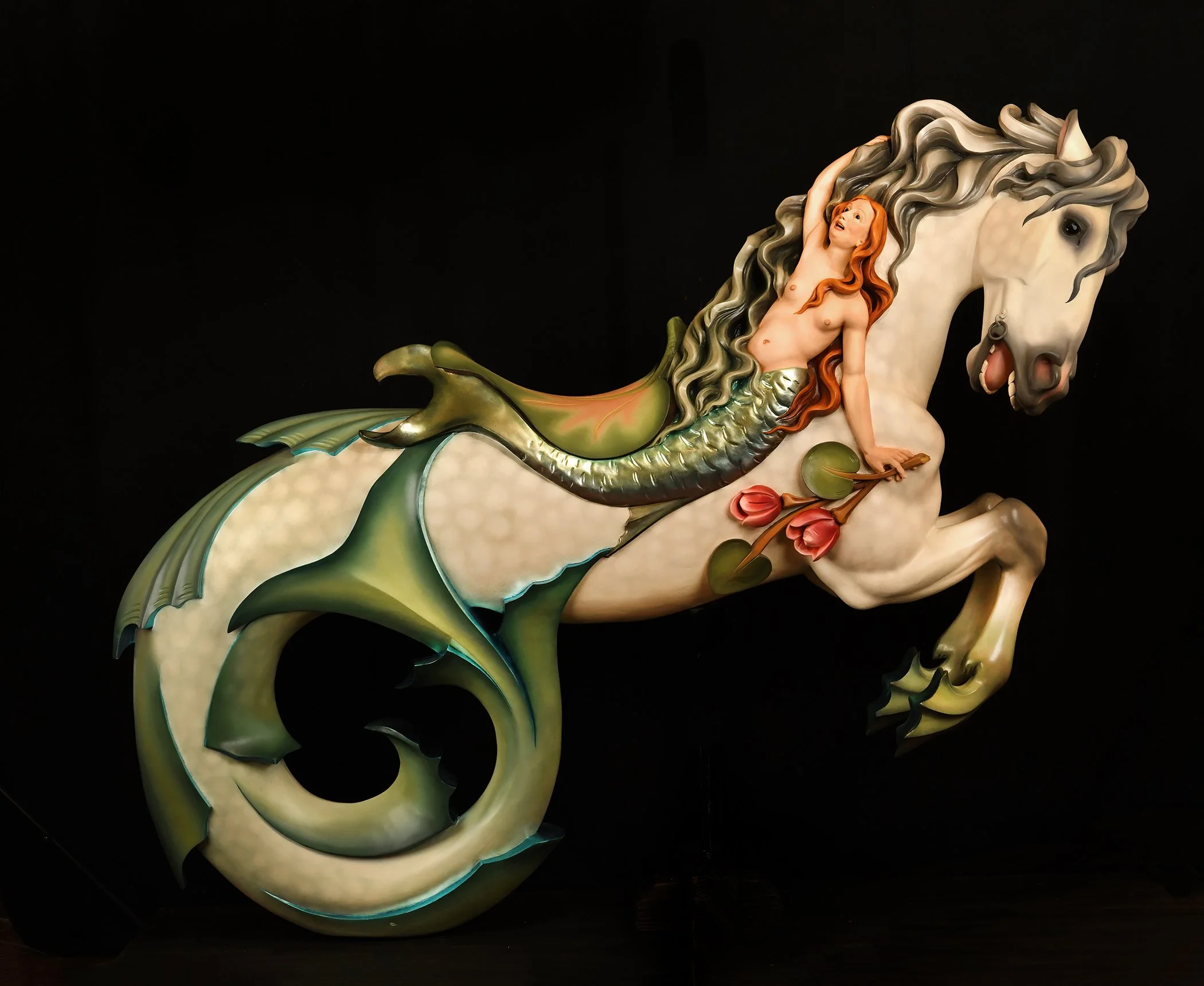
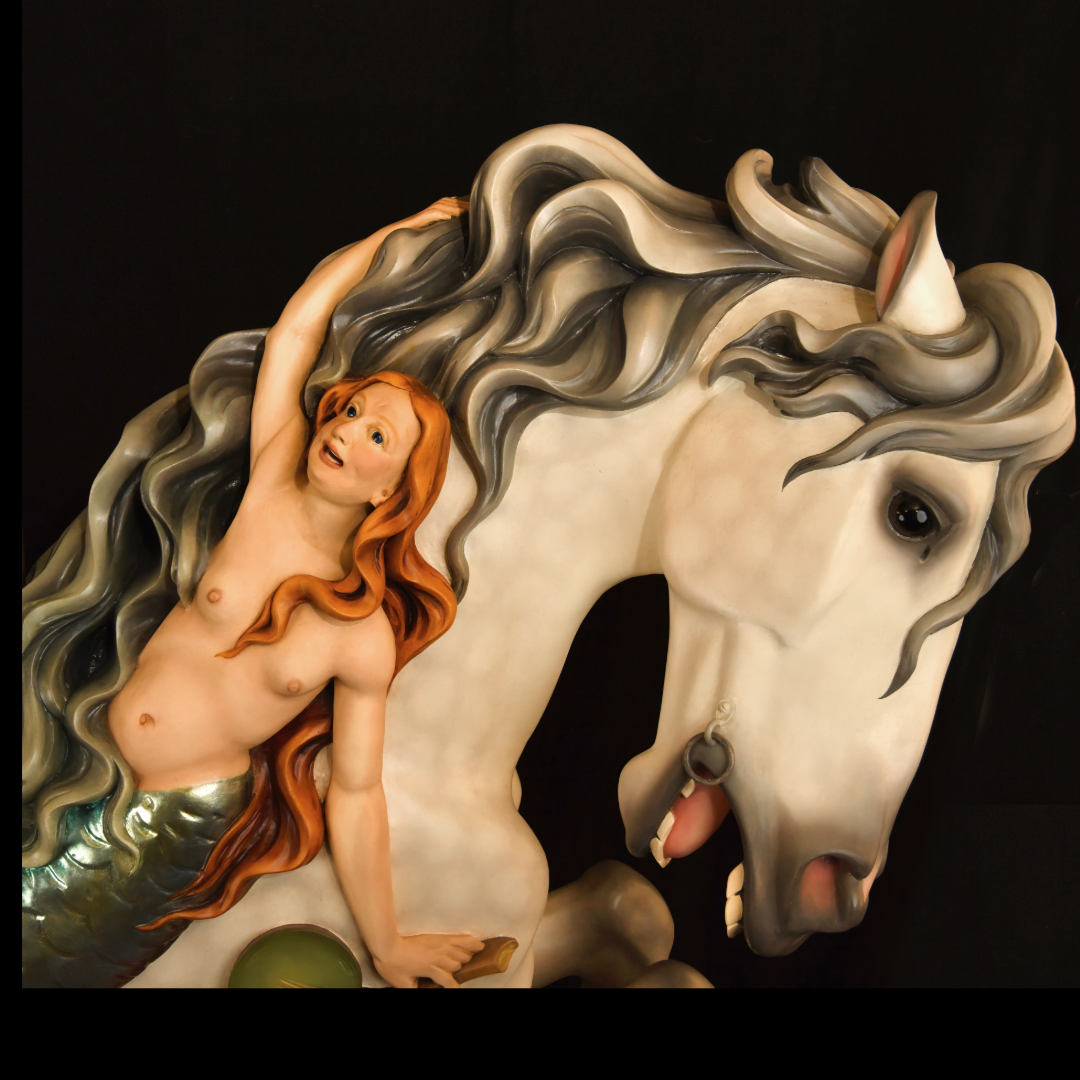
-
A large carved and painted carousel hippocampus — the mythological sea-horse, with the forequarters of a horse and a fish-scaled, coiling lower body — attributed to the Philadelphia Toboggan Company, circa 1907 (reported and sourced). The piece is distinguished from every other documented carousel hippocampus by its saddle figure: a fully three-dimensional, life-sized carved nude female with flowing red-auburn hair and a scaled lower body, reclining along the horse's withers, her right arm raised above her head into the carved mane, her left hand holding a spray of three pink tulips on a long leafed stem at the flank. Her own scaled tail, rendered in the same iridescent green-and-gold palette as the hippocampus's coiling lower body, trails along the horse's back where it meets the saddle. The horse forequarters are finished in cream with a deeply incised silver-grey mane, a dark glass eye, an open mouth with carved teeth and tongue, and a ring bridle. The fish lower body loops back upon itself in a full coil, terminating in a bifurcated fin with elaborate lateral fins along its length and a dorsal fin behind the saddle. The interior of the tail coil shows a pale belly with subtle scale pattern.
-
Acquired in February 2018 from Jim and Gayle Aten of Portland, Oregon (Antique Carousel Figures, 7626 S.W. Hood Avenue), with a documented purchase price (2/1/2018, on file). A second Aten letter dated 3/30/2020 confirms the sale and the selling price (sourced — Aten letter, on file). The piece was sold in stripped condition — taken down to bare wood by the prior owner to reveal the carving detail — and was subsequently shipped to Pam Hessey at Hawk's Eye Studio in Kingman, Arizona, for restoration. Shipping was coordinated through L. Drew Gerard of Boca Raton, Florida, on the recommendation of Rusty Donohue of Americana Antiques (Oxford, Maryland), at an estimated cost of $500 per figure plus insurance (sourced — Donohue letter dated 4/1/2019, on file). The piece is currently displayed in its restored painted state.
-
PTC #14, factory code name "Qualtri," built in 1907; first installed at Melville Park (Bayonne, New Jersey), then Clason Point (New York), then Tirell's South Beach (Staten Island, New York); rebuilt as PTC #55R in 1920 and relocated to Rocky Glen Park in Moosic, Pennsylvania, later renamed Ghost Town in the Glen; last operated there until the park closed in 1987 (sourced — CarouselHistory.com; Richard Gardner, Carousel News & Trader, June 2010). The machine was dispersed in August 1988. The figure subsequently entered the Tuttle Collection and was sold to the Aten dealership, which placed it with the current owners in 2018 (sourced — Aten letter dated 2/1/2018).
The collection file includes two photographs that document the figure in its operating life: a wide interior shot of the carousel labeled by hand as "Three row Machine. Two inner rows jumpers. Code Name 'Qualtri.' Staten Island," and a period photograph of a child riding this specific hippocampus during its working years. The latter image shows the mermaid figure integral to the piece during operation — the strongest available evidence that the mermaid is original to the carving and not a later addition. A third photograph, of the figure outdoors in stripped pre-restoration condition, documents the state at which Aten received and sold it.
-
The carousel hippocampus form was carved by only a handful of American Golden Age makers, all in the very early 1900s, and is among the rarest of all menagerie figures to survive. CarouselHistory.com identifies the Philadelphia Toboggan Company, the Dentzel firm, and Daniel Müller as the only American producers of the carousel hippocampus; the sea dragon and sea monster are related but distinct forms produced by other workshops (sourced). The Philadelphia Toboggan Company was founded in 1904, with its head start built on the purchase of the E. Joy Morris Company in 1903; the most celebrated PTC hippocampi were carved by Daniel Müller, who left the firm around 1906 to start his own business (sourced — Kit Carson County Carousel Museum; CarouselHistory.com). By 1907, when PTC #14 was built, Müller had departed, and the menagerie figures for the machine were carved by the remaining hands working from established patterns and inventory. The specific carver of the PTC #14 hippocampus is not identified in available sources and is not claimed here.
The Aten letter of 2/1/2018 states that this figure is "one of only four known," with all four pictured in Carrousel Art Magazine, Issue #25, page 11. The Aten letter also cites Carrousel Art Issue #12, back cover, and Geoff Weedon and Richard Ward's Fairground Art, page 97, as published references for this specific piece (sourced — Aten letter). CarouselHistory.com's hippocampus gallery independently documents a 1907-PTC-14 carousel hippocampus image (Barbara Williams Collection) and a separate ca. 1905 PTC hippocampus restored by Steve Crescenze that appeared on the Carousel News & Trader cover in January 1998 (sourced). The combination of published-literature citations and the operating-period photograph anchors the attribution as strongly as can be done for an unsigned PTC menagerie figure.
The mermaid secondary carving has no documented parallel in the auction record, dealer catalogs, or institutional holdings consulted. A Daniel Müller hippocampus from the T.M. Harton carousel at Conneaut Lake, conserved by Lise Liepman, sold at Bonhams Los Angeles on 4 December 2012 for $50,000 against a $35,000–$45,000 estimate; that figure is cited in Painted Ponies, American Carousel Art (William Manns, 1986, page 67) and was described by Bonhams as "rare to auction" and "one of only three known by Müller" (sourced — Bonhams lot record). An E. Joy Morris / PTC hippocampus with fish-scale saddle, acanthus-leaf mane, and short wings sold at Thomaston Place Auction Galleries on 27 February 2022 (sourced — Lot-Art aggregator). Neither of those comparables — nor any other hippocampus in the consulted record — includes a figural rider, which means the singular feature of this piece has no direct market benchmark.
The hippocampus form is rarely encountered on the private market, with surviving examples concentrated in institutional collections and a small number of private holdings.
-
Restored painted state, with surface restoration and paint completed by Pam Hessey at Hawk's Eye Studio in Kingman, Arizona, following the April 2019 shipping arrangements documented in the file (sourced). Carving is intact throughout, including the mermaid's hair, scaled body junction, the horse's mane, the carved tulip spray with leaves at the flank, the dorsal and lateral fins along the tail, and the bifurcated terminal fin. Glass eye is present in the horse; the mermaid's eyes are rendered in paint. The piece is mounted for display on a metal pole. The restoration is exceptional in quality — the iridescent treatment of the scaled fish body, the modulated cream-to-grey carving of the mane, and the delicate handling of the mermaid's face and hair are all at the highest tier of work documented in the collection.
A formal condition rating is pending direct physical inspection.
-
Level: High — Attribution to PTC is supported by named-dealer bill of sale citing PTC #14, three independent published literature references, the documented "Qualtri" factory code name, an operating-period photograph of the carousel, and an operating-period photograph of this specific figure with its mermaid in place. The provenance chain — PTC factory through park installations through 1988 dispersal through the Tuttle Collection through Aten to current owners — is documented at every step. The specific carver within the PTC workshop is not claimed; that gap is the only material item not closed.
-
Owner audio interview (transcript on file) — primary source for collection record and photograph identification
Owner-supplied current photographs (three high-resolution images: full romance side, three-quarter view, and head-and-mermaid detail)
Bill of sale and provenance letter from Jim Aten (Antique Carousel Figures), 2/1/2018
Confirmation letter from Jim Aten, 3/30/2020
Vintage black-and-white photograph of the PTC #14 carousel ("Qualtri," Staten Island), on file
Period photograph of a child riding this hippocampus during its operating life, on file — primary evidence for original mermaid integration
Photograph of the figure in stripped pre-restoration condition, on file
Shipping coordination letter from Rusty Donohue (Americana Antiques, Oxford, Maryland), 4/1/2019
CarouselHistory.com — PTC #14 page and Hippocampus / Sea Dragons gallery
Richard Gardner, Carousel News & Trader, June 2010 — PTC #14 history
Bonhams Los Angeles auction record, 4 December 2012, lot 558 (Daniel Müller hippocampus comparable, $50,000)
AntiqueCarousels.com — c. 1907 PTC Rounding Board sale page (PTC #14 provenance)
Kit Carson County Carousel Museum — PTC No. 6 production history
Carrousel Art Magazine, Issue #25, page 11 (per Aten letter)
Carrousel Art Magazine, Issue #12, back cover (per Aten letter)
Geoff Weedon and Richard Ward, Fairground Art, page 97 (per Aten letter)
William Manns, Painted Ponies, American Carousel Art, 1986, page 67 (cited comparable, per Bonhams)
Carousel News & Trader, January 1998, Issue No. 1, Vol. 14 (Crescenze PTC hippocampus cover)