
Unknown - Ape
Catalog #040 79×72×31cm
-
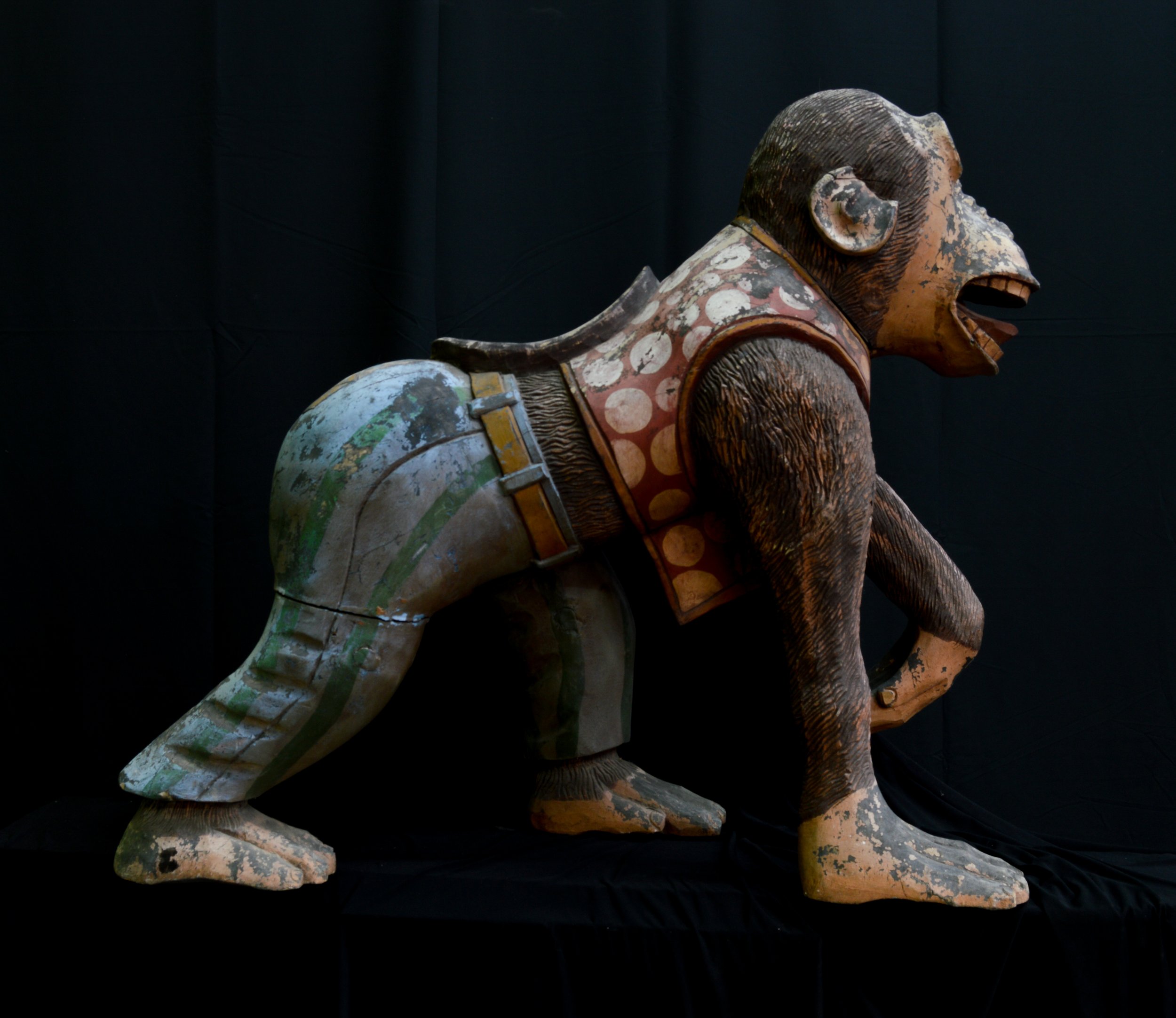
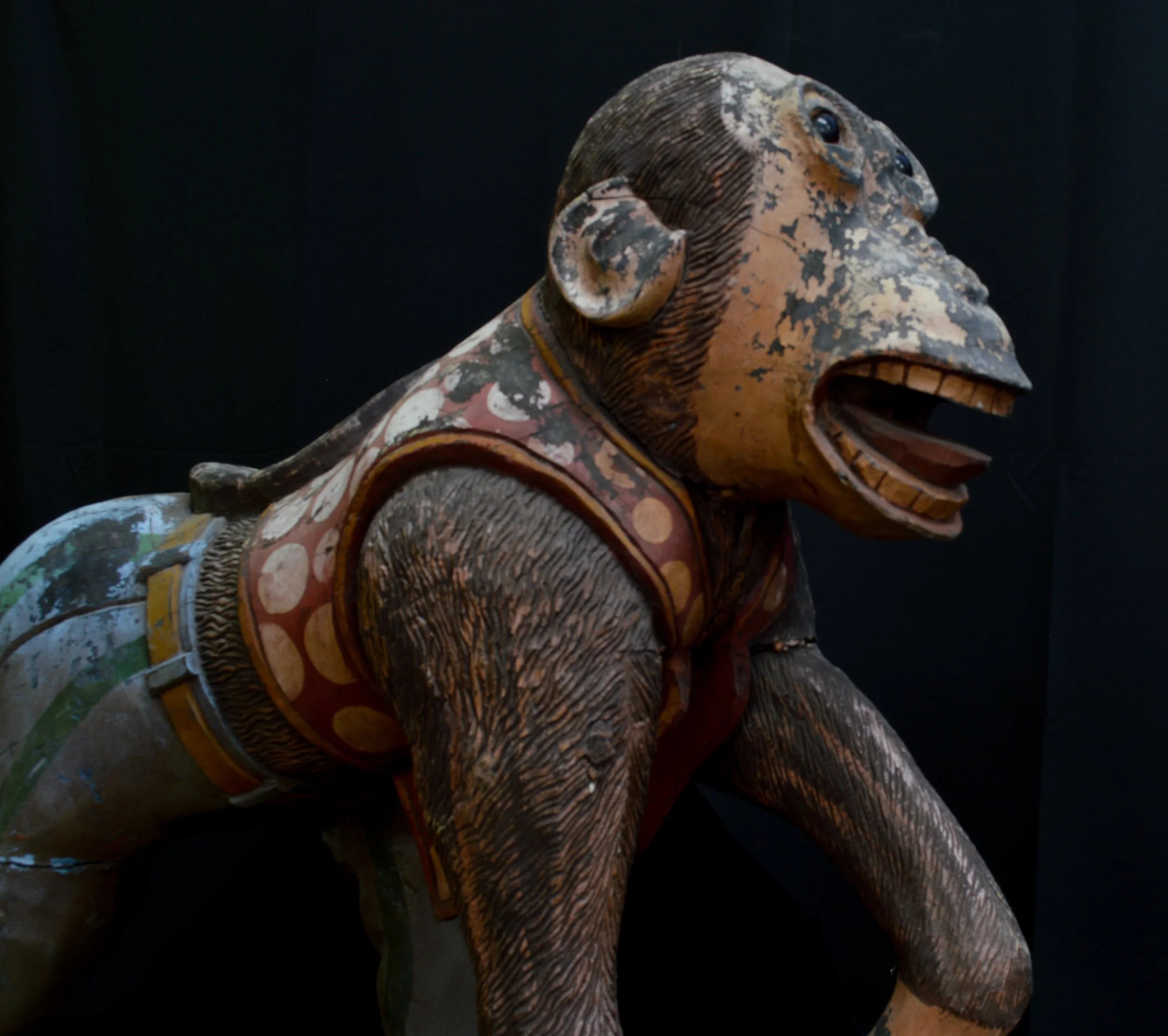
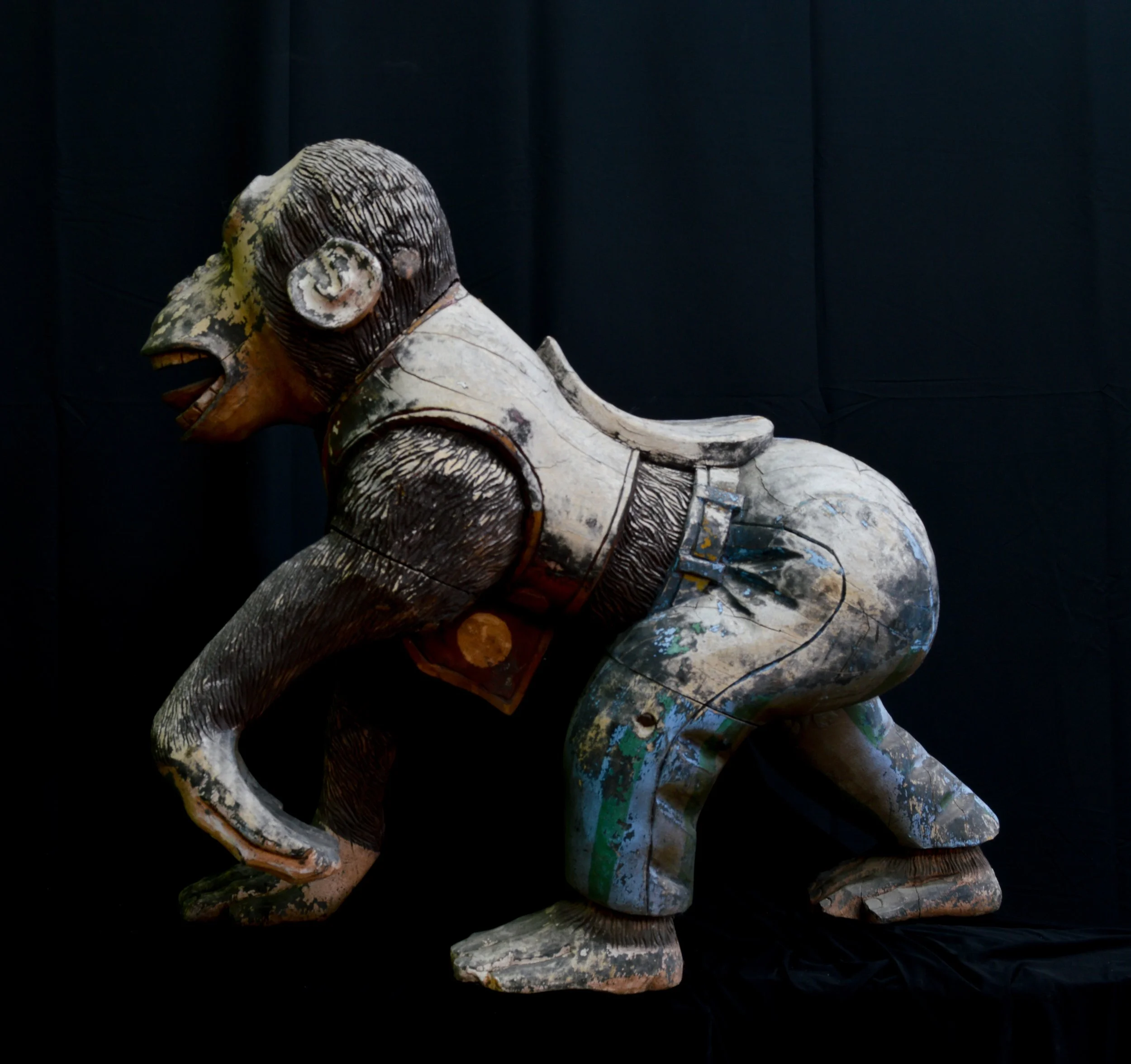
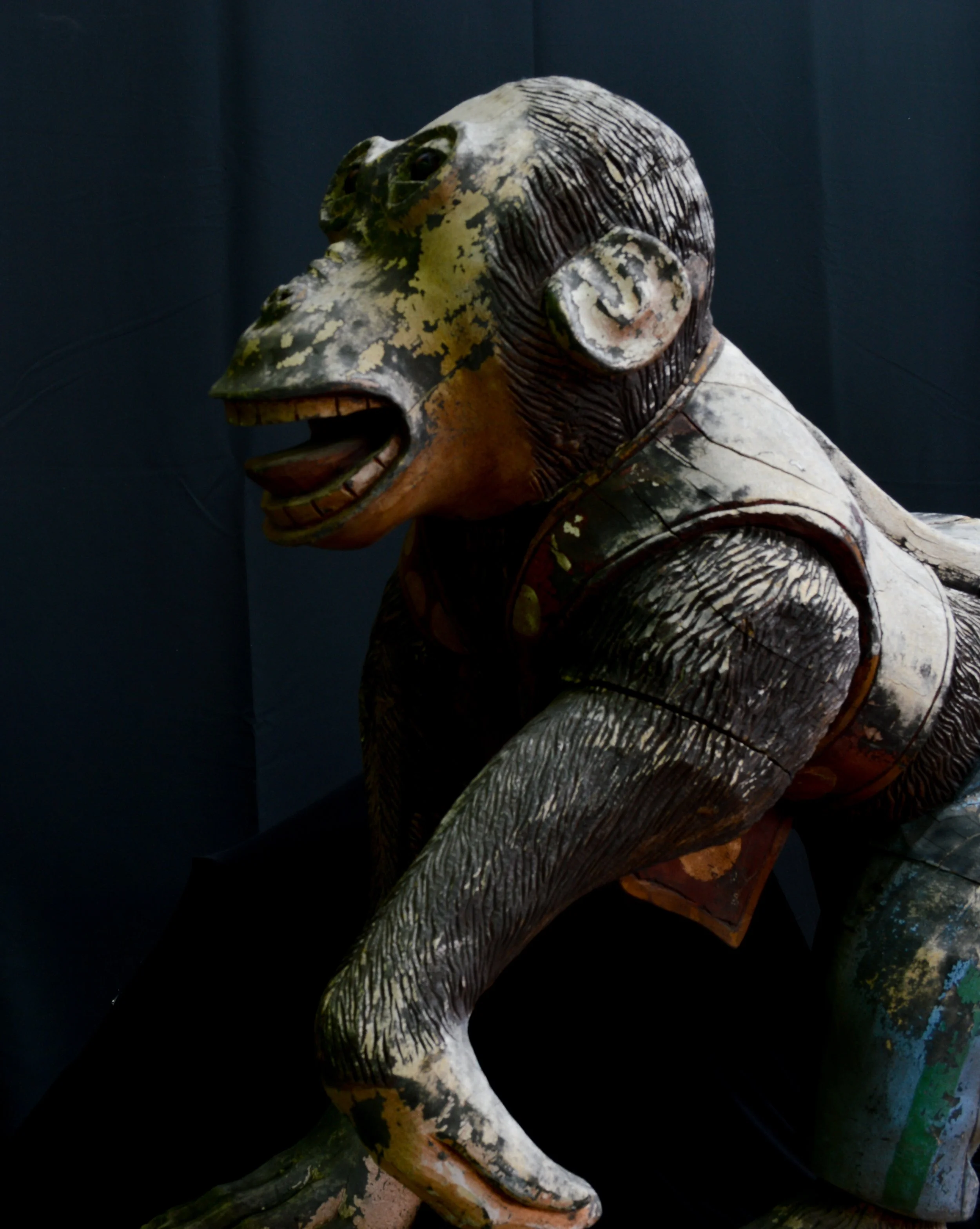
A carved wooden chimpanzee in a quadrupedal walking pose, anthropomorphically dressed in striped trousers and a polka-dot vest. The figure is rendered with remarkably fine, densely incised fur work across all exposed surfaces — arms, legs, head, chest, and hands. The romance-side vest panel carries a white polka-dot pattern on a reddish-brown ground with gold/yellow buckle details at the waist. The trousers are painted in green and gray/blue stripes. The face is highly expressive: mouth open showing individually carved teeth, prominent rounded carved ears, and glass inset eyes. A short tail or tail stub extends from the rear. A square wooden block at the belly center serves as the pole mount point. The figure is relatively small, measuring approximately 26–28 inches in length based on a tape measure visible in one photograph. The owner identifies it as "small chimpanzee" and confirms it is authentic, noting the carving is "real fine in the hair" and considers the figure too ornate to be of Mexican origin (reported).
-
Acquired from Morphy Auctions (reported). The owner references "Morphy II," likely indicating a second Morphy sale or the second piece acquired from the house (reported). The price paid is not recalled (reported). The owner notes a second primate figure — a gorilla — in the collection and suggests comparing the two (reported).
-
The trail begins at Morphy Auctions in Denver, Pennsylvania. Morphy is a major American auction house with documented strength in carousel and amusement-related material (sourced). The specific lot number, sale date, and catalog details have not been confirmed. Pre-Morphy provenance is unknown.
-
A standalone dressed chimpanzee as a carousel or fairground ride figure is extremely rare. In the documented American carousel tradition, primates appear almost exclusively as secondary carvings — small monkeys perched on the cantles of saddles, most commonly on camel figures attributed to a major Brooklyn manufacturer (sourced). One surviving example on the Children's Creativity Museum carousel in San Francisco features a monkey as a saddle-mounted secondary figure (sourced). Standalone rideable primate figures are not part of the documented repertoire of major American Golden Age manufacturers.
The owner's instinct that this figure is not Mexican is worth noting. Mexican carousel workshops produced a wide range of exotic animal types, including primates, but the owner's assessment — that the carving is too fine and ornate — has photographic support. The fur incising on this figure is exceptionally detailed and consistent throughout, carried at comparable quality across both sides, a level of refinement that exceeds the typical output of mid-twentieth-century Mexican workshops.
The anthropomorphic dressing — a chimpanzee in striped trousers and a polka-dot vest — places this figure firmly in the European singerie tradition, a decorative convention with deep roots in French art dating to the seventeenth century, in which monkeys and apes are depicted dressed and behaving as humans. This motif was applied to fairground and carousel figures in Continental European practice. A French carved and painted wooden carousel monkey has been documented through dealer inventory (sourced). European fairground workshops — French, German, and Belgian — produced dressed animal figures for children's rides, shooting galleries, and decorative carousel elements throughout the nineteenth and early twentieth centuries.
The figure's construction is consistent with professional carousel workshop practice: laminated block body with visible seams, a centered pole mount block, and polychrome paint applied in multiple campaigns. The paint wear is heavy and authentic, showing multiple layers consistent with park use over an extended period. The romance side is more elaborately painted than the non-romance side — the polka-dot vest treatment appears primarily on the romance side, while the non-romance side shows a plainer treatment — which is standard carousel practice.
No direct auction comparable for a dressed chimpanzee carousel figure has been located. The figure's rarity, quality of carving, and condition make it difficult to value against standard menagerie figure benchmarks.
-
The figure is structurally intact. The carving detail is well-preserved throughout, with the fine incised fur work legible on all surfaces despite extensive paint loss. The polychrome paint is heavily worn, with large areas of bare wood visible, particularly on the non-romance side and the lower legs. Multiple paint campaigns are discernible in the layering. The glass eyes appear intact. Carved teeth are intact and clearly defined. The pole mount block at the belly center is present and visible. Some seam separation is visible at lamination joints on the body barrel. The whiteboard reads #040 (no date visible). Overall, the figure reads as a working carousel or fairground piece with authentic park wear — unrestored and in as-found condition. A formal condition assessment is pending.
-
Low. The figure is confirmed authentic by the owner and its physical characteristics support that assessment. The Morphy Auctions acquisition provides a credible commercial provenance anchor. However, no maker, country of origin, or workshop has been identified. The anthropomorphic dressing and carving quality are consistent with Continental European fairground traditions, and the singerie convention points toward French origin, but this remains inferential. The figure type is rare enough that close documented parallels have not been located.
-
Owner interview recording (transcribed), providing acquisition source (Morphy Auctions), authenticity assessment, rejection of Mexican attribution, and reference to a companion gorilla figure in the collection
Six photographs (DSC_2538 through DSC_2544): romance side with whiteboard, romance side full, romance side head close-up, non-romance side full, non-romance side head close-up, non-romance side with tape measure
Morphy Auctions company profile and specialization documentation (sourced)
Collectors Weekly: documentation of monkeys as secondary carousel figures on American machines
1stDibs: French carved and painted wooden carousel monkey listing; Looff-style carousel camel with monkey secondary carving
CarouselHistory.com: menagerie figure documentation and gallery archives