
Carmel - Horse
Catalogue #101 tbd
-
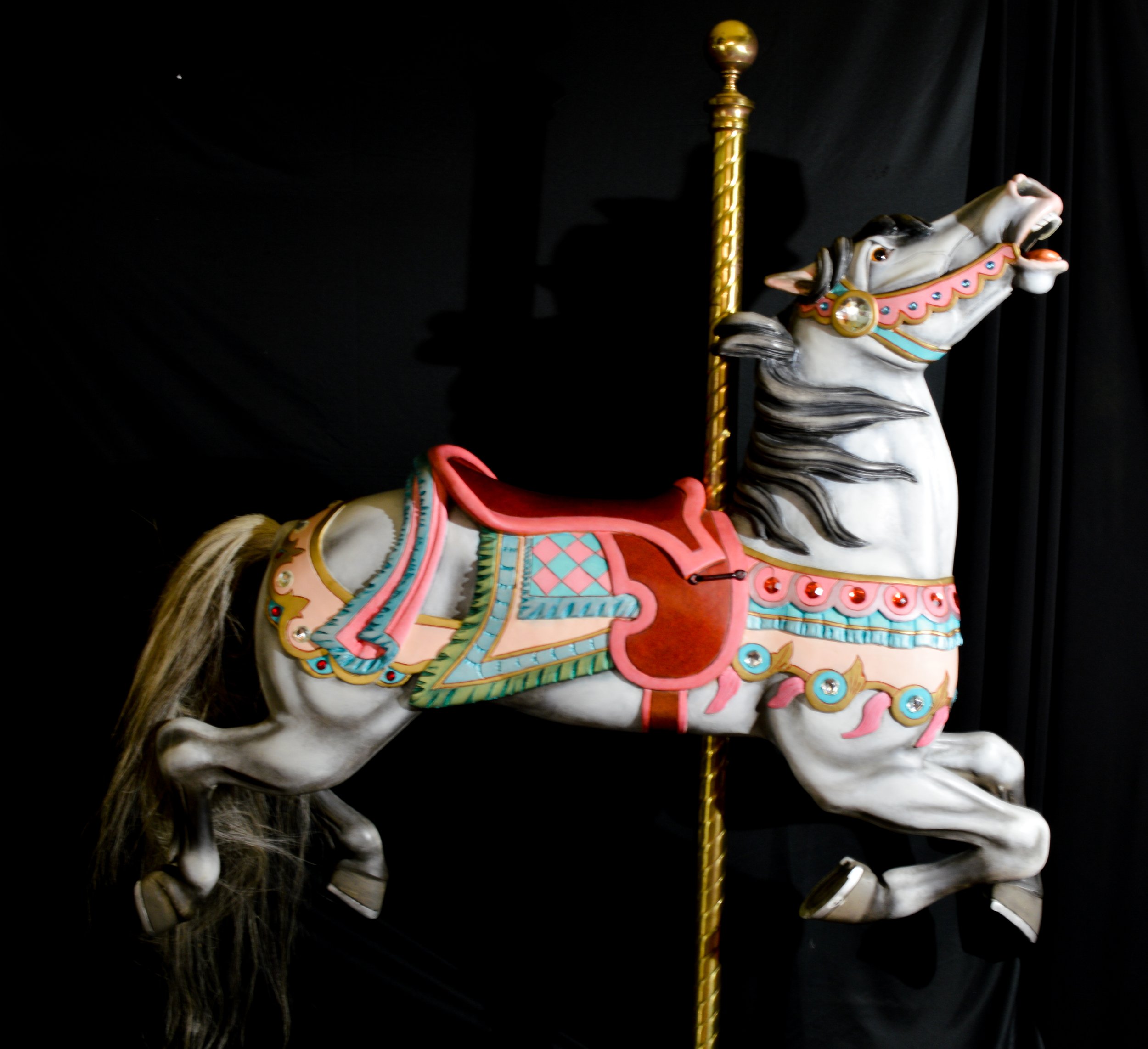
A full-size carved wood outside-row stargazer jumper, attributed to Charles Carmel of Brooklyn, New York, c. 1914, traced to the Luna Park, Sydney, Australia carousel. The figure is in the classic stargazer pose — head raised and tilted sharply upward, mouth open with carved tongue and teeth, ears swept back, eye lifted. The body is painted in soft dapple grey with darker grey-black flowing mane and a real horsehair tail in cream and grey tones. All four legs are in motion with the front legs tucked tight and the rear legs extended back. The romance-side trappings are elaborate: a coral-pink saddle with raised cantle and pommel over a complex saddle blanket of pink and teal harlequin diamonds, scalloped layers in pink, teal, sage green, and gold, with carved tassels and pendant scrollwork. The bridle and breast collar carry pink-and-gold jeweled cartouches set with red and clear cabochons. Brass twisted pole through the back with a ball finial. The figure is named "Sydney" in the collection (reported).
-
Purchased at the American Carousel Museum auction (the "Norton" auction) in San Francisco, 1991 (reported). The owner notes this was the same auction at which the Dentzel rooster (ID 061) was sold — the rooster going to a different buyer at the time, then making its way into the collection nearly thirty years later through a separate purchase from Jim Aten in 2020.
-
The provenance chain is unusually well documented for a piece of this kind. The auction context is independently corroborated: the American Carousel Museum's 1991 San Francisco sale dispersed figures from three documented sources — the Rock Springs Müller carousel from Chester, West Virginia; Edgewater Park Dentzel figures from Detroit, Michigan; and Carmel figures from Luna Park, Sydney, Australia (sourced — CarouselHistory.com Norton Amusement Park Auction Timeline).
The Luna Park Sydney provenance carries an additional documented layer worth recording. North Sydney Heritage records confirm that the original Luna Park Sydney carousel was sold to the United States as the park went through closure and refurbishment cycles in the 1980s (sourced — North Sydney Heritage Leaflet 8, Luna Park). Some of those figures moved first through Guernsey's New York in 1988, with documented Bonhams resales since then describing the provenance as "Luna Park, Sydney, Australia; Guernsey's, New York; 1988" (sourced — Bonhams auction records). The 1991 San Francisco sale appears to have dispersed additional figures from the same carousel; specialist sources also reference the machine as "the Dolle Carousel at Luna Park in Australia" (sourced — AntiqueCarousels.com Carmel Lion listing).
A date divergence worth flagging: Luna Park Sydney did not open until 1935, while the figure is dated c. 1914 (reported, sourced from owner master list). This is not a contradiction — the carousel itself may date from 1914 and have been installed at Luna Park Sydney later, either from another Australian park (Luna Park Melbourne opened in 1912) or shipped from Brooklyn for installation when the Sydney park opened. Pre-Sydney production-to-installation history of the Carmel figures is not currently documented in this research pass.
-
Charles Carmel (1865–1931) operated his Brooklyn workshop from approximately 1903 until his death in 1931, after working first for the dominant Coney Island school carver and then for another major American manufacturer of frame and platform machinery. His figures are documented for ornate decoration — elaborately carved saddles, fish-scale armor blankets, jeweled bridles, secondary carvings — and the stargazer head-up pose is a documented Carmel form. A Carmel stargazer jumper sold by a major specialist dealer is described as "head up stargazer jumper. Large buckle. Fancy saddle and fish scale armor blanket... Hair tail" — a description that corresponds closely to this figure on every documented point (sourced — AntiqueCarousels.com listing, $6,500).
Documented Luna Park Sydney provenance places this piece in a small group of figures whose carousel of origin is established. Other Carmel pieces from that machine — including a documented Carmel Lion from the same carousel — are in collector hands. The dealer comparable provides a baseline for the figure type, but the documented Luna Park Sydney provenance raises the band substantially above unattributed Carmel stargazers.
Pigs appear in the standard Dentzel menagerie repertoire alongside the workshop's broader animal vocabulary (sourced), and pigs survive in multiples on at least one operating Dentzel machine — the Burlington City Park (NC) carousel carries four pigs among its forty-six animals (sourced). Each Dentzel animal was hollow-carved from basswood and poplar in a series of glued boxes built up into the basic shape and finished by hand (sourced), which is consistent with the construction one would expect on ID 099 pending inspection.
Pigs are therefore not the rarest Dentzel menagerie form — they are documented surviving on operating machines — but they appear infrequently on the private market relative to the workshop's horses and inside-row jumpers. The most directly comparable recent sale is a ca. 1911 Dentzel pig jumper from the Edgewater Park Carousel in Detroit, 44 × 11 × 29 inches, restored, with provenance through the Redbug Workshop of Maurice and Nina Fraley; AntiqueCarousels.com listed the piece at $9,000 (sourced). A Bonhams sale of a related Cernigliaro-attributed menagerie figure — a Dentzel goat, Philadelphia, circa 1905, with untouched original paint — was illustrated in Charlotte Dinger's The Art of the Carousel, page 63 (sourced), and a Dentzel goat under the same Cernigliaro attribution achieved $23,560 against a $15,000–$25,000 estimate at New Haven Auctions in June 2022 (sourced). The acquisition price for ID 099 sits below the documented Edgewater Park pig comparable, which is consistent with the absence of a park-of-origin trail and confirmed earlier provenance at the point of sale.
-
The dapple body paint is even and naturalistic, the carved decorative program reads crisply, the jeweling is intact, the saddle scrollwork is sound, and the horsehair tail is present and full. The brass pole is intact through the back with the original ball finial. Carved tongue, teeth, and the open mouth are all well preserved. No structural concerns visible from the single submitted photograph. Whether the current paint represents the figure's restoration at acquisition in 1991 or a subsequent restoration is not documented from current materials. Non-romance side documentation is pending.
-
Owner interview transcript (acquisition date, price, auction venue, "Sydney" naming, cross-reference to ID 061)
Photograph submitted (romance side, full figure)
Master collection list (PDF) — confirms 1914 dating, Luna Park Sydney provenance, "Sydney" name, and $8,000 purchase price
CarouselHistory.com — Norton Amusement Park / American Carousel Museum auction timeline (corroborating the 1991 San Francisco sale and confirming Luna Park Sydney Carmel as one of three documented source machines)
North Sydney Heritage Leaflet 8 — Luna Park Sydney carousel disposition to the United States
Bonhams auction records — documented Luna Park Sydney Carmel provenance language ("Luna Park, Sydney, Australia; Guernsey's, New York; 1988")
AntiqueCarousels.com — Carmel stargazer dealer comparable; Carmel Lion entry referencing the "Dolle Carousel at Luna Park in Australia"
Prior catalog entry ID 061 — establishing the cross-reference to the 1991 American Carousel Museum auction context
-
High. Maker attribution to Charles Carmel is supported by direct form correspondence with documented specialist-dealer descriptions of the same figure type and by an established documentary chain placing Carmel figures at Luna Park Sydney. Carousel-of-origin provenance to Luna Park, Sydney, Australia is independently corroborated by multiple specialist sources documenting the 1991 American Carousel Museum auction's content. Acquisition date, price, and auction venue are documented in owner records and consistent with the published auction record. Dating to c. 1914 is supported by alignment with the documented Carmel production period and is consistent with documented Carmel installation activity in Australia during the pre-1914 export window.