
Dentzel - Horse
Catalogue #102 tbd
-
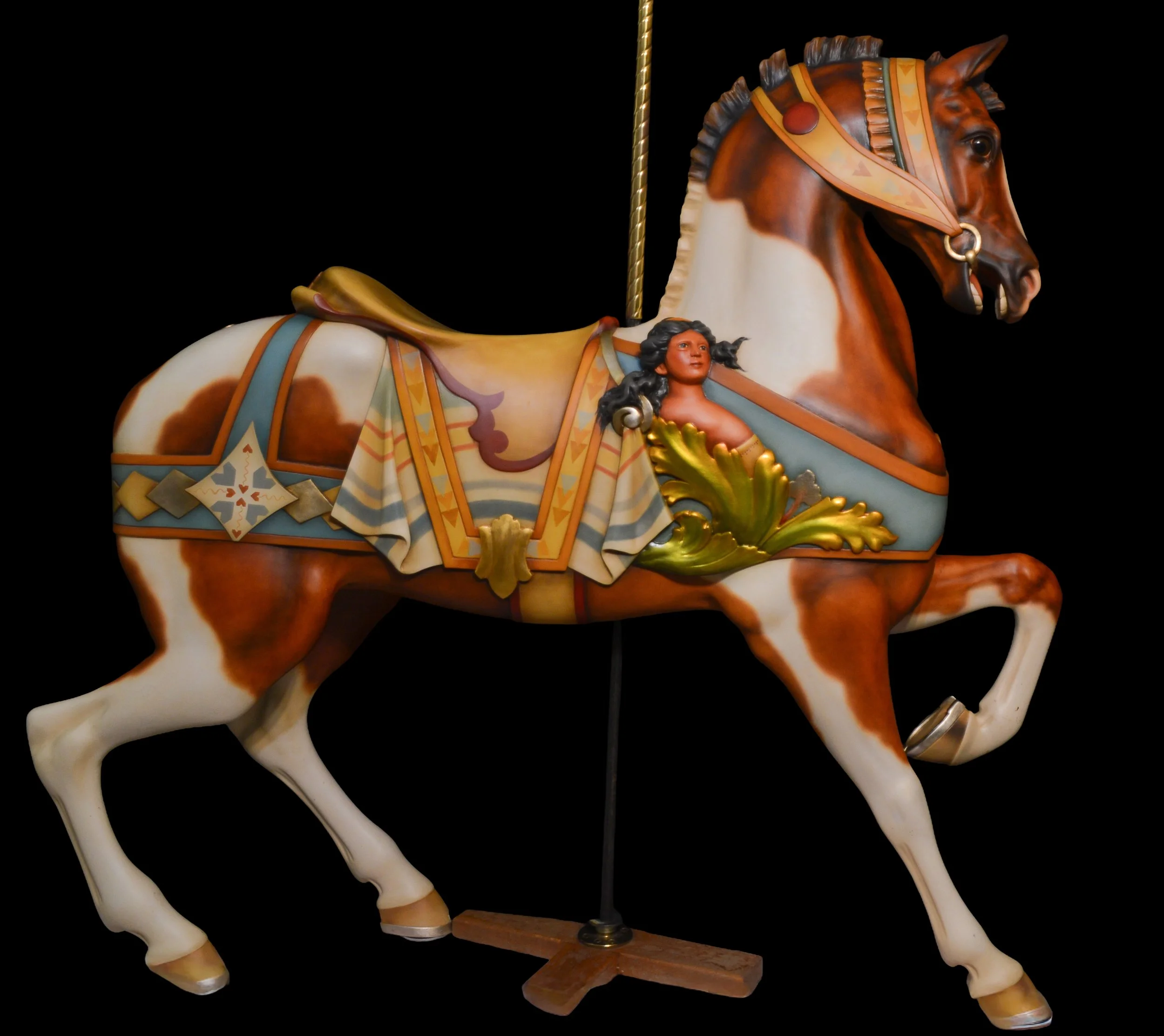
A full-size carved wood outside-row stander, attributed to the Dentzel Carousel Company of Philadelphia, with carving stylistically consistent with Daniel Müller's work for the Dentzel workshop. The figure is presented as an "Indian pony" thematic program: pinto/paint coat (chestnut patches on a white ground), close-cropped roached mane, naturalistic head with tucked neck, glass eye, and a metal bit ring at the mouth. The trappings are layered and ornate: a yellow-tan high-back saddle, an amber-and-blue geometric-patterned saddle blanket with chevron and diamond motifs (Native American textile reference in paint), draped cloth fall with knotted corner, and a deeply carved gold acanthus scrollwork pendant at the breast. Mounted as the secondary carving against the acanthus is a naturalistic carved female bust with long dark flowing hair, bare-shouldered, presented as a portrait figure. The horse stands in a prancer posture with the right foreleg raised. Brass twisted pole through the back, wooden cross-stand. Painted by Pam Hessey of Hawk's Eye Studio (reported).
-
Acquired from the Ersepke collection (reported). The price paid is unrecorded in current materials but recalled as below typical market for the form, with the acquisition occurring "near the end of the sale" (reported). Restoration paint by Pam Hessey is confirmed by the owner directly (reported); Hessey has provided no additional documentation to date.
-
The provenance trail begins at the Ersepke collection, the same source that recurs across the holdings, including ID 012 (Dentzel tiger), ID 060 (Dentzel lion), ID 081 (Dentzel rabbit), ID 099 (Dentzel pig), and this figure. Pre-Ersepke ownership, carousel of origin, and operating-park history are not yet documented. The collection itself has not been independently identified in specialist carousel sources across multiple prior research passes.
-
Attribution to the Dentzel Carousel Company rests on several physical characteristics consistent with documented Dentzel/Müller outside-row stander production. Specialist dealers describe a comparable Dentzel form as having "tucked head with roached mane. High back double eagle saddle with scroll trappings" — a description that aligns with this figure's tucked head, close-cropped mane, raised saddle back, and gold acanthus scrollwork (sourced — AntiqueCarousels.com, Dentzel outside-row stander listing). The naturalistic anatomy, restrained decoration relative to Coney Island school production, and refined head carving with bit ring are consistent with the Philadelphia school's documented aesthetic across its Dentzel-period output.
The "Indian pony" thematic program — pinto coloring, roached mane, geometric textile-pattern blanket, and a naturalistic female bust secondary carving — is documented specifically within the Dentzel workshop's later production through Daniel Müller's carving. A Carousel News & Trader photograph published in 1992 documents a "restored Müller Indian pony from Pen Mar carousel" (sourced — CarouselHistory.com Issue No. 12, Vol. 9, December 1993 contents listing). Daniel Müller and his brother Alfred ran their own carousel company from 1903 to 1917 and then returned to work for the Dentzel factory from 1918 to 1926 (sourced — AntiqueCarousels.com; National Park Service Forest Park Carousel record). Specialist dealers note that the Müller brothers "added a number of fun, new designs to the Dentzel herd in those years up until 1926 when 'the carving died'" (sourced — AntiqueCarousels.com, Dentzel/Müller stander listing). The Indian pony form sits within this Müller contribution to the Dentzel output.
Müller's training is significant for reading this figure: he studied sculpture at the Pennsylvania Academy of the Fine Arts, and his figures are documented as "particularly beautiful and realistic... with expressive eyes, intricate compositions, and naturalistic muscles," with sculptors noting qualities similar to Augustus Saint-Gaudens (sourced — National Park Service, Forest Park Carousel). The naturalistic female bust on this figure — modeled with anatomical fidelity rather than as a cherub or fantasy figure — is consistent with Müller's fine-arts background and documented preference for portrait realism in secondary figures.
The female bust's painted treatment (warm olive-brown complexion, long dark wavy hair) is most plausibly a restoration paint decision applied to a carving that could be read either as a generic Mediterranean portrait figure or as a specifically Native American maiden depending on paint choices. Whether the original carving was painted this way or whether the Indian-maiden reading was emphasized during the Hessey restoration would require photographic documentation pre-restoration to resolve.
A note on attribution alternatives worth recording: the "Indian pony" thematic program — pinto coat, roached mane, geometric textile blanket, female bust secondary — is also documented at three Coney Island-school workshops of the same period. A circa 1910 outside-row stander from one of those workshops, a circa 1915 stander from a second, and a stander from a third all carry comparable thematic programs (sourced — auction archive descriptions). Without underside marks, machine-of-origin provenance, or direct specialist examination, the attribution cannot be fully closed against those alternatives on photographic evidence alone. The Ersepke collection's consistent Dentzel sourcing across other entries is the strongest single piece of supporting evidence for the Dentzel attribution here.
Auction and dealer comparables:
Dentzel outside-row stander, c. 1905, "tucked head with roached mane, high back double eagle saddle with scroll trappings" — sold via AntiqueCarousels.com (price not retrieved, dealer-sold) (sourced).
Dentzel outside-row stander, c. 1905, "high eagle back saddle and interesting flopped over mane," dealer asking $18,000–$22,000 (sourced — AntiqueCarousels.com).
Dentzel/Müller outside-row stander, c. 1920, from the collection of "the late, revered Jon Abbott," dealer-sold (sourced — AntiqueCarousels.com).
Outside-row standers with documented "Indian pony" thematic programs from contemporary workshops have realized in the $12,000–$22,000 range unattributed and $22,000–$40,000+ when firmly attributed to a named workshop (sourced — prior collection research notes).
-
Photographs show a fully restored figure presented at a high standard. The pinto coat paint is naturalistically blended, the carved details on the saddle, trappings, breast collar, and acanthus scrollwork all read crisply, and the gold-leaf passages are even and intact. The secondary bust is fully painted with intact dark wavy hair, eyes, and shoulders. Glass eye on the horse's head is intact. Bit ring is present. Brass pole is intact through the back. The wooden cross-stand is sound. No structural concerns visible from the single submitted photograph. Whether the current restoration represents the figure's first restoration or one of multiple over its history is undocumented. Non-romance side documentation is pending.
-
Owner interview transcript (Ersepke collection source, Pam Hessey paint confirmation)
Photograph submitted (romance side, full figure)
Master collection list (PDF) — entry for ID 102 confirms Dentzel attribution, Ersepke collection source, Pam Hessey paint
AntiqueCarousels.com — Dentzel outside-row stander dealer listings (multiple), including the c. 1905 "tucked head with roached mane" form and the c. 1920 Dentzel/Müller stander
CarouselHistory.com — Issue No. 12, Vol. 9 (December 1993) contents listing referencing the restored Müller Indian pony from the Pen Mar carousel
National Park Service — Forest Park Carousel record, Daniel Müller biographical and stylistic documentation
vintagecarousels.com — Cernigliaro and Müller biographical context and Dentzel workshop production history
Prior catalog entries in this collection (IDs 012, 060, 081, 099) — recurring Ersepke source documentation
Prior research pass on this same figure (photograph DSC_2797) — initial photographic analysis flagging the Indian pony program
-
Medium. Dentzel attribution is reported by the owner and supported by recurring source-collection patterns across the broader holdings. The tucked-head, roached-mane, layered-trappings construction is consistent with documented Dentzel/Müller outside-row standers. The "Indian pony" thematic program with naturalistic female bust secondary carving is documented at the Dentzel workshop specifically through Daniel Müller's carving from the c. 1918–1926 period, with documented examples at the Pen Mar carousel. However, the same thematic program is also documented at Coney Island school workshops of the same period, and without underside marks, machine-of-origin provenance, or specialist examination, an attribution alternative cannot be ruled out on photographic evidence alone.