
Looff - Tiger
Catalogue #103 tbd
-
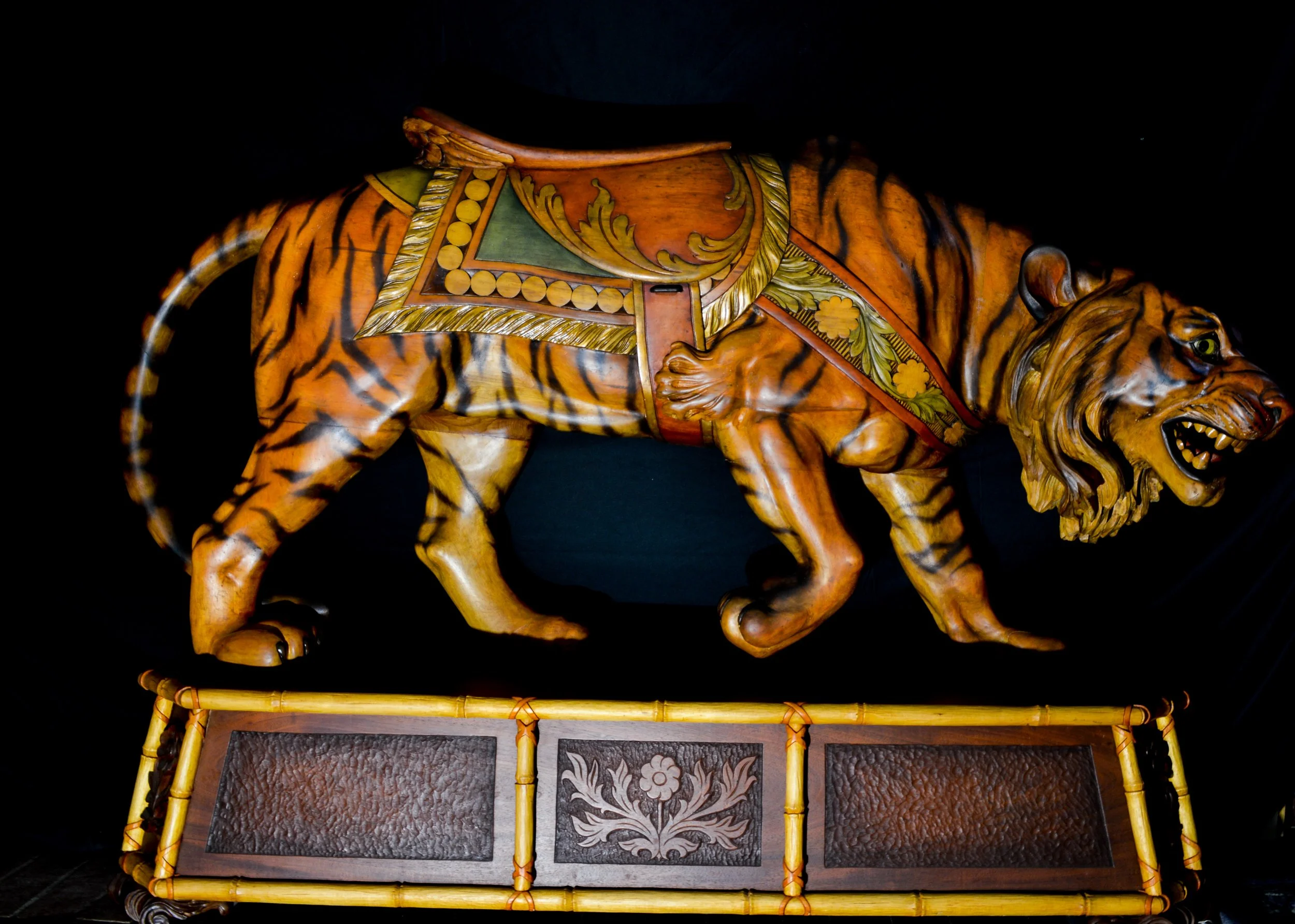
A full-size carved wood carousel tiger in the documented "sneaky" stalking pose — body low and elongated, head dropped slightly forward, mouth open showing carved teeth and tongue, yellow-green glass eyes alight. The figure is one of only three "sneaky" tigers known to exist (sourced). Attributed to the Charles I.D. Looff Company, c. 1909, with carving attributed to John Zalar (1876–1924) (sourced). The surface treatment is unusual and deliberate: during restoration the figure was stripped of its original paint layers and the wood was stained with various colors, allowing the grain to show through (sourced). Black tiger-stripe markings are applied over the stained ground; the saddle area carries a brown leather-style saddle with a green saddle pad, a gold coin-disc border, deep gold acanthus scrollwork at the cantle, a brown-and-gold breast collar, and a carved floral spray over the shoulder. The tail curls in a circular loop behind the body. The figure is mounted on a custom display base of yellow bamboo-style frame with three inset panels; the center panel carries a relief-carved flower-and-acanthus motif.
-
Acquired from the collection of John and Cathy Daniel (sourced — Tobin Fraley, Carousel Animals: Artistry in Motion, page 105). The Daniels are documented carousel collectors whose holdings included a major historic carousel rescued from the Los Angeles County Fairgrounds in Pomona and sold shortly before John Daniel's 2011 death. Pam Hessey of Hawk's Eye Studio (Kingman, AZ) completed the restoration and paint in 1994 (sourced — Americana Insights / Tobin Fraley Archive). The custom display base is documented by the owner as a recent commission from a carver and restorer in Santa Monica, CA, encountered in person during the owner's visit there (reported).
-
The figure last operated at Sans Souci Park, Wilkes-Barre, Pennsylvania (sourced — Fraley, Carousel Animals, p. 105). Sans Souci Park began as Hanover Grove in 1880, became Hanover Park in 1892, and was renamed Sans Souci Park in 1905 when a syndicate spent approximately $125,000 to install rides and convert it into what local newspapers called "a Coney Island of its own" (sourced — Wilkes-Barre Times Leader). The Looff carousel at Sans Souci was a documented installation of that period; other figures from the same machine have appeared on the specialist market — for example, a c. 1914 Sans Souci Looff outside row stander with documented Sans Souci provenance was sold via a major specialist dealer and described as having "elaborate trappings all around including a dagger, powder horn and pouch at the cantle" (sourced — AntiqueCarousels.com).
The chain established for this figure:
Carved c. 1909 by John Zalar for the Charles I.D. Looff Company (sourced — Americana Insights / Tobin Fraley Archive; Fraley, Carousel Animals, p. 105)
Installed on the Looff carousel at Sans Souci Park, Wilkes-Barre, PA (sourced — Fraley)
After dispersal of the Sans Souci machine, entered the collection of John and Cathy Daniel (sourced — Fraley)
Restored and painted by Pam Hessey, Hawk's Eye Studio, Kingman, AZ, 1994 (sourced — Americana Insights)
Sold from the Daniel collection (reported)
Custom display base added subsequent to acquisition (reported)
This is the most fully documented provenance trail in the collection alongside ID 012 (Dentzel tiger, Swen Swenson provenance) and ID 061 (Dentzel rooster, bill of sale provenance).
-
The "sneaky" tiger is among the rarest single forms produced by any American carousel workshop. Tobin Fraley's The Carousel Animal: Artistry in Motion establishes the type's rarity directly: "The tiger was a favorite on many machines, but only three of these ferocious 'sneaky' tigers are known to have been made. With his head down and a gleam in his eyes, there was no mistaking that this cat was on the prowl" (sourced — Fraley, Carousel Animals, p. 105). The Spokane Carrousel organization independently confirms the rarity count: "Sneaky is one of only three carousel tigers in this pose known to exist. And he's the only one still on public display" (sourced — spokanecarrousel.org).
The three documented sneaky tigers are: the example still in operation on the 1909 Looff carousel at Riverfront Park, Spokane, Washington (sourced — National Register of Historic Places, Riverfront Park Carousel; Spokane Carrousel); this figure, which last operated at Sans Souci Park, Wilkes-Barre; and a third example whose current location is not established in the current research pass.
The Spokane Riverfront Park Looff carousel — a 1909 Looff machine built as a wedding gift from Charles Looff to his daughter Emma Vogel and her husband Louis Vogel, owners of Natatorium Park — is documented as "the last operating carousel created by Charles Looff" and is listed on the National Register of Historic Places. It is documented as the only Looff carousel on which all horses are jumpers, with 54 jumpers, one giraffe, one tiger, and two dragon chariots in the menagerie. Four of the horses are armored and the tiger is identified as a "sneaky" (sourced — Wikipedia, Riverfront Park Carousel; vintagecarousels.com). The shared 1909 dating between the Spokane Looff and the Sans Souci Looff figure provides a documented production-period anchor for the form.
John Zalar (1876–1924) is documented as "an extraordinarily talented carver who worked for both the Looff Company and the Philadelphia Toboggan Company" (sourced — Americana Insights). The Spokane Riverfront Park Looff carousel is documented as a machine on which "most, if not all, of the horses were carved by John Zalar" — the strongest single piece of evidence connecting Zalar to the sneaky tiger form, since Spokane's surviving sneaky tiger rides on a machine where Zalar is the documented carver of the figure population (sourced — vintagecarousels.com). Zalar's documented signature is "bold and daring figures with fierce facial expressions, sleek muscular legs, and flowing manes" — characteristics fully evident in this tiger's anatomy and head carriage.
The Hessey restoration approach — stripping the original paint and staining the wood rather than repainting — is unusual in the specialist field and was a deliberate choice to expose the carving's quality. The result is closer to a sculptural display than a typical carousel restoration. Pam Hessey of Hawk's Eye Studio is documented as a leading specialist restorer with credits including the 1924 Dentzel carousel figures at the Please Touch Museum, Philadelphia, and multiple high-profile collection pieces (sourced — A&E Sculpting biography; project records).
Auction and dealer comparables:
Sans Souci Park Looff outside-row stander, c. 1914, restored — dealer-sold via AntiqueCarousels.com (price not retrieved in this pass) (sourced).
The Daniel collection's major historic carousel realized "over a million dollars" at sale shortly before John Daniel's 2011 death (sourced — collection records for ID 011; CarouselHistory.com).
Looff outside-row standers with documented operating-machine provenance run $15,000–$40,000+ in the current market depending on condition and restoration.
Rare-form Looff menagerie figures with documented provenance and specialist restoration sit in a higher band; the world record for a Looff menagerie piece is $69,000 for a Whalom Park greyhound, June 2001 (sourced — CarouselHistory.com).
The sneaky tiger's rarity profile (one of three known), its documented carver attribution (Zalar within Looff), its documented operating-machine provenance (Sans Souci Park), its documented collection history (Daniel collection), and its specialist restoration with named restorer and date (Hessey, 1994) place this figure in the highest documentary tier of carousel art in private hands.
-
The figure presents in exceptional condition consistent with the 1994 Hessey restoration. The stained-wood-and-stripe finish is even and stable; the gold scrollwork at the cantle and breast collar reads crisply; the glass eyes are intact with the documented yellow-green coloration; the carved teeth, tongue, claws, and tail curl are all sound. No structural concerns visible from the submitted photograph. The custom display base is recent and in excellent condition. Non-romance side documentation is pending. Whether any of the original paint was preserved as evidence prior to stripping is not documented in current materials; this is a meaningful question for restoration record-keeping.
-
Owner interview transcript (Looff attribution, Daniel collection source, Hessey paint, Santa Monica base carver)
Photograph submitted (non-romance side, full figure with base)
Tobin Fraley, Carousel Animals: Artistry in Motion (2002), page 105 (PDF scan provided) — published attribution: "Charles I.D. Looff Company, c. 1909... only three of these ferocious 'sneaky' tigers are known to have been made... Last operated at Sans Souci Park, Wilkes-Barre, Pennsylvania. Painted by Pam Hessey. From the collection of John and Cathy Daniel."
Americana Insights / Tobin Fraley Archive — "Attributed to John Zalar (1876–1924) for Charles I.D. Looff Carrousel Manufacturers, Tiger... Restored and painted by Pam Hessey, Hawk's Eye Studio, Kingman, AZ, 1994. Photograph by Tobin Fraley. This 'sneaky' tiger is one of three known examples."
SpokaneCarrousel.org — independent confirmation of three-known-examples count and Spokane location of operating example
AntiqueCarousels.com — Sans Souci Park Looff stander comparable (c. 1914)
National Register of Historic Places — Riverfront Park Carousel (Spokane Looff, 1909) record
vintagecarousels.com — Spokane Looff machine inventory and Zalar carving attribution
Wilkes-Barre Times Leader — Sans Souci Park history (Hanover Grove to Sans Souci Park, 1905 conversion)
A&E Sculpting / Roth Management — biographical and operational record for Ed Roth, Santa Monica Pier carousel operator (possible identification for the "Santa Monica" base carver referenced in the owner's transcript)
Prior project records for IDs 011 and 012 — establishing Daniel collection context and Hessey restoration network
-
High. Maker attribution to the Looff Company is documented in published reference material (Fraley, 2002). Carver attribution to John Zalar is documented in the Tobin Fraley Archive publication via Americana Insights. Carousel of origin (Sans Souci Park, Wilkes-Barre) is documented in published material. Restorer and restoration year (Pam Hessey, 1994) are documented. Prior collection ownership (John and Cathy Daniel) is documented in published material. The rarity claim (one of three known) is independently corroborated by two specialist sources. This is the second piece in the collection (after ID 012) to attain the project's highest documentation tier.