
Herschell - Horse
Catalogue Piece #033 77×59×16cm
-
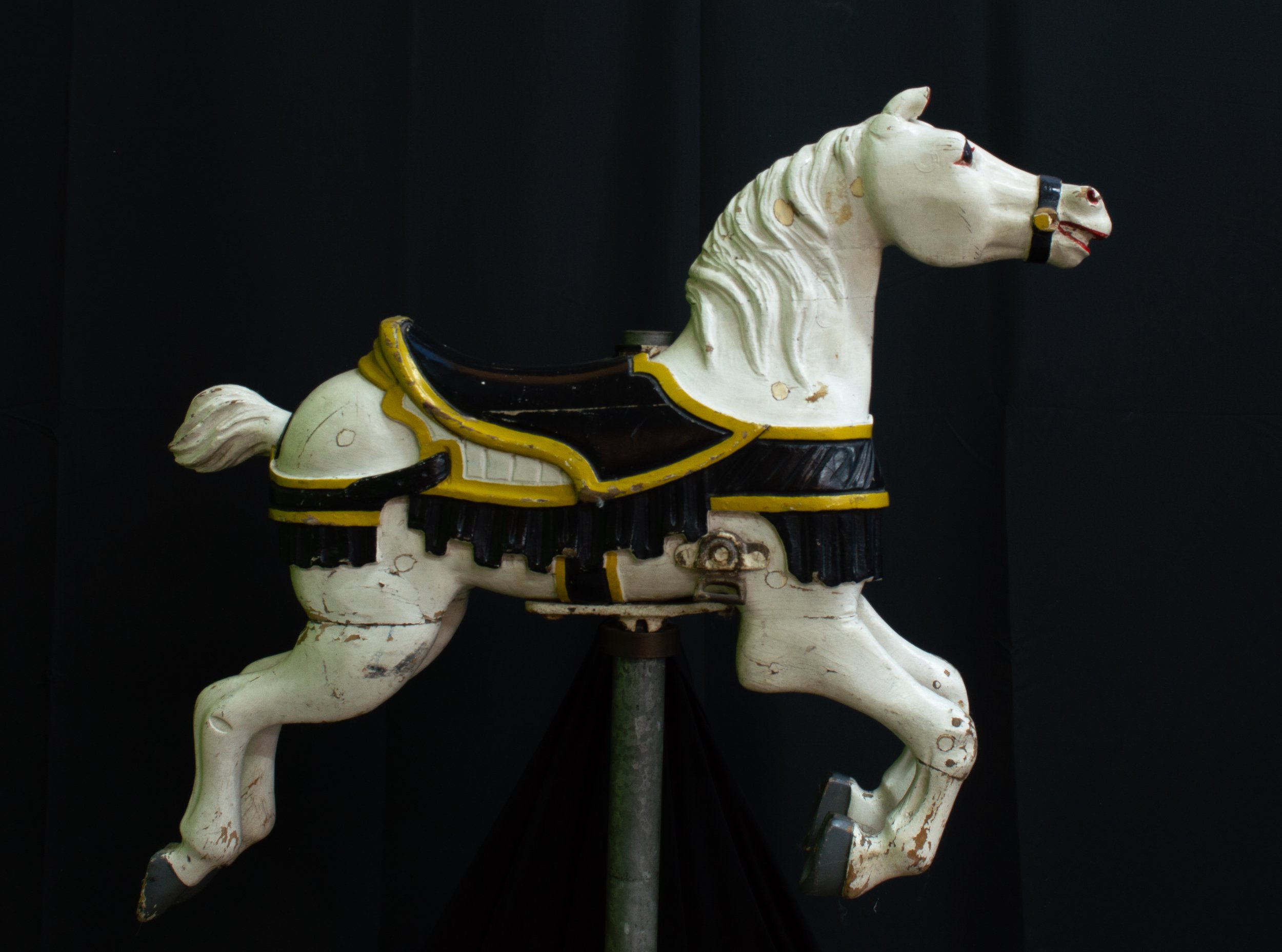
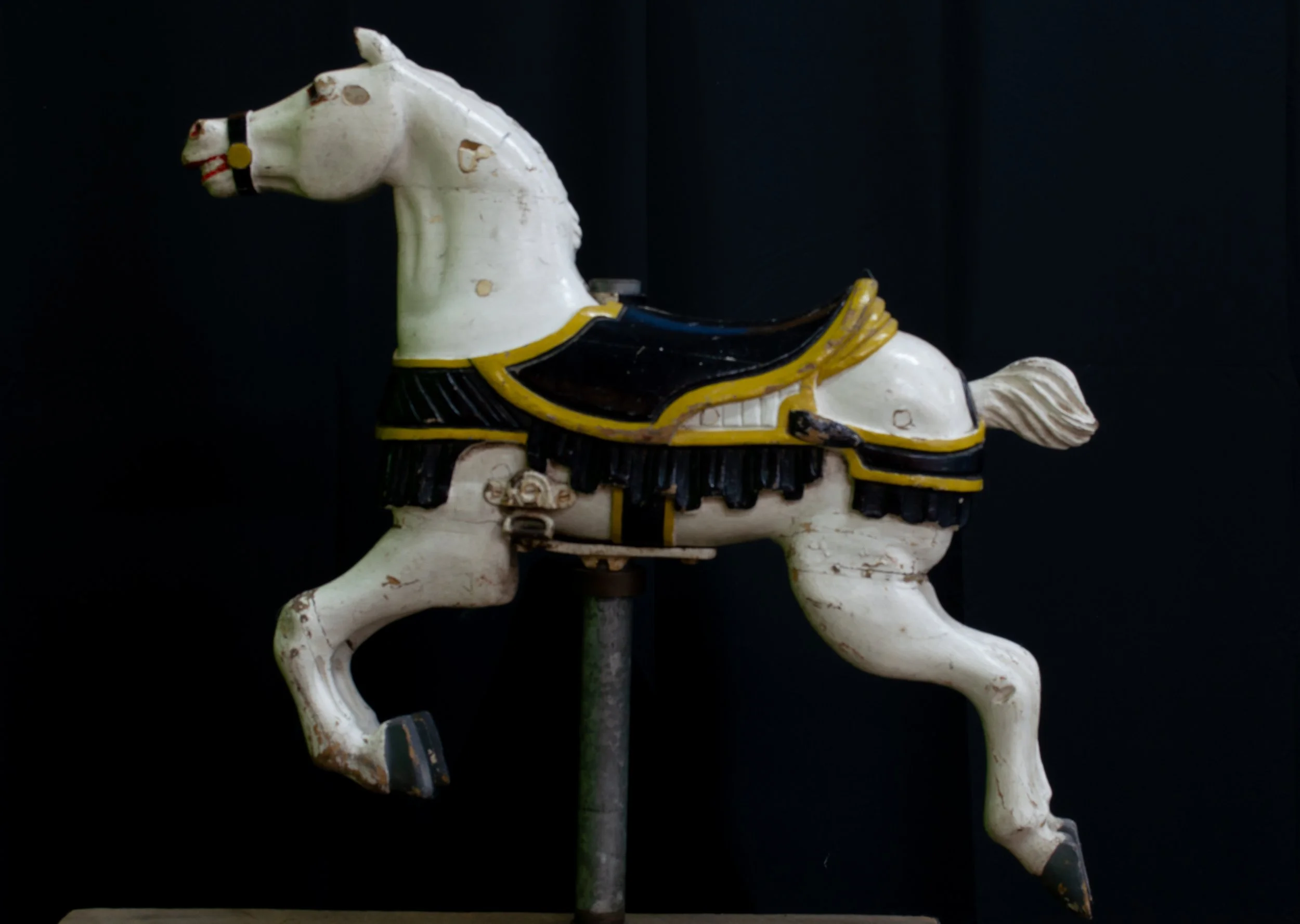
A small-scale jumper-pose carousel horse in white with a bold black-and-yellow saddle scheme, attributed on photographic evidence to the Allan Herschell Company of North Tonawanda, New York, and consistent with their portable traveling machine production from the 1930s through early 1950s (inferred). The figure presents a full gallop stance — all four legs extended — with a simple, smoothly modeled body devoid of secondary carvings. The owner notes the collection has held this piece for a long time (reported); no further acquisition detail was captured in the session.
-
No acquisition source, date, or price was recorded in the owner interview. The owner characterized the piece as a long-held collection item (reported). Further interview material is required before this section can be completed.
-
Unknown. No prior owner, institutional history, or machine of origin has been identified. No documentary provenance is currently attached to this piece.
-
The Allan Herschell Company was founded in North Tonawanda, New York in 1915 and specialized in portable carousel machines designed to be packed, transported, and reassembled at county fairs and traveling carnivals. The company's production approach prioritized utility and durability over ornament: their horses are relatively simple, easy to move, and spread widely throughout the country. Nearly 3,000 portable carousels were made from 1915 to 1959 by the Allan Herschell Co. in North Tonawanda, NY.
Herschell carousels originally featured wooden hand-carved horses, but these were replaced after WWII with cast aluminum horses which are more durable for transporting. These horses are called "jumpers" since they have four legs in the air and are meant to simulate a galloping motion. Specialist dealer sources document the cast aluminum production period as running from the 1930s through the 1950s (sourced, Carousel Workshop). These aluminum kiddie-size figures were used on traveling carousels and were made in just the right size for toddlers.
A parallel construction method, sometimes called the "half and half" or "Jughead," combined a hollow wooden body with cast aluminum head, legs, and tail. This design was used by Herschell on traveling machine horses circa 1935–1950; middle-row horses of this type typically feature double blankets, saddle, and a plain bridle, with no elaborate decorative pattern — stenciling rather than carving was the factory standard for blankets and saddle decoration.
The photographic evidence for ID 033 — the circular paint-loss pattern at the neck and flank, the smooth and uniform surface finish, and the absence of carved secondary ornamentation — is consistent with cast aluminum or half-and-half construction rather than fully carved wood, where paint failures tend to follow grain lines and seam separations (inferred). Material composition requires owner confirmation before this attribution can be resolved.
In market terms, plain inner-row or middle-row Herschell jumpers in unrestored condition occupy the lower tier of the Americana carousel market. Allan Herschell cast aluminum horses have appeared at auction through multiple US houses, with individual unrestored examples in generally worn condition typically finding buyers in the several-hundred-dollar range. Fully wooden carved Herschell inner-row jumpers in comparable condition command somewhat higher prices, generally from $800 into the low thousands depending on restoration state, row designation, and provenance. This figure's plain saddle, absence of jewels, and lack of secondary carving are consistent with an inner or middle-row traveling machine horse — the least market-valuable form from the Herschell line — though the piece's long tenure in the collection predates current market conditions.
-
Paint is worn but largely intact in the black-and-yellow saddle area, which retains good color and apparent gloss (sourced from photographs). Body shows circular paint loss concentrated at the neck and upper flank, with the substrate visible beneath but no obvious structural damage evident (sourced from photographs). The pole mount hardware is intact and functional. Hooves are painted dark. No missing structural elements are visible in any of the three photographs. Formal condition rating is pending owner inspection and material confirmation.
-
Owner interview (10/13/25): Identification session only; no acquisition data, maker attribution, or provenance provided. Owner noted long collection tenure (reported).
Photographs (DSC_2497, DSC_2498, DSC_2501): Three views — non-romance side, romance side, and identification board — analyzed for form, surface condition, saddle scheme, pose, and construction indicators (sourced).
Carousel Workshop (carouselworkshop.com): Documenting Allan Herschell cast aluminum and half-and-half construction practices, production period (1930s–1950s), and middle-row horse characteristics (sourced).
International Independent Showmen's Museum / showmensmuseum.org: Documenting Allan Herschell post-WWII cast aluminum production for portable carousels (sourced).
Wikipedia — Allan Herschell Company: Company history, production volume, and portable machine design philosophy (sourced).
LiveAuctioneers (liveauctioneers.com): Market survey of Allan Herschell aluminum and half-and-half carousel horse auction appearances (sourced).
AntiqueCarousels.com: Full machine records confirming cast aluminum horse production on traveling Herschell machines of the 1930s–1940s (sourced).
-
Low. Maker attribution is photographic inference only. Material composition — the central determination for maker ID and market placement — has not been confirmed by the owner. No acquisition data, provenance, or independent physical inspection is on record.