
PTC - Leopard
Catalogue Piece #083 tbd
-
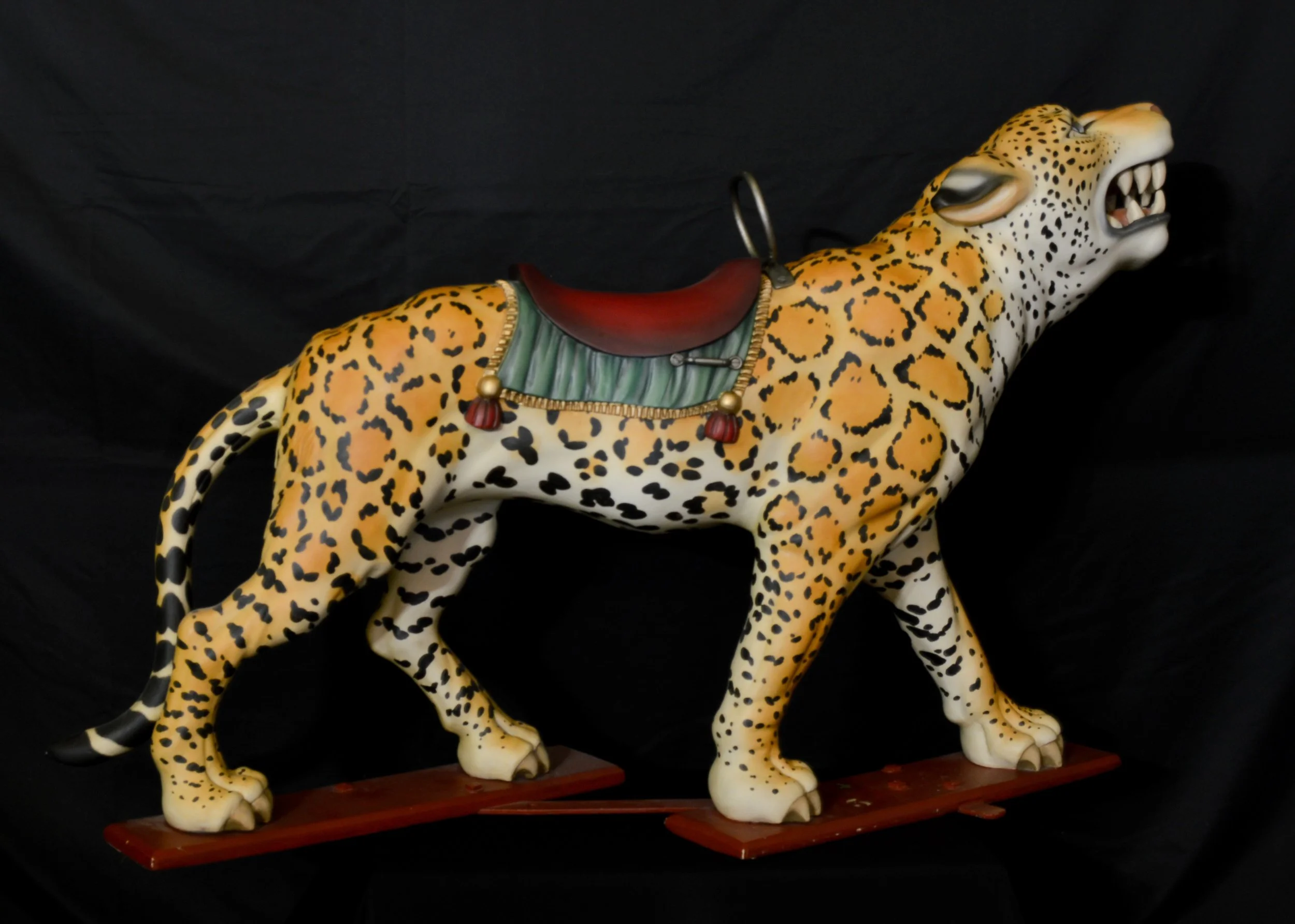
A children's-size carved wooden carousel leopard in a walking prancer pose, attributed to the Philadelphia Toboggan Company (reported). The figure is naturalistically rendered with a warm gold-orange body, cream-white underparts, and carefully painted black rosette markings concentrated along the back and flanks, transitioning to smaller solid spots over the chest, belly, and legs. The tail is held low and curved, finishing in a solid black tip. The head is raised and turned slightly outward, with the mouth open in a full snarl exposing carved teeth and a painted pink tongue; the eyes are dark with carved upper lids. All four feet are planted in a mid-stride walking pose. The romance side shown carries a red leather-style cantle-and-pommel saddle laid over a green pleated saddle blanket trimmed in gold braid, with a brass cresting ring rising from the saddle's center, a small brass stirrup hanging beside the flank, and two pendant tassels — gold spheres above carved red drops — descending from the corners of the trappings. The figure is mounted on a pair of red-painted wooden display skids, not original to the carousel.
-
Purchased at the Swen Swenson carousel collection auction in 1993 (reported, supported by the auction catalog in the owner's records). The owner identifies this figure as the most expensive restoration in the entire collection, completed by Pam Hessey of Hawk's Eye Studio in Kingman, Arizona, a number of years after acquisition and reviewed most recently in spring 2026 (reported). The owner briefly weighed an alternative attribution to another carver represented in the same auction catalog before resolving the question on stylistic grounds in favor of PTC (reported).
-
The most recent documented owner before the current collection was Swen Swenson (1932–1993), the Broadway dancer whose carousel holdings were described in contemporary trade press as the largest private collection of carousel animals in the world (sourced — Variety obituary, June 29, 1993; Carousel News & Trader, October 1993, "Swen Swenson Memoriam"). Swenson died on June 23, 1993, and his collection was dispersed at auction later the same year; the Swen Swenson auction catalog is in the owner's records (sourced — catalog cover supplied). Two other figures in this collection — a child-size prancing tiger by another Philadelphia-school carver (ID 089) and a Dentzel tiger (ID 012) — share Swenson provenance, anchoring the auction as a documented source for multiple pieces.
The specific PTC carousel from which this leopard originated has not been identified. PTC produced 87 carousels between 1904 and 1933, of which approximately 35 remain in operation today (sourced — CarouselHistory.com; Philadelphia Toboggan Coasters, Inc.). Only one PTC menagerie carousel — PTC #6 (1905), now the Kit Carson County Carousel in Burlington, Colorado, and a National Historic Landmark — survives intact (sourced — Kit Carson County Carousel; KUNC; National Park Service). PTC menagerie figures still in private hands therefore derive from carousels that have been broken up and sold off animal-by-animal, the largest of which include PTC #9 from Pine Grove, Pennsylvania (sourced — CarouselHistory.com).
-
The Philadelphia Toboggan Company was founded in 1904 by Henry B. Auchy and Chester Albright in Germantown, Philadelphia. PTC menagerie work was strongly shaped by an earlier acquisition: when Auchy purchased a competing Philadelphia manufacturer in the early 1900s, PTC took possession of an existing pattern library that supplied the carving templates for several early menagerie machines, including PTC #6 (sourced — WorthPoint, Kit Carson County Carousel article). The result is that PTC's earliest menagerie carvings sit visibly within the broader Philadelphia carving tradition rather than presenting a fully independent house style.
Surviving PTC menagerie figures of any kind are uncommon on the private market, a direct consequence of the survival pattern: with only one intact PTC menagerie carousel still operating, every other PTC menagerie figure in private hands came from a dispersed machine (sourced — Kit Carson County Carousel; CarouselHistory.com). Within the PTC menagerie repertoire, large cats are themselves uncommon — the documented inventory of PTC #6 lists a tiger but no leopard among its forty-six figures (sourced — National Carousel Association Photo Show Project, PTC #6 inventory). Children's-size (inner-row) feline figures from PTC are correspondingly scarce: smaller stations on operating machines were the most heavily ridden positions, suffered the most wear, and were the most frequently replaced, lost, or scrapped during the long century of carousel attrition.
The Swen Swenson auction of 1993 is among the more important late-twentieth-century dispersals of American carousel material. Swenson's collection passed substantially into the hands of serious private collectors at that sale; documented Swenson-provenance figures continue to appear on the specialist market, with examples including a Bayol donkey now listed by AntiqueCarousels.com and pictured in The Art of the Carousel by Charlotte Dinger (sourced — AntiqueCarousels.com listing).
Direct auction comparables for children's-size PTC leopards have not been recovered. Public auction records for any carousel leopard — at any size and from any maker — are sparse, reflecting both the rarity of the form and the tendency of these figures to move privately between specialist collectors rather than through open sale.
-
The figure is in excellent visual condition following Pam Hessey's restoration (reported). The owner characterizes this as the most expensive repair job undertaken on any piece in the collection, which implies substantial structural and surface work beyond paint alone (reported); specific details of the scope have not yet been documented. The leopard pattern is carefully and uniformly painted, with rosettes graduating naturalistically from larger broken-ring forms along the spine to smaller solid spots on the underbody and legs. The saddle paint — green pleated blanket, red cantle and pommel, gold braid and tassels — is fresh and presents no visible loss in the available photograph. No structural damage, cracks, or surface losses are visible. A single right-side photograph is in hand; a left-side image would document the non-romance side and any condition variation between the two faces.
-
The figure is in excellent visual condition following Pam Hessey's restoration (reported). The owner characterizes this as the most expensive repair job undertaken on any piece in the collection, which implies substantial structural and surface work beyond paint alone (reported); specific details of the scope have not yet been documented. The leopard pattern is carefully and uniformly painted, with rosettes graduating naturalistically from larger broken-ring forms along the spine to smaller solid spots on the underbody and legs. The saddle paint — green pleated blanket, red cantle and pommel, gold braid and tassels — is fresh and presents no visible loss in the available photograph. No structural damage, cracks, or surface losses are visible. A single right-side photograph is in hand; a left-side image would document the non-romance side and any condition variation between the two faces.
-
Medium-High. The maker attribution is reported by the owner and rests on stylistic judgment; the provenance from the Swen Swenson auction in 1993 is documented by the catalog in the owner's records, which is a credible primary source. Independently verified: the historical reality of the Swenson collection and 1993 dispersal, the rarity of surviving PTC menagerie figures, and the documented absence of a leopard from the only surviving PTC menagerie carousel. Not yet established: the specific PTC carousel of origin, the catalog lot number and any descriptive text in the Swenson catalog, and any pre-Swenson provenance.