
Heyn - Horse
Catalogue Piece #087 tbd
-
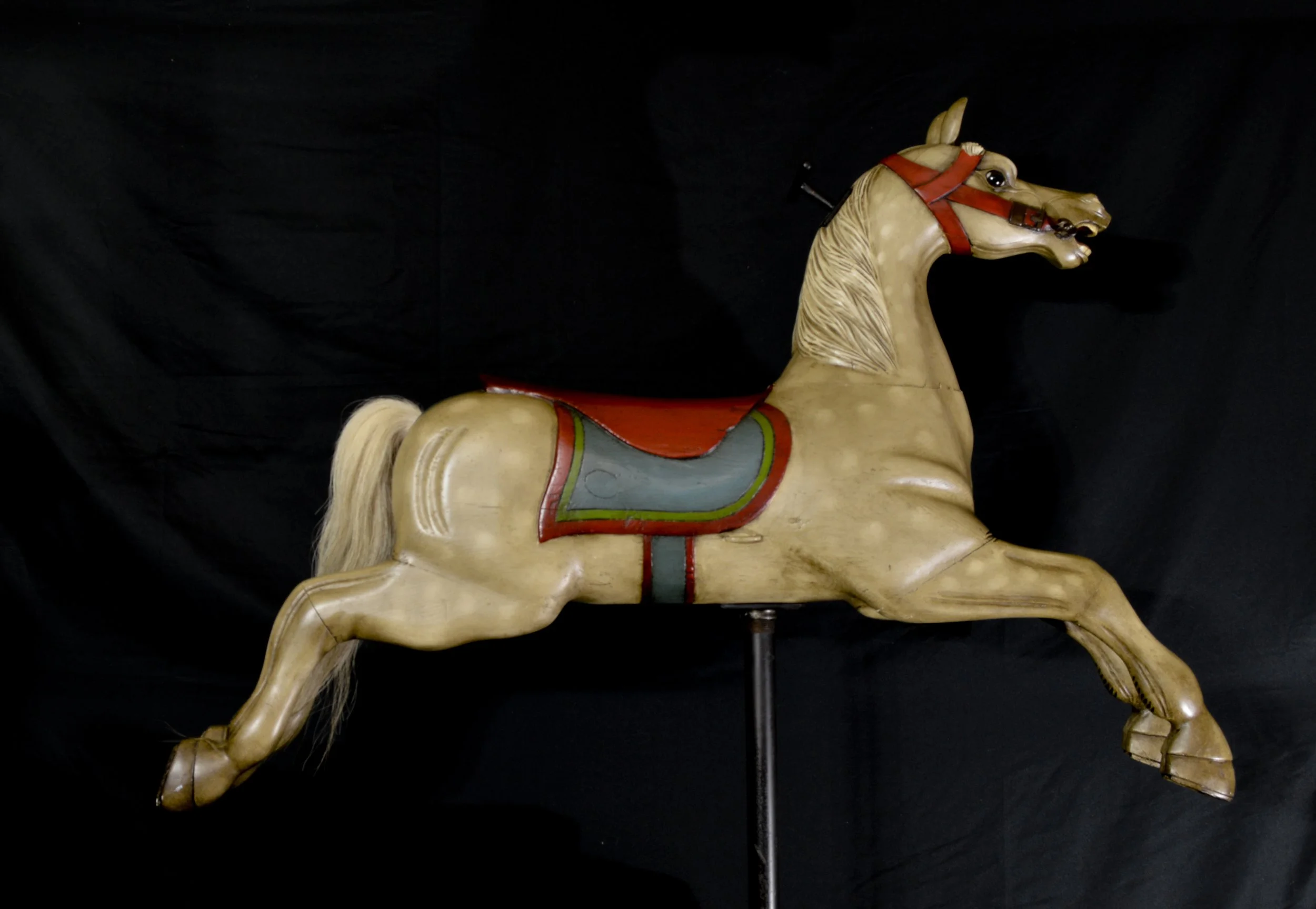
A small carved wood carousel horse in a fully extended jumper pose — all four legs in flight, front legs reaching forward, hind legs streaming behind — captured mid-stride with the head turned slightly toward the viewer (romance side, right), mouth open and tongue visible, ears forward, and the carved mane sweeping back from a deeply modeled poll. The body is finished in cream-palomino with carved-and-painted dappling — soft lighter circles across the flanks, neck, and hindquarters in the convention used to suggest a dapple-grey or palomino coat. The eye is glass, deeply set. The tail is real horsehair, cream-white and full, attached at the dock.
Trappings are simple and read as period-original in design: a red leather bridle with metal buckle at the cheek; a red saddle seat; a blue saddle blanket bordered in red with a thin green inner band; a red girth strap; and a small carved circular medallion centered on the blanket. A short carved roll or blanket pad is set behind the saddle. The carving across the legs is notably delicate, with anatomically accurate musculature, slim cannons, and well-defined hooves — the kind of fine equine carving that distinguishes the German school from the more stylized French and the more decorative American work. A small metal stake is visible at the poll, likely a remnant of the original carousel mounting hardware (a feature documented on Heyn horses, which were fitted with metal stays at head and tail attaching to the carousel sweep). The piece is mounted on a black metal display pole.
-
Purchased from the Walt and Mary Lawrence Youree collection in June 1988 (reported). This places the acquisition among the earliest in the present collection — predating Jacques Rabbit (ID 086, May 1989), and contemporary with the Ortega Mexican giraffe (ID 002, May 1988) and the Armitage-Herschell jumper (ID 004, May 1989). The Heyn was the second Youree-sourced piece acquired in 1988, with the giraffe and the Heyn falling within a month of each other and likely representing a single Oregon City buying visit.
The owner identifies the carver as "Heyn" in voice transcript (reported) — rendered phonetically as "Hein" — and this corresponds unambiguously to Friedrich Heyn of Neustadt-an-der-Orla, Germany, whose workshop produced the standard reference work for fine carved German carousel horses of this period.
-
Walt and Mary Lawrence Youree collection — Oregon City, Oregon, until June 1988. The Yourees are the documented source of multiple foundational pieces in this collection (IDs 002, 004, 054, 086, 087, 088). Walt Youree (1915–2001) is memorialized on CarouselHistory.com; portions of the Youree holdings were later donated to the American Folk Art Museum (sourced — CarouselHistory.com).
Prior to the Youree collection: Not documented. The figure's path from Neustadt-an-der-Orla to Oregon City is not currently traceable. German carousel horses from the Heyn workshop entered the U.S. through several channels during the late 19th and early 20th centuries — most commonly as imports for American park and traveling carousel operators who supplemented domestic American figures with German imports, particularly before the rise of the Philadelphia school made U.S. production fully self-sufficient. Whether this piece arrived through that channel or through a later collector path is not currently established.
-
Friedrich Heyn (1840–1898) opened a carousel-figure workshop in Neustadt-an-der-Orla in 1870, operating under the formal name Caroussel-Pferde und Kunstfiguren Fabrik, Neustadt an der Orla — "Carousel Horse and Art Figure Factory." Heyn is documented in the standard reference literature as the earliest established carousel-figure manufacturer whose operation can be positively verified by date, predating the Angers French ateliers, the British fairground workshops at King's Lynn, and the American Philadelphia school (sourced — Ward & Weedon, Fairground Art; Egidi MadeinItaly archive). The workshop continued production under the Heyn name through approximately 1929. On the cover of his 1905 catalogue, Heyn described his firm as the Founder and first established expert of the Molbitz-Neustadt carousel industry and the Largest and most important factory in Germany specialising in fine Dresden horses (sourced — Heyn 1905 catalogue).
The Heyn workshop's documented output convention bears directly on the present figure. Heyn horses were offered in twelve sizes ranging from 57 cm to 150 cm body length, with prices in the 1905 catalogue running from 21 marks for the smallest, plainest model to 145 marks for the largest, most luxurious "Dresden" model (sourced — Heyn catalogue documentation, Egidi archive). Five distinct standing-horse types were offered, differentiated by the richness of carved and applied decoration. Standard features included hand-carved limewood (lindenwood) construction, inset glass eyes, real horsehair tails (typically; brass tails were also offered), embossed brass ornaments on luxury models, and polished colored glass cabochon decoration on the most elaborate examples. Hardwood legs were available for extra charge. The smaller and plainer end of the production range — to which the present figure clearly belongs — relied on paint work rather than applied jewelry for its decorative effect, with simple painted trappings over a finely carved palomino, dapple, or chestnut body. This matches the figure cleanly.
Documented Heyn auction comparables:
The Heyn record. A large rearing horse (grand cheval cabré) sold at Cornette de Saint Cyr in the Marchal collection dispersal in 2011 for €38,400 — establishing the world auction record for Heyn at that time (sourced — Drouot auction record). This was a luxury Dresden-class figure of substantial scale, not directly comparable to the present small jumper.
MutualArt aggregate. Heyn auction prices currently track from approximately $428 to $8,028 across all recent sales; the upper figure was set by a Bonhams New Bond Street sale in 2024 (sourced — MutualArt artist record).
A small Heyn child's stander with horsehair tail and glass eyes, approximately 40 in. long × 36 in. high, recently carried an insurance appraisal of $4,400, with an estimated auction range of $1,800–$2,600 (sourced — Worthpoint comparable).
A small wooden Heyn carousel horse, attributed Heyn, glass eyes, 27.5 × 38 × 11 in., described as imported from Bristol, England and likely used on a children's carousel, in apparent original paint with documented repairs to two front legs (sourced — Barnebys lot record).
The June 1988 pricing sits at the upper end of the small-Heyn market band of the period and reflects the Youree provenance. In current market terms the figure remains comfortably within the documented small/juvenile Heyn auction range, with restored examples commanding the upper portion of that band.
Heyn's small jumping horses are documented but not common in U.S. private collections — German carousel horses of any maker are encountered less often than American Golden Age or French juvenile pieces, and small Heyn jumpers specifically are encountered less frequently than the larger luxury Dresden standers that Heyn's reputation is built on. The piece's classification within the workshop output is approximately small jumper, plain trapping grade, mid-tier production — not a luxury Dresden but a finely carved working example of the Heyn small-jumper line.
-
The surface presents as a restoration: even paint coverage, soft edges between body color and trappings, well-preserved carved detail underneath the paint, and no visible losses or significant wear across the body, legs, or face. The dapple-painting convention is intact and reads naturally rather than being applied over a stripped or oversanded surface. The real horsehair tail appears intact and full. The glass eye is clear and well set.
The small metal stake at the poll is the most notable construction detail visible. Heyn carousel horses were fitted with structural metal stays at head and tail joining the figure to the carousel sweep — what is visible here is consistent with that original mounting hardware, retained through restoration. No restorer is recorded for this piece. The acquisition predates the documented restoration relationships (Lise Liepman, Pam Hessey) established for later acquisitions in this collection, which suggests the restoration was either done before the Yourees' tenure or by a restorer not yet identified in project records.
Formal condition rating: Good to Excellent pending physical inspection of underside, leg joints (small-Heyn comparables consistently note front-leg repair as a stress point), tail attachment, and the head stake.
-
Owner interview, recorded: Identification, attribution to "Hein" (Heyn), Youree provenance, acquisition date (June 1988), German origin, "small jumping horse" description, circa date (1910).
Owner master catalog list: Entry #87 — "HEYN: Small jumping horse from Germany purchased in June 1988 from Walt and Mary Lawrence Youree collection for $4500. Circa 1910."
Photograph (DSC_2747): Single image, romance side — analyzed for pose, proportions, dapple painting, real horsehair tail, glass eye, trapping detail, mounting hardware.
Ward, Richard, and Geoff Weedon. Fairground Art: History of Fairground Carving and Painted Imagery in Britain, America and Europe — published Heyn reference work (Heyn horse documented on p. 45).
Heyn 1905 catalogue documentation — workshop history, size and price range, decorative grades.
Egidi MadeinItaly archive — Heyn workshop documentation, "Dresden" horse classification, size/price grading.
Cornette de Saint Cyr / Drouot auction records — Marchal collection sale, Heyn record price €38,400 (2011).
MutualArt — Heyn artist auction record range ($428–$8,028).
Worthpoint, Barnebys, Proantic, Egidi — small Heyn horse comparables.
CarouselHistory.com — Walt Youree memorial.
-
Medium-High. The Heyn attribution is reported by the owner and supported by stylistic, decorative, and constructional features that match documented Heyn small-jumper production (glass eye, real horsehair tail, dapple-painted palomino body, fine equine anatomical carving, simple painted trappings, head stake hardware). The size and pose fit cleanly within the documented Heyn 12-size production range at the smaller end. Youree provenance is documented and consistent with other Youree-sourced pieces in this collection. Price and acquisition date are recorded. The piece is unsigned in any way visible from the single photograph; physical inspection for a maker's mark or label would move the confidence rating to High.