
Illions - Horse
Catalogue Piece #091 tbd
-
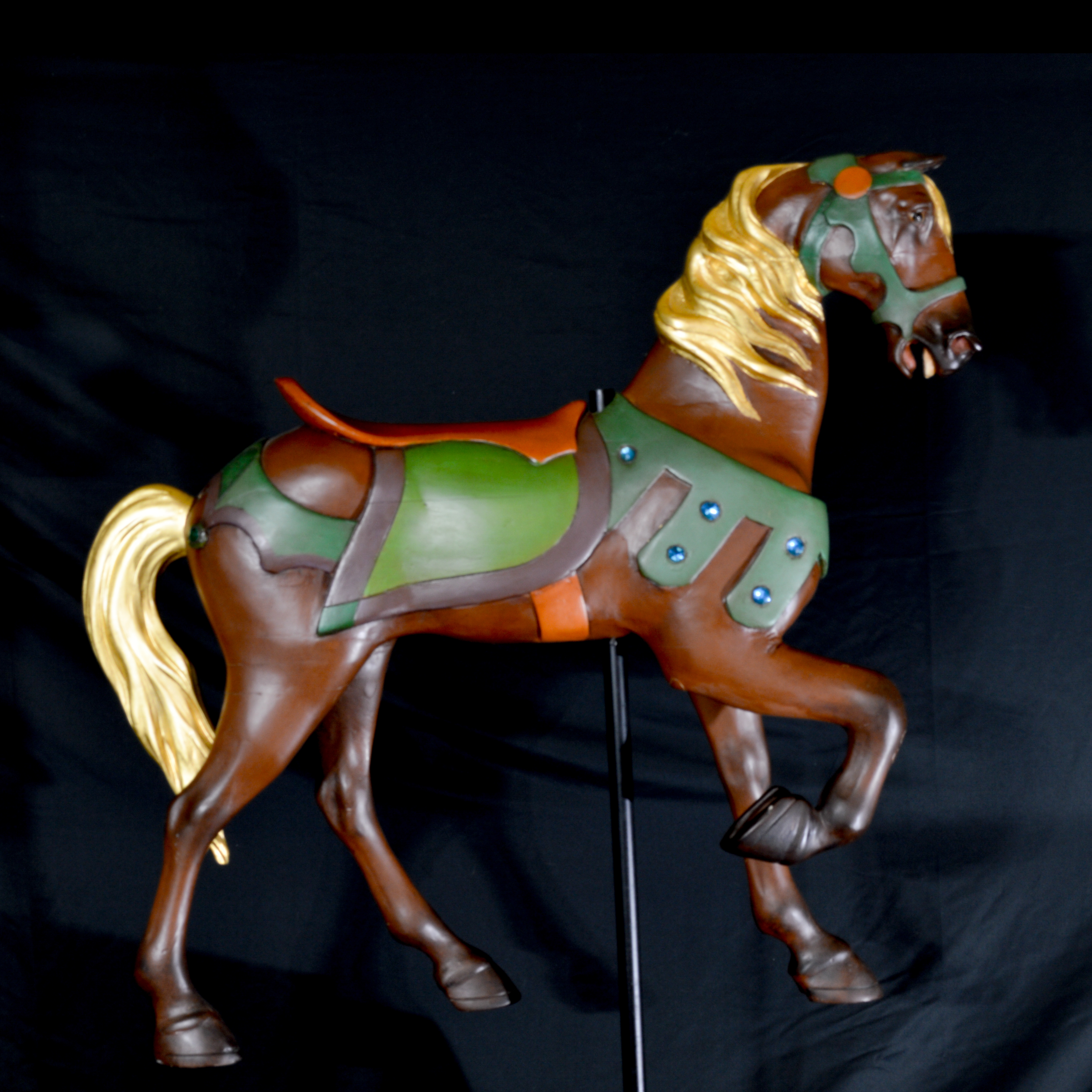
A child-scale stander carousel horse in a spirited prancing pose, romance side photographed: forelegs extended with the near foreleg raised, hindquarters planted, head turned outward with mouth open showing bared teeth, flared nostril, and a fierce alert eye. The figure carries the full visual signature of the Coney Island carving school — an explosive wavy mane finished in gold leaf, a long flowing gold-leafed tail, a green and brown saddle blanket with raised relief work, an orange cantle and stirrup, and three rows of blue cabochon jewels set into the chest harness and bridle, with a green and orange jewel rosette at the brow. The body is rendered in warm chestnut with darker shading at the musculature (inferred from photograph). The piece is attributed to Marcus Charles Illions, circa 1914, by a signed and dated appraisal from Mary Lawrence Youree (sourced — Youree appraisal, 24 September 1995, on Cast Iron and Cast Offs letterhead). The horse carries the owner's nickname "Old 42" — for the owner's birth year (reported).
-
Acquired from Mary Lawrence Youree in or near September 1995 (reported and sourced). The piece was purchased as a birthday gift for the owner (reported). The owner's recollection in interview places the acquisition in 1998; the documentary record (a signed Youree appraisal dated 24 September 1995) is taken as definitive on the year. The horse arrived already finished with the gold-leaf mane and tail and the present trapping paintwork (inferred from photograph; restorer identity to be confirmed — see Open Questions).
This was the owner's only Illions piece until a second documented Illions ("the signature piece that just came back") rejoined the collection more recently (reported).
-
Mary Lawrence Youree, Cast Iron and Cast Offs, 14941 Henrici Road South, Oregon City, Oregon — held until ~September 1995 (sourced — Youree appraisal letterhead and date).
Prior to Youree: undocumented in the records currently available. The Youree appraisal asserts the piece was carved by Marcus Illions circa 1914 for a company that operated child-size standers and jumpers on the streets of Coney Island, but does not identify the company by name or trace a specific chain of custody back to that original operation.
The Youree appraisal pattern — signed dealer-restorer documentation accompanying acquisition — is consistent with at least three other pieces in this collection (IDs 002, 004, 088), each acquired from the Cast Iron and Cast Offs dealership in Oregon City between 1985 and 1994. The 1995 appraisal date on the ID 091 letter places this acquisition immediately after that cluster. Mary Lawrence Youree is independently documented as both a serious collector and a working restorer-painter; Walt Youree (1915–2001) is memorialized on CarouselHistory.com; figures from the Youree collection have been donated to the American Folk Art Museum (sourced — CarouselHistory.com; American Folk Art Museum records).
-
Marcus Charles Illions (c. 1871–1949) was the foremost carver of the Coney Island carousel tradition. Born in Lithuania, he emigrated to the United States in 1888 and worked in the Coney Island workshops of Charles Looff and W. F. Mangels before opening M. C. Illions and Sons Carousell Works on West Eighth Street (later Ocean Parkway) in Coney Island in 1909 (sourced — Brooklyn Public Library oral history archive; Coney Island History Project; Wikipedia). The New York Times called him "the Michelangelo of carousel carvers" (sourced — multiple). At the peak of his production, ten Illions-carved carousels operated in Coney Island simultaneously (sourced — Wikipedia; Coney Island History Project).
The defining features of the post-1909 Illions style — present and visible on this figure — are documented across the specialist literature: a fierce, animated face with open mouth, bared teeth, flared nostrils, and arched neck; an exaggerated flying or windswept mane finished in real gold leaf; jewel insets across the trappings; and a powerful straining body, often in a prancing or jumping pose (sourced — Roland Summit historian quote via Coney Island History Project; Brooklyn Museum carousel-horse object record; National Carousel Association; Art of the Carousel, Charlotte Dinger, 1983). The gold-leaf mane in particular is described by the Brooklyn Public Library as "a signature of Coney Island style" originated by Illions, and is the defining visual marker the appraisal flags by name on this piece (sourced).
The unusual claim in the Youree appraisal — that this is one of a small group of Illions child-size standers carved for a company operating portable carousels on the streets of Coney Island — has direct independent corroboration. AntiqueCarousels.com documents a 1910 Mangels/Illions "Children's Delight" street carousel featuring seven child-size Illions-carved horses, sold by the dealership and described as "the last of its kind known in existence" and "the last authentic example of early American horse-drawn street carousels" (sourced — AntiqueCarousels.com listing for the 1910 Mangels/Illions Children's Delight carousel). This is precisely the production category the appraisal describes. The 1910 dating of the documented Children's Delight machine is four years earlier than the 1914 date the appraisal attributes to the present figure, leaving open whether this horse was from a second, undocumented production run, from a later replacement set, or whether the c. 1914 estimate is approximate. What is firmly established is that Illions child-size figures from a street/kiddie carousel production are an extremely rare and well-documented category, and that survival outside a single documented machine is essentially unknown in the published record.
The appraisal's specific count — "one of three small Illions ever carved by Illions as standers" — is not independently verifiable. The Children's Delight roster of seven figures would have included both standers and jumpers, and the standers subset within that or any related production may indeed be very small, but no published source confirms or refutes a count of three. The figure is treated as exceptionally rare on the basis of the documented production type, not on the basis of the specific stander count.
Auction comparables for full-size Illions horses are well established. Outside-row Illions jumpers in restored condition with gold-leaf manes and complete jewel trappings have sold in the $20,000–$45,000 range at LiveAuctioneers-tracked sales; smaller inside-row Illions jumpers and standers from documented carousels (e.g., Chesapeake Beach) have moved through specialist dealers at five-figure prices, with one Illions Supreme inside-row jumper restored by Lise Liepman offered through AntiqueCarousels.com (sourced — LiveAuctioneers and AntiqueCarousels.com listings). A documented child-size Illions horse falls outside this published price band entirely, because so few have entered the market. The 1995 appraised value of $6,500 represents the dealer's contemporaneous judgment of the piece's value; current market value would require fresh appraisal.
-
Surface presents as a complete restoration: warm chestnut body color with shaded musculature, polychrome trappings in green, brown, orange, and red, and gold leaf applied to the mane, tail, and select trapping accents (inferred from photograph). Jewels appear secure and complete in the visible (romance) side trappings. The piece is mounted on a black metal stand, not the original carousel pole. The pose, posture, and trapping arrangement are characteristic restoration choices — the underlying carving and proportions, not the paint, are the basis for the attribution. Condition is consistent with the appraisal's characterization of "excellent condition" (sourced — Youree appraisal, 1995). Construction details (single-piece versus joined body, head attachment, eye material), the non-romance side trappings, any factory signature or stamp, and the underside have not been photographed. Formal condition rating withheld pending additional photography and material confirmation.
-
Owner interview transcript — naming, acquisition recollection, Illions attribution, gold-leaf mane reference, "three small Illions standers" count, Coney Island street carousel context, "Old 42" nickname (reported)
Mary Lawrence Youree appraisal letter, single page on Cast Iron and Cast Offs letterhead, dated 24 September 1995, signed "Mary Laurence Youree," documenting Illions attribution, c. 1914 date, the three-stander count, the Coney Island street-carousel production context, the gold-leaf mane as an Illions trademark, and the $6,500 valuation (sourced — primary document in owner's records)
Owner pricing sheet entry 91: "ILLIONS; Small child size stander painted by Mary Lawrence Youree Circa 1914. It even has the gold leaf mane that is common on Illions's pieces. Paid $6500" (reported)
Photograph DSC_2758 (romance side, single view) (primary visual evidence)
AntiqueCarousels.com — 1910 Mangels/Illions "Children's Delight" street carousel listing documenting child-size Illions production (sourced)
Brooklyn Public Library Coney Island Carousel Carver archive — Illions biography and gold-leaf mane as documented signature (sourced)
Coney Island History Project — Illions hall of fame entry and Coney Island style definition (sourced)
Brooklyn Museum object record — Carousel Horse, Southern Belle attributed to Marcus Illions; gold and silver leaf practice and Coney Island style trademark (sourced)
Wikipedia — Marcus Illions biography, B&B Carousell article, Coney Island carousel history (sourced — used as starting point; underlying citations cross-checked)
National Carousel Association — Major Carousel Builders and Carvers by Brian Morgan, defining Coney Island style (sourced)
VintageCarousels.com — Illions style characteristics and post-1910 production limitations (sourced)
-
Medium-High. The maker attribution rests on a signed and dated 1995 appraisal from a documented dealer-restorer of the figure's vintage, and is independently consistent with every visible stylistic marker (gold-leaf mane, fierce open-mouthed face, jewel insets, prancing pose, child scale). The unusual production-context claim — child-size figures for street/portable carousel use — is independently corroborated by the documented 1910 Mangels/Illions "Children's Delight" carousel. The attribution is not advanced to High because the appraisal does not provide a documented chain back to a specific Illions sale, the Children's Delight machine itself, or any other named carousel, and because the specific "three standers" count is not independently verifiable.