
Unknown - Donkey
Catalogue Piece #092 tbd
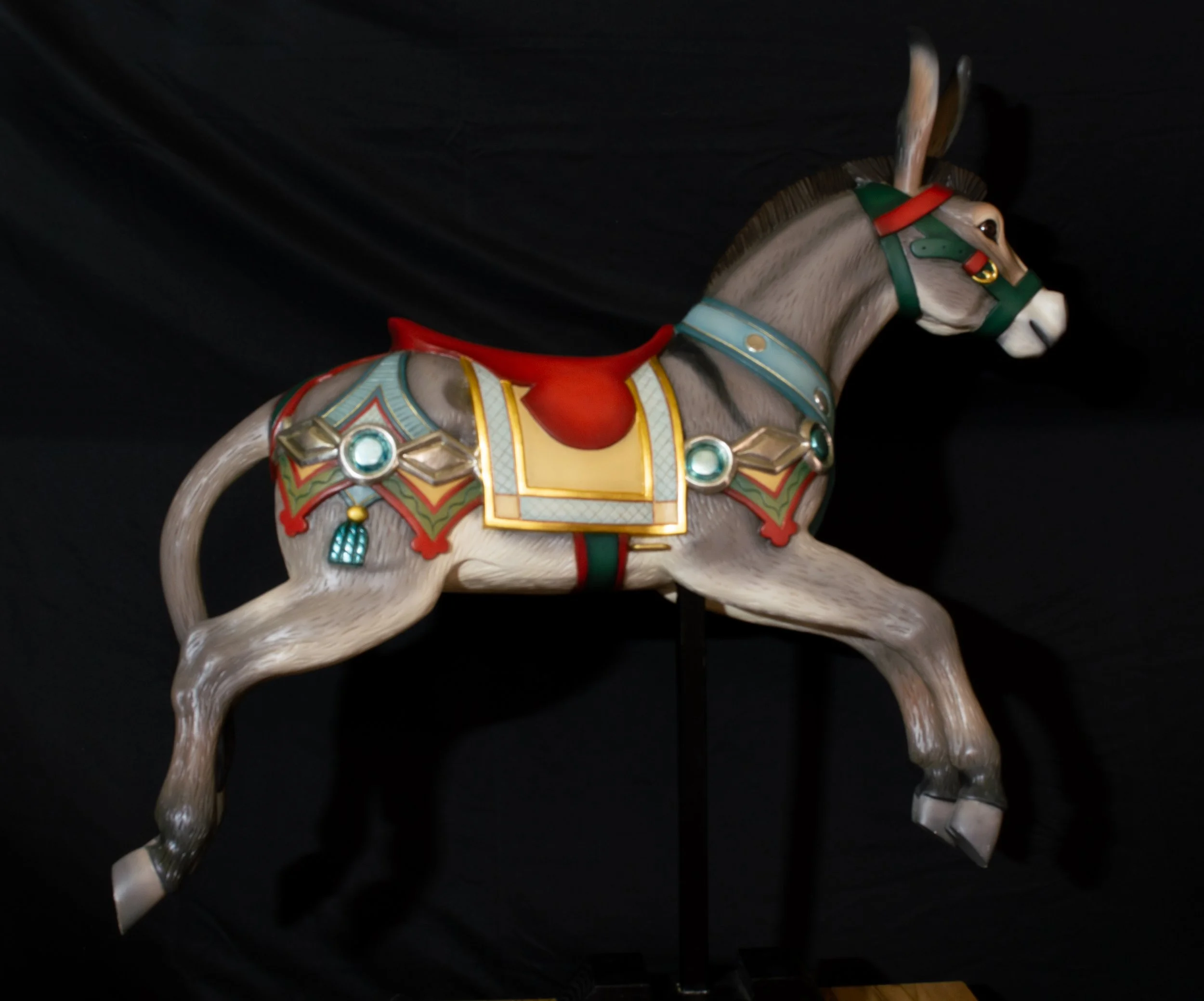
-
A leaping carousel donkey in airborne galloper pose, romance side photographed: forelegs extended fully forward, hindlegs extended back, body suspended over the stand with no foot contact, head turned outward, ears upright. The figure presents a naturalistic dappled gray coat with carved fur striations across the body and legs, a short clipped crest mane, a white muzzle, glass eyes, and a faintly amused expression. The trappings are unusually elaborate for a child-scale figure: a green strap bridle with red accents and a small gold bell at the cheek; a pale blue throat band with central rosette stud; a red Western-style cantle saddle layered over a yellow center panel and a quilted pale blue-green saddle blanket edged in gold; and a particularly decorative rear-quarter trapping incorporating diamond-shaped silver jewels alternating with large teal cabochon insets, set on a layered red-yellow-green chevron-edged panel that drops to a turquoise tasseled element at the flank. The body is finished in a clean naturalistic restoration palette (inferred from photograph). The owner records the piece as "believed to be a French piece" (reported); that attribution is not well supported by the visible evidence and should be treated as a working guess pending further research and documentation.
-
Acquisition source is uncertain. The owner recalled the piece may have come from "Swenson's" auction, but immediately walked the recollection back: "I don't have it right now. That's good. All right, let's try another one." (reported). No acquisition date, price, or dealer documentation is currently available. The Swen Swenson auction is a documented source for at least two other pieces in this collection — the Carl Müller tiger at ID 089 (referenced as appearing on page 15 of the Swen Swenson auction catalog from November 1993) and correspondence relating to the Anderson dragon attribution shift on ID 017 — so the Swenson lead is plausible but uncorroborated. Owner records or original auction catalogs would close this question.
-
Unknown pending owner interview and acquisition record retrieval. The figure carries no visible markings in the available photograph that would establish maker, factory number, or prior collection. A second photograph showing the non-romance side, head-on view, and underside (looking for maker plaques, factory stamps, or pole-hole construction details) would assist further identification.
-
The owner's working attribution of "French" presents an evidentiary problem that the catalog should record honestly rather than smooth over.
The dominant French carousel donkey tradition is centered on the workshop of Gustave Bayol of Angers (active 1884–1909) and his successors Coquereau and Maréchal (sourced — Bonhams Bayol attributions; AntiqueCarousels.com Bayol manufacturer page; Art of the Carousel, Charlotte Dinger, 1983). The defining Bayol donkey form is a stander, often with an internal nodding-head mechanism actuated by a hook-and-weight assembly inside the body, and characteristically with the cast brass "Bayol Angers France" plaque applied to the body or saddle blanket (sourced — Bonhams lot 128 nodding donkey; Sotheby's lot 101 Bayol pig-and-donkey pair; AntiqueCarousels.com Bayol Âne listing). Documented Bayol donkey trappings tend toward agrarian country-fair simplicity — painted blankets, leather reins and stirrup straps, small bells. The collection already contains one Bayol-style stander donkey (ID 050) and a separately catalogued nodding donkey (ID 051) consistent with that production tradition.
The present figure does not fit that mold. The airborne leaping/galloper pose with both forelegs extended forward and both hindlegs extended back, body fully suspended in motion, is the signature pose of the English fairground galloper tradition — Frederick Savage of King's Lynn, Arthur Anderson of Bristol, Charles J. Spooner and Orton & Spooner of Burton-on-Trent, Robert Tidman of Norwich, and Lines Bros. of London (sourced — Fairground Heritage Trust documentation of the Edwards Gallopers; National Carousel Association notes on Six Flags Great Adventure carousel describing "outstretched legs depict[ing] the horses in mid jump"; Sworders documentation of the John Barker collection). English galloper carvers are independently documented as producing not only horses but cockerels, ostriches, bears, leopards, and farm animals in this same stretched leaping form (sourced — Fairground Follies Sydney; Fairground Heritage Trust). The elaborate jeweled rear-quarter trapping with chevron edging on the present figure is also outside the typical Bayol decorative vocabulary; while not specifically a documented Anderson or Spooner pattern either, the combination of complex layered trappings with the leaping pose sits more comfortably in the English fairground tradition than in the French country-fair tradition.
Other possibilities should remain open. Continental European production after 1909 — the Bayol successors Coquereau and Maréchal, who are documented as employing "a greater degree of extravagance" in their work (sourced — Bonhams Bayol attribution notes) — could conceivably produce a figure of this elaboration. German makers (Friedrich Heyn of Neustadt an der Orla; Hübner & Poeppig) produced carousel donkeys, though the documented examples are typically standers in the German skeined-mane tradition rather than airborne leapers (sourced — Hermann Historica auction record; AntiqueCarousels.com Heyn listings). Belgian carousel production through workshops such as DeVos of Antwerp is another candidate that would warrant investigation if any prior dealer documentation surfaces.
A separately documented French-tradition piece of relevance is the Limonaire Frères donkey listed on 1stDibs and described as "extremely rare, museum quality, one of only a handful imported to the United States, and quite possibly the last surviving donkey" (sourced — 1stDibs Limonaire Frères donkey listing). Limonaire produced sculptures pour forains in Paris from the late 19th century and is the principal French production tradition outside the Bayol/Angers line. The Limonaire vocabulary leans toward elaborately painted layered surfaces, and is worth comparing against this figure if a second photograph reveals a brass maker plaque consistent with the Limonaire format.
Auction comparables for documented English galloper donkeys are thin — donkeys are uncommon non-horse galloper subjects across all English makers. Anderson galloper horses sell in the £3,500–£8,000 range at Sworders and Preston Services; Spooner jumpers in similar ranges; Limonaire Frères donkeys, when they appear, command prices substantially higher because of documented scarcity. A figure of unconfirmed attribution but high-quality execution and complete restoration would likely sit in the mid-thousands range absent maker confirmation.
-
Surface presents as fully restored: clean dappled gray body paint with shaded musculature, polychrome trappings in green, red, yellow, pale blue, and gold, and intact jewel inserts at the rear quarter and throat (inferred from photograph). The figure is mounted on a black metal stand; the original pole and pole-hole are not visible in the romance-side image. Construction details (single-piece versus joined body, head attachment, eye material, any factory plaque or maker mark on the underside or non-romance side, evidence of an internal nodding mechanism), the off-side trappings, and material composition (wood versus a later cast or composite reproduction) cannot be assessed from the single available photograph. Formal condition rating withheld pending additional photography and owner confirmation of material.
-
Owner interview transcript — "believed to be French piece," possible Swenson acquisition (immediately walked back) (reported)
Owner pricing sheet entry 92: "CARVER UNKNOWN; Donkey is believed to be a French piece" (reported)
Photograph DSC_2761 (romance side, single view) (primary visual evidence)
Bonhams — Bayol-attributed nodding donkey lot 128 and Bayol history (workshop founding 1884; sale to Coquereau, Chailloux, Maréchal in 1909) (sourced)
AntiqueCarousels.com — Bayol-French manufacturer page; Bayol Âne donkey listing with Lise Liepman paint credit; Anderson and Heyn comparables (sourced)
Fairground Heritage Trust — Edwards Gallopers documentation; English fairground carver attributions (sourced)
Sworders — John Barker Collection documentation of Anderson, Spooner, Savage, and Lines Bros. fairground production (sourced)
National Fairground and Circus Archive, University of Sheffield — Orton & Spooner production history (sourced)
1stDibs — Limonaire Frères donkey listing and Orton & Spooner leopard listing (centrifugal lean documented) (sourced)
1stDibs — Bayol carousel galloper listing (1895–1909 first period production) (sourced)
Vintage Carousels — Six Flags Great Adventure carousel documentation (Savage/Anderson/Spooner combined production) (sourced)
Cross-reference to ID 050 (Bayol stander/nodder donkey in this collection) and ID 089 (Carl Müller tiger sourced via Swen Swenson catalog) (internal collection records)
-
Low. The owner-provided "French" attribution is not supported by the pose, which sits comfortably in the English fairground galloper tradition rather than the French Bayol/Angers tradition. The elaborate jeweled rear-quarter trapping vocabulary is also outside the typical French country-fair register. The figure cannot be advanced beyond Low confidence on the present evidence — but the piece itself is well-executed and well-restored, and a second photograph plus owner-record review (acquisition source, original dealer letter or auction lot, any maker plaque on the non-romance side or underside) could move it substantially.