
Illions - Horse
Catalogue Piece #200 tbd
-
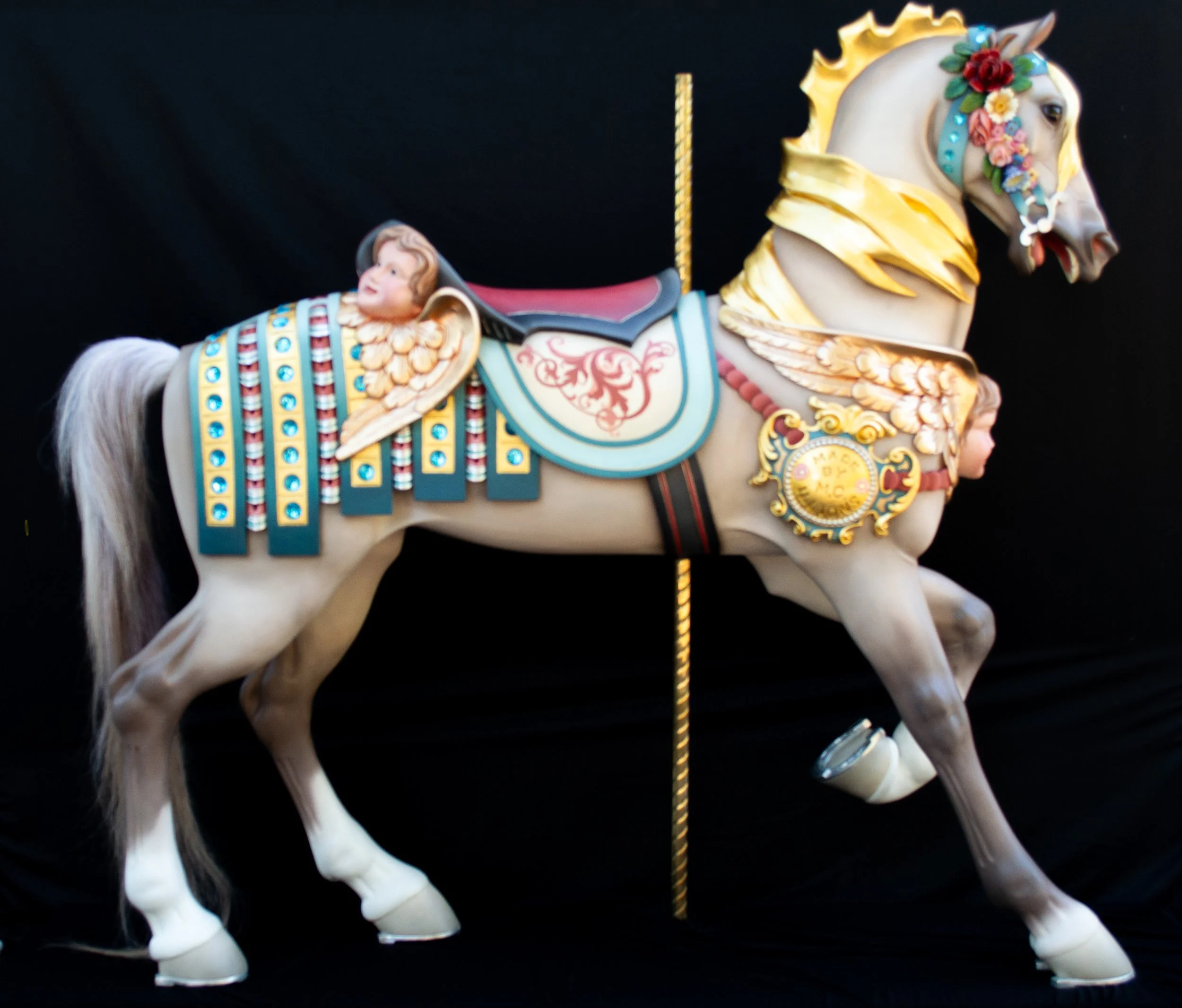
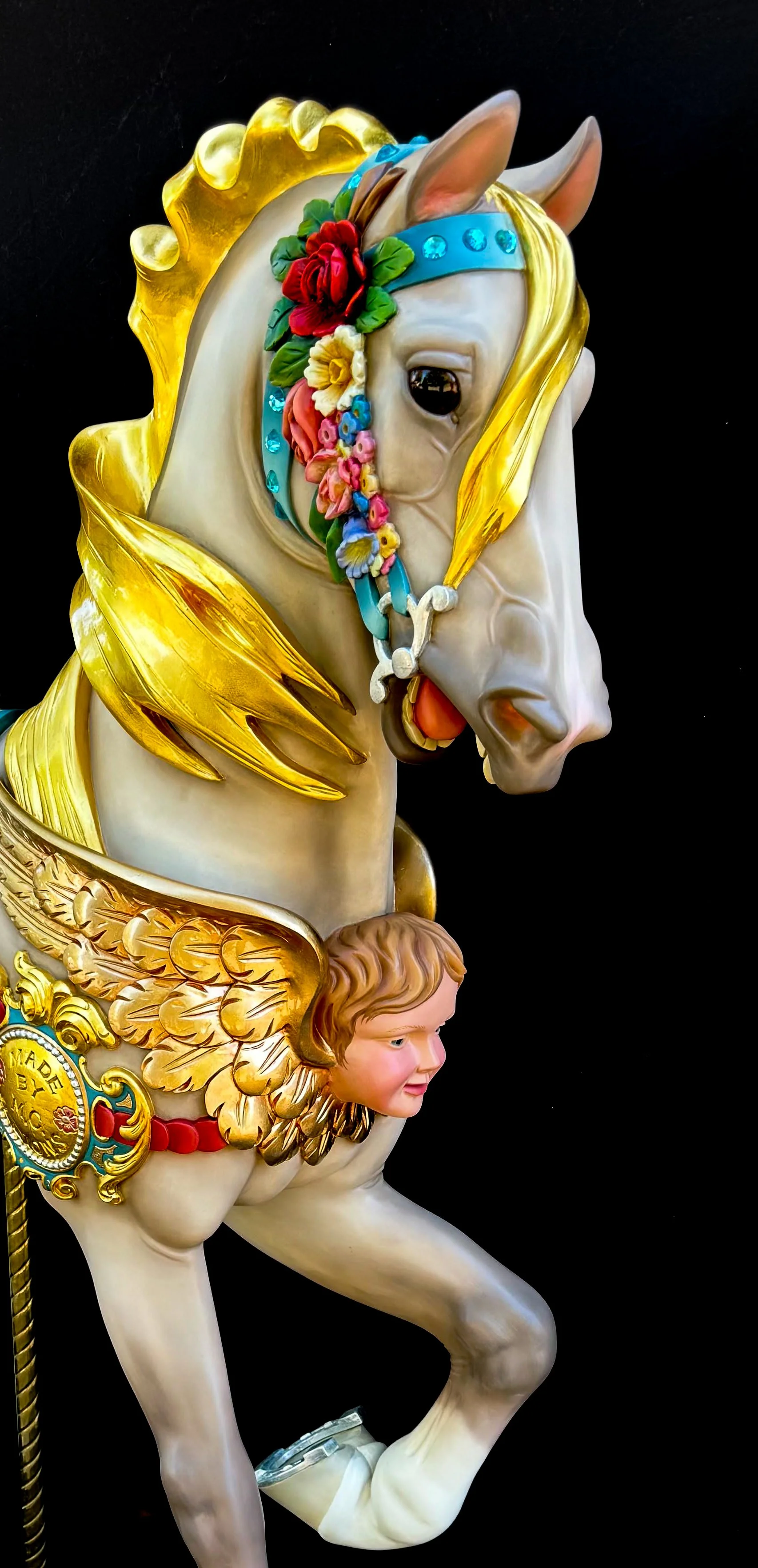
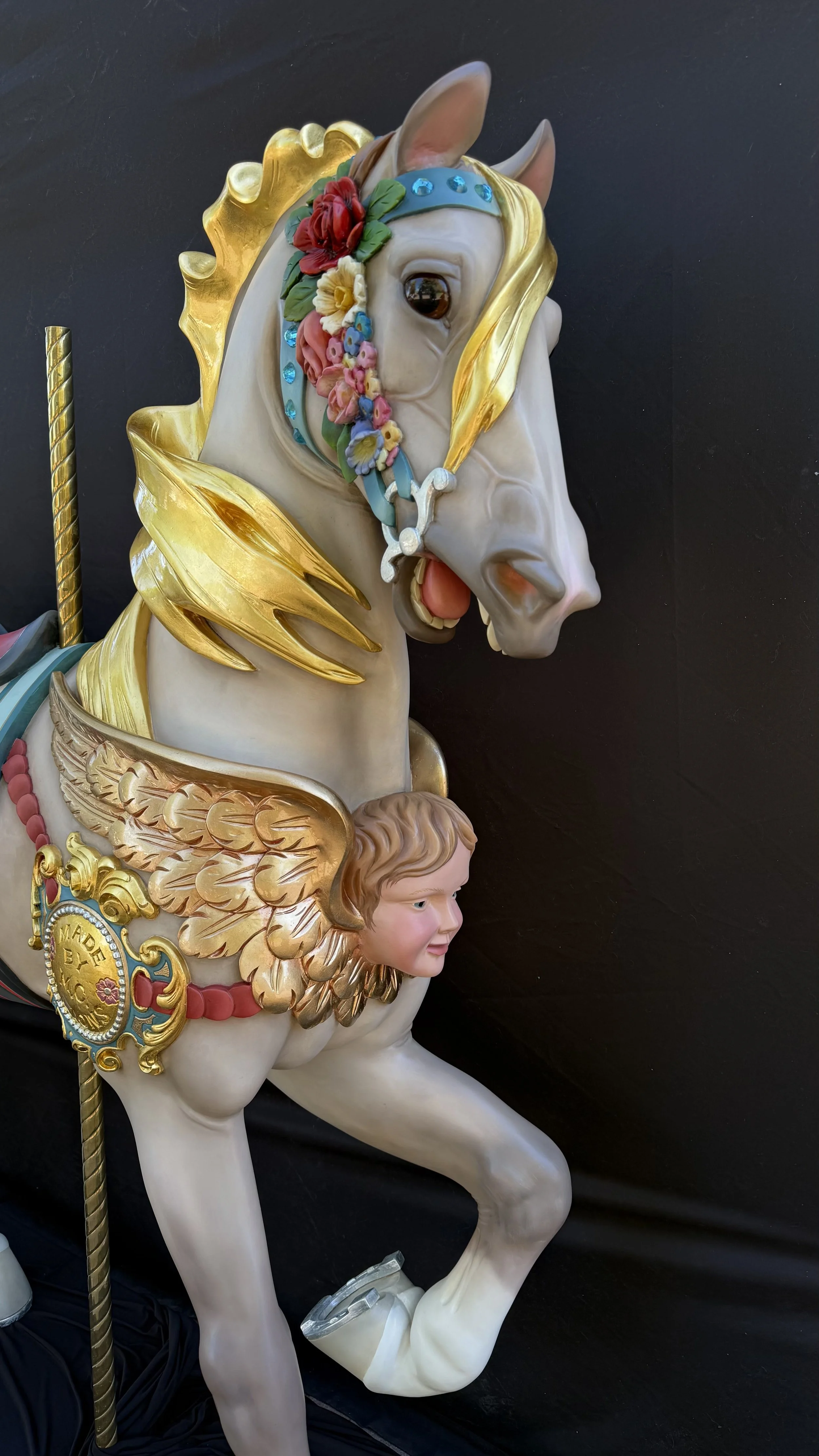
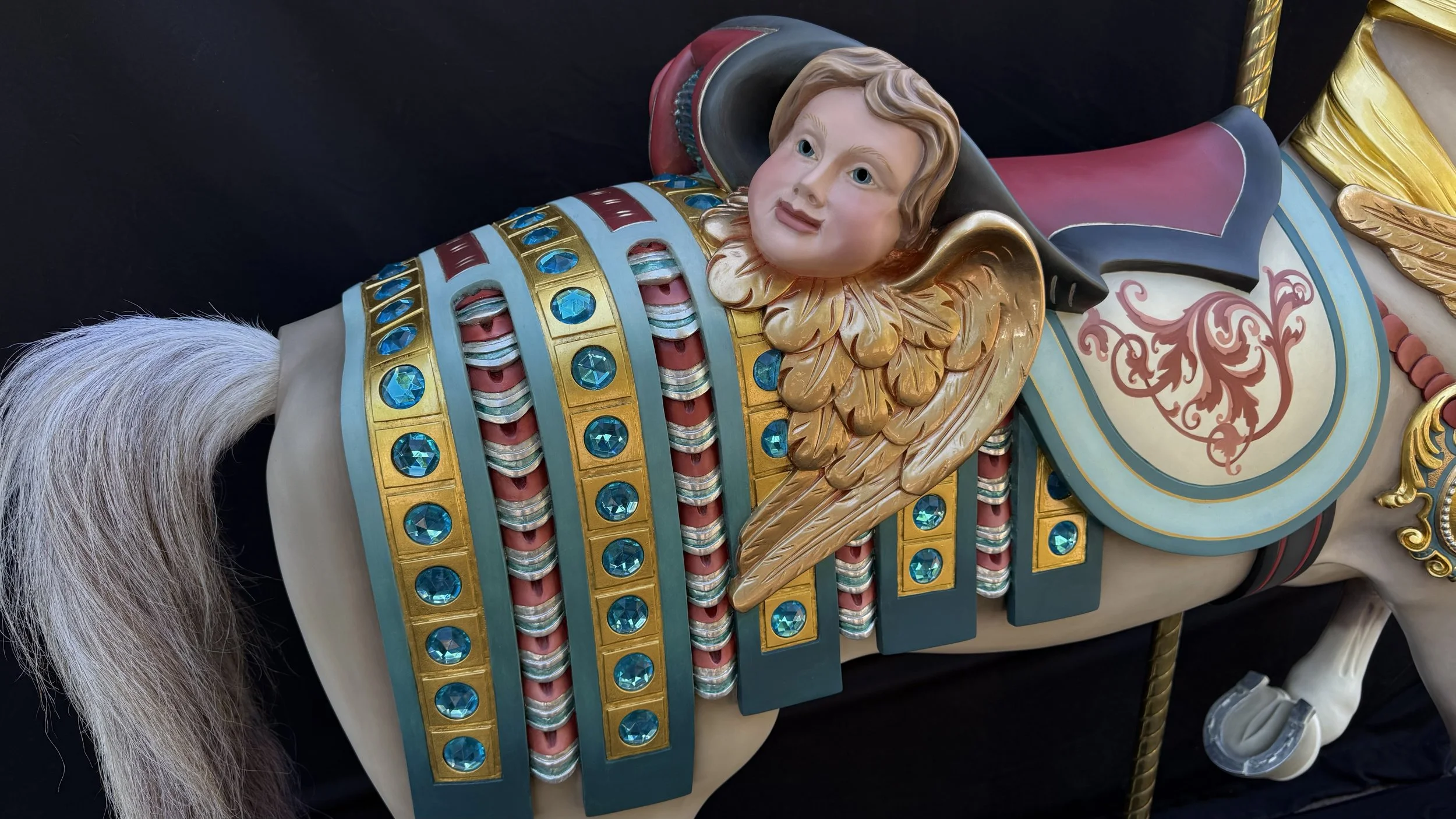
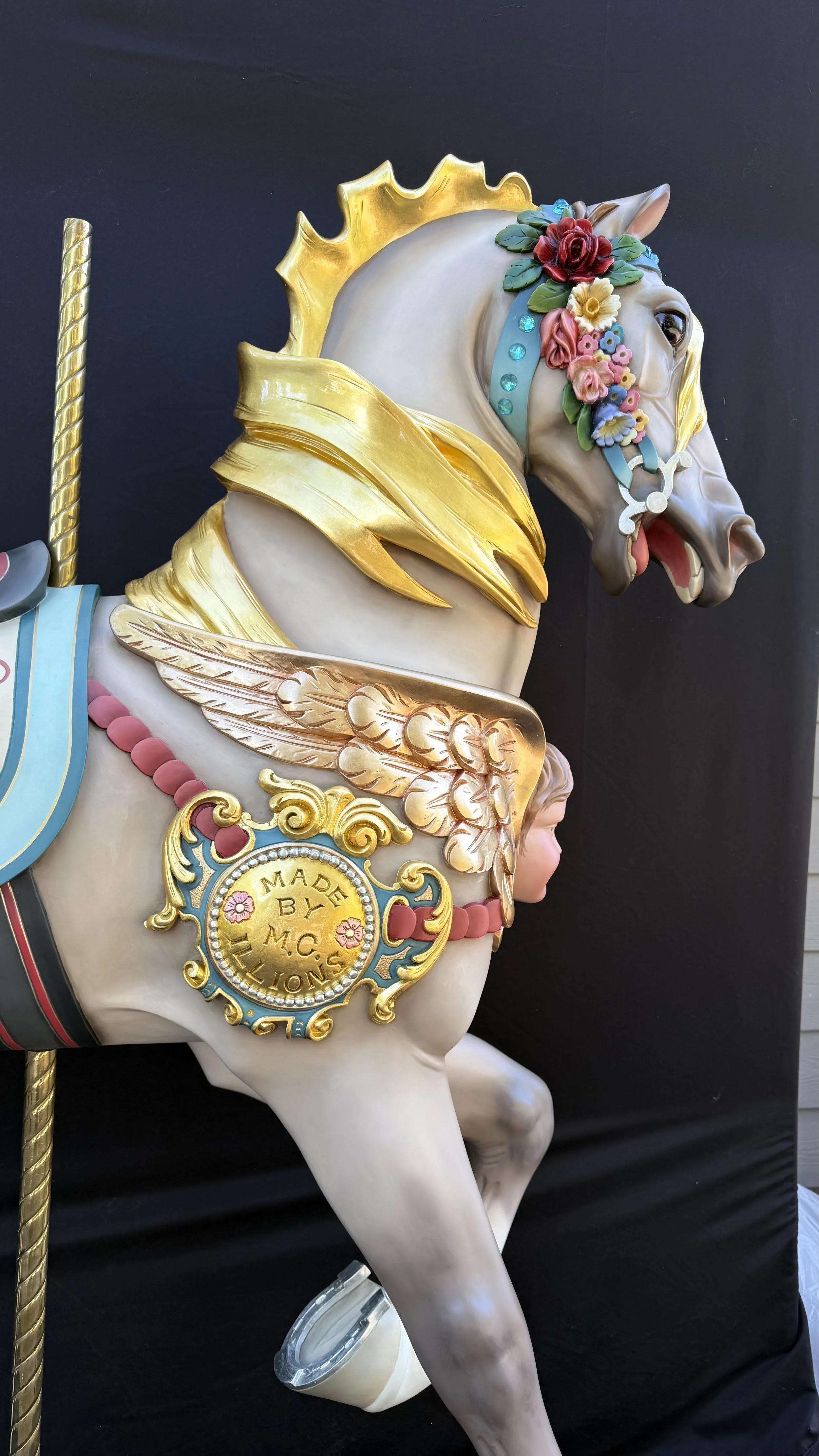
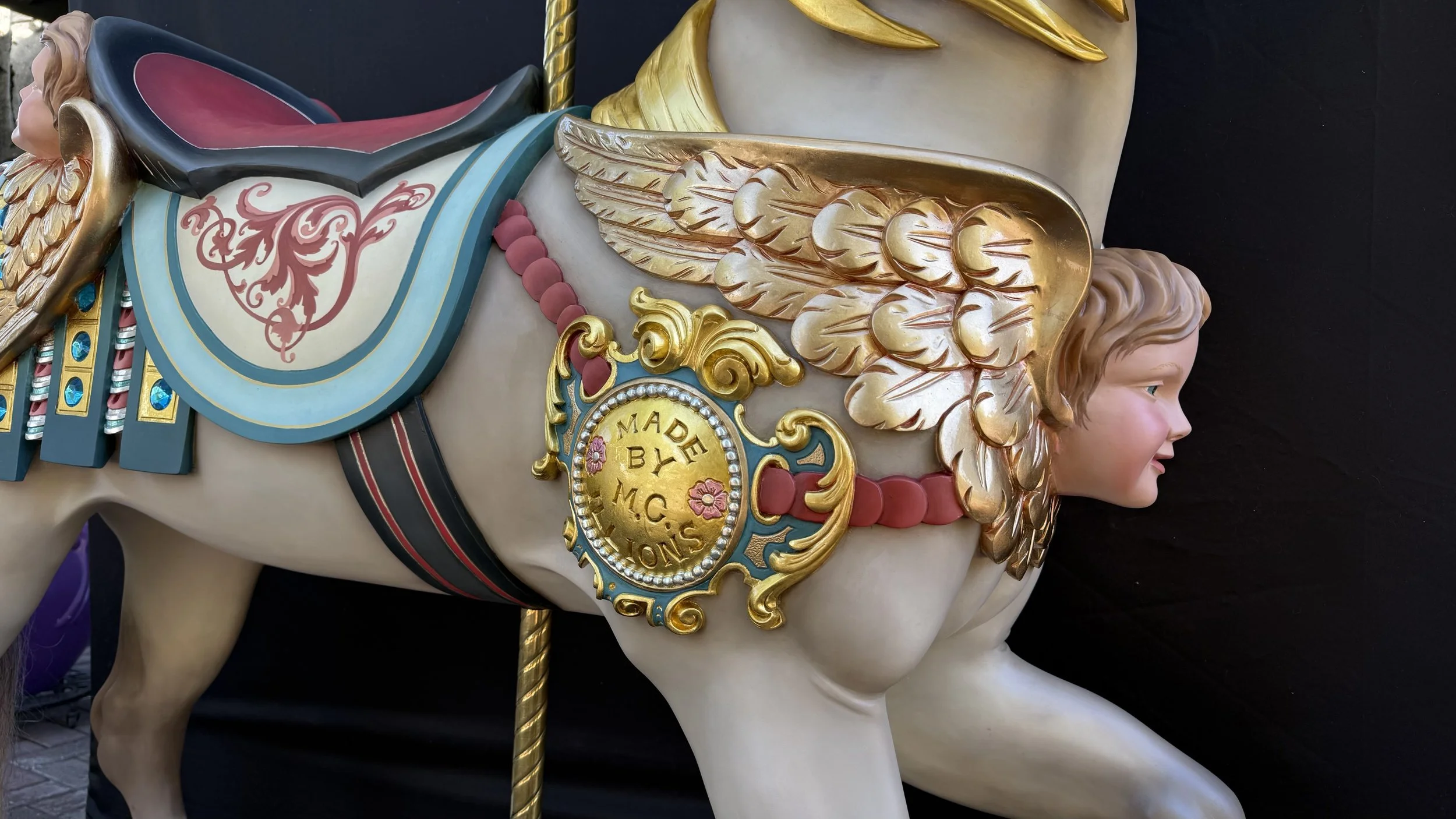
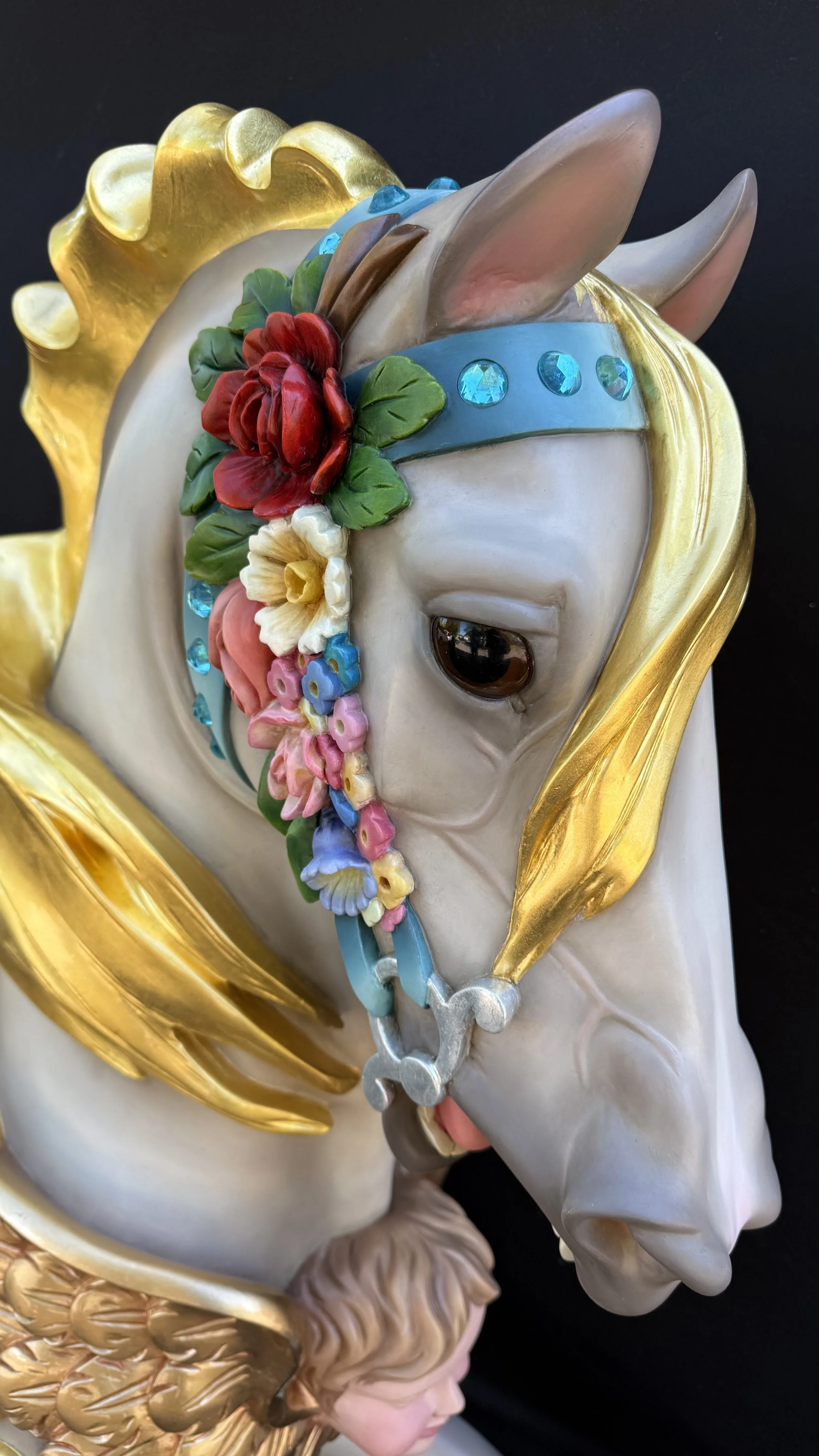
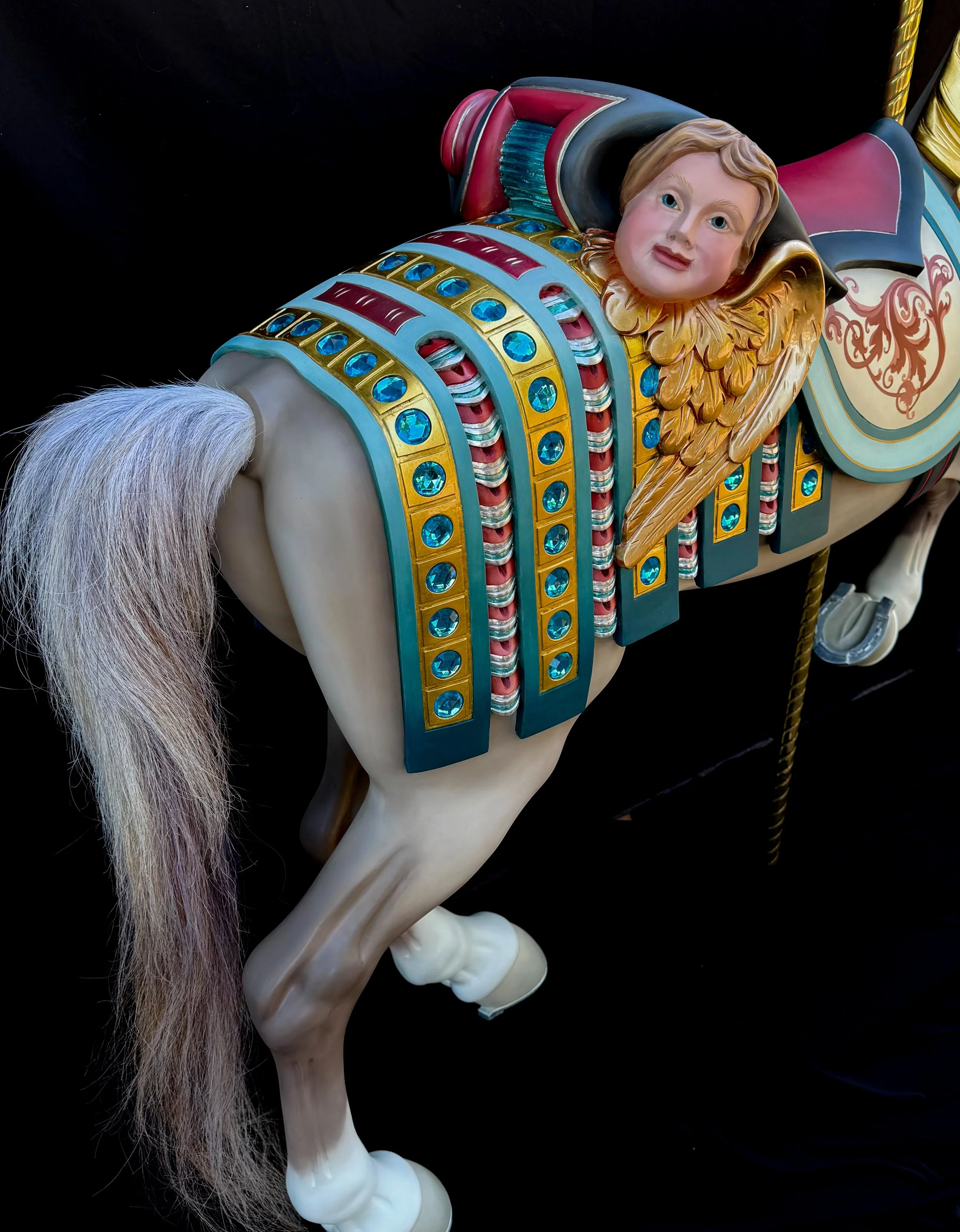
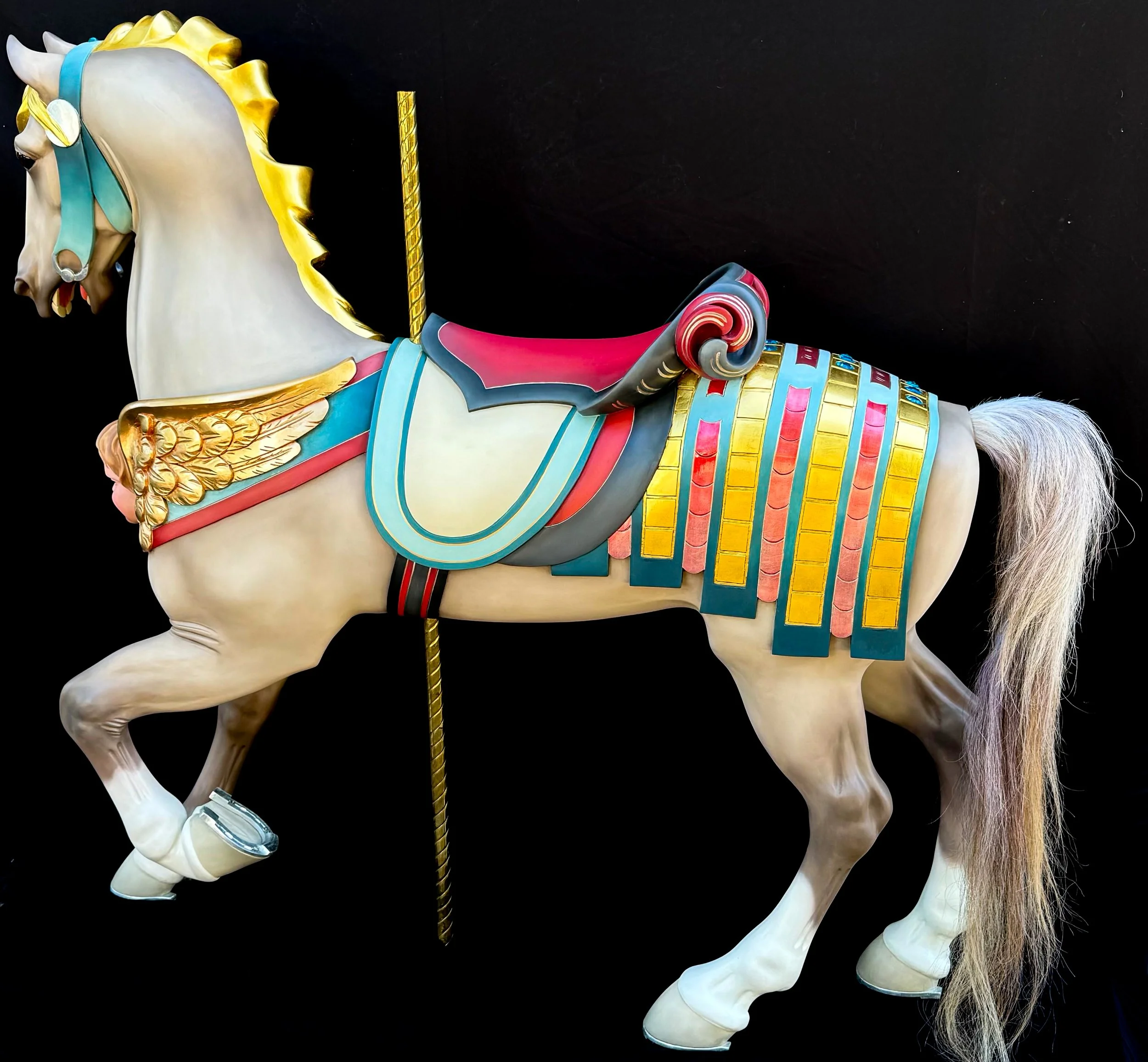
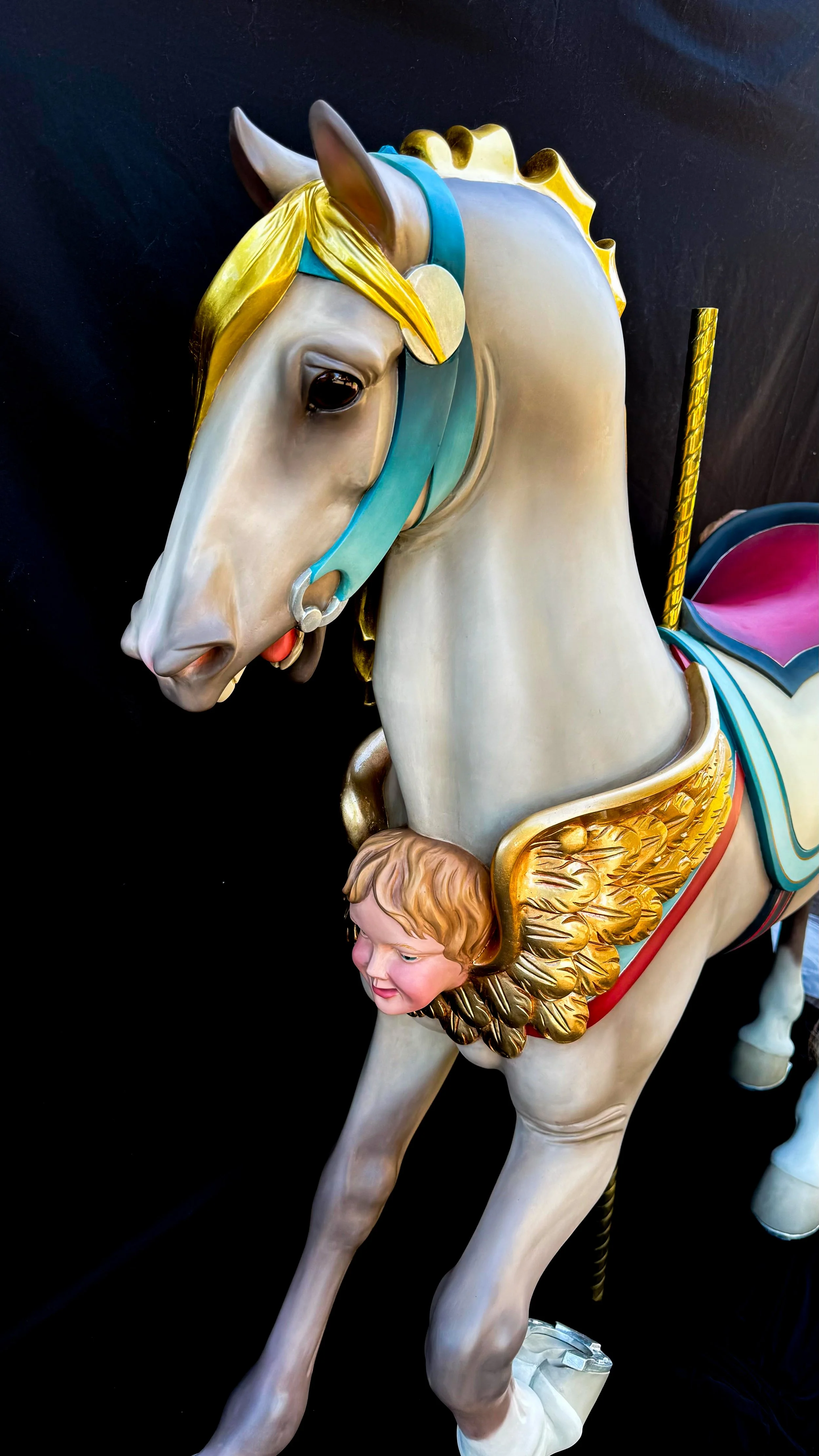
A large outside-row carved wooden carousel stander attributed to M.C. Illions and Sons Carousell Works, Coney Island, Brooklyn, in the Supreme style. The romance (right) side carries a heavily floral bridle band with red roses and a cascading bouquet, a gold-leafed flowing mane and forelock, and a deep amber glass eye. Both flanks bear carved cherub heads with feathered wings — the romance side paired with an oval cartouche reading "MADE BY M.C. ILLIONS" framed in gold acanthus scrollwork and pearl border, and the non-romance side carrying a larger forward-facing cherub set against rows of faceted aqua glass jewels mounted in gold and teal panels. The owner refers to this piece as "Uhlan" (reported).
-
Acquired four to five years ago from dealer Jim Aten, with the original find credited to Rusty Donohue, who located the piece (reported). The owner is precise on the restoration sequence: the horse was represented as paint-ready when it arrived at Pamela Hessey of Hawk's Eye Studio, but on examination revealed broken pieces and significant wood rot that placed it beyond the scope of paint restoration. It went from Hessey to Ed Roth in California for approximately two years of structural restoration and re-carving, then back to Hessey for painting and gold leaf, before being delivered to the collection (reported). The owner is explicit that "this is not 100% original. It has been restored" — and that Ed Roth should receive full credit for the carving and re-carving work (reported).
-
Dealer chain through Jim Aten and Rusty Donohue is established. Earlier ownership history before the Aten/Donohue acquisition is not documented in the interview material and remains an Open Question. The owner expects to learn more about the piece — including the basis for the "Uhlan" name — at the National Carousel Association convention in the Monterey area in June (reported).
-
Marcus Charles Illions (1871–1949) emigrated from Lithuania to Coney Island in 1888, carved early in his career for Charles Looff and then in collaboration with carousel builder W.F. Mangels, and established M.C. Illions and Sons Carousell Works in 1908–1909 on Ocean Parkway in Coney Island (sourced — Brooklyn Public Library, CarouselHistory.com, Wikipedia). The New York Times called him "the Michelangelo of carousel carvers" (sourced — Coney Island Museum). He is the defining figure of the Coney Island school, characterized by flamboyant horses with jeweled trappings, gold and silver leaf, and dramatic carved manes — features all directly present on this figure.
Illions is documented to have signed his work openly, with surviving examples carrying "Built by MC Illions" carved into their trappings, most famously on the 1909 Lincoln Centennial Horse still operating at the B&B Carousell on Coney Island (sourced — Amusing the Zillion, Coney Island Museum, Wikipedia). The "MADE BY M.C. ILLIONS" cartouche on this piece is consistent with that documented practice.
The Supreme designation belongs to Illions' final and most ambitious work — three carousels carved in 1926 and 1927, considered by many specialists to be the finest carousels ever produced (sourced — CarouselHistory.com, KPBS, Brass Ring Carousel Company). Only one of the three Supremes survives intact: the 1927 machine that originated at the Prospect Hotel in New York, was moved to Los Angeles in 1952 by Harry Illions, operated for years at the Los Angeles County Fairgrounds in Pomona, and is currently undergoing multi-year restoration at Brass Ring Carousel Company in California with original paint research by Rosa Patton, gold leaf work by Pamela Hessey, and paint by Lise Liepman (sourced — CarouselHistory.com). Carved cherub heads with wings — the defining secondary-carving motif on this piece — are a documented Supreme trim element, with original Supreme cherub-head pairs and rounding-board panels appearing on the specialist market (sourced — Carousel Workshop).
The Supreme carousels are widely cited as among the most-copied carousels in existence, with a documented full-scale Ed Roth–carved replica installed at Peddler's Village in Lahaska, Pennsylvania in 1998 and another Supreme-style installation at Gilroy Gardens in California (sourced — Peddler's Village, Worlds of Fun.org). This complicates attribution for any Illions Supreme-style figure encountered outside a documented original machine, and the owner's account here — that broken pieces were duplicated and re-carved by Roth during restoration — places this piece honestly within that complex spectrum rather than misrepresenting it as wholly original.
Ed Roth is documented as the most prolific master carousel wood carver of his generation, operating A&E Sculpting and Paint Studio in Los Alamitos, California; he carved the 46 figures for the Peddler's Village Grand Carousel, was featured in a Learning Channel documentary on that project, and has restoration credits including the 1924 Dentzel carousel at the Please Touch Museum in Philadelphia and the Seabreeze Carousel (sourced — A&E Sculpting, Peddler's Village, Akron Legal News, Coasterpedia). His involvement in the restoration of this piece is consistent with the standard restoration ecosystem for figures of this caliber.
Auction comparables ground the rarity context. At the December 1988 Guernsey's New York carousel auction, an Illions flying-mane stander from the Fun Forest Amusement Park Carousel in Seattle sold for $101,750 — then a world-record price for any carousel figure at auction (sourced — CarouselHistory.com, Guernsey's archive). A circa 1905 Illions outside-row stander from Willow Grove Park, Pennsylvania, restored and carrying a carved eagle cantle, has been offered through AntiqueCarousels.com at $22,850 — illustrating the wide spread driven by provenance, condition, and degree of restoration (sourced — AntiqueCarousels.com). A circa 1915 Illions horse purchased at the 1995 Guernsey's auction is documented at $8,000 (sourced — carouselandrockinghorses.com). Supreme-attributed figures sit at the top of this range, with individual horses from the surviving Supreme reportedly valued in the millions (sourced — KPBS, Brass Ring Carousel Company).
On the name: "Uhlan" was a celebrated American Standardbred trotter foaled in 1904, purchased by Chicago industrialist C.K.G. Billings, who set a world trotting mile record of 1:58 at Lexington, Kentucky in 1912 and toured Europe and Russia on exhibition before his retirement in 1916 (sourced — Bedford Historical Society, Harness Racing Museum, Daily Racing Form archive). Illions is documented as an owner of real horses who carved with intimate familiarity with equine anatomy and named or commemorated specific horses in his work — the Lincoln Centennial Horse being the clearest documented example of his portrait carving practice (sourced — Worlds of Fun.org, Coney Island Museum, Wikipedia). Whether "Uhlan" is the documented original name for this specific carving or a collection-applied name has not been independently verified and remains an Open Question.
-
The piece presents in fully restored condition, with structural wood restoration and re-carving of broken elements by Ed Roth, and paint and gold leaf finishing by Pamela Hessey of Hawk's Eye Studio (reported). Photographs show the surface in excellent display state: gold leaf intact across mane, forelock, neck wave, cherub wings, and cantle scrollwork; jewels seated and color-true across the saddle blanket panels; carved floral bridle and noseband elements unbroken; horsehair tail in good order. No paint losses, splits, or surface damage are visible in the photographs supplied. Formal condition rating pending dimensions and physical inspection.
-
Owner interview transcript, recorded session
Photographs supplied for this entry (twelve frames covering romance side, non-romance side, head, both cherubs, jeweled cantle detail, and full-figure profile)
CarouselHistory.com — Marcus Illions archive; 1927 Supreme restoration documentation; Guernsey's 1988 auction archive
AntiqueCarousels.com — Illions inventory and Supreme-style listings
Coney Island Museum — Illions biographical material and Lincoln Centennial Horse documentation
Brooklyn Public Library — Coney Island carousel carver biography
Wikipedia — Marcus Illions; B&B Carousell; Uhlan (Bedford trotter context via secondary sources)
Bedford Historical Society — Uhlan trotter biography
Harness Racing Museum — C.K.G. Billings biography
Daily Racing Form archive (University of Kentucky) — Billings stable records
KPBS Public Media — Ultimate Restorations Supreme episode documentation
Peddler's Village — Grand Carousel restoration documentation
A&E Sculpting and Paint Studio — Ed Roth biographical and project record
Carousel Workshop — Illions Supreme cherub head and trim documentation
-
Medium-High. Style attribution to Illions is strongly supported by the documented "MADE BY M.C. ILLIONS" cartouche signature, the Supreme-style cherub-head trim, the gold-leafed flowing mane and forelock, the heavily jeweled cantle paneling, and the Coney Island school carving treatment of head and body. The owner's account of substantial restoration and re-carving by Ed Roth is explicit and documented within the interview, and the restorer credits (Roth, Hessey) align with the established restoration ecosystem for figures of this caliber. What is not established: the degree to which the surviving wood is original Illions versus Roth re-carving; the original carousel of origin; the documentary basis for the "Uhlan" name; and the pre-Aten/Donohue ownership chain.