
Herschell-Spillman - Cat
Catalogue Piece #098 tbd
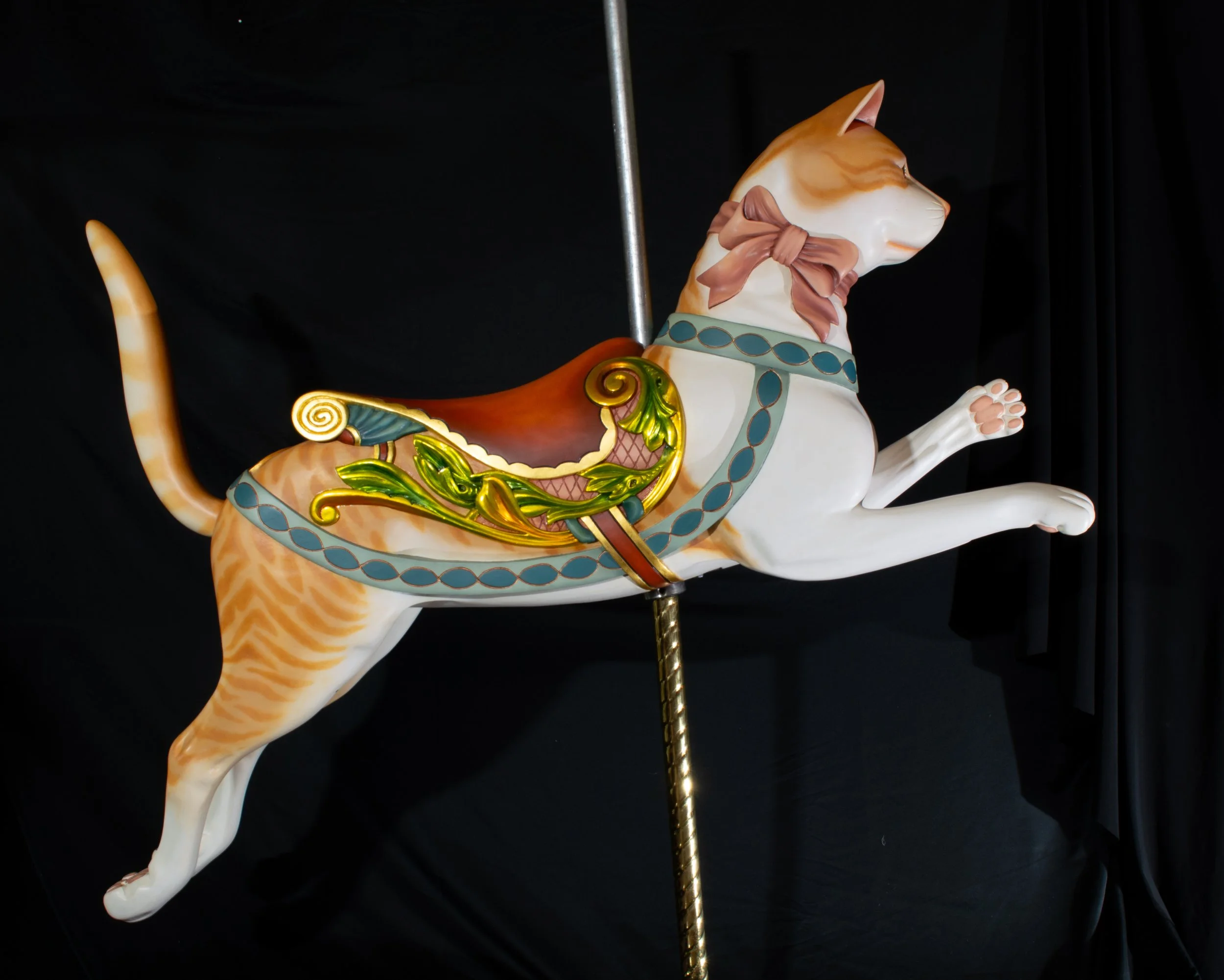
-
A full-size carved wood leaping cat, attributed to the Herschell-Spillman Company of North Tonawanda, New York (reported). The figure is modeled in a full stretch — front legs extended forward, rear legs trailing, tail long and held back — with the head turned slightly forward and ears upright. The painted finish presents the cat as an orange tabby: warm orange tiger-stripe markings over the haunches and tail, fading to a soft white underbelly and chest. A large knotted pink ribbon bow sits at the neck and a continuous blue chain-pattern strap encircles the chest and rear. The saddle is built around a rust-brown leather seat with deeply carved gold scrollwork at pommel and cantle — twin volutes flanked by acanthus leaves — over a saddle blanket worked in a pink quilted diaper pattern. Mounted on a twisted brass pole with a cast silvered base. Restored and painted by Pam Hessey (reported).
-
Acquired by the owner from Jim Aten in June 2016 (reported). The owner's interview material identifies the maker, dealer, and restorer; price paid is not yet documented in the project records.
-
Jim Aten is documented as a specialist dealer in antique carousel figures based in Portland, Oregon, and is the source of multiple acquisitions in this collection. The operating carousel of origin for this cat has not been established, and earlier collection or dealer history before the Aten transaction is not recorded in the project material. Tracing back through Aten's June 2016 records — if accessible — would be the strongest available lead.
-
The Herschell-Spillman Company of North Tonawanda, New York, was active from the early 1900s through the company's reorganization in the 1920s and was, by The Henry Ford's own accounting, the largest American carousel manufacturer between 1904 and 1920 (sourced). The firm's menagerie carousels were distinctive for the variety of animal types carved alongside horses: storks, dogs, frogs, roosters, ostriches, zebras, pigs, and — uncommonly — cats.
The specialist record establishes domestic carousel cats as one of the more scarce figure types from any American maker. Golden Age carousel cats came mostly from The Dentzel Co. and Herschell-Spillman in the US, with very rare early PTC cats and a Bayol carved cat in France; there were quite a few cats carved, but not a lot by any one maker, so they remain among the more coveted carousel figures (sourced — CarouselHistory.com). The same documentary record names only two specific operating Herschell-Spillman cats in its survey: the ca. 1911 Herschell-Spillman cat at Tilden Park and the ca. 1910 Herschell-Spillman cat at Rocky Point, Rhode Island (sourced). The Tilden Park machine — a 1911 H-S 4-row park model — carries a single cat among seventeen menagerie animals (sourced — VintageCarousels); that one-per-machine pattern is characteristic of the type, and on machines without a cat there is simply none. This is not a generic menagerie figure with a broad survival count. It is a one-off-per-carousel form that survived selectively.
The figure's carved saddle treatment — paired volutes flanked by deeply undercut acanthus leaves over a quilted diaper pattern — and the chain-pattern girth strap are consistent with the more elaborate menagerie figures the workshop produced for its park-model carousels rather than the simpler portable-machine output. The breed presentation (orange tabby, soft pink bow) reflects a contemporary restoration interpretation by Pam Hessey; original Herschell-Spillman cat paint schemes documented on operating machines (Tilden, Rocky Point) showed more naturalistic tabby and tortoiseshell markings, but specific original surfaces vary across surviving examples.
Auction comparables are sparse — a function of how few figures of this type exist outside operating carousels. The figure type's combination of maker-specific scarcity (only two named operating examples documented in the specialist literature), single-figure-per-machine survival pattern, and species-level rarity across all Golden Age American makers places it in a substantively different rarity bracket from a Herschell-Spillman horse, dog, or frog.
-
The photographic surface presents as excellent: even paintwork, no visible cracks, no seam separations, complete ears and tail, intact paw pads visible on the rear foot. The Hessey restoration appears comprehensive — surfaces are tight, the gilded scrollwork is cleanly highlighted, and airbrushed shading on the body coat is smoothly graduated. The current paint scheme is a restoration interpretation; whether any original paint survives beneath has not been documented in the project records. The figure is rod-mounted on a twisted brass pole with a cast silvered base. Formal condition rating pending physical inspection.
-
Owner interview (voice transcript, ID 098 session): Maker attribution to Herschell-Spillman; acquisition from Jim Aten, June 2016; restoration by Pam Hessey; reference to existing artist renderings of the figure.
Project catalog PDF (entry 98): "HERSHEL SPILLMAN; Purchased from Jin Aten in June of 2016. Cat restored by painted by Pam Hessey. INCLUDE ARTIST RENDERINGS."
Photographs (DSC_2778, DSC_2780): Full romance-side view and survey-rod measurement reference. Document pose, saddle carving and color, ribbon and girth placement, body painting, ear and tail position, mounting hardware.
CarouselHistory.com — Historic Carousel Cats (October 2015): Golden Age maker survey identifying The Dentzel Co. and Herschell-Spillman as the two primary U.S. sources of domestic carousel cats; ca. 1911 Tilden Park H-S cat and ca. 1910 Rocky Point, RI H-S cat documented by name and image.
The Henry Ford — 1913 Herschell-Spillman Carousel: Identifies Herschell-Spillman as the largest U.S. carousel manufacturer between 1904 and 1920; documents the firm's menagerie variety.
VintageCarousels.com — California survey: 1911 Herschell-Spillman 4-row park carousel at Tilden Park, with 17 menagerie animals including one cat.
AntiqueCarousels.com: Jim Aten / Antique Carousel Figures, Portland, OR — documented specialist dealer; Pam Hessey / Hawk's Eye Studio — documented carousel restoration specialist.
-
Medium-High. The figure type is independently confirmed as a documented Herschell-Spillman production; the dealer and restorer are reputable and documented; the owner-reported attribution and acquisition details are internally consistent. The remaining work — operating-carousel origin, pre-Aten provenance, and either a published photograph or auction record showing this specific figure — is what would push confidence to High.