
Orton & Spooner - Cockerel
Catalogue Piece #084 tbd
-
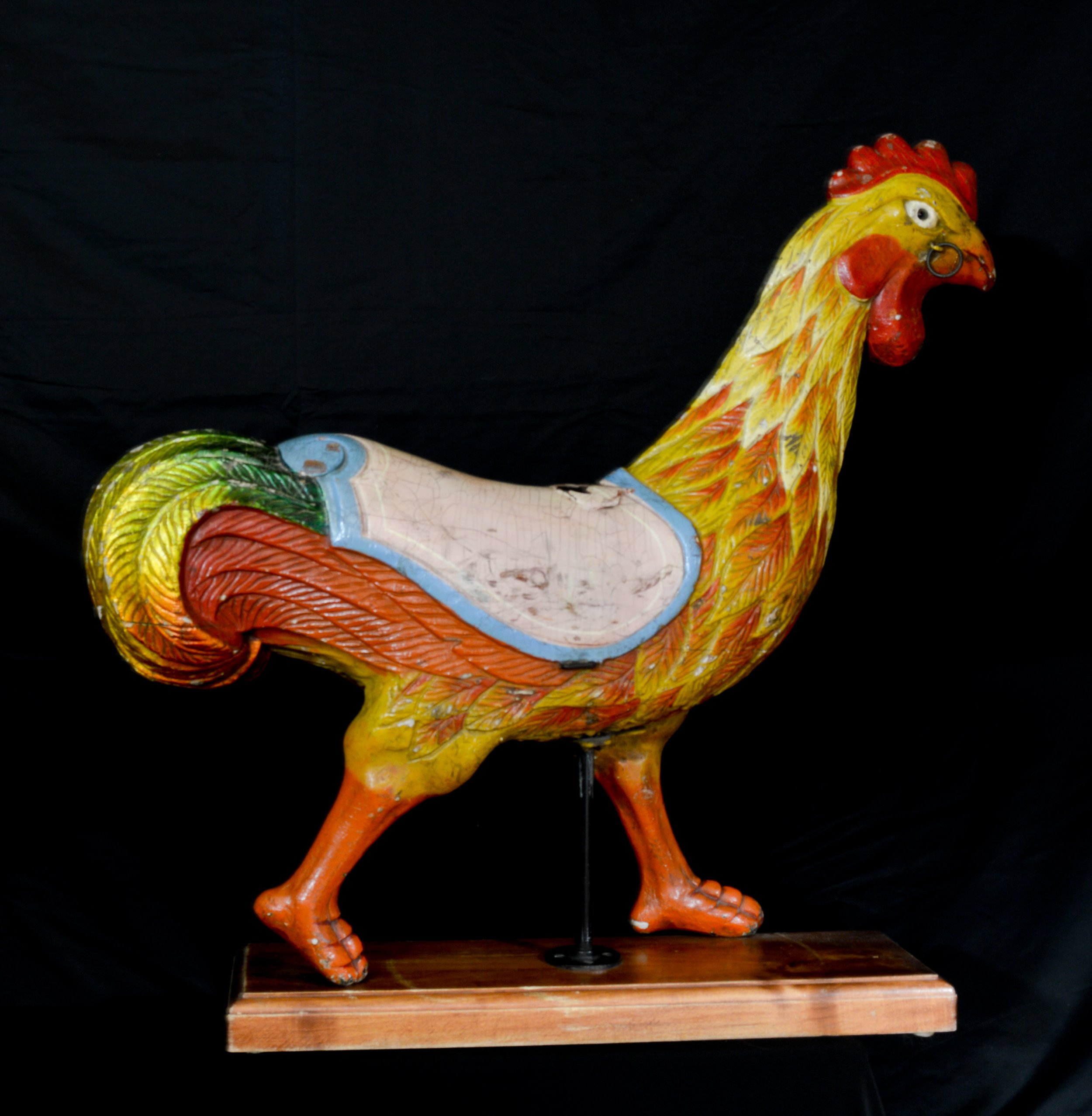
A carved wooden English fairground cockerel attributed to Orton & Spooner of Burton-on-Trent, in original park paint, in a walking/striding pose with the head held high and slightly turned outward (sourced). The body is densely carved with overlapping feather detail across the neck, chest, flanks, and the upper part of the legs, painted in graduated yellows, oranges, and reds with the layered translucent quality characteristic of English fairground decoration. The comb is bright red and deeply carved; the wattles below the beak are heavy and naturalistically rendered in matching red; a small brass ring is set near the beak for a rein. One painted white eye with a black pupil is visible on the side shown. The tail is a generous upward sweep of carved feathers in green at the apex transitioning through gold and orange to deep red below, with a separate downward sickle group of carved wing or sickle feathers in iron-oxide red overlapping the upper thigh. The saddle is a shallow scoop set into the back, edged in soft blue and floored in worn cream; the surface there shows pronounced craquelure, paint losses, and rider wear consistent with extended operating use. The legs are bright orange, carved with leg-feather and scale detail to the talons, in a striding pose — left leg trailing, right leg forward. The figure is mounted on a later wooden display base with a single metal support post.
-
Purchased in 1993 (reported). The owner identifies this figure as "from the Swenson collection" (reported); the timing aligns with the Swen Swenson auction dispersal in November 1993, which is independently documented and is also the source of at least two other figures in this collection (sourced — Carousel News & Trader, October 1993; Variety, June 29, 1993). The owner explicitly characterizes the paint as one of their favorite examples of original European fairground decoration and identifies the surface — particularly the layered, graduated, almost iridescent feather painting — as distinctive of European work and uncommon in the rest of the collection, which is largely American (reported).
-
A handwritten valuation letter dated April 15, 1994, on the letterhead of Mary Lawrence Youree's business "Cast Iron and Cast Offs" (14941 Henrici Road South, Oregon City, Oregon), is in the owner's records. The letter lists "Orton-Spooner Rooster" as one of two figures belonging to the current owners, and states that the figures are in excellent condition and "are not to be confused with any reproductions" (sourced — Youree letter, April 15, 1994; document in owner's possession). The Youree letter is dated approximately five months after the Swenson dispersal and is the earliest documentary trace of the figure in this collection.
Mary Lawrence Youree is documented elsewhere in this collection's records as a major Oregon-based collector and restorer who was the source of several other pieces in the catalog (reported and previously documented in entry records). Her independent identification of this figure as Orton & Spooner — separate from the owner's identification, separate from the Swenson catalog attribution, and made by a recognized specialist — is the single strongest piece of attribution evidence currently in hand. The figure is reported by the owner to be illustrated on page 33 of Charlotte Dinger's Art of the Carousel (1983), which would constitute a third independent attribution if verified against the published page (reported; pending direct verification of the page contents).
Pre-Swenson ownership has not been established. As an English fairground figure surviving in original park paint, the piece's deeper history is most likely traceable through Burton-on-Trent records, the Fairground Heritage Trust, and the National Fairground and Circus Archive at the University of Sheffield — though Charles Spooner's shop did not maintain consignment records of the kind that some later American manufacturers kept.
-
Orton & Spooner of Burton-on-Trent emerged from the partnership of George Orton — a wheelwright and coachbuilder — and Charles Spooner, who began working with Orton in 1894 and married Orton's daughter Rose Ann in 1897 (sourced — Fairground Heritage Trust; Grace's Guide). Charles Spooner is widely regarded in the British fairground literature as "the finest showman's carver of them all," and his shop produced a remarkable range of carved animal figures for fairground roundabouts: galloping horses, cockerels, swans, turkeys, pigs, donkeys, cows, goats, elephants, ostriches, bears, lions, and dragons (sourced — Fairground Heritage Trust; Grace's Guide). The firm formally amalgamated as George Orton, Sons and Spooner Ltd. in 1925; Charles Spooner stopped designing and carving around 1914 to become a travelling salesman for the company, and died in 1939 (sourced — Fairground Heritage Trust). Pieces in unequivocally Spooner-carved condition therefore cluster in the production period of roughly 1894–1914, with later figures from the Burton-on-Trent works carved by other hands in the same tradition.
The "iridescent" feather painting that the owner identifies as a European hallmark is more precisely a documented British fairground technique: layered transparent glazes applied over a coloured undercoat, often combined with metallic underpainting in the gold and bronze ranges, producing graduated colour shifts as the figure rotated under the ride's lighting. The technique is consistently associated with English galloper sets of the late Victorian and Edwardian periods and only rarely appears on American carousel figures from the same decades.
Cockerel figures from Orton & Spooner are recurring but uncommon survivors. Direct auction comparables include an Orton & Spooner cockerel offered by Preston Services (UK), described as "very rare, full (adult) size," in good unrestored condition, sold at price on application (sourced — Preston Services listing); a circa 1910–1915 Orton & Spooner double-seater cockerel restored to mint condition listed at $6,500 by Gameroom Show (sourced — Gameroom Show listing); and an English carved rooster attributable to Orton & Spooner, late 19th/early 20th century, 64" tall × 72" long, stripped of paint with only traces remaining around the saddle, offered by Potter & Potter Auctions in September 2019 at an estimate of $4,000–$6,000 (lot passed) (sourced — Potter & Potter / LiveAuctioneers archive). The principal differentiator in this small comparable set is paint condition: stripped or fully restored examples represent the majority of the market, while pieces retaining original park paint are decidedly less common and command a corresponding premium when they appear. Original-paint cockerels are otherwise concentrated in institutional and specialist private holdings — the Fairground Heritage Trust's Dingles centre operates and displays British fairground material of this period, and Hollycombe Steam in the Country preserves a hand-turn ride featuring cockerels and horses among other working machines (sourced — Fairground Heritage Trust; Hollycombe).
Within the broader category of British carved fairground figures, cockerels occupy a middle range of frequency: more common than the maker's documented one-off forms (peacocks, generals'-head curiosities) but less common than the horses that made up the bulk of any galloper set. As an extraneous animal type — neither a horse nor a chariot — every cockerel that survives represents a position on an operating ride that has been broken up. Survival of original-paint examples additionally requires that the figure escaped both the standard mid-twentieth-century repaint cycle and the late-twentieth-century restoration market, which generally stripped surviving original surfaces in favour of new decoration.
-
The figure is in original park paint and unrestored (reported, supported by photographic evidence). The April 1994 Youree letter rated condition as "excellent" (sourced — Youree letter). Photographic observation confirms the surface as authentic period paint exhibiting age-appropriate craquelure throughout the carved feather areas, with the most pronounced wear concentrated in the saddle scoop — exactly where extended rider use would be expected to produce paint loss, abrasion, and accumulated patina. Visible paint chips and minor losses appear along the leading edges of the comb and wattle, around the rein-ring fitting at the beak, on the saddle rim, and along the leg tops. No fresh repaint or overpaint is apparent. The carved relief of the feathers reads cleanly through the paint, suggesting the original surface is thin enough to preserve carving detail rather than the thick build-up of multiple repaint cycles. A separate photograph of the non-romance (left) side would document any condition variation between the two faces and would close the photographic record.
-
Owner interview recording: identifies the figure as ID 084, attributes it to Orton & Spooner ("Orton Spooner is the name of the carousel, not just Spooner"), confirms acquisition in 1993, locates documentation on page 33 of Charlotte Dinger's Art of the Carousel, characterizes the surface as a distinctive European fairground painting technique, and confirms unrestored condition
Photograph DSC_2741: right (romance) profile, full body
Mary Lawrence Youree valuation letter, April 15, 1994 (in owner's possession): attribution to Orton-Spooner Rooster, confirms excellent condition and authenticity (not reproduction)
Fairground Heritage Trust (fairground-heritage.org.uk): biographical and corporate history of Orton & Spooner, including Charles Spooner's reputation, the range of carved animal types produced, and the company timeline
Grace's Guide (gracesguide.co.uk): corporate history and the documented production range
Preston Services (UK) listing: comparable adult-size Orton & Spooner cockerel in unrestored condition, sold price on application
Gameroom Show listing: comparable c. 1910–1915 double-seater Orton & Spooner cockerel, restored, listed at $6,500
Potter & Potter Auctions / LiveAuctioneers, September 28, 2019: English carved rooster attributable to Orton & Spooner, late 19th/early 20th century, stripped paint, estimate $4,000–$6,000, lot passed
Carousel News & Trader, October 1993, Issue No. 10, Vol. 9: Swen Swenson Memoriam contemporaneous with the 1993 dispersal that is the most likely auction source
Charlotte Dinger, Art of the Carousel (1983), p. 33: reported by owner as picturing this figure; pending direct verification
-
Medium-High. The maker attribution rests on the owner's identification, Mary Lawrence Youree's independent identification documented in a contemporaneous 1994 valuation letter, and the reported page-33 illustration in Charlotte Dinger's Art of the Carousel. Three independent attribution sources converge on Orton & Spooner. The figure's physical characteristics — carving style, paint technique, pose, scale, and saddle treatment — are entirely consistent with documented Orton & Spooner production. The acquisition route through the Swenson dispersal in 1993 is reported by the owner and chronologically consistent with the Swenson auction in November 1993. What is not yet verified at High confidence: direct page-33 confirmation in the published Dinger volume, the specific Swenson catalog lot number, and any pre-Swenson provenance.