
Unknown - Horse
Catalogue # 053 127×102×31cm
-
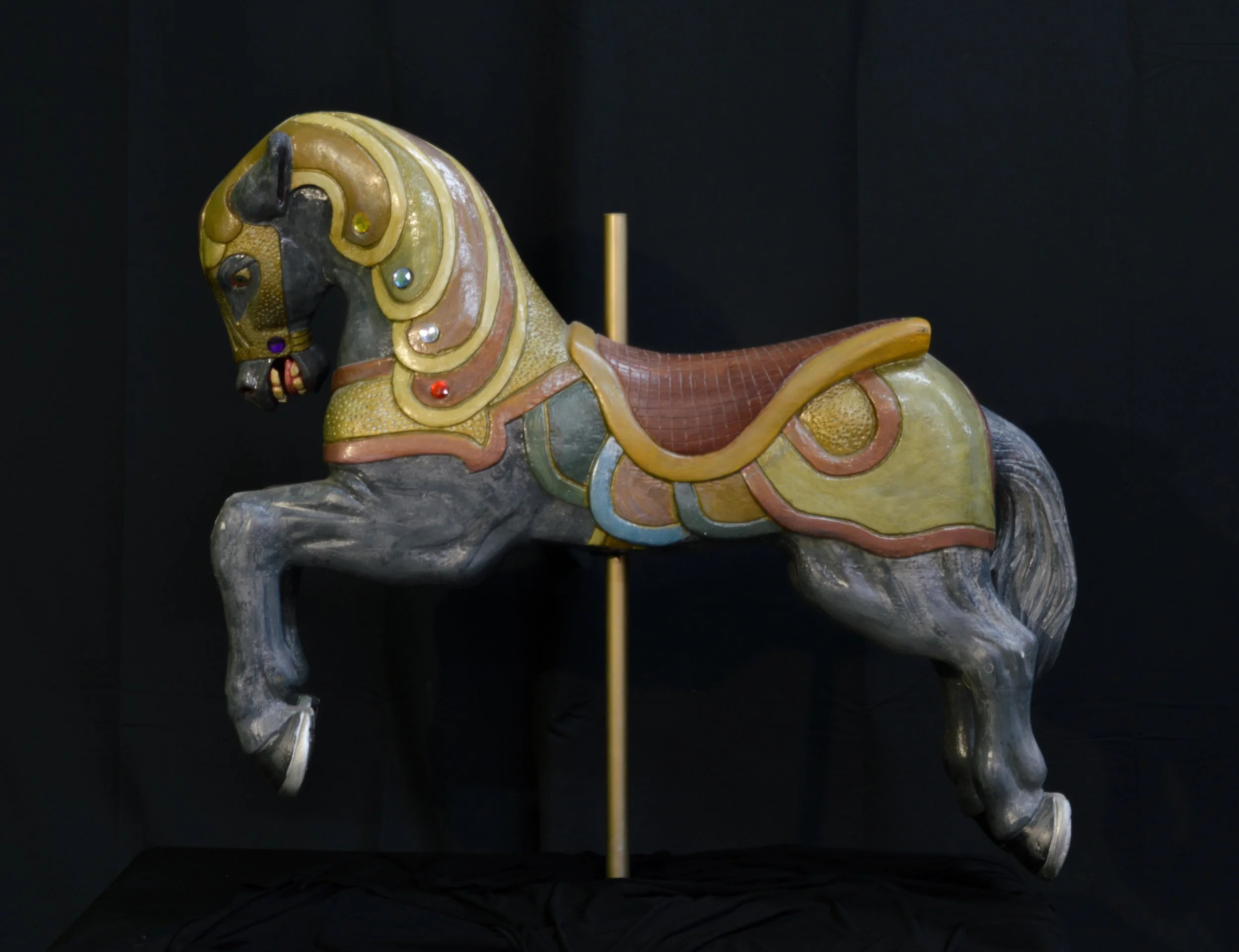
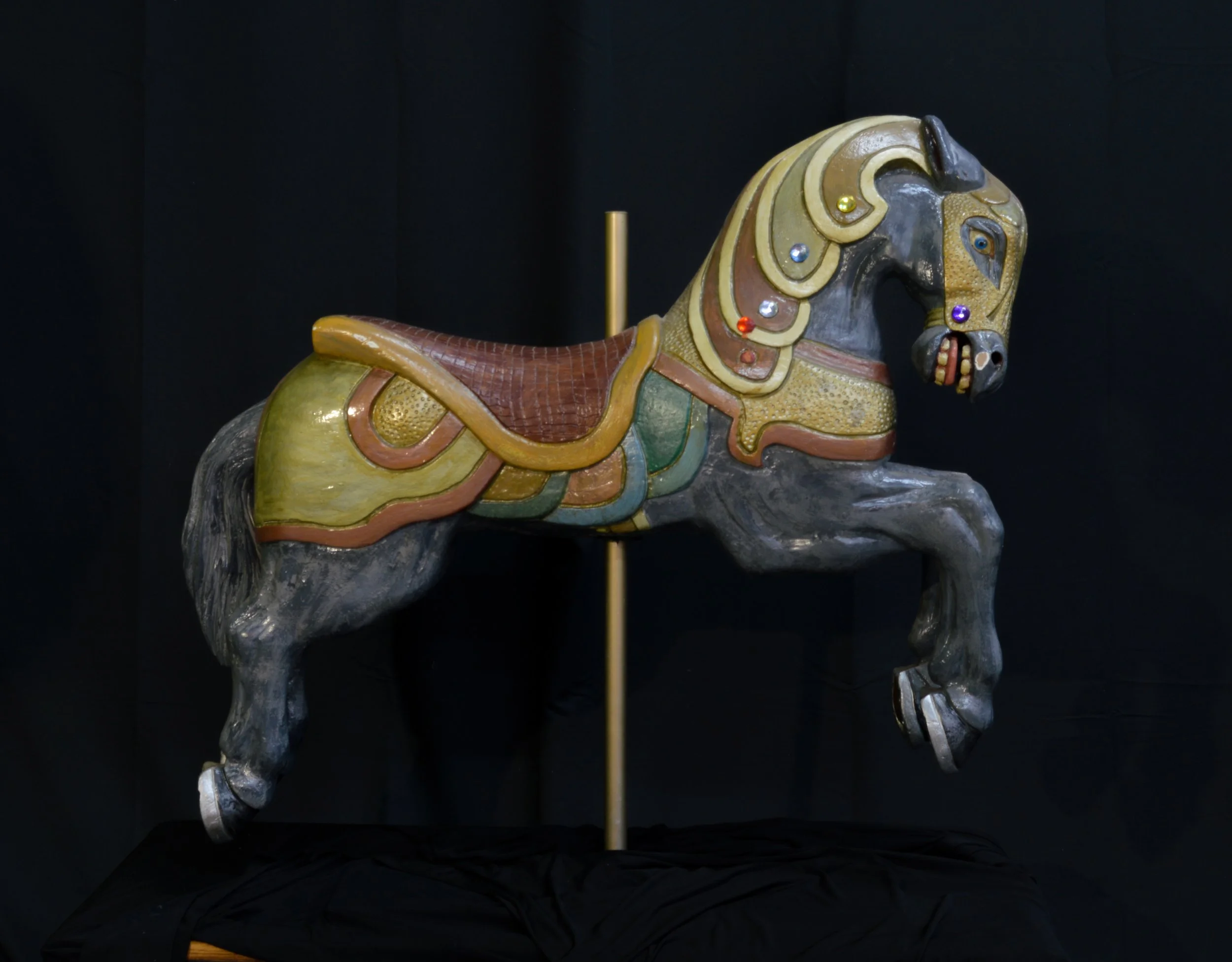
A hand-carved and painted wooden carousel horse in full jumper pose — all four hooves off the ground — attributed by the owner to Mexican production (reported). The figure is approximately 38–40 inches to the top of the head, estimated from the measuring rod in Image 2, and is displayed on a custom wooden base with a brass pole. The body is painted a consistent dark charcoal blue-gray throughout — an unusual color for American carousel production and visually consistent with Mexican carnival painting traditions. The mane is the figure's most elaborate feature: deeply scrolled and flowing carved locks in warm gold and ochre with copper-pinkish highlights, set with glass jewels in at least five colors — yellow/amber at the crest, aqua, clear/crystal, red-orange at the chest armor, and purple at the chin. The cheek and forehead show a distinctive pebbled or stippled gold texture treatment not typical of American or European production. The saddle is semi-armored as the owner describes (reported): layered trapping panels in olive-gold, mauve, and slate-blue wrap both sides of the figure, with a cross-hatched leather-look seat pad and a rounded rear apron panel on the romance side. The face presents a squared muzzle with carved visible teeth, amber glass eye, and prominent carved nostrils. Tail carved in matching charcoal body color, hanging naturally. Silver finish on all four hooves.
-
Acquired at Morphy Auctions (reported). The owner's characterization was brief and candid: "Mexican jumper, Morphy's auction. Semi-armored. I don't care for her." (reported). Morphy Auctions, headquartered in Denver, Pennsylvania, handles carousel figures and related Americana across their broader sale calendar. Lot number, sale date, and price paid were not captured in the interview and remain outstanding.
-
No prior collection history reported or located through research. Morphy Auctions is the confirmed acquisition point; pre-auction history is unknown. Mexican carnival-tradition carousel horses surface at American auction houses through a range of channels — private estate sales, park dispersals, and dealer networks — and provenance documentation for this category is rarely preserved. No connection to the Youree collection or to the Oregon City acquisition network has been established for this piece; while that network is documented as the source for other Mexican figures in this collection, it is not claimed here and should not be assumed.
-
Mexican carousel carving tradition is among the least-documented sectors of the broader field. Specialist collectors documenting Mexican carousel figures have noted that very little information on Mexican carvers and their work is available, even online, making independent attribution and maker identification for individual figures difficult without direct physical examination or documentation from the original carousel operator.
The figures produced for Mexican traveling carnivals (caballitos) are formally and decoratively distinct from their American contemporaries. Several diagnostic features of ID 053 are consistent with documented Mexican production: the in-the-round decoration (both sides substantially finished, as visible across all four images), the dark and unusual body color palette, the pebbled or stippled gold surface texture on the cheek and muzzle areas, and the layered polychrome armor-trapping style combining warm and cool tones simultaneously. None of these features are characteristic of the American Coney Island or Country Fair traditions.
LiveAuctioneers records confirm at least one comparable Mexican carved wood carousel horse from the 20th century has passed through the American auction market, at dimensions of 48" × 36" — consistent in scale with this figure. No price data is available for that lot without subscription access, and no further documented auction comparables for Mexican-tradition jumpers with armored trapping have been located through this research pass. The market for this category remains thin relative to American production, and realized prices — when they exist — are rarely aggregated into accessible databases. This is not a search failure; it reflects the genuine state of documentation for the category (inferred).
The Laurie Manera Pinterest collection board dedicated to Mexican carousel art — the most comprehensive publicly available visual archive for this category — illustrates the scale of the documentation gap: 530 pins assembled for educational purposes because no systematic scholarly record exists (sourced). Within this context, the rarity of this figure is better understood as a documentation problem than as scarcity on the ground. Mexican carnival carousels operated widely through the 20th century; what is rare is not the figures themselves but their appearance in the documented American collector market.
-
Owner interview, November 15, 2025 (reported)
Photographs: four images, November 15, 2025 (photographic evidence)
LiveAuctioneers price-result database: Mexican carved wood carousel horse, 20th century, 48" × 36" (sourced)
Laurie Manera, "Mexican Carousel Art" board, Pinterest — specialist documentation of the category's research landscape (sourced)
1stDibs listing: circa 1920 Mexican carousel horse, carved wood (sourced)
-
Low-Medium. Mexican origin is consistent with all visible physical characteristics and is confirmed by the owner (reported). No individual carver, workshop, or regional attribution has been established — the documentation infrastructure for this category does not currently support it. Paint condition and originality require physical assessment before the entry advances.