
Anderson - Dragon
Catalog #017 155×190×20cm
-
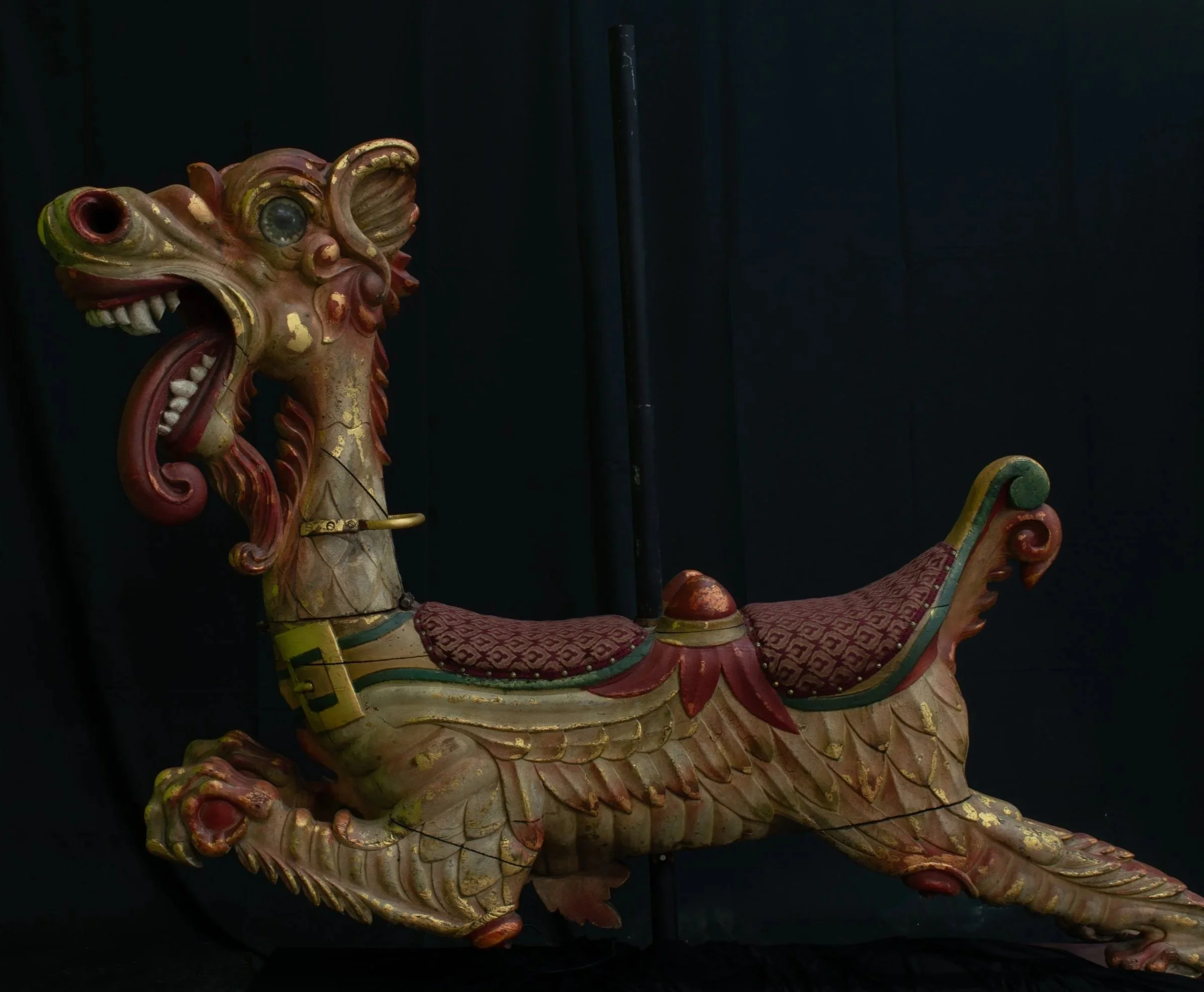
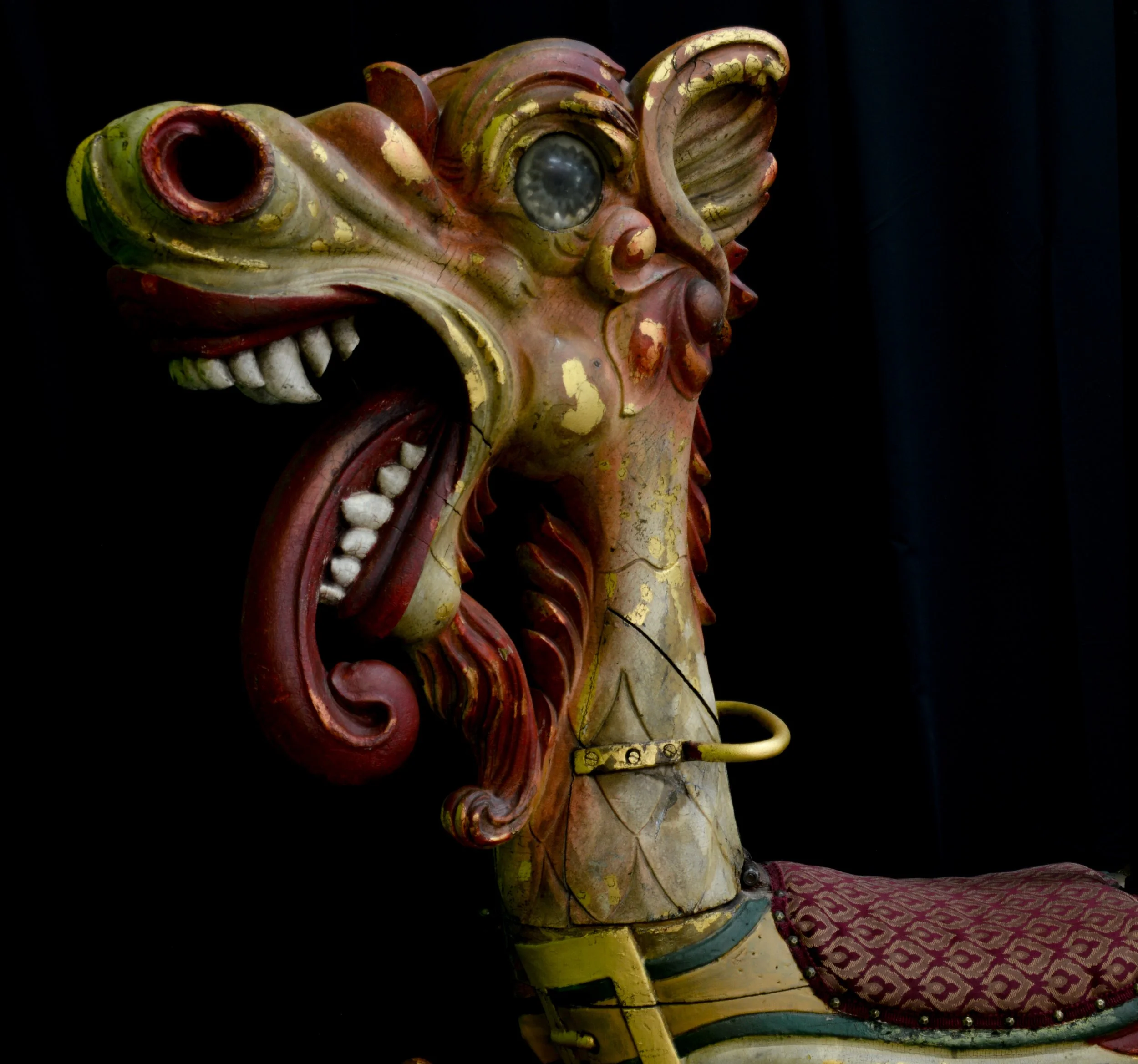
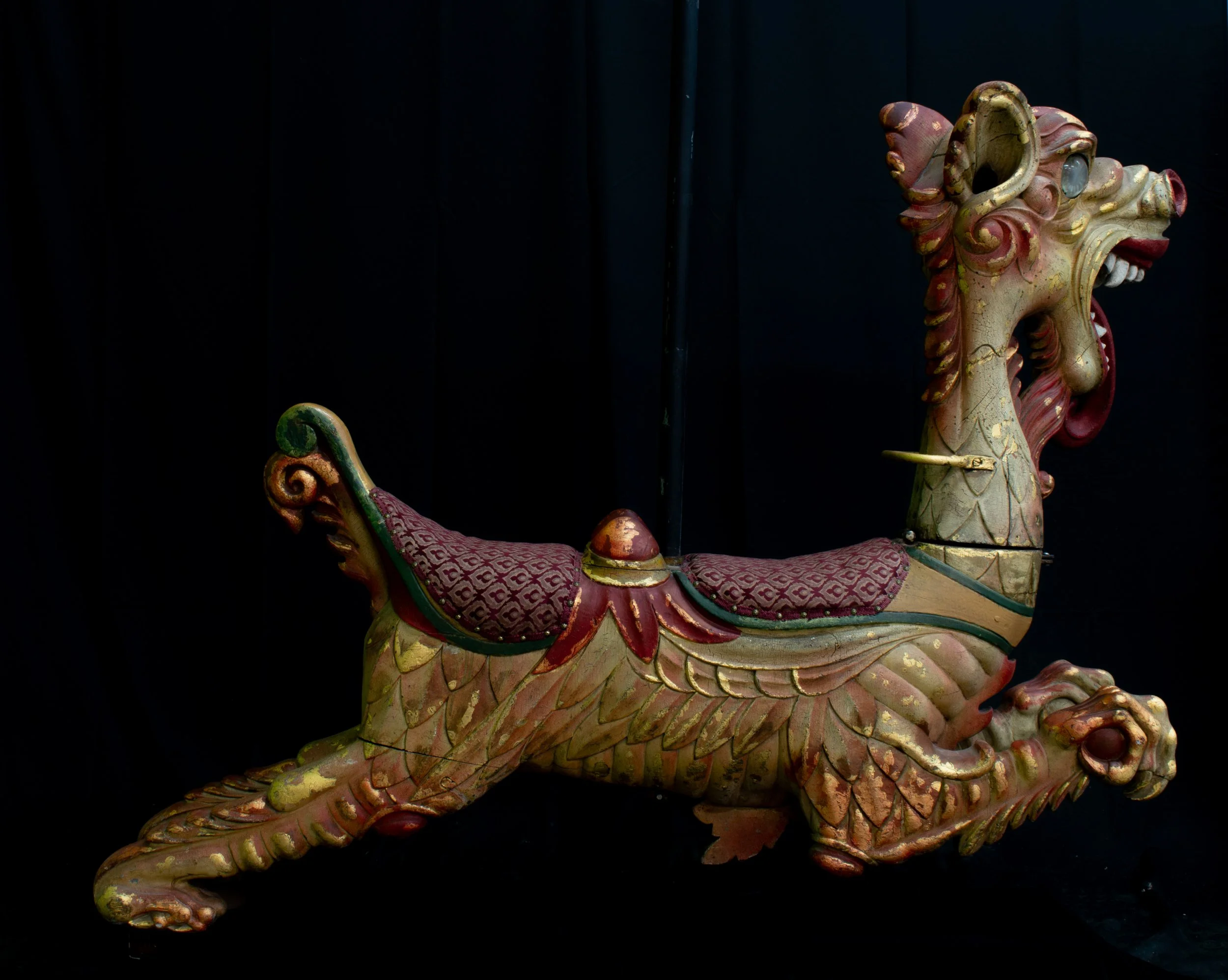
A full-size carved wood two-seater galloping dragon, attributed on stylistic and feature grounds to Anderson of Bristol (trading variously as Williams & Anderson, J. R. Anderson, and Arthur Ernest Anderson) (inferred from sourced records). The figure is configured as a bench-style mount: a long horizontal body in extended galloping pose with two upholstered saddle pads separated by a central carved pommel, designed to carry two riders. The body is covered in deeply carved overlapping scales transitioning to layered feather-like wing elements along the flanks and underside, with a red feathered crest running from the back of the head to the curl of the tail. The head presents a wide-open mouth with carved upper and lower teeth, a long curling red tongue, an open tubular nostril, scrolled red horns at the back, and large domed glass eyes of the "paperweight" type — internally lit, glowing red when plugged in (observed; tested). A brass collar with carved girth buckle encircles the neck and supports a gold ring grab handle.
-
Purchased from a private estate sale in Berkeley, California, within the last five years (approximately 2020–2024) (reported). A collector named Mark assisted in the acquisition (reported; confirmed in prior owner interview). The master inventory records this as an Estate Sale in Berkeley. No history accompanied the piece at sale and no price has been recorded (reported).
-
Provenance prior to the Berkeley estate sale is undocumented. The figure's English fairground origin places it on a working roundabout in the United Kingdom from approximately 1900 through the 1920s or 1930s before crossing the Atlantic at some unrecorded point. Berkeley is a known destination for European antiques and decorative-arts material, but no dealer, prior collection, or original ride has been traced for this piece.
-
Anderson's workshop originated in mid-19th-century Bristol as Williams & Anderson, ship's figurehead carvers based at Commercial Row in Hotwells, close to the city's docks. As demand for sailing-ship figureheads declined toward the turn of the twentieth century, the firm transitioned to fairground carving, registered as J. R. Anderson between 1889 and 1900, and continued under Arthur Ernest Anderson until the business closed in 1936, when Anderson's estate was dispersed at auction in Clifton (sourced: Bonhams, lot history for Arthur Ernest Anderson, d. 1936). The University of Sheffield National Fairground Archive describes the firm's signature style as "burgeoning scrollwork under the animal's belly, complete with Italianate grotesque grins upon its flanks, and a flying ribbon frozen onto the neck, lettered with name of a famous horse or friend" (sourced). The Fairground Heritage Trust's preserved Edwards' Gallopers is described as carrying a superb set of mounts "mostly carved by Britain's greatest fairground carver, Arthur Anderson of Bristol" (sourced: Fairground Heritage Trust).
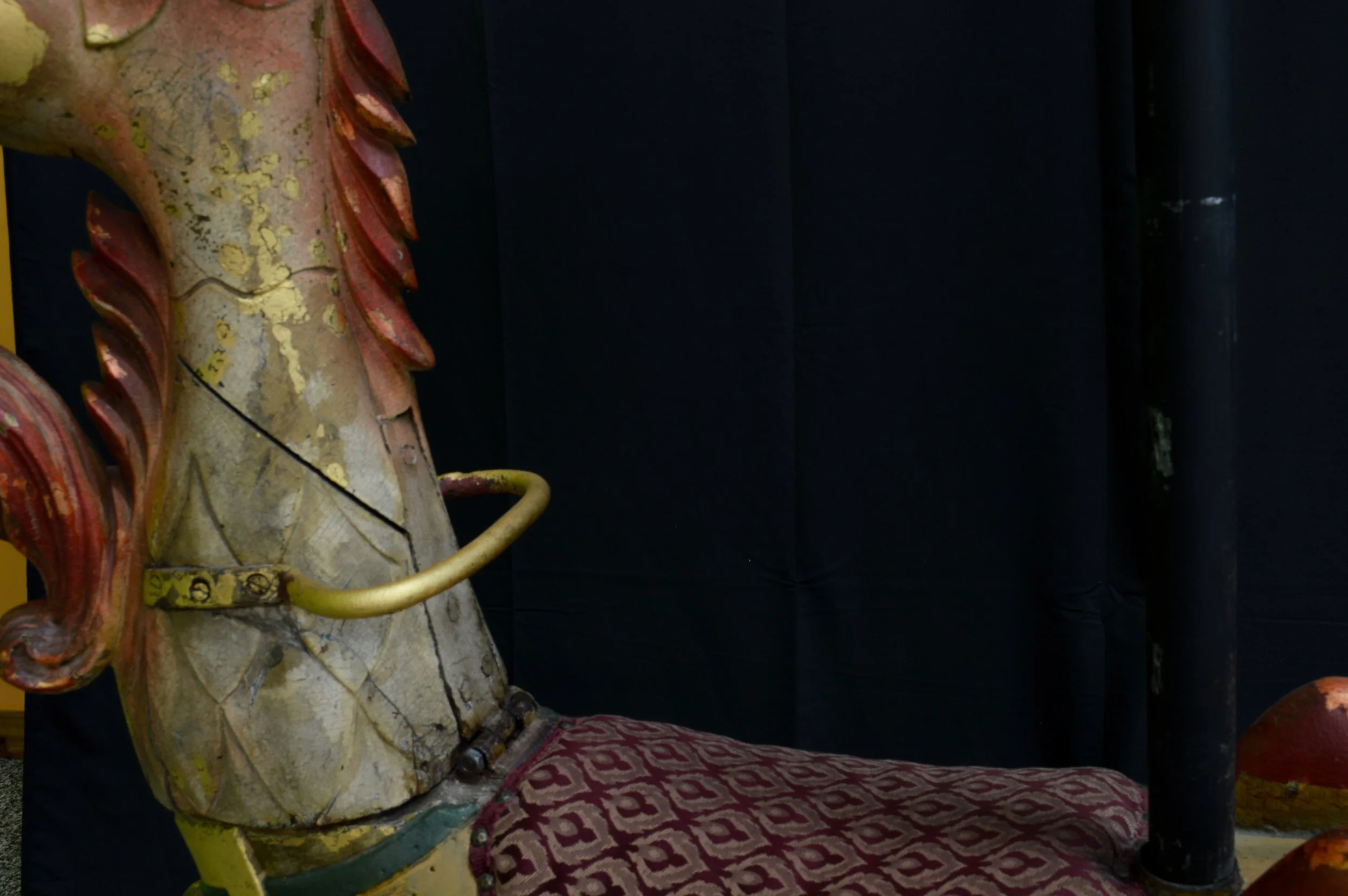
The strongest direct comparable for this figure is the group of Anderson dragons documented in the Swen Swenson auction catalog of November 1993 (pp. 32 and 55, lots #56, #57, #58, #104, and #105): full-size two-seater galloping dragons measuring approximately 58" tall by 5'6" long, in old park paint, with round "paperweight" clear glass eyes wired with lights behind them — originally red glass — and hinged necks for transport and storage (sourced: Swenson catalog). The catalog observes that the bodies of these dragons are similarly carved, while each head differs in facial design, ear configuration, and tongue treatment. The horizontal galloping form documented at Swenson #105 corresponds in pose, body construction, eye type, and decorative vocabulary to the piece under entry here. Visible horizontal seams at the base of this dragon's neck (Images 1, 4, 5) align with the hinged-neck construction Swenson explicitly attributes to Anderson dragons.
The Bonhams sale of the Ross Hutchinson fairground collection in September 2024 included "an English carved and painted galloping double-seater figure of a dragon attributed to John Anderson, circa 1900" with a pre-sale estimate of £4,000–6,000 (sourced: Bonhams press release) — direct documentary support for both the form and the Anderson attribution.
An alternative attribution to Orton & Spooner of Burton-on-Trent must be considered: the same Hutchinson sale included multiple double-seated galloping dragons attributed to that firm (one c. 1915 sold for £2,560, another juvenile c. 1920 for £3,584), and Orton & Spooner is documented as having produced "Dragon Cars" and a 1919 "Dragon Scenic" for Dagnall's of Cricklewood (sourced: Bonhams; Fairground Heritage Trust). However, the Swenson catalog's direct attribution of this two-seater dragon form to Anderson — together with the specific combination of paperweight eyes, hinged-neck construction, and the Bristol carving vocabulary of scrolled scales and grotesque facial treatment — makes Anderson the stronger working attribution in the absence of a maker's mark.
Dragon figures of any form are uncommon survivors. They appear infrequently on operating roundabouts in either the English fairground or American carousel traditions, and most surviving examples are concentrated in specialist private collections (Swenson, Hutchinson, Barker) and institutional holdings such as the Fairground Heritage Trust. Auction comparables since 2000 cluster between £2,500 and £6,000 for English double-seated dragon figures in old park paint (sourced: Bonhams; Sworders; LiveAuctioneers).
An earlier open question about a "chest marking" is resolved through closer photographic examination (Image 3): the gold-and-green geometric element on the side of the neck is a carved and painted girth buckle, integral to the saddle strap design, not a maker's mark or independent geometric symbol.
-
Old park paint throughout, with significant wear consistent with operational service: gold leaf and color layers rubbed through to base coats across the upper body, head, and front limbs, with paint chipping at scale edges and high points. The illuminated eye mechanism is intact and functions — the figure plugs in and the eyes glow red (reported; tested). The clear domed glass eyes appear to be the "paperweight" replacements documented in Anderson's surviving dragons rather than original red glass, with red interior lighting recreating the original effect (inferred from sourced Swenson description). Visible horizontal seams at the base of the neck (Images 1 and 4, immediately below the brass collar) are consistent with the hinged-neck construction documented for this form. Lamination cracks are visible along the body, particularly on the right-facing side; this is normal aging for a piece of this age and operational history. The carved teeth, tongue, scrolling horns, ornamental tail, and saddle framework are intact. The upholstered saddle pads (burgundy diamond-pattern textile with green trim) are later replacements in good condition. Formal condition assessment is pending.
-
Medium-High — The Anderson attribution is supported by direct form correspondence with the Swenson catalog reference, by feature-level matches across hinged neck, paperweight eyes, red illumination, scaled-and-feathered body, scrolled tail, and Italianate grotesque head treatment, and by the existence of a documented contemporary Anderson galloping double-seater dragon at the 2024 Hutchinson sale. Confidence is held below High because no maker's mark, foundry plate, or original provenance documentation has been recovered, and the alternative attribution to Orton & Spooner remains plausible without direct side-by-side comparison.
-
Owner interview transcript (provided with photographs; whiteboard dated 8/20/2025)
Six photographs analyzed (DSC_2377, DSC_2379, DSC_2380, DSC_2381, DSC_2382, DSC_2384): both profiles, head close-ups, neck/chest detail, full body with measuring tape
Master inventory entry: "17. CARVER UNKNOWN; This dragon was purchased from a Estate Sale in Berkley CA. It is in park paint, and the eyes glow red when plugged in. Circa 1900"
The Carrousel Collection of Swen Swenson, auction catalog, November 1993, pp. 32 and 55 (lots #56, #57, #58, #104, #105) — "The Anderson Dragons"
Bonhams: The Greatest Show: The Fairground World of Ross Hutchinson, 10–11 September 2024, London — press release and live/online lot results
Bonhams: Lot history and firm biography for Arthur Ernest Anderson (d. 1936) of Bristol
Fairground Heritage Trust: Edwards' Gallopers exhibit; Orton & Spooner workshop essay
University of Sheffield National Fairground and Circus Archive: Anderson firm signature style
Antique Collecting magazine: "Fairground Art — a collector's guide" (January 2025), referencing the Bonhams Hutchinson sale
Prior research cycles on this piece (March and April 2026): documented the two-seater configuration and Berkeley acquisition context