
Dentzel - Rooster
Catalog #061 tbd
-
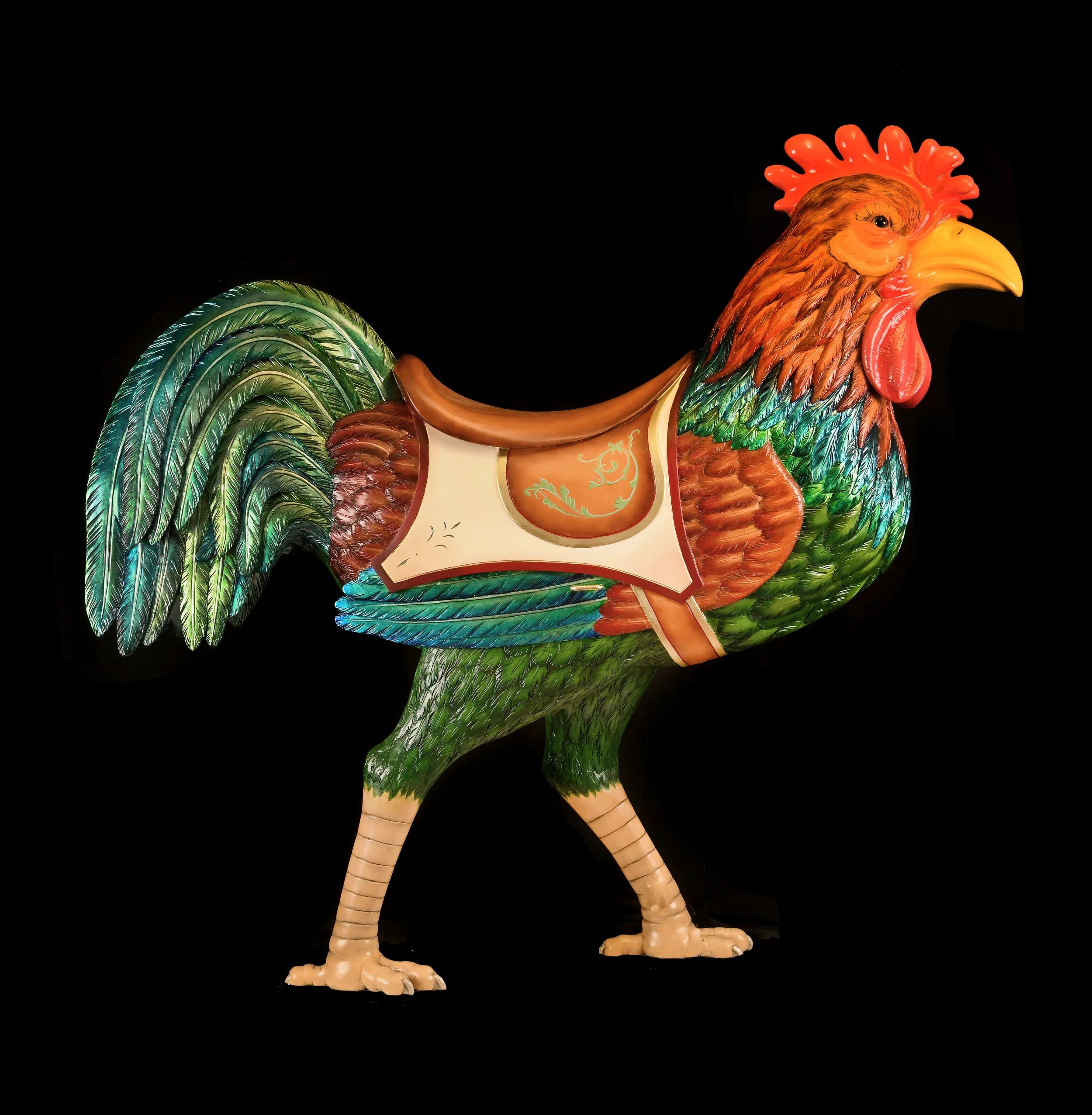
A full-size standing carved wooden rooster, attributed to the Gustav Dentzel Carousel factory, Philadelphia, circa 1895–1900 (documented attribution per bill of sale; strongly supported by physical evidence). The figure stands with head held forward in profile, full carved comb and wattles, glass eye, and carved yellow beak. The body and tail are exceptionally well-carved: layered feather detail across the chest, body, and wing; long, swept tail feathers carved in full three-dimensional relief; cross-hatched scaling on the legs to render the bird's foot anatomy; and substantial talons at the base. The figure is presented in a contemporary professional restoration paint scheme — a feathered gradient running from orange-red across the head and chest through deep green-teal across the body and tail, with iridescent blue-green highlights on the wing and rear plumage. The saddle is a Dentzel-conventional brown leather-look seat with cream side panels, gold-fillet trim, and a delicate scrolled foliate motif on the side flap. A blue feathered cinch wraps the body beneath the saddle. The restoration is to a museum standard.
-
Acquired from Jim Aten of Antique Carousel Figures (Portland, OR) on December 25, 2020 (documented — handwritten bill of sale on Aten letterhead, signed and dated). The bill of sale carries Aten's attribution to the Gustav Dentzel factory circa 1895–1900, states that the figure had been stripped to bare wood at time of sale, identifies it as "one of six known," and records its prior auction history: "The rooster sold at auction on October of 1991 for $145,000" to someone else (documented per bill of sale). The owner personally witnessed that 1991 auction sale — "the rooster that we saw sold at auction… in 1991" (reported) — establishing direct firsthand observation of the figure in its stripped, pre-restoration state.
Following the 2020 acquisition, the figure was restored: wood restoration by Rich DeCuir and painting by Lise Liepman (reported; consistent with Liepman's documented Bay Area restoration practice and her established involvement with other pieces in the collection). The owner also references having an additional Dentzel rooster recorded as one of seven known, suggesting that a seventh example has been documented since the 2020 bill of sale was written (reported).
The bill of sale is addressed to the current owners here.
-
The documented chain is unusually complete for a piece of this age:
Manufacture: Gustav Dentzel factory, Philadelphia, ca. 1895–1900 (attributed per bill of sale)
Original carousel: Not yet identified
October 1991: Sold at auction in San Francisco for $145,000 in stripped condition (documented per bill of sale; corroborated by owner's firsthand recollection). This auction is the American Carousel Museum auction held in October 1991 in San Francisco — independently documented in the CarouselHistory.com issue archive (Vol. 7, No. 9, September 1991, which covered the upcoming auction) and through subsequent auction records that cite "American Carousel Museum Auction, Oct. 1991, San Francisco, CA" as provenance for other lots from that sale (sourced).
1991 to 2020: Owner not yet identified; possibly the "Rudy Dory" salutation on the Aten bill of sale, possibly an intermediate party
December 25, 2020: Sold by Jim Aten to current collection for (documented per bill of sale)
2020–present: Wood restoration by Rich DeCuir; painted by Lise Liepman (reported)
The carousel of origin remains the principal unresolved provenance question. The American Carousel Museum auction dispersed pieces from multiple sources, so the 1991 sale establishes the figure's modern recovery but does not by itself identify the operating machine.
-
Roosters are among the rarest of all documented American carousel figures. Only two American workshops are known to have carved them — the Dentzel workshop of Philadelphia, and a single North Tonawanda manufacturer (sourced — CarouselHistory.com, "Historic Carousel Roosters"). Of Dentzel's production, between six and seven examples are currently documented as surviving (reported per bill of sale "one of six known" 2020; updated to seven known per current owner). The market history reflects that scarcity directly:
Sotheby's, 1989: A Dentzel rooster sold for $148,500 — the world record price for any carousel figure at auction at that time, a record subsequently broken only by a major sale of an unrelated figure type (sourced — CarouselHistory.com archive, Vol. 5, No. 4, April 1989).
American Carousel Museum auction, October 1991, San Francisco: this figure sold for $145,000 in stripped condition (documented per bill of sale).
William Bunch Auctions, April 2016, Chadds Ford, PA: a Dentzel rooster sold for $75,000 to a private collector in Alabama, described in coverage at the time as "the first Dentzel rooster to come to auction in nearly 25 years" — a description consistent with this figure's 1991 sale being the prior auction event (sourced — Antiques & Auction News).
The Dentzel rooster has been documented in major reference literature, including Charlotte Dinger's Art of the Carousel (1983), where a comparable example appears on page 46 (reported per collection notes — to be verified via direct reference check).
The figure's carving program — full three-dimensional tail feathers, individually rendered body and wing plumage, cross-hatched leg scaling — is consistent with the most ambitious Dentzel menagerie production of the Gustav era. The attribution date of 1895–1900 places it among the earliest of the surviving Dentzel rooster group and predates the 1903 arrival of the workshop's later master carver. This is consistent with the relatively simple saddle treatment (no elaborate floral or armorial secondary carving), which reflects the Dentzel decorative vocabulary in use before the most elaborate trappings program became standard at the workshop.
-
Photographs show a fully restored figure presented to a museum standard. The carving surfaces are crisp; the painted feather gradient is exceptionally well-executed; glass eye is in place; comb, wattle, beak, and tail feathers all intact with no visible loss. The Rich DeCuir / Lise Liepman restoration represents a complete transformation from the stripped bare-wood state observed at the 1991 auction. No structural concerns are visible. Formal condition rating pending direct inspection.
-
High. Maker attribution is documented in writing by the dealer (Jim Aten) and is fully consistent with the figure's physical characteristics, carving style, and decorative program. The 1991 auction provenance and 2020 acquisition price are both documented on the bill of sale. Restoration provenance (Rich DeCuir, Lise Liepman) is reported by the owner and consistent with documented restoration practices in the field. The original carousel of origin and the identity of any owner between the 1991 auction and the 2020 sale to the current collection are the remaining gaps.
-
Bill of sale, handwritten on Jim & Gayle Aten letterhead (Antique Carousel Figures, Portland, OR), dated December 25, 2020 — documenting maker attribution, period, condition at sale, rarity claim, prior auction history, and sale price
Owner interview, transcribed (audio recording) — corroborating bill of sale details, identifying restorers Rich DeCuir and Lise Liepman, confirming personal observation of the 1991 auction
Photograph analyzed (romance side, post-restoration)
CarouselHistory.com — Historic Carousel Roosters reference; Vol. 5, No. 4 (April 1989) Sotheby's record; Vol. 7, No. 9 (September 1991) American Carousel Museum auction coverage
Potter & Potter Auctions — corroborating provenance to American Carousel Museum auction, October 1991, San Francisco, on a separate Dentzel lot
Antiques & Auction News — coverage of the April 2016 William Bunch Dentzel rooster sale ($75,000)
Charlotte Dinger, Art of the Carousel (1983) — page 46 reference cited in collection notes for a comparable example (verification pending direct check)
Frederick Fried, A Pictorial History of the Carousel (1964); vintagecarousels.com Carvers and Manufacturers reference for Dentzel workshop production context