
Looff - Horse
Catalog #063 tbd
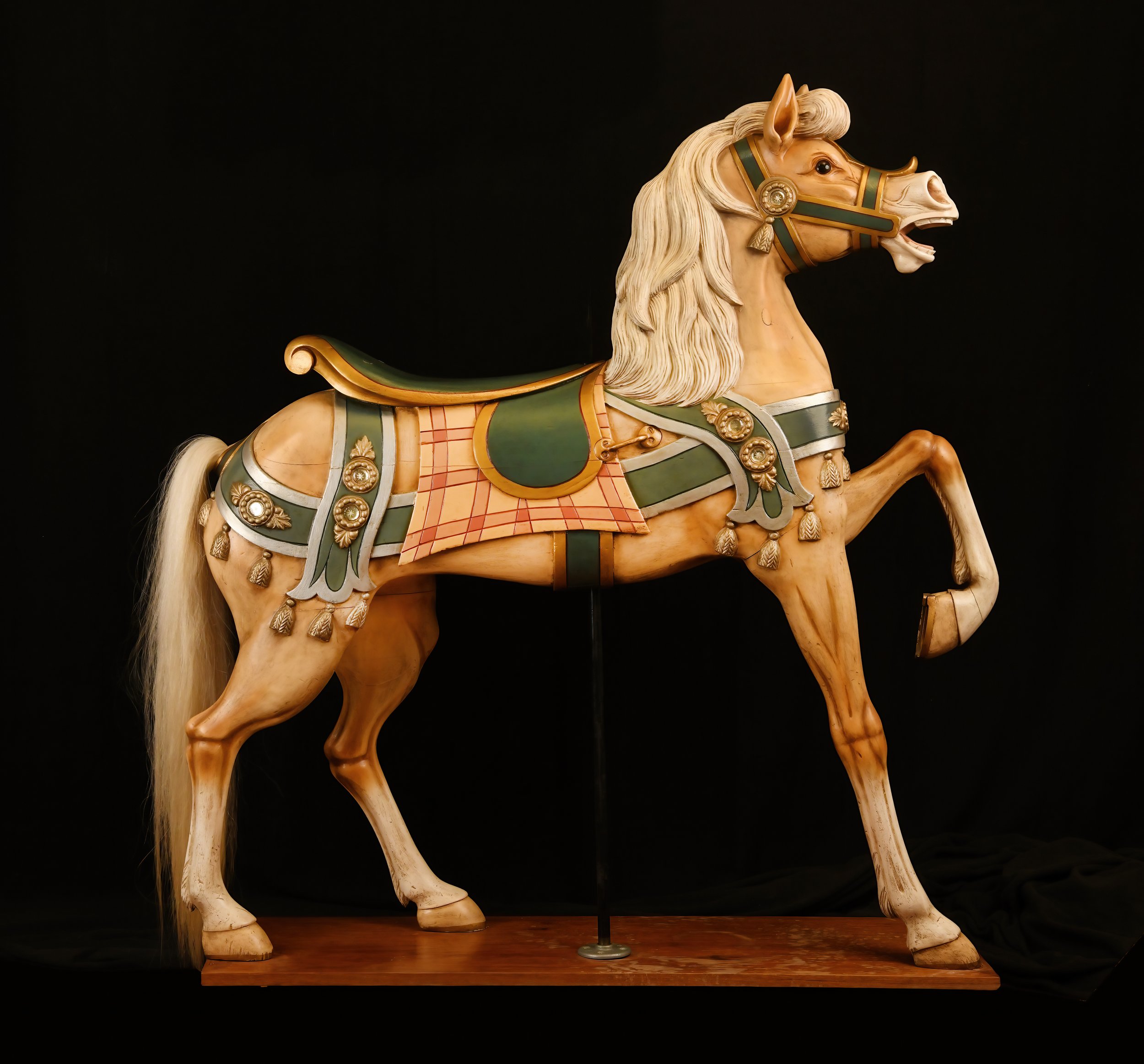
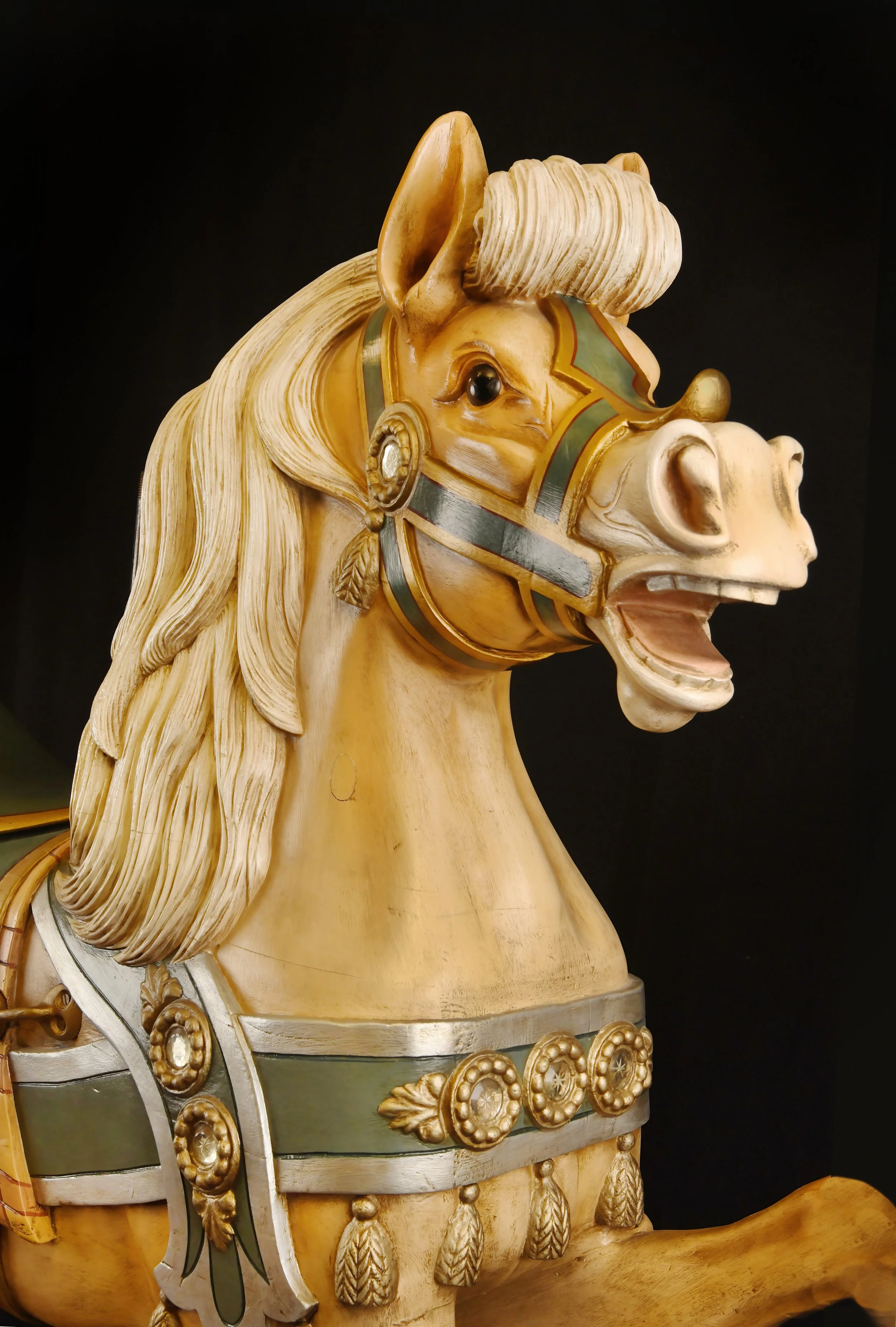
-
A carved wood outside-row prancing stander attributed to Charles I.D. Looff, characterized by the owner as an early example of the maker's hand (reported). The figure is presented in palomino/buckskin coloration with a long, cream-colored mane and tail — the tail formed of real horsehair, a documented house preference of the originating workshop (sourced). The romance side photograph shows an animated prancing pose with the right foreleg lifted and tucked, mouth open with carved teeth and tongue, glass eyes, and a forelock rendered as a high, neatly carved top knot. Trappings are elaborate but restrained: a green and gold cantle scroll, a green saddle plate with gold trim, a tartan-pattern saddle blanket in soft pink and orange tones, and a wide green and silver belly band ornamented with mirrored rosettes, gold-leaf foliate accents, and hanging gold tassels.
-
Acquired at a California auction conducted by Jim Aten (reported). The figure was shipped directly from the auction venue to a restoration shop in Maryland, then shipped a second time to the current location once restoration was completed (reported). The owner remarks on the practical difficulty of long-distance carousel-figure shipping today, noting that "back when you could" handle the transit through normal freight, the logistics were simpler than they now are.
The owner's transcript also notes that artist renderings — conceptual restoration drawings prepared during the restoration process — exist for this piece and should be associated with the entry.
The acquisition file previously recorded this piece as having come from the Kissel auction. The owner's interview corrects that record: it was a Jim Aten auction. The earlier note appears to have been a memory crossing — the owner explicitly says "I always thought we bought that at the Kissel auction" before confirming the Aten attribution.
-
The piece is described by the owner as having come from the same source collection — the Ersepke collection — that has supplied approximately nine figures to the collection (reported). The owner indicates that this entry carries the spelling in printed form in their reference materials. That printed reference, when retrieved, should resolve a documentation gap that runs across a meaningful portion of the collection. The collection name has not been independently identified in specialist carousel sources despite repeated searches.
Pre-source-collection ownership, original park or carousel of operation, and any operating history are not currently documented.
-
Charles I.D. Looff (1852–1918) emigrated from Holstein to Brooklyn in 1870 and built the first carousel installed at Coney Island in 1876, going on to manufacture more than fifty carousels across his career in Brooklyn, Rhode Island, and California (sourced — multiple specialist sources including Heritage Museums & Gardens and CarouselHistory.com). Documentation of his career divides his output into three phases: an early period (1876–1888) characterized by gentle expressions; a middle period (1889–1900) marked by elegant heads with intricately carved flowing manes; and a late California period of increasingly ornate decoration (sourced). The figure under discussion shows the characteristic markers of the middle phase — naturalistic body proportions, a sweet-faced expression rather than the wild-eyed intensity of the later Coney Island flamboyance, and an intricately carved flowing mane (inferred from visual evidence against documented period descriptions).
Several physical features support the owner's Looff attribution. The real horsehair tail is a documented house preference of the originating workshop, favored specifically for the sense of motion it added to figures in operation (sourced — Heritage Museums & Gardens, which holds an operating 1908 Looff carousel). The tartan-pattern saddle blanket is consistent with a documented decorative feature on the earliest horses from documented Looff machines, where Heritage records that horses carved in the 1880s carry checkered or plaid blankets under their saddles (sourced). The restrained-but-elaborate decorative program — ornate rosettes and gold-leaf foliate trim without the heavy jeweling of later Coney Island production — is more consistent with the originating workshop's house style than with the more heavily ornamented work of the next generation of carvers trained there (inferred).
Auction comparables for restored Looff outside-row standers establish a market range. A Charles Looff outside-row stander, circa 1905, carved and painted wood with jewels, 61 × 65 × 18 inches, was offered at Fontaine's Auction Gallery; hammer price not currently retrievable from the lot page. An 1895 Looff carousel horse with older partially-stripped park paint, horsehair tail, and pole stand, 47 × 72 inches, was offered at William Bunch Auctions in December 2017. AntiqueCarousels.com has listed a Looff inside-row stander from the Glendale Park (Nashville) carousel — purchased at Guernsey's NYC auction in December 1988 and fully restored by Keith Jamieson in 2015 — characterized as "classic early Looff with sweet dish-shaped face." The Carousel Workshop has listed Looff standers from the Keansburg, NJ, amusement park carousel acquired from the 1987 Saratoga auction (all sourced).
Looff figures with documented restoration histories, original horsehair tails, and clear provenance to a named operating carousel tend to command higher prices than unprovenanced examples; restored figures without identified machine origin typically fall into a lower band. Standers in restored condition from this originating workshop appear on the private market with moderate regularity — less frequent than standard jumpers, more frequent than menagerie figures from the same hand.
-
The photographs show a beautifully restored figure. Surface paint is intact and lustrous across the body, with the palomino base shaded smoothly into the cream of the legs and underbelly. Trappings paint is clean and crisp; gold-leaf accents and mirrored rosettes read as intact. Small dark marks visible on the right cheek and at one upper-flank seam line appear consistent with old fill or seam mark-through rather than active loss. The carved teeth, tongue, glass eyes, and ear interiors are well preserved. The mane and forelock retain their long, deeply incised flow lines. The horsehair tail appears full and well attached. Mounted on a wooden plinth with a metal pole.
Restoration was performed in Maryland; the specific restorer is not named in the current interview record. Artist renderings prepared during the restoration process are reported as available and should be included with this entry on publication.
-
Medium-High — Looff attribution is reported by the owner and independently supported by multiple physical and stylistic indicators (horsehair tail, restrained decorative vocabulary, sweet-faced expression consistent with the middle-period style, plaid blanket feature documented on the earliest figures). The acquisition record is internally consistent once the Kissel/Aten correction is applied. Open questions remain on the specific date of production within the maker's three-phase career, the carousel of original operation, and the source collection's correct identity.
-
Owner interview (voice transcript) — primary source for Looff attribution, Jim Aten auction provenance, Maryland restoration, source collection, approximate price, and the existence of restoration artist renderings
Photographs (two images: full romance-side view and head/neck detail) — primary visual evidence for pose, decoration program, surface condition, mane and tail composition
Heritage Museums & Gardens (heritagemuseumsandgardens.org) — documented operating 1908 Looff carousel; source for horsehair tail house preference and plaid/checkered blanket convention on the earliest figures
CarouselHistory.com — Looff career documentation, the 1890s Looff Broadway Flying Horses Carousel record, and general maker context
Fort Wayne Museum of Art blog (fwmoa.blog) — Looff prancer attribution discussion and the Synagogue-to-the-Carousel tradition that informs the originating workshop's carving lineage
AntiqueCarousels.com — Looff manufacturer category and comparable listings including the Glendale Park Nashville stander
Carousel Workshop (carouselworkshop.com) — Looff Keansburg NJ stander listing and Saratoga 1987 auction provenance
LiveAuctioneers / Fontaine's Auction Gallery — Charles Looff outside-row stander comparable, c. 1905
1895 Looff Carousel Horse with older park paint — William Bunch Auctions, December 2017 (LiveAuctioneers archive)