
Unknown - Seal
Catalog #030 127×127×26cm

-
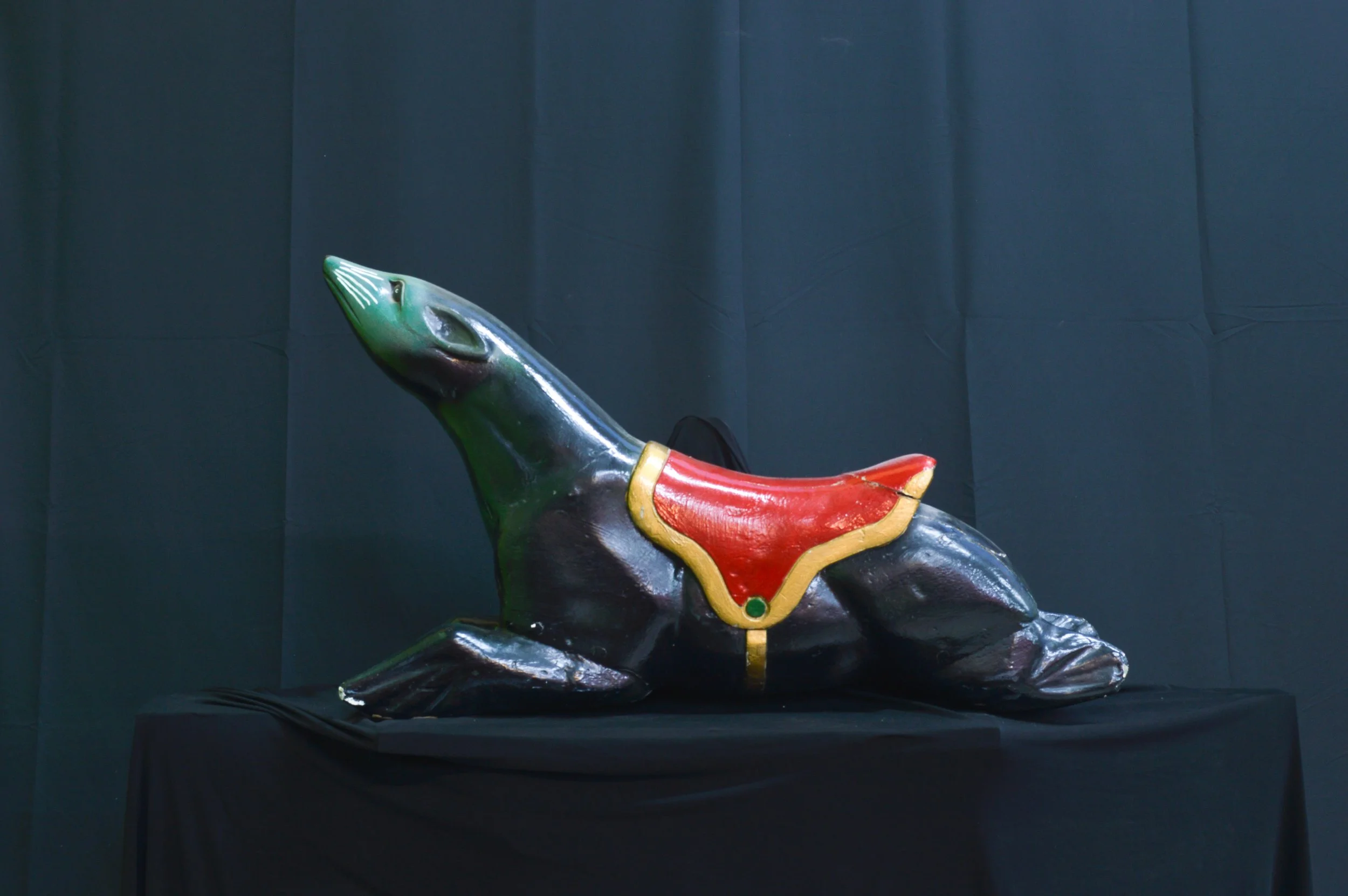
A carved and painted carousel seal in a reclining pose with head raised upward, attributed to the Mexican carousel tradition (reported). The body is painted glossy black with greenish-teal highlights on the head, flippers, and tail. The snout is elongated and upturned, with carved whisker lines on the muzzle. A small dark eye is painted on each side. Webbed front flippers are tucked beneath the body; rear flippers extend at the back. A simple red saddle with gold-yellow scalloped trim and a small green jewel at the front point sits on the back. The figure sits flat — a sitter form, not a jumper. The carving is simplified and folk-art in character, consistent with Mexican carousel production documented elsewhere in this collection.
-
Purchased from Morphy Auctions (reported). No date, lot number, or price has been provided. This is the third Mexican carousel figure in the collection acquired from Morphy's, following the gorilla (ID: 025) and the centaur (ID: 028).
-
Not established beyond the Morphy's sale. The owner holds Morphy's auction records that have not yet been consulted for this figure (reported in earlier interviews).
-
A seal is an uncommon subject in any carousel tradition. No American carousel manufacturer is documented as having produced seal figures during the golden age of carousel carving. The subject is consistent with the broader and more imaginative range of figure types produced by Mexican carnival carvers, who are documented as having carved subjects including primates, mythological hybrids, and other figures that fall outside the standard American and European menagerie vocabulary.
This figure joins a growing group of Mexican carousel pieces in the collection: the gorilla (ID: 025), the centaur (ID: 028), and the giraffe (ID: 002). All share a folk-art carving sensibility and simple, boldly colored trappings. Whether they originate from the same workshop, the same region, or the same carousel is unknown and represents a significant open research question. The Morphy's records, once consulted across all three Mexican pieces purchased from that house, may reveal whether they were consigned together.
-
The glossy paint shows wear, cracking, and some surface losses, particularly on the body and around the saddle edges. The greenish-teal highlights on the head and flippers are intact. The underlying carving appears structurally sound. No major cracks, missing elements, or repairs are visible in the photographs. A formal condition assessment is pending.
-
Low. The figure is identified as Mexican by the owner, and the carving style and paint character are consistent with Mexican carousel production documented elsewhere in this collection. No maker attribution has been offered or independently established. The Morphy's auction record is the primary outstanding research lead.
-
Owner interview recording (October 13, 2025): identifies the figure as a Mexican seal purchased from Morphy Auctions
Three photographs (DSC_2482, DSC_2483, DSC_2484): left profile, right profile, and whiteboard showing "#030" and "10/13/25"