
Müller - Horse
Catalogue Piece #094 tbd
-
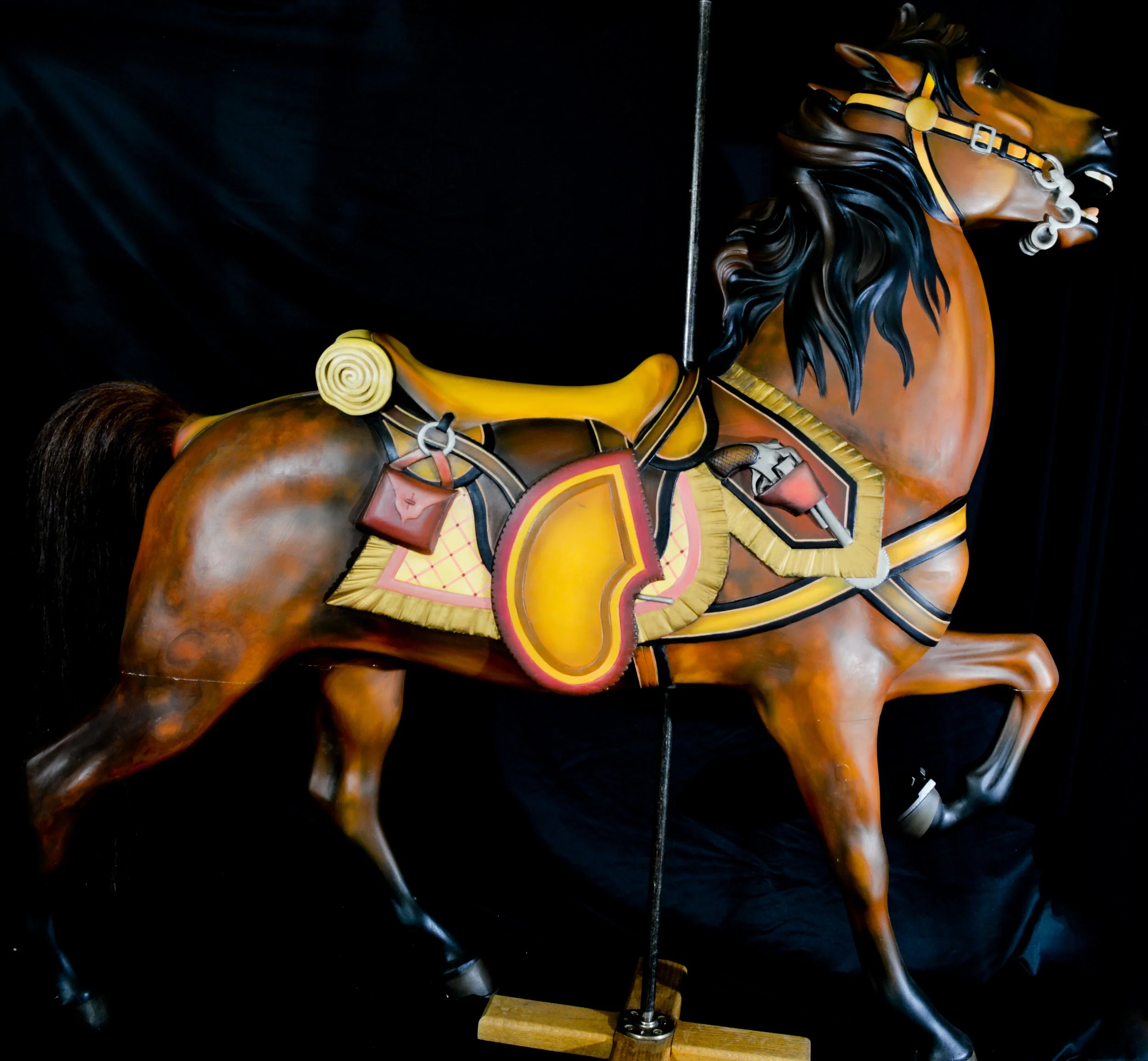
Outside-row standing horse attributed to Daniel Carl Müller, posed with the right foreleg lifted in a controlled prance, head turned sharply outward to the romance side with mouth open, teeth bared, and glaring inset eyes — a signature Müller expression of contained drama. The horse carries a full military trapping suite: a McClellan-style saddle with a fringed and quilted blanket, a bedroll lashed across the cantle, a leather sidearm pouch on the near hip, and a holstered revolver mounted at the right shoulder. Currently presented in a natural-finish restoration with the body in stained and shaded bare wood and only the trappings polychromed.
-
Acquired from Jim Aten (reported). Previously held in the Murphy collection (reported).
-
The Murphy collection reference in interview notes almost certainly corresponds to the Shawn and Kate Murphy collection of Berkeley, California, documented in Tobin Fraley's 2023 Americana Insights essay on Daniel Carl Müller as the owners of a separate Müller horse restored by Pam Hessey in 2020 (inferred from sourced records). If correct, this places ID 094 in a known and serious private collection of Müller material prior to its acquisition by the present owner. Earlier history — original park placement, carousel of origin, restoration history — has not been established. Jim Aten / Antique Carousel Figures (Portland, OR) is the documented selling dealer.
-
Daniel Carl Müller (1872–1952) was an academically trained sculptor — a student at the Pennsylvania Academy of the Fine Arts under Charles Grafly, where he won the Edmund Stewardson prize and produced the bronze Mermaid Fountain still installed in the academy lobby (sourced — Americana Insights, "Daniel Carl Müller: The Artist as Carousel Carver," Tobin Fraley, 2023). His path into carousel work runs through Gustav Dentzel: Müller's father Johann was a Dentzel carver and family friend, and after Johann's death in 1889 the orphaned Daniel and his younger brother Alfred were raised within the Dentzel household and apprenticed in the Germantown workshop (sourced). The brothers left Dentzel in 1903 to form D. C. Müller & Bro., "Manufacturers of Caroussels of High Artistic Merit." The company built roughly twelve carousels before closing in 1917 under competitive pressure from larger factories; Daniel returned to the firm under William Dentzel from 1918 until William's death in 1928 (sourced — Americana Insights; CarouselHistory.com; AntiqueCarousels.com).
Müller's military horses form a recognized sub-category of his outside-row work. Civil War motifs held a particular fascination for him, and a number of his carousels included horses outfitted with McClellan saddles, cavalry sabers, canteens, bedrolls, and other Union officer accoutrements (sourced — Americana Insights, citing Müller's surviving logbooks). The Metropolitan Museum of Art holds a directly comparable military Müller (c. 1925, 62 × 66 × 12 in.) with McClellan saddle, cavalry saber, glass eyes, and steel horseshoes — gifted by Larry and Gail Freels in 2019 (sourced — Met collection record 830041). A second known variant survives as the Tenth Cavalry horse, carved as homage to the Buffalo Soldiers and incised with "10" on the saddle (sourced — Americana Insights, Fig. 17). AntiqueCarousels.com separately documents a ca. 1910 D. C. Müller Bro. Military Stander, indicating the form was a recognized factory line rather than a single commission (sourced). The revolver-and-holster trapping on ID 094, as distinct from the saber on the Met example, places this piece within the documented military Müller iconography but represents a less-common variant within that already specialized group.
Müller figures are widely held in major institutional collections — the Metropolitan, the Art Institute of Chicago, the Museum of Fine Arts Boston, the Philadelphia Museum of Art, the Nelson-Atkins, and the Getty (sourced — Americana Insights, note 1). On the private market they remain among the most sought-after of all American carousel figures. Auction comparables: an exceptional Müller horse attributed to either the Dentzel or D. C. Müller Bros. period realized $40,320 at Sotheby's New York in 2023 (sourced — MutualArt artist record); a Müller second-row prancer (56 × 56 in.) sold at Pook & Pook (sourced); AntiqueCarousels.com has separately listed a Müller outside-row stander from Waldameer Park (Erie, PA) at $14,500 in unrestored condition (sourced). Outside-row standers with full military trapping suites consistently price toward the upper end of this range, reflecting size, trappings complexity, and the recognition of the military sub-category by the specialist market. The acquisition figure of $32,000 (reported) sits comfortably within documented values for restored, fully trapped military Müllers.
-
Currently presented in a stripped-and-refinished state: the body has been taken back to natural wood with applied stain shading and airbrushed modeling, while the trappings, mane, tail, and hooves carry full polychrome. This is a specific restoration aesthetic — one that emphasizes the carving itself by removing color from the body while preserving narrative detail in the equipment. It is not original park paint, and it is not factory paint. Carving and form appear undisturbed in photographs; the trappings, including revolver, holster, bedroll, and sidearm pouch, present cleanly with no visible loss. Side shown: romance (right). Restorer not specified in interview notes.
-
Owner interview, recorded session (Matthew & Debbie)
Photographic analysis of romance side (DSC_2766, DSC_2768)
Americana Insights, "Daniel Carl Müller: The Artist as Carousel Carver," Tobin Fraley, 2023
Metropolitan Museum of Art, collection record 830041 (Müller outside-row standing horse, military)
CarouselHistory.com, D. C. Müller Brothers entry
AntiqueCarousels.com, Müller carver page and military stander listing
MutualArt artist record, Daniel Carl Müller (auction results)
Pook & Pook auction record, Müller second-row prancer
Source catalog document, entry 94
-
Medium-High. Maker attribution to D. C. Müller & Bro. is supported by the figure's iconography (McClellan saddle, military trappings, expressive pose, scale) matching documented Müller military horses across multiple institutional and auction sources. The Murphy collection lead aligns with a named Müller collection of record. What remains undocumented: the specific carousel of origin, original park, dating within Müller's career (D. C. Müller & Bro. period 1903–1917 vs. the William Dentzel return 1918–1928), and the identity of the current restorer.