
E. Joy Morris - Camel
Catalogue Piece #095 tbd
-
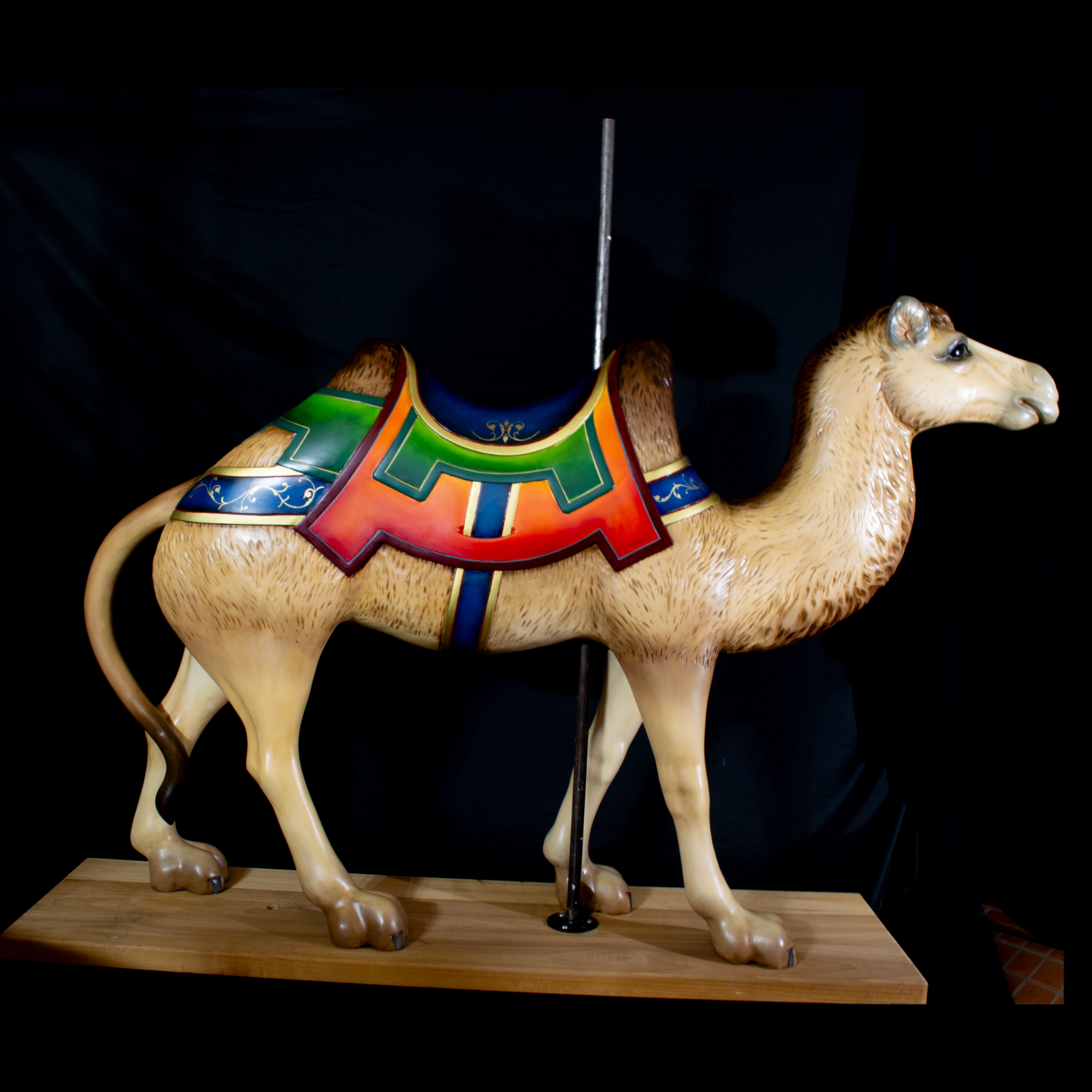
Single-hump dromedary carousel camel attributed to the E. Joy Morris Carousel Company, Philadelphia, walking pose with the right foreleg slightly advanced, head carried high and turned subtly to the romance (right) side, mouth closed with the characteristic camel sneer. The body is finished in stripped natural wood with airbrushed brown shading that picks out short stippled fur-texture carving across the flanks, neck, and hump. The carved saddle blanket carries the only polychrome on the figure — a stepped geometric pattern in green, orange, red, and blue with gold-scrolled blue panels and gold pinstriping. Carved tail. Currently mounted on a wooden platform with a metal pole.
-
Acquired from the Ersepke collection (reported, transcript). Specific date, price, and acquisition channel are not yet captured in interview notes.
-
The owner attributes the piece to either Charles I. D. Looff or E. Joy Morris in interview, expressing real uncertainty between the two (reported). The Ersepke collection is the same source as the owner's separately cataloged E. Joy Morris camel (ID 011, circa 1900) (sourced — catalog source document), which provides both a direct in-house comparison and a meaningful contextual signal: Ersepke-collection material in this catalog has consistently included Philadelphia-school work.
-
E. Joy Morris operated his Philadelphia carousel company from 1895 to 1903, when it was sold to the Philadelphia Toboggan Company; Morris-built figures continued to appear in PTC machines for several years afterward and were widely misattributed to PTC until corrected scholarship in the late 1980s (sourced — Carousel News & Trader; Carousel Workshop dealer records). From around 1897, Morris's carving shop was run by foreman Charles Leopold, formerly head carver at Gustav Dentzel and one of the most influential and least-credited figures of the period (sourced — Vintage Carousels; Americana Insights essay on Müller). Under Leopold, the Morris shop produced some of the most ornate and finely modeled menagerie work of the Golden Age — including carved camels.
The working attribution to Morris rather than Looff rests on three converging signals. First, the figure's provenance from the Ersepke collection matches the documented Morris camel (ID 011) already in the collection from the same source; collection-pattern evidence favors Morris. Second, the restrained painted saddle blanket — without carved tassels, medallions, jewels, or secondary figures — distinguishes this piece from the more ornate documented Looff camels of the period (the Heritage Museums Looff at Eldred's carries eagle-head saddle carving, carved tassels, and glass medallions; the Sherman's Park Looff carries comparable ornament). The ornament profile here reads as Philadelphia-school restraint rather than as Looff's typical fully-trapped menagerie vocabulary. Third, the head carriage and facial modeling — alert, high-carried, gently turned to the romance side, with the closed-mouth sneer rather than open-mouthed drama — align with Leopold-era Morris animal carving as documented in the surviving Morris menagerie record.
The single-hump dromedary form is consistent with documented Morris menagerie examples and is the form Looff most commonly carved when not producing Bactrians. It is not on its own decisive.
Caveats. Carved fur surface treatment is associated with both Looff anatomy and Leopold-era Morris menagerie work, and does not separate the makers. Looff produced figures across a wide ornamentation range, including restrained examples, so the saddle profile is suggestive rather than determinative. A connoisseurial assessment by a Morris specialist, with direct comparison to ID 011, would substantially strengthen or correct this working attribution (inferred from sourced records — Carousel News & Trader; Vintage Carousels; Eldred's; Fontaine's).
Rarity. Carousel camels in both single-hump and Bactrian forms are uncommon among surviving figures of the period, less frequently encountered than other menagerie types and substantially rarer than horses. Morris produced fewer than two dozen carousels in his eight years of operation before selling to PTC (sourced — Hammacher Schlemmer documented Morris record; Carousel Workshop), and menagerie figures within that production were a minority. Morris menagerie figures consistently command the upper tier of the period market when identified.
-
Currently presented in a stripped-and-refinished state matching ID 094 (the military Müller): body taken to natural wood with airbrushed stain shading, polychrome restricted to the carved saddle blanket. This is a deliberate restoration aesthetic — one that exposes carving while preserving narrative ornament. The treatment is not original park paint and not factory paint. Carving and form present cleanly in photographs. Tail intact. No visible structural damage or major loss. Restorer not specified in interview notes; the matched treatment across two pieces suggests but does not confirm a single hand.
-
Owner interview, recorded session (Matthew & Debbie)
Photographic analysis of romance side (DSC_2769, DSC_2772)
Catalog source document, entry 95 ("UNSURE: Either Looff or E Joy Morris camel") and entry 11 (separately documented Morris camel from Ersepke collection, circa 1900)
Vintage Carousels, Carvers and Manufacturers reference
CarouselHistory.com, E. Joy Morris archive
Heritage Museums & Gardens, Looff Carousel Facts (comparison)
Eldred's auction record, Charles Looff jeweled carousel camel (comparison)
Fontaine's Auction Gallery, Looff Coney Island carousel camel (comparison)
Carousel Workshop, E. J. Morris reference and prancer record
Hammacher Schlemmer, 1902 E. Joy Morris carousel horse documentation
-
Low–Medium. Working attribution to E. Joy Morris is supported by collection-pattern provenance (Ersepke source matches another confirmed Morris piece in the collection), restrained ornament profile inconsistent with the more typical Looff camels, and head-carriage and facial modeling consistent with Leopold-era Morris work. Attribution is not yet supported by signature, mark, original park records, or expert connoisseurial assessment. What is established: single-hump dromedary form, Golden Age American manufacture, carved fur texture, Ersepke collection provenance, and a shared restoration program with at least one other figure in the collection.