
Flores - Camel
Catalog #034 89×77×23cm
-
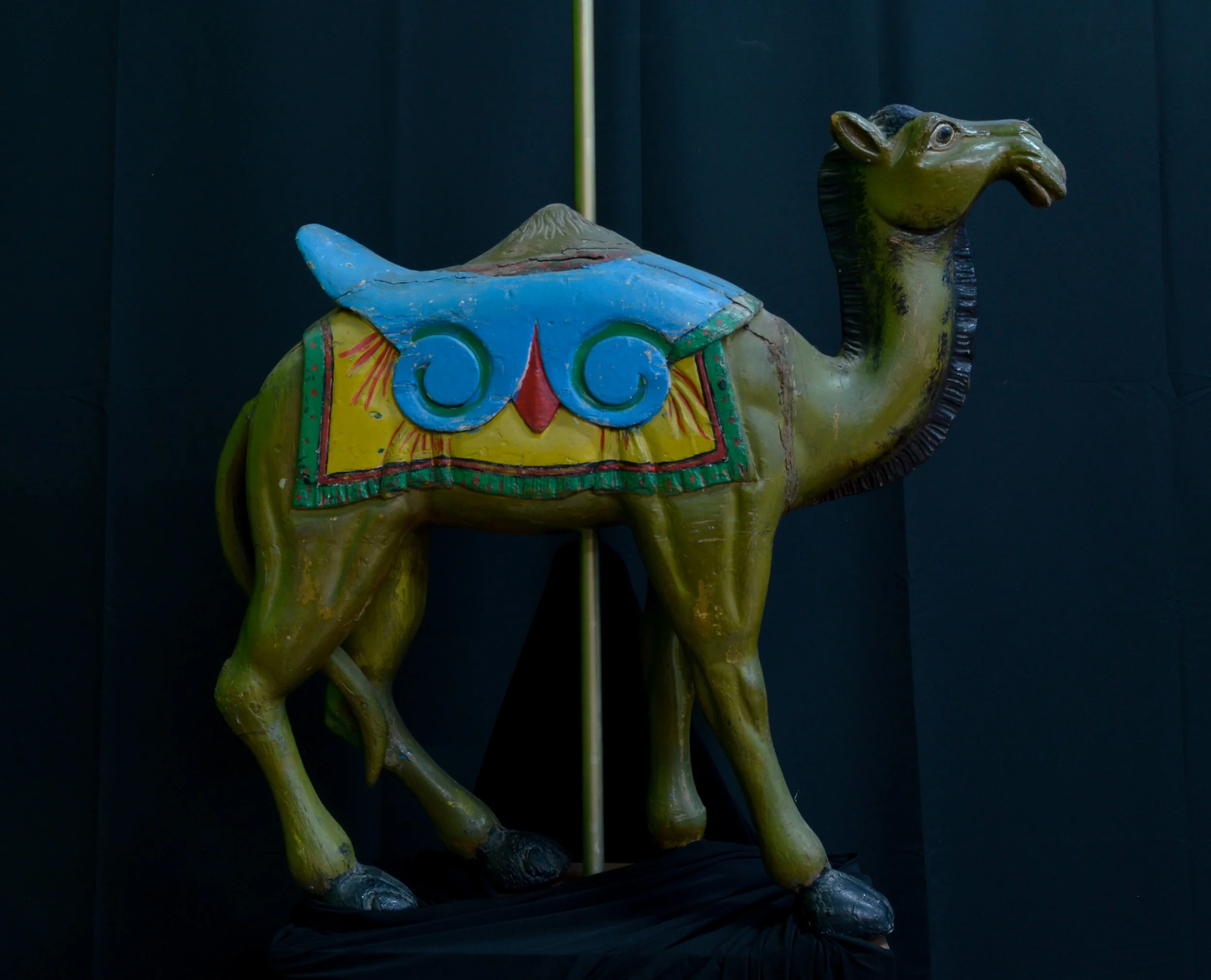
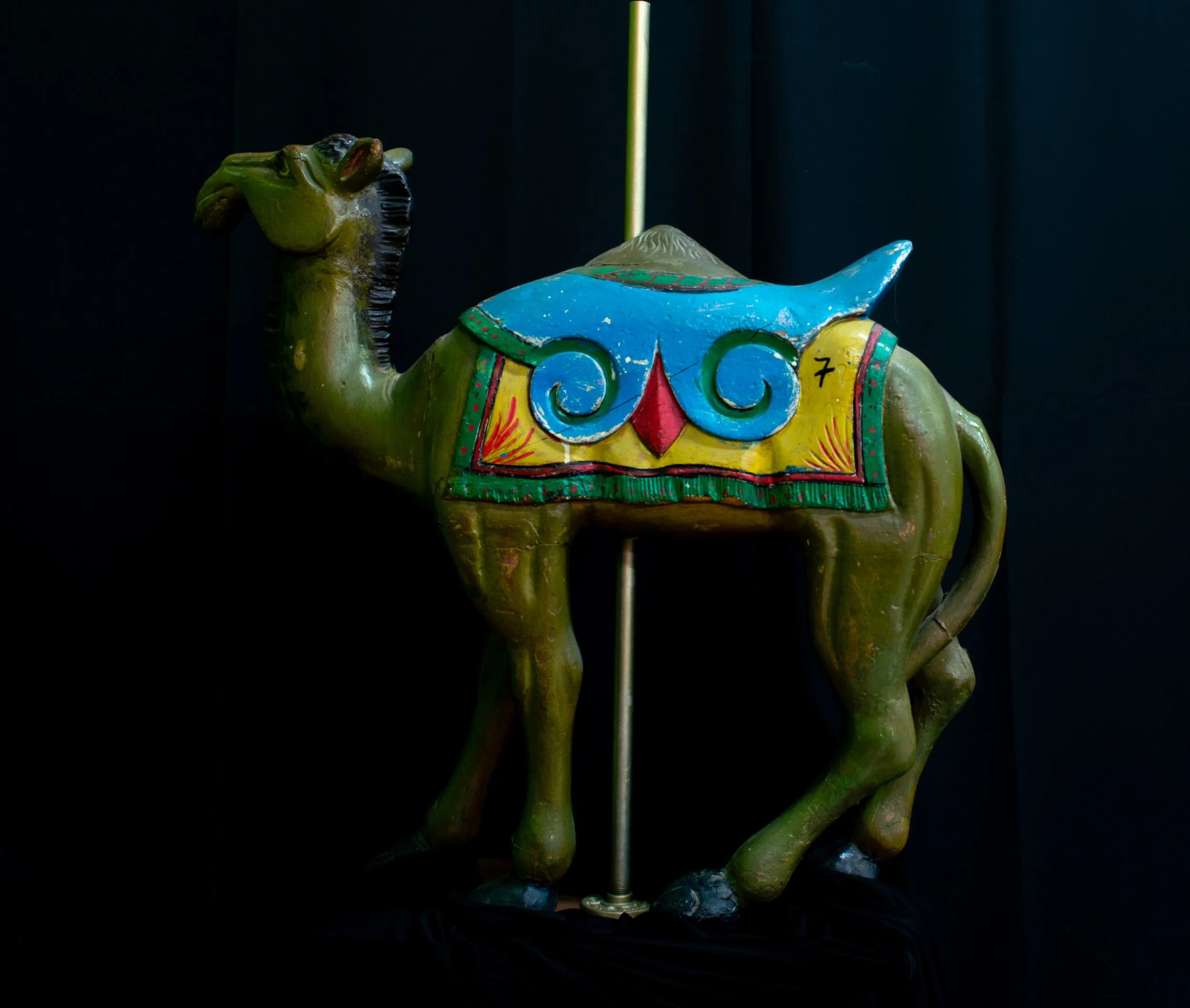
A carved wooden dromedary in a standing-walk pose, attributed by the owner to the Mexican carver Flores, ca. 1930s (reported). The figure is painted in olive-green with a contrasting saddle blanket of paired blue scroll motifs flanking a central red teardrop, set against a yellow field with red radiating lines and a green fringed border. The saddle decoration is repeated symmetrically on both sides — a diagnostic feature of figures made for small, hand-pushed portable machines viewed from all directions, rather than the romance/non-romance asymmetry of large American park carousels (inferred). A black "7" painted on the non-romance-side blanket is consistent with a position marker from the original machine (inferred).
-
Acquired from Morphy Auctions (reported). The owner identifies the carver as Flores, places the figure in the 1930s, and characterizes the originating machine as a small, hand-pushed portable carousel: "They were small because they were hand-pushed. There was no engine. So that's the size of a portable where they could go from [place to place] — they were traveling" (reported). No lot number, sale date, or hammer price was provided in interview. The owner holds Morphy's records that have not yet been consulted.
-
History prior to the Morphy's sale is not documented in the materials available. One specialist-dealer comparable — discussed in detail under Maker & Rarity Context below — was sold from a documented private collection, but the photograph-level evidence does not support identifying this figure as that same piece. The Morphy's lot description, when retrieved, may carry prior-collection language; until then, prior provenance is open.
-
The carver Flores is independently documented as a Mexican carousel carver active circa 1930. AntiqueCarousels.com — a long-standing specialist dealer — has sold a directly comparable figure: a small Arabian one-hump camel by Flores, 28 × 11 × 23 inches, in unrestored original paint, sold for $1,800 (down from $2,200), described as a "Rare figure" (sourced: AntiqueCarousels.com). That figure was offered from the renowned collection of Walter and Mary Lawrence Youree (sourced: AntiqueCarousels.com). The Youree collection is an established provenance anchor in this field and has supplied multiple pieces in the present collection through other channels.
The AntiqueCarousels.com Flores camel is described as carrying a bell and tassel (sourced). Those details are not clearly visible on the figure documented here. That difference argues that the present camel is a distinct individual figure from the same maker rather than the same piece offered through a different channel (inferred). Workshop-scale production would account for closely related but non-identical figures across the Flores output.
The bilateral saddle decoration visible in the photographs is consistent with the construction context the owner describes. Outside-row figures on large American park carousels are typically decorated only on the romance (outward-facing) side, because the inner side is rarely seen by the public. Figures made for small portable carousels — hand-pushed, traveling, viewable from all approaches — were commonly decorated symmetrically. The position number "7" on the non-romance side is the kind of marking carousel operators applied to keep figures in their assigned slots during setup and teardown of a traveling machine (inferred from documented carousel-operator practice).
Documentation on Mexican carousel carvers is thin. The Pinterest specialist board dedicated to Mexican carousel art notes directly: "Very little info on Mexican carvers and their work is available, even online" (sourced: Pinterest / keyhorse Mexican Carousel Art). CarouselHistory.com documents the related but distinct Mexican Müller-Dentzel carousel discovered at Chapultepec Park in Mexico City and dispersed through silent auction in 1994 (sourced: CarouselHistory.com) — that machine is a separate tradition (a full-size, mechanized, factory-attributed carousel that ended up in Mexico) and should not be conflated with the small hand-pushed Mexican-carved tradition Flores worked in.
Auction records for Flores camels outside the AntiqueCarousels.com channel could not be located. The absence of comparable auction-record sales is itself documentary evidence that figures of this maker and type rarely surface on the broader auction market — most known examples appear to move through specialist dealer channels rather than open auctions. Stated narrowly: rarely encountered on the private market; documented production limited to specialist sources (sourced/inferred).
-
Paint wear is visible across the body and saddle in all four photographs. The blue saddle field shows surface chipping and crackling, particularly along the front edge. The body paint shows scattered loss revealing earlier paint or substrate beneath, especially on the haunches and lower belly. Hooves are darkened and worn. The mane carving and facial detailing remain crisp. Whether the current paint represents the original program, an early repaint, or a later restoration is not established from photographs alone — the AntiqueCarousels.com comparable was specifically described as "very old / original paint," but visual comparison from photographs is not sufficient to assert the same here. Formal condition rating: pending direct examination.
-
Medium. Maker attribution is reported by the owner and independently supported by a closely matching specialist-dealer comparable. Date range is consistent with documented production for the maker. Construction context (hand-pushed portable) is reported by the owner and consistent with the bilateral saddle decoration visible in the photographs, though not independently confirmed for this specific figure or maker. Morphy's acquisition is reported but the lot record has not been consulted; consulting it could resolve provenance further.
-
Owner interview: maker attribution to Flores, 1930s dating, Morphy's acquisition, hand-pushed portable carousel context (reported).
Photographs DSC_2506–2509: romance side, non-romance side, full-body documentation; confirmed bilateral decoration; "7" position marker on non-romance side; paint condition observable.
AntiqueCarousels.com: Flores Mexican Arabian camel listing, 28 × 11 × 23 in, $1,800, Youree collection, ca. 1930, "rare figure," with bell and tassel details (sourced).
CarouselHistory.com: Mexican Müller-Dentzel Chapultepec Park carousel context (sourced — establishes that the parallel "Mexican carousel" reference in collector discussions does not refer to this tradition).
Pinterest / keyhorse Mexican Carousel Art: specialist confirmation that Mexican carousel carver documentation is sparse across all sources (sourced).
Wikipedia, Carousel: broad confirmation that early portable carousels were hand-cranked, hand-pushed, or animal-powered (sourced — supports the construction context the owner describes, without independently confirming the specific Mexican 1930s hand-pushed practice).