
Unknown - St. Bernard
Catalog #039 87×72×23cm
-
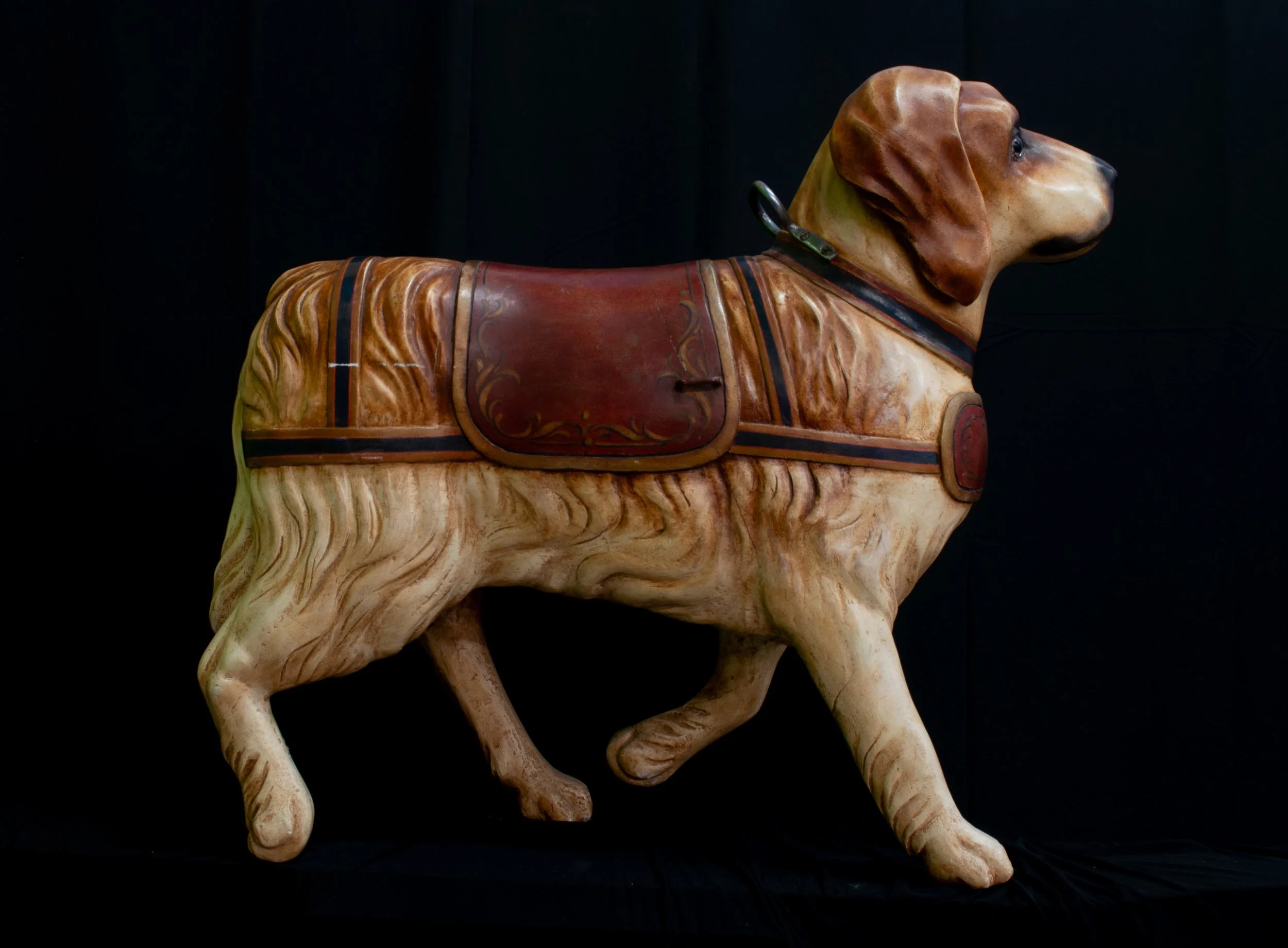
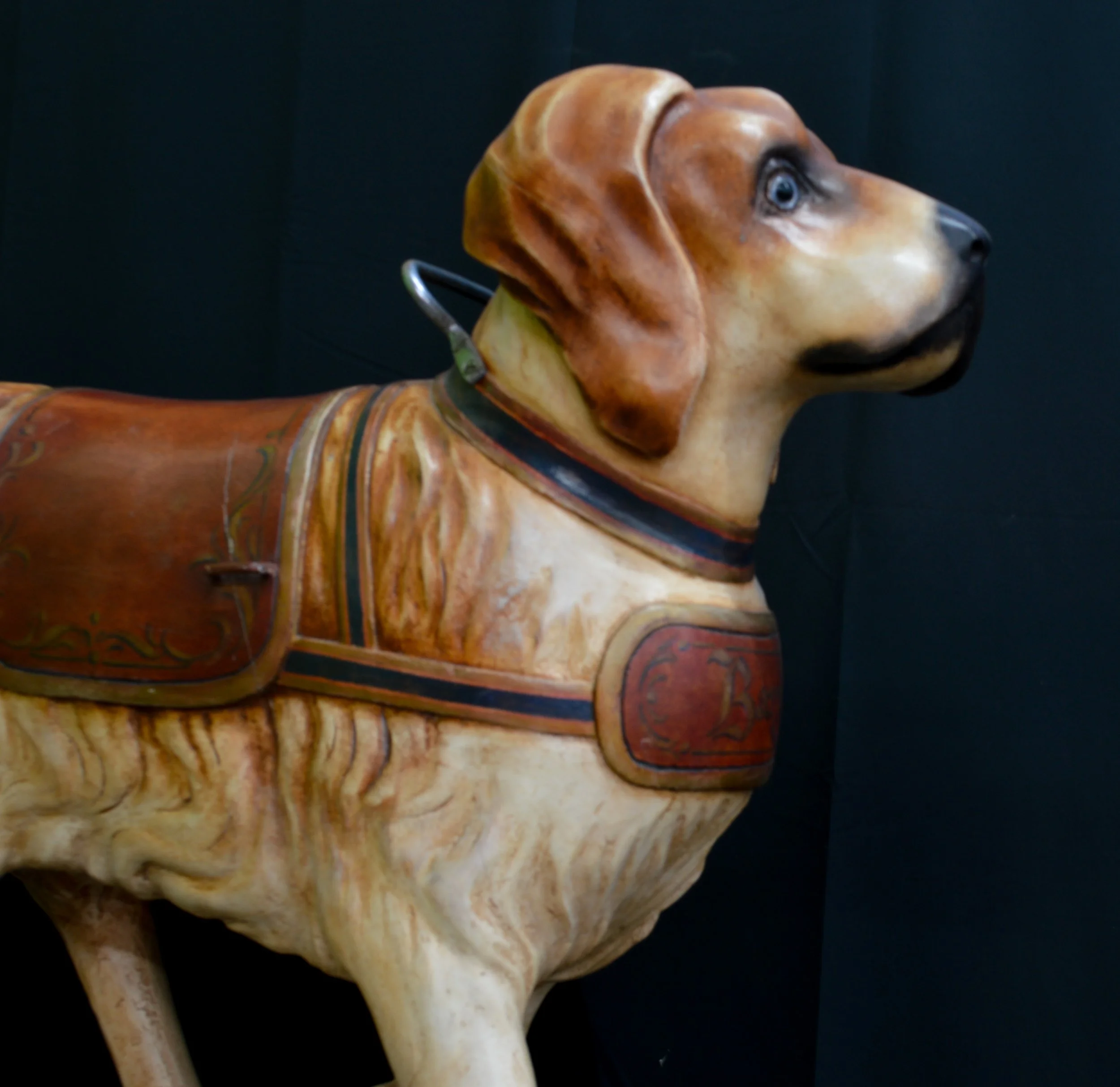
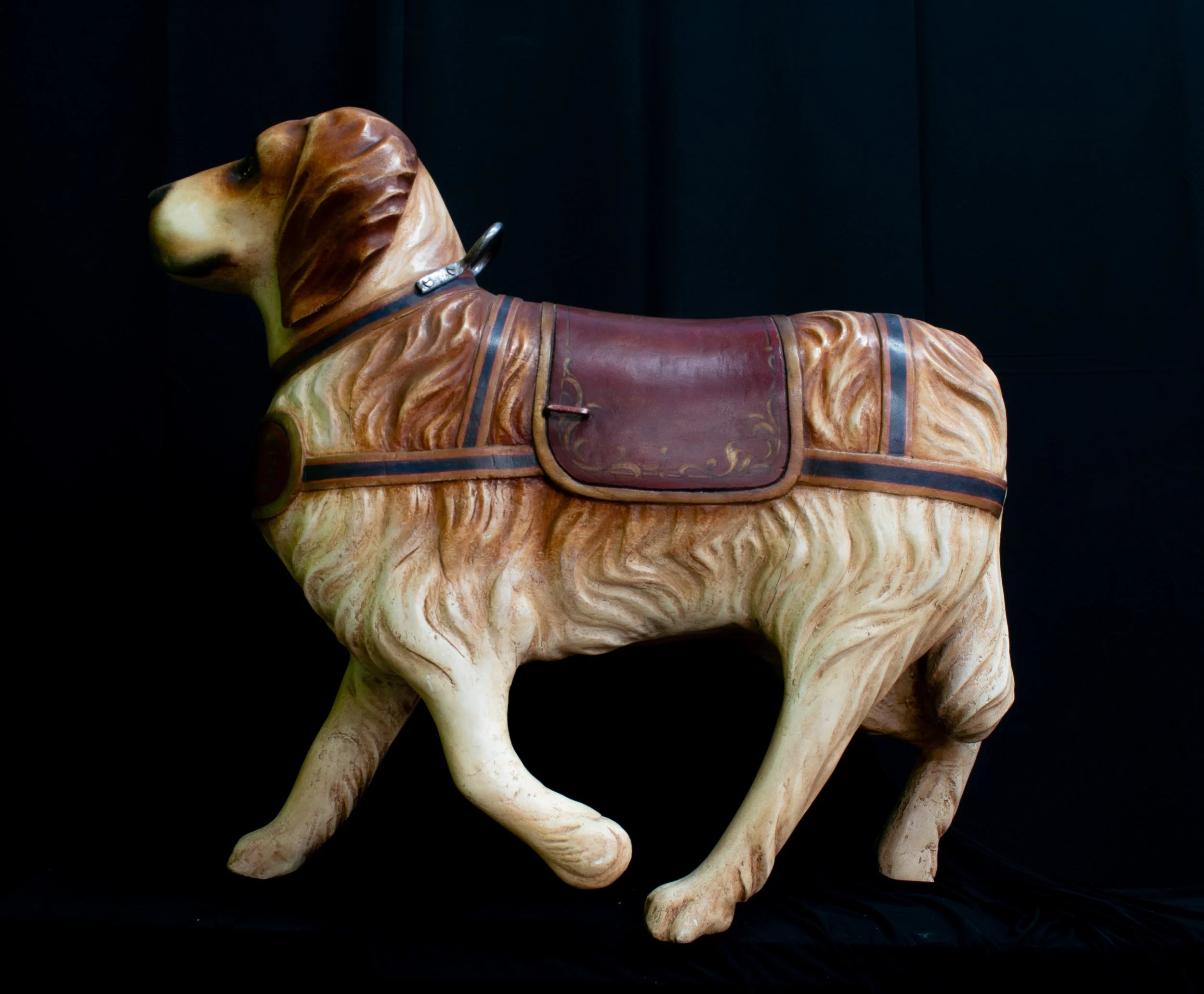
A carved wooden dog in a full leaping pose, attributed by the owner to a French children's carousel (reported). The figure is identified by the owner as a poodle, and the photographic evidence is consistent with that identification: long, deeply incised flowing fur is rendered through the head, ears, neck, and chest, while the body and hindquarters are deliberately carved smooth — the classic silhouette of a poodle in continental ("lion") clip, the working clip in which water-retrieving poodles were customarily depicted in 19th- and early-20th-century European decorative art (sourced). The head carries a waved forelock, pendulous lower lip with a small carved tongue visible, an inset glass eye, and a plain carved collar at the throat. Small fur tufts ("feathering") are retained at the ankles, and the tail is short with a tufted tip — again, consistent with continental-clip depiction. The figure shows visible block-construction seams through the barrel, a saddle keyhole mortise on both flanks, and is mounted on a brass twist pole with a cast finial. Notably, the carving carries through fully on the non-romance side, with comparable depth and detail to the romance side — an unusual treatment, since carousel figures generally simplify the non-romance side (inferred from photographic comparison).
-
Acquired from the estate of John and Ann Engelhart of Sedona, Arizona (reported). The owner characterizes the figure as a more recent acquisition: "the poodle is on the newer side" — meaning recent in the collection's timeline, not recent in age. The owner cites a photograph reference phonetically transcribed as "social art, number three, at page 27." Research strongly suggests this refers to Carrousel Art Magazine, issue 3 — a publication written and printed by Marge Swenson in 1978–79, with issue 3 dedicated to Daniel Carl Müller (sourced via Carousel Workshop's issue index). This finding is significant and discussed below.
-
The provenance chain begins and ends with the Engelhart estate of Sedona, Arizona (reported). No independent records of a John and Ann Engelhart carousel collection in Sedona were located through auction databases, carousel specialist sites, or collector archives (sourced — search returned no relevant records). The reference to Carrousel Art issue 3, if confirmed, would establish a documented publication appearance for this figure or a directly related one, and would also raise an attribution question (see below).
-
Dogs are a documented but scarce menagerie figure type across American and European carousel traditions (sourced). CarouselHistory.com's dedicated historic carousel dogs gallery establishes a documented category that includes Saint Bernards from a major Philadelphia workshop, greyhounds and Labradors from a New England-based carver, hounds from a North Tonawanda manufacturer, and French carousel poodles (sourced — CarouselHistory.com). A specialist dealer listing for an antique French menagerie carousel dog, c. 1890, characterizes the figure type as scarce, noting "it is extremely rare that a dog was part of the animal menagerie on a carousel" (sourced — 1stDibs/Chairish dealer listing).
The continental-clip poodle silhouette — full fur at head, ears, neck, chest, and ankles; smooth body, hindquarters, and upper legs — derives from the working clip developed for water-retrieving poodles and codified in European art and breed depiction long before the carousel era. The breed itself has been associated with France since the period in which French clipping conventions popularized the standard internationally, though the dog originated in Germany as a water retriever (sourced — AKC and UKC breed history). The carving treatment in this figure aligns with the continental-clip convention and is consistent with a deliberate stylized poodle depiction rather than a generic long-haired dog.
The figure's surface is a warm amber-brown stain or aged varnish rather than polychrome park paint. Whether this represents an early stripped state, a later strip, or a never-painted blank is undetermined from the photographs alone.
The Carrousel Art issue 3 reference is the most significant lead in this entry and the most consequential to resolve. Issue 3 is dedicated to Daniel Carl Müller (1872–1952), one of the most accomplished American carousel carvers of the Philadelphia school (sourced — Carousel Workshop magazine index; multiple Müller biographical sources). Müller's documented menagerie figures include horses, goats, zebras, lions, deer, tigers, bears, and unicorns; dogs are not currently in the documented Müller corpus (sourced). If the figure does appear on page 27 of Carrousel Art issue 3, the implications are substantial: it either suggests a Müller-attributed dog (which would significantly elevate the figure's significance) or it documents the figure in a comparative context that needs to be read directly. The page-27 citation must be checked against the actual magazine before the French attribution can be considered settled.
Auction comparables for French and European carousel dogs. A scarce European antique French menagerie carousel dog, c. 1890, was offered at a specialist dealer at near-full-size scale (43" H × 41" W × 10" D), with the dealer explicitly describing the figure type as exceptionally rare (sourced — 1stDibs/Chairish). A Spanish fairground carousel dog of similar children's scale sold in the $2,700 range (sourced). A full-size Herschell-Spillman carousel dog sold through a specialist dealer at $4,000; another was estimated $1,000–$2,000 at a regional U.S. house (sourced — referenced in prior research). The paid amount sits within the established market for children's-scale carved wood carousel dogs of European origin, on the assumption of a Continental rather than American attribution. A documented PTC St. Bernard achieved $174,000 at auction in the early 1990s — a market ceiling for the figure type, but applicable only to top-tier American attributions (sourced — CarouselHistory.com).
-
The figure is structurally intact and presents as a complete, mounted, rideable carousel piece with original brass pole and finial hardware. Visible block-construction seams are present on the barrel and shoulder, consistent with standard laminated hardwood carousel construction. The saddle keyhole mortise is present on both flanks. The surface shows old fastener punctures on the body, likely originating from saddle straps or trappings now removed. The amber-stained finish is uniform and appears intentional — consistent with a stripped-and-stained restoration rather than bare wood or unfinished surface. No structural losses or major repairs are visible in the photographs. Material confirmed as wood by the owner.
-
Medium-Low. Owner identification places the figure in the documented French carousel-poodle category, and photographic evidence is fully consistent with the continental-clip poodle convention. However, no maker's mark is visible, no provenance chain extends beyond the Engelhart estate, and the Carrousel Art issue 3 reference — if read literally — points toward an American Philadelphia-school context that is in tension with the French attribution. Until the magazine citation is resolved, the maker attribution should be treated as French (reported) with an active alternative line of inquiry.
-
Owner interview (October 2025): identification as French children's carousel poodle; acquisition source (Engelhart estate, Sedona, AZ); price paid ($2,500); photo-reference citation ("social art, number three, at page 27"); material confirmation (wood).
Photographs (DSC_2523, DSC_2524, DSC_2527, DSC_2529): full romance-side view, non-romance side, head close-up; established the continental-clip silhouette, block construction, saddle mortise locations, finish character, and full carving treatment on both sides.
CarouselHistory.com, "Historic Carousel Dogs": documents French carousel poodles as a recognized category of historic carousel dog (sourced).
Carousel Workshop, Carrousel Art Magazine issue index: identifies issue 3 of the Marge Swenson magazine series (1978–79) as dedicated to Daniel Carl Müller (sourced).
1stDibs / Chairish dealer listings: French menagerie carousel dog comparables and rarity language (sourced).
AKC, UKC, Americana Insights, NPS, Met Museum, CarouselHistory.com Müller page: poodle breed clipping convention, Müller biographical and stylistic record (sourced).