
Bayol - Pig
Catalogue Piece #097 tbd
-
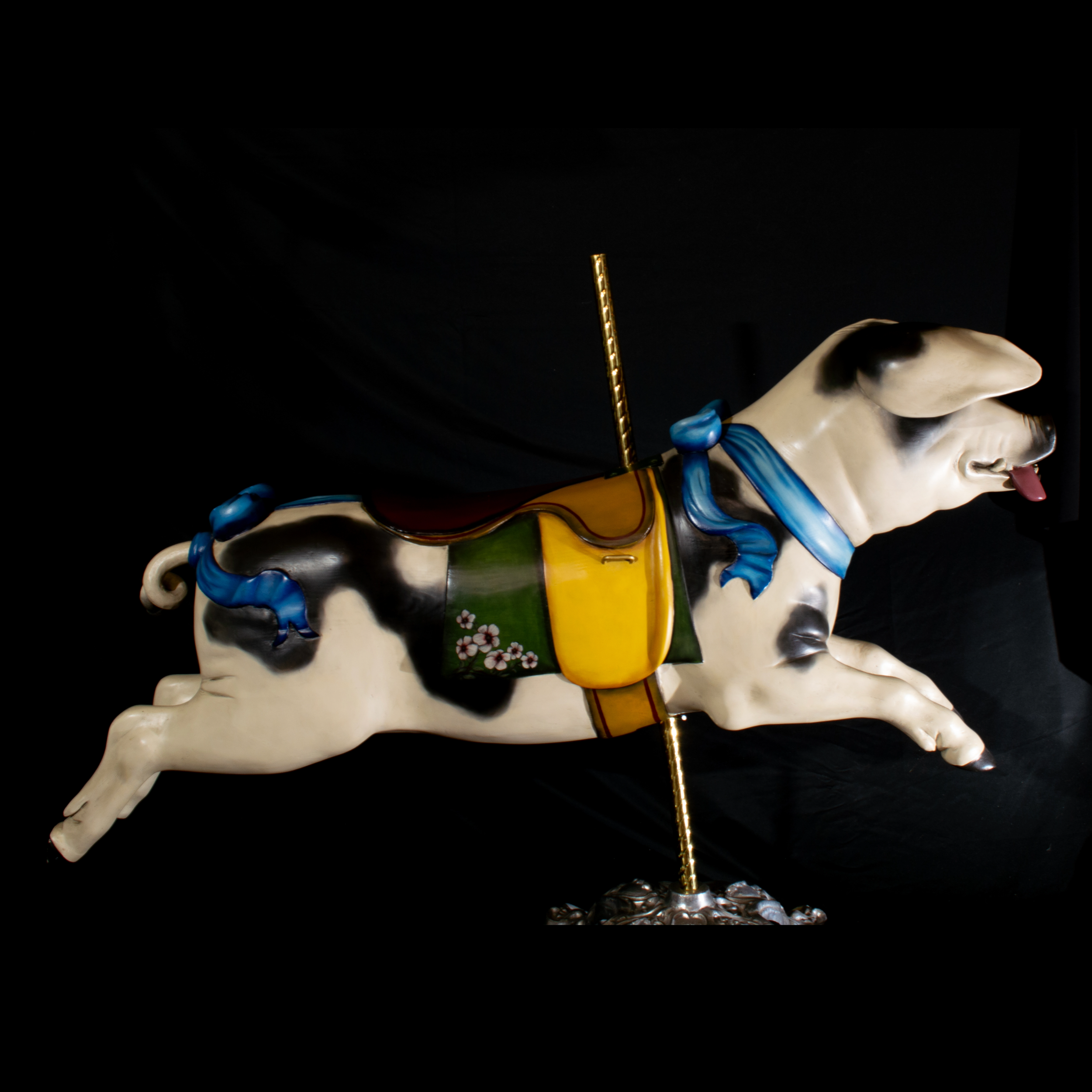
A full-size carved wood carousel pig in a running/leaping jumper pose, carved by Gustave Bayol in Angers, France, c. 1909 (sourced — Fraley). The figure is fitted with a wrought-iron tail and shows the full set of documented Bayol pig identifiers: lolling red tongue, dark glass eyes, large flat ears swept back, carved blue ribbons knotted at neck and rear haunches, and a saddle assemblage of yellow seat over a green blanket painted with pink and white floral sprays, edged in gold and red trim. The body is finished in a black-and-white spotted treatment with airbrushed shading defining the markings. Restored by Tobin Fraley Studios (sourced — Fraley) and pictured on page 104 of Fraley's The Carousel Animal (1983/1987), where it is documented as previously held in the Collection of Will Leighton (sourced — Fraley).
-
Acquisition details for this piece — dealer, date, and price — are not yet captured in the project records. The owner has confirmed the maker attribution and the Fraley page-104 connection but the acquisition source has not yet been documented in interview material.
-
Documented prior owner: the Collection of Will Leighton, as of the figure's appearance in The Carousel Animal (1983) (sourced). Restored by Tobin Fraley Studios prior to or at the time of book photography (sourced). Last operating carousel of origin: Unknown — Fraley records this explicitly (sourced). The chain of custody between the Leighton collection and the current owner's acquisition has not been traced; this is the strongest open provenance lead in the entry.
-
Gustave Bayol (1859–1931) established his workshop in Angers, France, and is documented as the foremost French carousel carver of the late nineteenth and early twentieth centuries, with the firm active from approximately 1895 to 1931 (sourced). He was known specifically for carvings of the farm animals found in the French countryside (sourced) — pigs, donkeys, cows, rabbits — a focus that distinguished his output from contemporaries who concentrated on horses and exotic menagerie subjects.
Fraley documents an observation about the Bayol pig form that bears directly on rarity and influence: the Bayol pig was modeled after a species of domestic pig found in France and became the prototypical European carousel pig form, copied by both English and German carvers, with the expression and pose remaining the same in each case and only the trappings altered to fit regional styling (sourced — Fraley). The oversized ears are read by Fraley as a deliberate carving choice meant to sustain the illusion of flight in the leaping pose (sourced — Fraley). This pictorial inclusion in a standard reference work — combined with the documented restorer and prior collection — places this specific figure in a different category of provenance than an undocumented attributed piece.
The figure carries the full set of documented Bayol pig identifiers established by surviving signed examples and standing auction descriptions: a swine modeled running at a swift pace, tongue lolling to one side, glass eyes, a scallop-edged saddle cloth, and bow-knotted ribbons at tail and neck (sourced), with the wrought-iron tail construction that a signed Bayol pig and donkey pair at Sotheby's in 2006 confirmed as a documented Angers workshop feature (sourced). Documented Bayol pigs frequently carry an inscribed name on the carved ribbon — recorded examples include a blue ribbon inscribed "Toto" (Freeman's, May 2022) (sourced) and a ribbon inscribed "Le Toine," an affectionate diminutive of St. Antoine, the saint traditionally accompanied by a pig (Rafael Osona Auctions) (sourced). Inspection of this figure's blue neck ribbon for any underlying inscription would be material.
Documented auction comparables establish the market range for full-size signed and attributed Bayol pigs: a Bayol pig comparable to the Rafael Osona example sold at Christie's New York on September 24, 2015, lot 92, for $11,250 (sourced); a Bayol carved and polychrome carousel pig with red saddle blanket and green ribbons, approximately 26 by 60 inches, sold at Brunk Auctions, April 10, with late nineteenth- to early twentieth-century dating (sourced); and an attributed pig sold at Freeman's, Philadelphia, in May 2022 (sourced). This figure measures 25 inches high by 57 inches long (sourced — Fraley), placing it slightly under the Brunk full-size example. On rarity: farm-animal figures from this workshop are among the most distinctive in European carousel production, and pigs in particular appear infrequently on the private market relative to horses from the same firm.
-
The photographic surface presents as excellent: clean paintwork, no visible cracks or seam separations, intact glass eyes, intact tongue and ears, complete wrought-iron curled tail. The black-and-white spotted body treatment and floral blanket are the Tobin Fraley Studios restoration interpretation as documented in The Carousel Animal (sourced); original Bayol palette is not visible beneath. Whether any further restoration or repainting has been performed since the 1983 book photography is not established. Formal condition rating pending physical inspection.
-
Owner interview (voice transcript, ID 097 session): Maker attribution to Gustave Bayol; identification of the piece as the one pictured on page 104 of The Carousel Animal by Tobin Fraley.
Project catalog PDF (entry 97): "GUSTAVE BAYOL; Pig as seen on page 104 of Carousel Animal by Fraley."
Photograph (DSC_2776): Full romance-side view; documents pose, saddle assemblage, ribbon placement, body painting, eyes, tongue, ears, mounting pole, decorative base.
Tobin Fraley, The Carousel Animal (Zephyr Press 1983 / Chronicle Books 1987), p. 104: "FRENCH PIG c. 1909 — Carved by Gustave Bayol in Angers, this pig, complete with metal tail, appears to be using his ears to sustain this illusion of flight. Although the ears seem to be oversized to produce this illusion, the pig was actually fashioned after a species of domestic pigs found in France. The Bayol pig was one of a number of barnyard animals that were quite popular on French carousels and was copied by both English and German carvers. The expression and pose remained the same in each case, only the trappings were altered to fit regional styling. Last Operated — Unknown. Collection of Will Leighton. Restored by Tobin Fraley Studios. 25" high, 57" long." Page reproduction submitted as supporting documentation.
Brunk Auctions: Bayol carved and polychrome carousel pig, late 19th/early 20th century, Angers, France; running swine, lolling tongue, glass eyes, red saddle blanket, green knotted ribbons; approximately 26 x 60 in.
Rafael Osona Auctions (Nantucket): Gustave Bayol carved and painted wood carousel pig; running pose, lolling tongue, brown scalloped saddle cloth, blue bow-knotted ribbons, ribbon inscribed "Le Toine"; 44 x 66 x 28 in.; with Christie's New York Sept. 24, 2015 lot 92 comparable at $11,250.
Freeman's, Philadelphia: A carved and painted carousel pig attributed to Gustave Bayol Carousel Company, lot 147, May 3, 2022; blue ribbon inscribed "Toto," inset glass eyes.
Sotheby's, New York: Carved Pine Carousel Pig and Donkey, marked Bayol Fabricant, Angers, late 19th/early 20th century; both with glass eyes; pig wrought-iron tail.
-
High. Maker, period, dimensions, restorer, and one documented prior owner are all sourced to a published specialist reference. The remaining gap is the chain of acquisition between Will Leighton (as of 1983) and the current owner.