
Herschell-Spillman - Labrador
Catalogue Piece #096 tbd
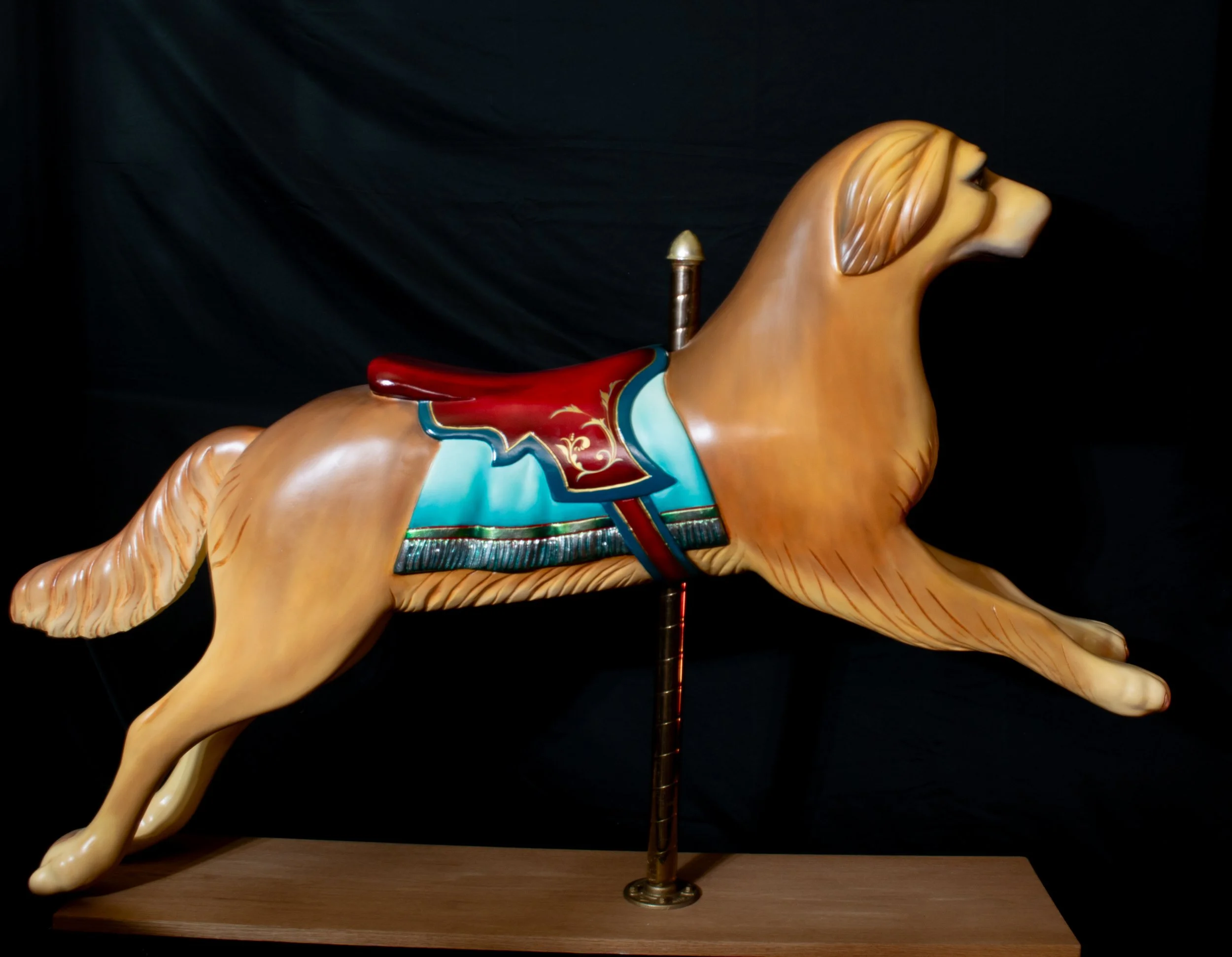
-
A carved wooden carousel dog in full leaping jumper pose, all four legs extended, with the long-haired retriever or setter physique that American menagerie carvers favored when the figure called for a "hound" rather than a sleek racing breed. The carving emphasizes feathered fur on the haunches, legs, and tail, with large pendulous ears and a long muzzle. The figure carries a turquoise saddle blanket beneath a deep red mantle with gold scrollwork and a silver-and-green fringe — a restored color scheme rather than original park paint (inferred). Painted by Lise Liepman, the Bay Area restoration artist whose work appears on multiple pieces in this collection (reported).
-
From the Ersepke collection (reported). The owner notes a "Los Gatos" reference associated with the piece's appearance at sale or auction — possibly the sale location or a specific event tied to the collection's dispersal (reported, requires verification). Acquisition date and price are not stated in the available interview material.
-
The Ersepke collection is a recurring source for figures in this collection; prior catalog work has placed at least one piece from the same collection at the Swen Swenson auction of November 1993 (ID 089). Whether this dog was acquired through the same auction venue or by direct purchase is not established here. The "Los Gatos" reference may be a sale location, a prior owner's location, or a name associated with the figure — owner clarification needed to resolve.
The owner did not state a date or carousel of origin. No carver inscription, factory mark, or operating-park photograph is available in the interview material.
-
The catalog record lists this piece as "Either Looff or Spillman" (reported). Both attributions are within documented production: CarouselHistory.com explicitly catalogs "Greyhounds and Labradors from Looff" and "Hounds from Herschell-Spillman" as the principal American sources for hand-carved carousel dogs in the late nineteenth and early twentieth centuries (sourced). The visual evidence in the photographs is consistent with the Herschell-Spillman hound tradition rather than the Looff greyhound or Saint Bernard types, on the following grounds.
The Herschell-Spillman Company of North Tonawanda, New York, was the largest U.S. carousel manufacturer between 1904 and 1920 (sourced), and its menagerie machines characteristically included dog jumpers among the carved-wood figures. A documented Herschell-Spillman carved-wood leaping dog from a portable menagerie carousel circa 1900 — square jeweled collar, carved tail, glass eyes — measures 32 inches tall and 54 inches long (sourced, Proxibid auction record). The figure in these photographs reads at similar overall scale. The Tilden Park 1911 Herschell-Spillman machine in Berkeley, California — one of the maker's surviving park-model menageries — carries a single dog among its seventeen menagerie animals (sourced), and the Balboa Park 1910 Herschell-Spillman in San Diego carries two dogs in its menagerie (sourced). Dog figures appear as single or paired figures on surviving Herschell-Spillman machines, not in large numbers.
The Looff alternative is not ruled out, but the visual case is weaker. Looff's documented carousel dogs include greyhounds — perhaps only a dozen produced — all said to be modeled on a family pet, with examples bearing the "Riverside" stamp made at the Rhode Island factory between 1905 and 1910 (sourced, Museum of Fine Arts Boston). The figure here is not a greyhound: the body is fuller, the coat is rendered as long and feathered, and the tail is heavily carved with flowing hair rather than tapering to a whip. Looff's other documented dog form is the Saint Bernard, which carries a heavy ruff and broader muzzle than this figure shows.
A leaping hound with long-haired tail, large soft ears, and a slender feathered body is closer to the Herschell-Spillman hound type than to either documented Looff dog form (inferred from sourced records). This visual case is consistent with — though not a substitute for — direct factory-mark or stencil evidence, neither of which is reported.
On rarity: dog figures are among the less common menagerie types on surviving American machines, appearing as single or paired figures rather than in row counts. They appear on the private market less frequently than horses, roosters, or pigs, and significantly less frequently than the better-known cats, tigers, or rabbits. The Proxibid Herschell-Spillman dog reference cited above carried a low estimate of $1,000 and a high estimate of $2,000 in older park paint (sourced); figures with documented provenance and quality restoration work consistently realize higher prices, though no directly comparable sold price is on hand for this entry.
-
The figure is fully restored. Surface is smooth, paint is fresh, and no losses or structural issues are visible in either photograph. The turquoise-and-red saddle, gold scrollwork, and silver-green fringe are restoration choices rather than documented original park paint. The brass pole and mounting plate appear new or polished. Formal condition rating pending in-person assessment.
-
Owner interview (voice transcript)
Owner catalog list (PDF, ID 096 — "UNSURE: Either looff or Spillman")
Photographs DSC_2773 and DSC_2775
Lise Liepman studio confirmation as recurring collection painter (prior research, this project)
CarouselHistory.com — Historic Carousel Dogs photographic inventory
Proxibid auction record — Herschell-Spillman leaping dog, circa 1900
The Henry Ford — Carousel Figure of a Dog, 1910–1914, Herschell-Spillman
VintageCarousels.com — Tilden Park and Balboa Park Herschell-Spillman menagerie census
Museum of Fine Arts Boston — Looff greyhound, Riverside-marked, 1905–1910
-
Low-Medium. The owner's two-option attribution ("either Looff or Spillman") is consistent with documented production by both makers. The visual evidence — coat type, body proportion, tail rendering — favors Herschell-Spillman over the documented Looff dog forms (greyhound, Saint Bernard), but no factory mark, signature, stencil, or operating-carousel photograph has been identified, and the heavy restoration paint and modern mounting hardware obscure surface evidence that might otherwise sharpen the attribution.